encyclopedia
Draping
Creating form without rigid construction
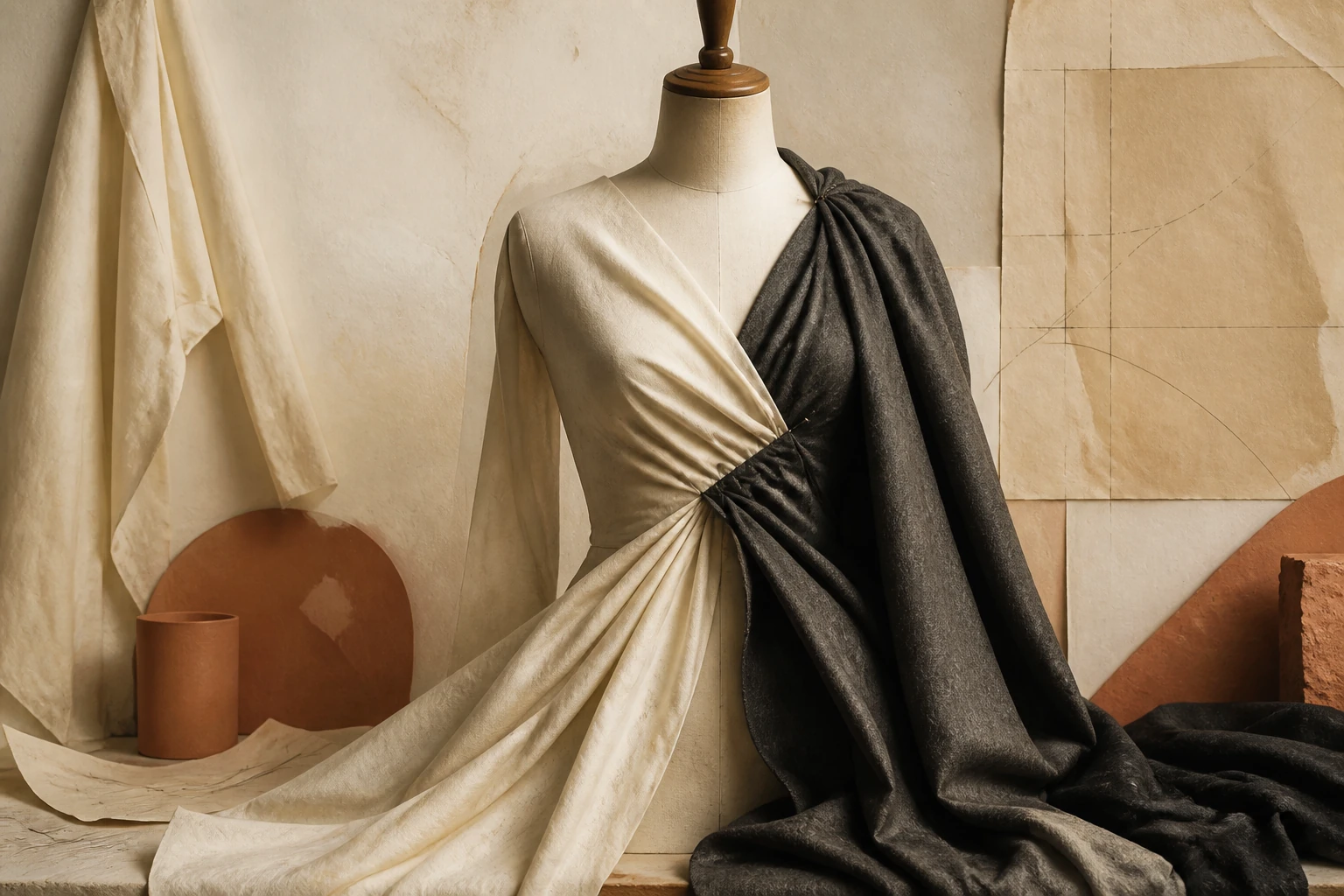
Draping builds volume not through a frame but through cloth weight, tension, gravity, and anchor points, turning material into an active co-author of form.
Editorial thesis
Draping creates form directly on a mannequin or body, allowing cloth to reveal its own direction, weight, and potential for movement. Unlike rigid construction, it builds volume through folds, tension, sag, and the distribution of excess material.1
Reader question
How can cloth create silhouette without rigid structure, heavy interfacing, or a fully predetermined flat pattern?
Short answer
Draping, also called soft construction, is created directly on a mannequin or model: cloth is pinned, folded, tensioned, and distributed until the desired silhouette appears, after which the form may be translated into a pattern or retained in the finished garment.1
The method is highly sensitive to weight, pliability, grain direction, and surface. Madeleine Vionnet worked three-dimensionally on a reduced-scale mannequin and combined draping with bias cutting so garments could move with the body.13
1. Draping as method
Draping is not merely a decorative fold. It is a design method in which form is discovered directly in space rather than only on paper.
2. Soft construction
FIT defines draping as soft construction: material is worked on a form or model and may later be removed to create a paper pattern.1
3. The dress form as working surface
A dress form makes it possible to see front, back, side, and transitions between them at the same time.
4. The body as variable
The same cloth behaves differently on different bodies. Bust volume, waist, shoulders, and posture redirect folds.
5. Fabric weight
Heavy cloth pulls downward and creates deep falls. Lightweight cloth creates air but may hold definition less readily.
6. Pliability
Pliable cloth follows curved form easily. Stiffer cloth creates more graphic, architectural folds.
7. Thickness
Thick cloth forms large folds and accumulates volume quickly. Thin cloth allows more material to gather without heavy bulk.
8. Surface
Matte surfaces quieten form; lustrous surfaces emphasise every edge and intensify light and shadow.
9. Lengthwise grain
Lengthwise grain stabilises cloth and limits stretch. Draping on grain usually appears more controlled.
10. Cross grain
Cross grain generally offers more mobility and can soften form or redirect sag.
11. Bias
Bias gives diagonal mobility and allows cloth to flow around the body. Vionnet made this possibility central to modern draped dress.1
12. Gravity
Draping always negotiates with gravity. Anchor points determine where cloth is held and where it is free to fall.
13. Anchor point
Shoulder, waist, hip, neckline, or seam can become the point from which an entire fold system develops.
14. Excess cloth
Complex draping requires extra cloth. Excess is distributed, gathered, twisted, or directed toward a chosen area.
15. Tension
Tension draws cloth close to the body and creates diagonals. Reduced tension creates a softer fall.
16. Sag
Sag appears between anchor points. Its depth depends on span, cloth weight, and attachment angle.
17. Gathering
Gathering concentrates substantial volume into a short distance. It creates soft rhythm and can flow into free drape.
18. Tucks
Tucks direct folds more precisely than gathering and help organise cloth around the body without rigid structure.
19. Twisting
Twisting changes grain direction and creates tension. The twist can act as both construction and ornament.
20. Knot
A knot holds material and creates a local compositional centre, but it adds thickness and must be tested for comfort.
21. Cascade
A cascade is built from successive falling folds and is especially effective in soft fabrics with good flow.
22. Cowl
A cowl is a soft hanging volume at neckline, back, or another edge. It depends on correct cloth allowance and grain direction.
23. Asymmetry
Asymmetrical draping creates movement even in stillness. Balance comes through weight distribution rather than mirrored repetition.
24. Symmetry
Symmetrical draping can appear ceremonial and classical, but demands precision because small differences are immediately visible.
25. Classical tradition
Classical dress demonstrated that cloth can shape the body through wrapping, fastening, and folds without complex cutting.
26. Madeleine Vionnet
Vionnet worked on a reduced-scale mannequin, rotating the form and observing cloth in the round. Museum accounts emphasise the mathematical precision and sensitivity of her draping.31
27. Vionnet and movement
In Vionnet's dresses, asymmetrical draping and circular cutting produced continual undulation in motion.1
28. Without decorative overload
Vionnet often avoided decoration that interfered with natural fall. Construction itself became ornament.3
29. Draping and bodily freedom
The V&A links Vionnet's flowing forms with release from heavy corsetry and more natural bodily movement.1
30. Adrian
FIT notes that Adrian used draping in both film costume and ready-to-wear, working especially inventively with silk jersey.1
31. Silk jersey
Jersey combines weight, stretch, and softness. It can cling and create deep sag at the same time.
32. Chiffon
Chiffon produces airy drape and may require multiple layers or many fixing points when controlled form is needed.
33. Crepe
Crepe has a grainy surface and holds soft folds well. Its weight often produces a calm, fluid fall.
34. Satin
Satin intensifies every fold edge through highlight and requires precision because distortion is highly visible.
35. Knit
Knit drapes through stretch as well as weight, allowing form to be built through tension and recovery.
36. Muslin for testing
Inexpensive toile material is often used to search for form, but the final drape must be tested in cloth with the actual weight and surface.
37. Transferring to pattern
After draping, seam lines, balance points, and grain direction are transferred to paper. An error at this stage destroys the discovered volume.
38. Draping without a conventional pattern
Some garments retain wrapping and tying principles without being fully translated into conventional flat patterns.
39. Seams as support
A seam can do more than join pieces: it can hold a fold, distribute weight, and direct drape.
40. Lining
Lining stabilises the interior and reduces friction, but a lining that is too rigid can destroy fluidity.
41. How to photograph draping
Side light reveals fold depth; frontal light reduces relief. Soft cloth benefits from preserved mid-tones rather than contrast alone.
42. Movement in the frame
Walking, turning, and moving air reveal the true construction of drape. A static image does not always explain how the form works.
43. What a designer should analyse
Assess fibre, weight, grain direction, anchor points, excess, sag depth, comfort, and structural stability.
44. What an art director should analyse
Draping already creates a complex composition of lines and shadows. Background, pose, and accessories should support rather than compete with it.
45. Conclusion
Draping creates form without rigid construction by using cloth weight, grain direction, tension, and gravity as active tools. Its strength lies in building volume directly around the body.