encyclopedia
Jacquard
Fabric as a complex image system
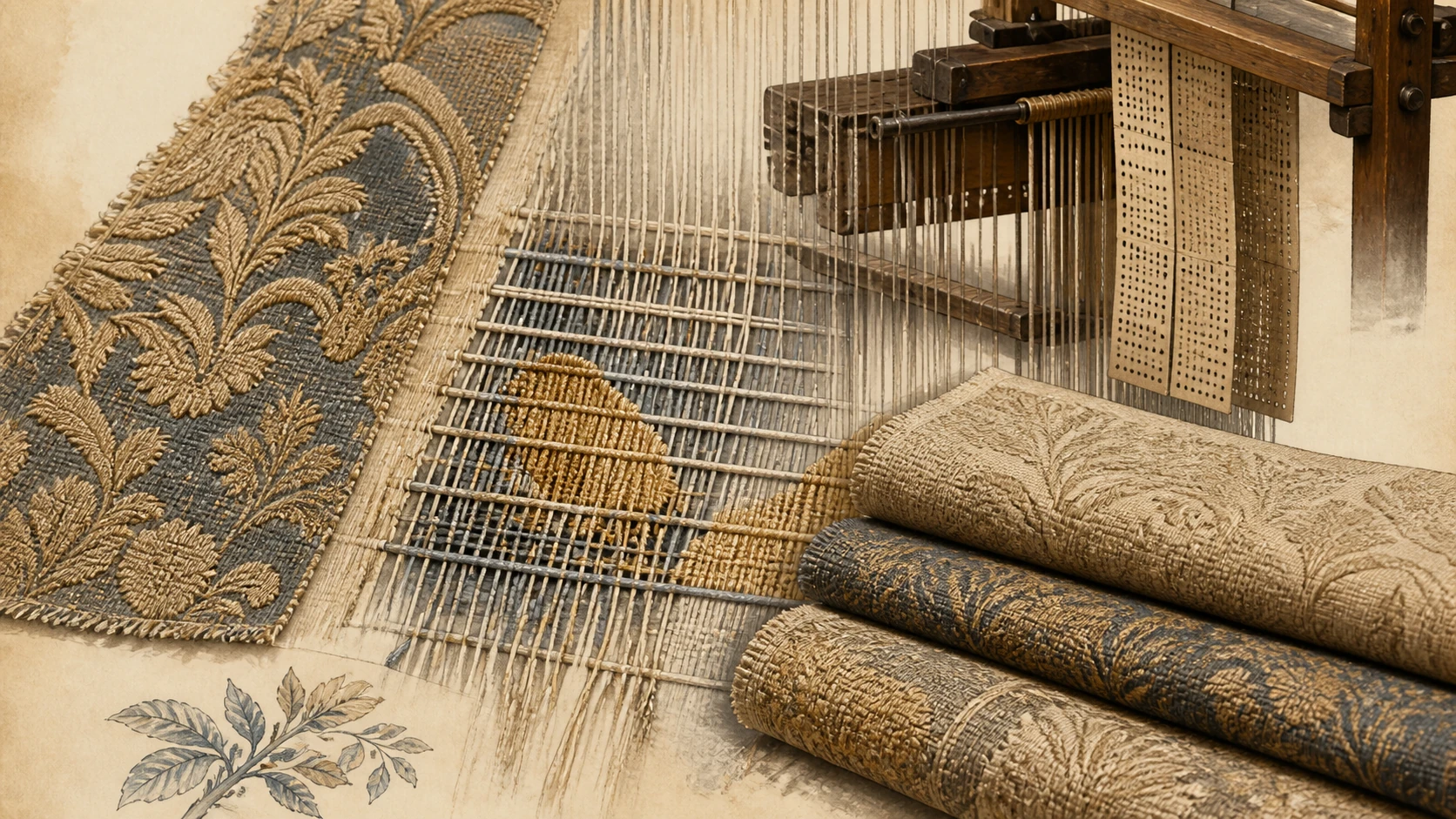
The image is not applied to jacquard: it emerges from the weave, making colour, light, relief, and construction one system.
Editorial thesis
Jacquard shows how technology becomes visual language. Individual warp selection made complex woven imagery reproducible and accelerated its production.1
Reader question
Why is jacquard more than simply patterned fabric?
Short answer
Because the pattern is formed by the weave itself. The historical Jacquard mechanism controlled warp threads through a sequence of punched cards.1
The Met notes that the system accelerated complex pattern setup and removed the need for the drawboy who manually operated a drawloom's pattern cords.1
1. Jacquard is a method of controlling pattern
Jacquard is best understood not as a fibre but as a method of individually controlling warp threads. It may therefore be silk, wool, cotton, synthetic, or blended.
2. The image is inside the cloth
In printed cloth an image is applied to the surface. In jacquard it emerges from weave structure: colour, sheen, and relief change with yarn distribution.
3. Warp and weft
Warp forms the longitudinal thread system and weft crosses it. The Jacquard mechanism expands control over the warp and enables complex repeats.
4. Before Jacquard: the drawloom
Before mechanisation, complex patterns were woven on drawlooms with an assistant controlling groups of threads. The Met notes that the Jacquard mechanism accelerated pattern setup and reduced required labour.1
5. Bouchon and Falcon
The story does not begin with one inventor. Basile Bouchon used perforated paper in 1725, while Falcon used linked punched cards in 1728.1
6. Joseph Marie Jacquard
Joseph Marie Jacquard consolidated and refined earlier solutions. The Science Museum Group dates the successful system to 1804–1805.1
7. The punched card as instruction
A hole or its absence instructs the mechanism. A card sequence stores pattern as a repeatable set of instructions.1
8. The connection to computing
The Jacquard loom was not a computer, but its punched-card principle of discrete instructions was later used in computing.1
9. Repeat
A repeat is the recurring unit of pattern. Individual warp control increases freedom of scale, asymmetry, and detail.
10. Face and reverse
The reverse often reveals the inverse logic of yarn distribution. Some jacquards are expressive enough on both sides for reversible use.
11. Colour is built with yarn
Colour is formed by dyed yarn rather than a layer of ink. Adjacency and overlap create optical mixing that changes with viewing distance.
12. Sheen as part of the pattern
Even monochrome jacquard can reveal pattern through yarn direction and weave changes. Matte and lustrous zones become an additional palette.
13. Relief
Long floats, dense areas, and novelty yarn create physical depth. The cloth can behave almost like low relief.
14. Pattern scale
A small motif becomes texture; a large motif becomes an image interacting with the silhouette of body or object.
15. Detail
The mechanism made highly complex woven images practical, including portraits resembling graphic prints.1
16. Damask
Damask often builds imagery through contrasts of weave and lustre, showing how powerful pattern can be without printing.
17. Brocade
Brocade is generally more dimensional and ornamental through supplementary or effect wefts. Terminology varies across production traditions.
18. Tapestry logic
Jacquard can approach tapestry-like visual complexity, but its production logic differs. Not every complex woven image is tapestry.
19. Silk jacquard
Silk's smoothness intensifies light contrast. A motif may nearly disappear in shadow and emerge as the angle of light changes.
20. Wool jacquard
Wool softens and mattifies the image. Edges become less graphic while the surface gains depth and physicality.
21. Cotton and linen
Cotton and linen give a dry, clear reading of structure, especially when pattern should work through weave rather than strong sheen.
22. Synthetic fibres
Polyester, polyamide, and other synthetics expand the range of sheen, strength, heat-forming behaviour, and cost.
23. Metallic yarn
Metallic yarn turns light into an active part of ornament. Even a small proportion can radically alter the surface.
24. Density
High density makes pattern crisp and cloth stable but increases weight. An open structure brings movement and air.
25. Floats
Long surface floats create sheen and colour continuity but snag more easily. The visual effect involves a technical compromise.
26. Weight and drape
Heavy jacquard supports architectural volume; lighter cloth can drape. Pattern still affects the direction and behaviour of folds.
27. Image and cut
Cutting breaks the continuous field of cloth. The designer decides where a motif is interrupted, matched, or deliberately displaced.
28. Placement
A large motif can be positioned on a specific part of the body. Cutting becomes composition because the cloth already contains centre and direction.
29. Pattern matching
Matching repeats across fronts, pockets, and sleeves requires extra yardage. Fabric consumption becomes the cost of visual continuity.
30. Seams and thickness
Multi-layered jacquard can create bulky seam allowances. Seam construction and edge finishing must respond to actual material volume.
31. Fraying
Some jacquards fray aggressively after cutting. Edges are stabilised before the pattern structure begins to disintegrate.
32. Lining
Lining protects reverse floats, reduces friction, and helps control form. In open jacquard it also affects colour.
33. Jacquard and fashion
In fashion, image and material are inseparable: ornament changes the thickness, weight, light, and movement of the garment itself.
34. Jacquard and interiors
In curtains, upholstery, and panels, repeat scale is read in relation to architecture, furniture, and viewing distance.
35. Electronic jacquard today
Modern machines replace physical punched cards with electronic control, but the principle remains: pattern is translated into thread-selection instructions.
36. Digital file and woven surface
A digital image cannot simply be printed as jacquard. It is interpreted through a limited system of yarns, structures, densities, and colours.
37. A pixel is not a yarn
The pixel analogy is useful but incomplete: yarn has thickness, direction, sheen, and tension. Textile information is physical.
38. Error as surface
Changes in tension or missed yarns disturb the pattern. In industry this is a defect; in authored textiles disruption may become an artistic device.
39. How to photograph jacquard
Directional side light reveals relief; soft neutral light is better for colour. Lustrous cloth should be tested from several angles.
40. Macro and full view
Macro reveals weave but loses motif scale. A wider view shows interaction with body or interior. Both scales are needed.
41. What a designer should analyse
Identify fibre and yarn, structure, repeat, colours, floats, density, and weight. Then judge the cloth for a particular form.
42. What an art director should analyse
Jacquard may be ornament, texture, or the main image in a frame. The stronger the repeat and sheen, the fewer additional elements are needed.
43. What distinguishes luxury jacquard
Luxury is defined by pattern precision, yarn quality, structural complexity, colour, finish, matching, and the relationship between material and form—not fibre price alone.
44. Why technology matters more than decoration
If we see only a beautiful pattern, the central point is lost: the image results from engineered control of material. Aesthetics emerge from construction.
45. Conclusion
Jacquard turns cloth into an image system in which yarn is simultaneously material, colour, and information. Pattern cannot be separated from weight, light, relief, and movement.