encyclopedia
Leather
Tanning, finishing, and luxury production
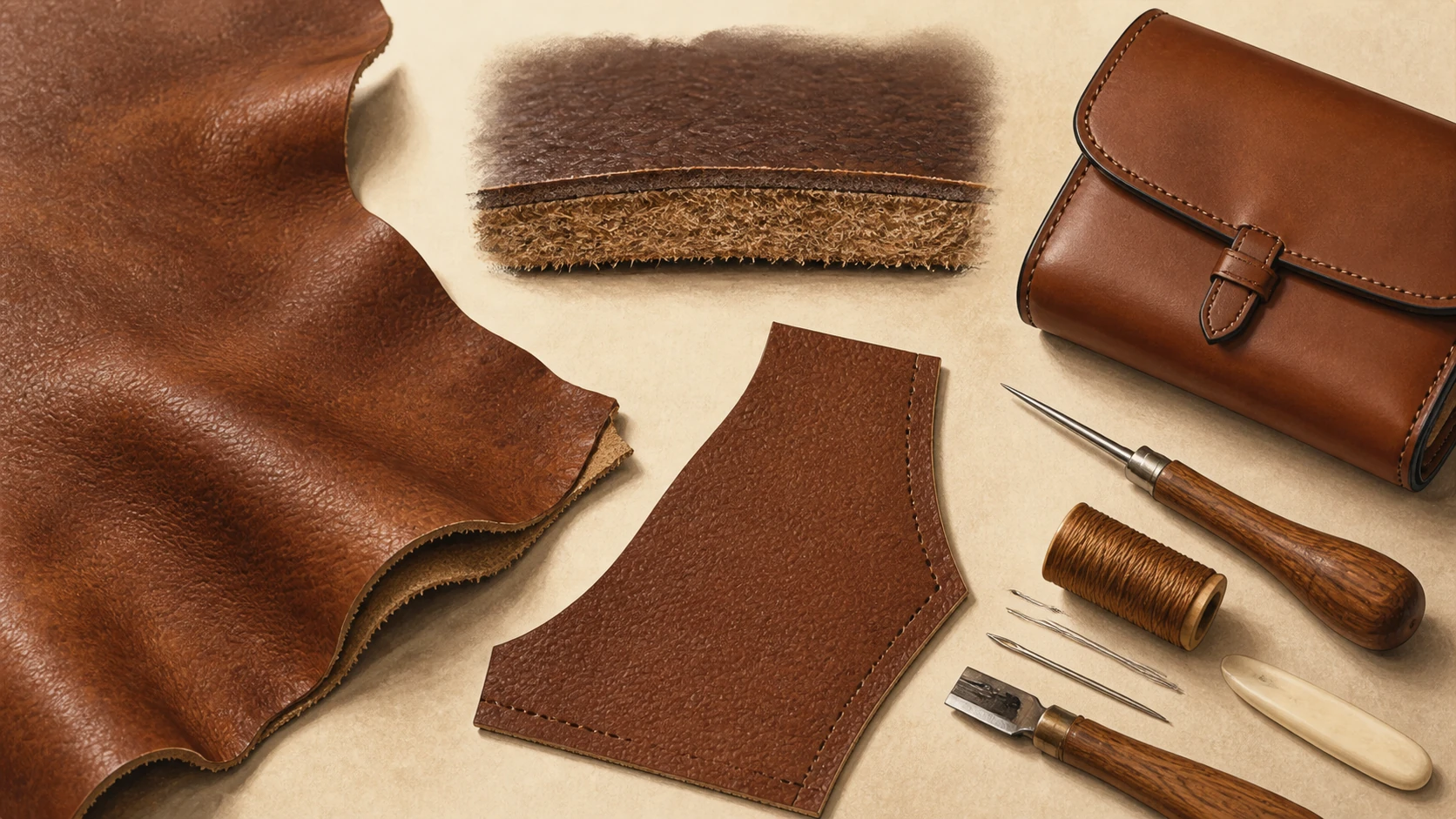
Leather becomes a luxury material not through origin alone but through the coherence of biological raw material, chemistry, mechanical processing, cutting, stitching, edges, and the capacity to age well.
Editorial thesis
Leather is not a uniform luxury material but a biological structure transformed through many manufacturing operations. Species, hide area, preservation, tanning, fatliquoring, dyeing, drying, mechanical processing, and finishing determine thickness, softness, sheen, smell, patina, and shape-making capacity. In luxury production, value is created by control of the entire chain—from traceability and chemistry to cutting, seams, edge finishing, and repair.1
Reader question
Why can two leathers of the same colour differ radically in price, pliability, ageing, and the quality of the finished object?
Short answer
A fresh hide is an unstable protein material. Beamhouse operations remove contamination, hair, and unwanted tissue; tanning stabilises collagen; later operations define colour, softness, thickness, and surface. Chrome, vegetable, and combination systems create different production behaviour, but quality cannot be judged by the tanning label alone.
Leather Working Group assesses facilities processing raw, tanned, or crust material into pre-tanned, tanned, crust, and finished leather. Its current audit covers environmental management, traceability, chemical management, social responsibility, and governance.11
1. Leather begins as biological structure
Hide is a network of interlaced collagen fibres. Natural pores, folds, scars, and density variations influence how it stretches, dyes, and ages.
2. Hide and skin
In professional language, hide often refers to larger skins such as bovine, while skin is used for smaller animals. Fashion may simplify both as leather, but production parameters differ.
3. Hide topography
Shoulder, bend, belly, and neck differ in density and stretch. Luxury cutting treats location as a material property rather than viewing the hide as one uniform sheet.
4. Raw-material preservation
Before tanning, hides must be protected from decomposition. Salting, chilling, and other preservation methods affect subsequent quality and demand control of time and conditions.
5. Soaking
Soaking restores moisture and removes salt, blood, and contamination. Uneven rehydration can cause inconsistent chemical penetration.
6. Liming and unhairing
Liming loosens hair and alters hide structure. It must open the fibre network without excessive damage.
7. Fleshing
Fleshing removes residual subcutaneous tissue. Clean and even processing affects later thickness and consistency.
8. Splitting
Splitting divides the hide by thickness into grain and lower layers. The top layer preserves the natural surface; lower layers require different finishing.
9. Full grain
Full-grain leather retains the natural surface with minimal correction. This does not automatically mean finish-free or guarantee quality without assessing raw material and tanning.
10. Top grain
Top-grain leather comes from the upper hide but may be sanded, corrected, or coated. Marketing terms must be checked against the actual specification.
11. Corrected grain
Sanding and embossing can even out visual defects and create a stable texture. Corrected leather may be technically excellent, though its surface less directly expresses natural grain.
12. Split leather
The lower split lacks the original grain surface. It may become suede, receive a polymer coating, or serve as a base for composite material.
13. Suede
Suede is produced by buffing the flesh side or a split. Nap direction changes colour when touched and makes light part of tactile perception.
14. Nubuck
Nubuck is created by lightly sanding the grain surface. It retains a dense base while gaining a short velvet nap and high sensitivity to soiling.
15. Tanning
Tanning stabilises collagen and increases resistance to decay, heat, and water. It is a chemical system followed by multiple additional operations.
16. Chrome tanning
Chrome tanning is valued for speed, softness, heat stability, and broad colour potential. Environmental performance depends on chemical control, effluent treatment, and waste management rather than the word chrome alone.
17. Vegetable tanning
Vegetable tannins produce denser, mouldable leather capable of developing pronounced patina. Processing is generally slower and the leather may initially be more sensitive to water and flexing.
18. Combination tanning
Retanning combines properties from different systems. A hide may be chrome tanned and subsequently retanned with vegetable or synthetic agents to change fullness and surface.
19. Wet blue, wet white, and crust
Wet blue generally describes chrome-tanned semi-processed leather, wet white alternative pale systems, and crust dried leather prepared before final finishing. LWG covers facilities at different stages of this chain.1
20. Neutralisation and retanning
These operations adjust chemical conditions and fill the fibre structure. They influence softness, density, colour evenness, and shape retention.
21. Drum dyeing
Drum dyeing carries colour into the material. Depth of penetration matters for cut edges, perforation, and products where thickness is visible.
22. Pigment and aniline
Aniline finishing preserves more natural variation; pigment creates greater colour uniformity and protection. Semi-aniline and hybrid finishes occupy a broad middle range.
23. Fatliquoring
Fatliquoring introduces oils and emulsions that reduce fibre adhesion during drying. It affects softness, elasticity, touch, and sometimes smell.
24. Drying
Vacuum, toggled, hanging, and other drying methods produce different flatness, area, and firmness. Mechanical softening often follows.
25. Staking
Mechanical staking works the fibre network and improves hand feel. Excessive treatment can reduce structural definition.
26. Milling
Dry-drum milling creates natural softness and may strengthen visible grain. The surface becomes livelier and less uniform.
27. Embossing
Embossing creates repeatable texture through heat and pressure. It may imitate exotic skin, correct the surface, or become an independent design.
28. Patent leather
Patent leather uses a high-gloss coating to create an almost mirrored surface. It intensifies colour but changes flex, ageing, and repairability.
29. Metallic and pearlescent finishes
Particles in the finish create directional reflection. Metallic surfaces may show micro-cracking at folds and stretched zones.
30. Thickness
Thickness defines construction range: thin glove leather drapes, medium weights suit garments and bags, while heavy leather forms belts, soles, and rigid objects.
31. Softness and temper
Temper describes not only softness but resistance to bending and recovery. Two leathers of equal thickness can behave completely differently.
32. Stretch
Leather stretches unevenly by direction and hide area. Cutting must account for backbone, belly, and the load in the finished product.
33. Shape memory
Wet moulding, heat, pressure, and structural seams allow leather to retain volume. This makes the material close to soft sculpture.
34. Edges
An exposed edge may be sanded, painted in layers, burnished, folded, or enclosed. In luxury products edge quality often reveals the production level.
35. Skiving
Skiving reduces thickness in folds, seams, and edges. An error can weaken the zone or create a visible step.
36. Seams
Needle holes remain in leather, limiting unpicking. Stitch length, needle, thread, and distance from the edge must be planned in advance.
37. Adhesives
Adhesive holds layers before stitching and may remain part of permanent construction. Excess, ageing, and migration can damage the surface.
38. Hand saddle stitch
Saddle stitching with two needles creates independent thread crossings in each hole. It is time-consuming but allows close tension control and repair.
39. Machine stitching
Machine production provides speed and repeatability. Luxury is not defined by the absence of machinery but by precision, setup, and the fit between method and construction.
40. Handles and load zones
Handles, corners, closures, and straps take maximum stress. They are reinforced with additional layers, inserts, and local thickness changes.
41. Lining and reinforcement
Lining protects the reverse and establishes internal friction. Reinforcement can stabilise soft leather but should age compatibly with the face material.
42. Selection and nesting
Pattern placement considers defects, direction, stretch, shade, and future load. Automated nesting does not eliminate expert selection.
43. Colour sorting
Natural leather varies among hides and within a single hide. Parts for one bag or garment are sorted for tone and sheen.
44. Bonnie Cashin
The Met shows how Bonnie Cashin used large areas of leather, strong colour, and metal hardware in the 1950s and 1960s, turning the material into modern everyday dress.11011
45. Azzedine Alaïa
Alaïa's ca. 1986 leather dress demonstrates the material as an instrument of precise sculptural cutting: broad shoulder, narrow waist, and body modelling are achieved through construction.1
46. Roberto Cavalli
The Met notes Cavalli's use of fine calfskin, laser cutting, and embroidery, allowing leather to be manipulated almost like silk.1
47. Geoffrey Beene
In Geoffrey Beene's dress, leather acts as an anatomical supporting yoke, simultaneously functional and visually connected with harness and architecture.1
48. Yves Saint Laurent
A 1968 YSL object combines leather with silk, plastic, wool, and metal, showing that luxury leather often operates inside a hybrid material system.1
49. Exotic leathers and law
International trade in skins and products from CITES-listed species requires relevant documentation. The CITES database records official trade in skins and leather products.16
50. Traceability
Traceability should connect incoming raw material, the processing facility, and outgoing leather. LWG includes incoming and outgoing material traceability in its manufacturer audit.1
51. What LWG assesses
The standard assesses water and energy, waste and effluent, emissions, chemical management, restricted substances, safety, social audit, and traceability.13
52. What LWG does not directly assess
LWG states that a tannery audit is not an audit of farms or slaughterhouses and does not directly assess animal welfare. Certification should not be presented as universal proof for the entire chain.3
53. EUDR and changing regulation
Regulatory context can change. In May 2026 LWG reported a European Commission proposal to exclude leather from the EUDR, which at that point was subject to public consultation.1
54. Patina
Patina develops through light, friction, oils, moisture, and oxidation. It is valuable only when ageing suits the function rather than disguising premature failure.
55. Repair
Good luxury construction anticipates replacement of handles, hardware, lining, and edge finish. Repairability depends on access to seams and material compatibility.
56. Care
Care depends on tanning and finish. A universal cream may darken aniline leather, damage nubuck, or alter patent gloss.
57. How to photograph leather
A large soft source reveals colour and overall form; a narrow side source reveals grain, embossing, and edge. Polarisation can reduce glare but may hide the character of the finish.
58. Black leather
Black leather should not be exposed as one undifferentiated dark shape. Separation comes from highlight gradients, rim light, and material contrast with the background.
59. Macro
Macro reveals pores, stitch, edge, and finish but cannot explain pliability. It should be paired with bending, movement, or the completed form.
60. What a designer should analyse
Check species and type, hide area, tanning, finish, thickness, temper, stretch, direction, edge, stitch, load, and repair.
61. What an art director should analyse
Leather carries several codes at once—craft, power, sensuality, protection, rebellion, and heritage. Visual direction should choose a specific thesis.
62. Conclusion
Luxury leather begins neither with a logo nor ends with an attractive surface. Quality comes from coherence among raw material, chemistry, mechanical processing, cutting, stitching, edges, hardware, traceability, and the ability to age and be repaired well.