encyclopedia
Corset Construction
Engineering the body in contemporary fashion
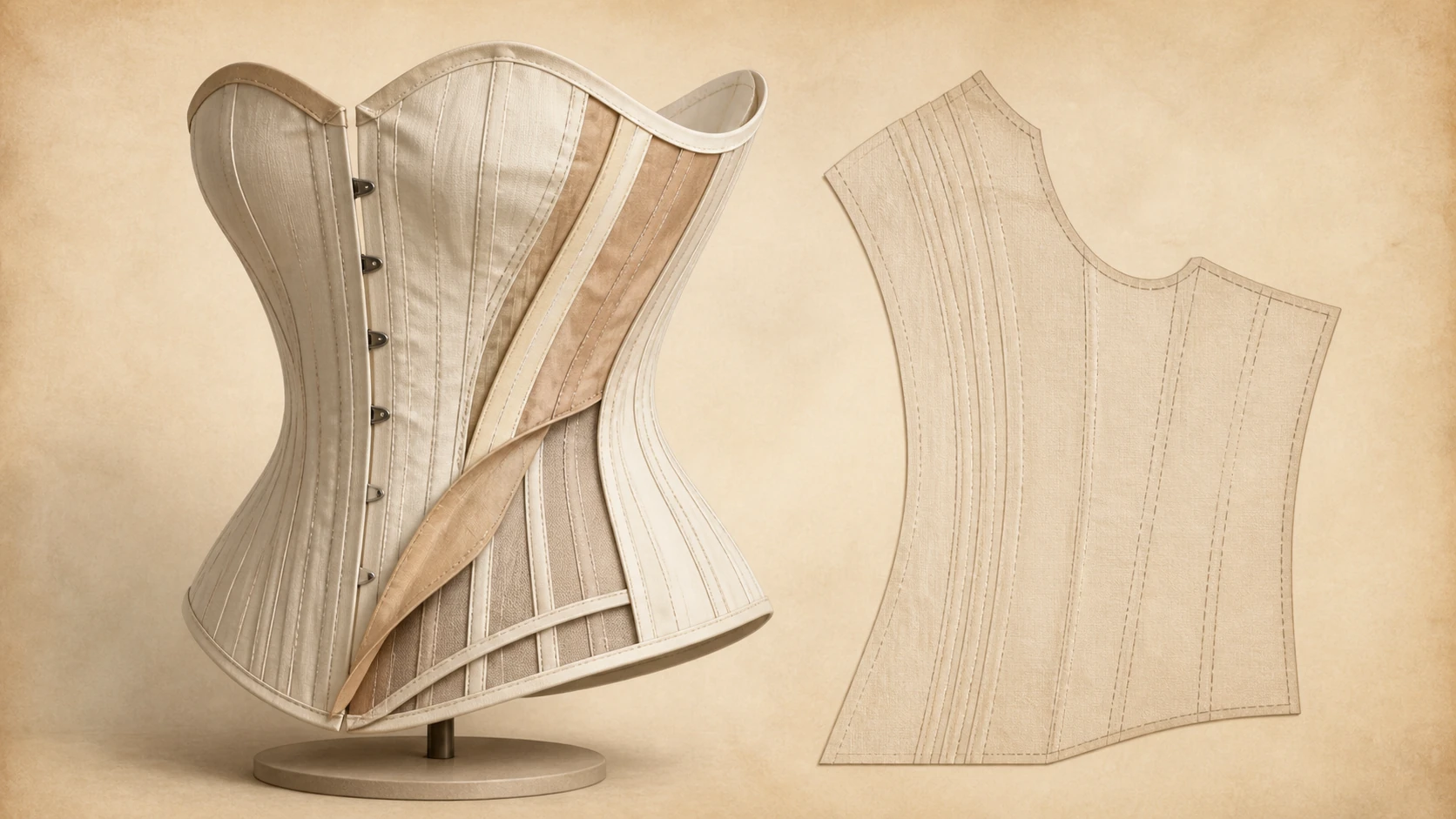
The modern corset operates simultaneously as load-bearing structure, visible graphic framework, and a cultural sign of power, discipline, eroticism, and protection.
Editorial thesis
Modern corsetry is not simply a return of historical underwear. It is a system for controlling silhouette, internal tension, posture, and the visual code of the body. In contemporary fashion, the corset may be hidden engineering, visible outerwear, a deconstructed frame, a gendered gesture, or a sculptural shell.1
Reader question
What makes a garment corseted: waist reduction, boning, lacing, close fit, or the underlying logic of load distribution?
Short answer
Corset construction shapes the body through dense material, panels, seams, boning, waist tape, closures, and lacing. Its purpose may be waist reduction, bust support, load distribution, postural change, or the creation of a visually rigid silhouette.
Historically, the corset has been both a fashion technology, a form of bodily discipline, and a contested object. The Museum at FIT stresses that its meaning is repeatedly redefined—from an icon of erotic femininity and oppression to visible fashion structure and a tool of self-presentation.1
1. Corset and stays
A corset and stays belong to changing historical vocabularies. Stays usually refers to earlier rigid structures, while corset became common later; contemporary fashion uses the term for both underwear and outerwear.
2. Structural function
A corset distributes pressure around the torso and creates controlled form. The result comes from the interaction of panels, boning, seams, and closure rather than one isolated feature.
3. Panel construction
Multiple narrow panels allow precise control of bodily curvature. The more complex the contour, the more important the balance among waist, bust, ribs, and hips.
4. Boning
Boning maintains vertical direction and prevents cloth from collapsing. Historical materials included baleen and steel; modern practice uses spiral steel, flat steel, plastics, and composites.
5. Spiral steel
Spiral steel flexes in several directions and suits curved seams. It supports form without turning the garment into a completely immobile shell.
6. Flat steel
Flat steel is stiffer and is often used beside closures, lacing, or areas requiring straight control.
7. Busk
A front busk combines rigidity with a separable closure. It simplifies dressing and creates a stable centre-front vertical.
8. Lacing
Lacing adjusts volume and distributes tension. Its performance depends on direction, eyelet spacing, and reinforcement of the load-bearing zones.
9. Eyelets
Eyelets require reinforcement because tension is concentrated around them. Weak cloth around an opening deforms quickly.
10. Waist tape
A waist tape carries much of the horizontal load and prevents the body of the corset from stretching. In quality construction it is a hidden structural element.
11. Outer fabric
The decorative outer fabric does not necessarily bear the load. Silk, jacquard, leather, or mesh may sit over a stronger inner layer.
12. Coutil
Coutil is a dense cloth traditionally used for the strength layer. Its weave resists stretch and supports boning channels.
13. Lining
Lining protects the body and internal construction but does not replace a strength layer. A soft lining alone cannot carry structural load.
14. Seam engineering
Seams act as load-bearing lines. Allowances, boning channels, and stitch direction must withstand repeated tension.
15. Underbust corset
An underbust corset ends below the bust and controls the waist and lower torso. Bust support is provided by another garment or upper structure.
16. Overbust corset
An overbust corset includes bust support and requires precise work around cup, top edge, and pressure balance.
17. Corset bodice
A corset bodice may be integrated into a dress and need not reduce the waist dramatically. It shapes the upper garment and can support skirt or embellishment weight.
18. Internal corsetry
In couture, internal corsetry is often hidden beneath the dress. It supports fabric, controls the neckline, and carries heavy embellishment.
19. Corset as outerwear
When the structure becomes visible, channels, seams, boning, and lacing become the graphic language of the garment.
20. Historical body shaping
The V&A shows how corsets shaped the waist while crinolines and bustles created skirt volume; historical silhouette resulted from several structures working together.1
21. Corsetry and health
Corset history is surrounded by myth and medical anxiety. Responsible analysis distinguishes moderate support, long-term wear, and extreme tight-lacing.
22. Tight-lacing
Extreme reduction is a specific practice, not an essential property of every corset. Its effects should not be projected onto all historical or modern constructions.
23. Fit and breathing
A properly fitted corset should not obstruct ordinary breathing or cause pain. Pressure must be distributed rather than concentrated.
24. Posture
Corsetry limits some torso movement and can alter posture. That change may be experienced as support, discipline, or theatrical stance.
25. Vivienne Westwood
The Museum at FIT identifies the revival of the corset as one of Vivienne Westwood's most important innovations. In Time Machine she combined corset and pannier with a modernised historical form.1
26. Westwood's historicism
Westwood did not copy historical dress literally. She used corsetry to collide museum form, punk, sexuality, and the contemporary street.
27. Jean Paul Gaultier
Gaultier made the corset one of the central motifs of his practice. The Met connects his cone bra and corset with the return of foundation garments to a new generation of popular culture.1
28. Madonna and underwear as outerwear
Madonna's stage corsets turned inner construction into a public image of power, sexuality, and artifice.
29. Mr. Pearl
In Gaultier couture, corsetry often required specialist craft. The Met credits Mr. Pearl as maker of the complex 2001 corset ensemble.1
30. Corsetry and gender
Contemporary fashion uses corsetry beyond the female body. It can emphasise, alter, or question gender codes.
31. Corsetry and queer fashion
The Museum at FIT shows how Gaultier and others used corsetry, underwear-as-outerwear, and mixed dress codes within queer fashion.1
32. Leather corsetry
Leather creates a rigid, fetishised, and protective surface. Gaultier's ca. 1995 corset combines leather, cotton, and metal, stressing the hybrid of lingerie and armour.1
33. Denim corsetry
Gaultier fused corset lacing with utilitarian denim, blurring boundaries among lingerie, workwear, and nightlife.1
34. Mesh and transparency
Transparent panels reveal load-bearing structure while reducing the apparent visual weight of the garment.
35. Three-dimensional moulding
Contemporary designers may replace parts of traditional panel construction with moulded plastic, resin, or digitally produced elements.
36. Deconstruction
A deconstructed corset may expose unfinished channels, displaced panels, and internal layers. Construction itself becomes the subject.
37. Corsetry and architecture
Corsetry behaves like small-scale architecture: support lines, shell, tension, and joints define space around the body.
38. Supporting skirt weight
In evening and bridal dress, internal corsetry can carry skirt weight so that the load does not hang only from the shoulders.
39. Strapless construction
In a strapless dress, the corset supports the upper body through precise fit and internal grip rather than constant tightening at the top edge.
40. Neckline control
The neckline must sit close without cutting in or standing away. Its behaviour depends on boning, cup shape, material, and front-to-back balance.
41. Contemporary ready-to-wear
In ready-to-wear, corset may be used as a visual term: a garment can imitate channels and lacing without possessing full structural engineering.
42. The marketing term corset top
Not every corset top is a corset in an engineering sense. A stylistic reference should be distinguished from a garment that genuinely distributes load.
43. How to photograph corsetry
Side light reveals structural ribs and panel transitions; frontal light emphasises graphics but may conceal volume.
44. Model pose
Pose should reveal how the corset changes posture and directs or restricts movement. Excessive arching can misrepresent actual fit.
45. What a designer should analyse
Analyse strength layer, panel geometry, boning type, waist tape, closure, lacing, pressure, breathing, and interaction with the outer garment.
46. What an art director should analyse
Corsetry already carries powerful codes: historicism, eroticism, power, fetish, discipline, and armour. Visual direction should select a thesis rather than combine all of them at once.
47. Ethics and safety
Corsetry should not be romanticised as compulsory suffering for beauty. Fit, model consent, and duration of wear are part of professional responsibility.
48. Conclusion
Modern corsetry exists between engineering and cultural sign. Its power lies in supporting cloth, altering silhouette, directing movement, and turning internal structure into visible fashion.