encyclopedia
Motion capture
Movement is separated from a body and becomes transferable data that can be edited, stored, and applied to another figure.
Editorial thesis
Motion capture matters as the moment when movement stopped being a property of a performer and became a separate asset with its own production chain.
Reader question
What happens to authorship when movement is recorded separately from the body and face that performed it?
Short answer
Authorship is distributed between performer, data-cleanup operator, and animator, and none of them produces the result alone.
1. Definition and boundaries
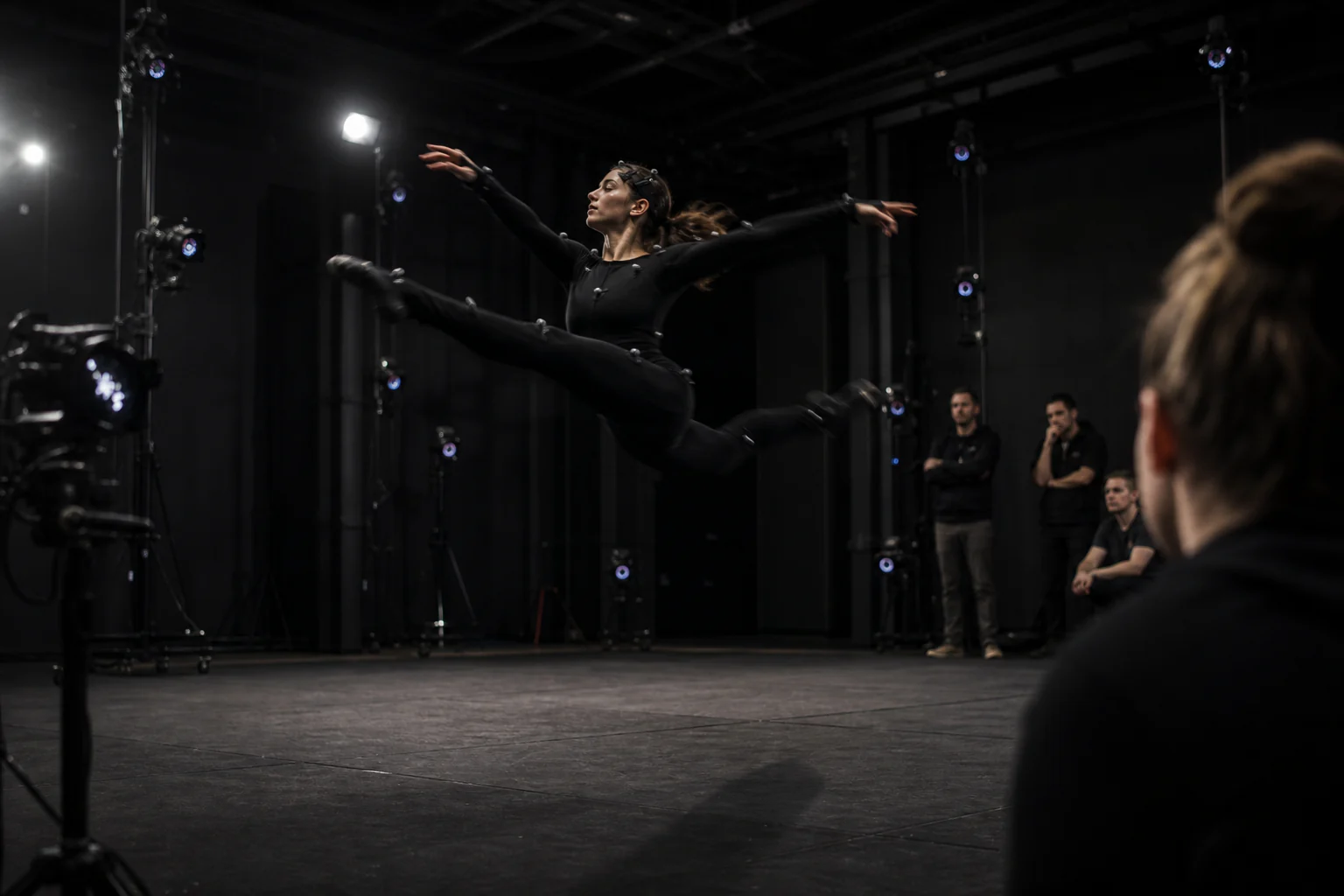
Motion capture is the recording of a body’s position over time and the transfer of that data onto a digital model. What is recorded is not an image but a sequence of joint coordinates.
2. Origins: rotoscoping
The method inherits from rotoscoping, in which an animator traced filmed movement frame by frame. The task was the same: to obtain credible movement without drawing it from scratch.
3. The biomechanical line
A second line of origin is medical and sports biomechanics, where gait measurement served a diagnostic purpose. Markers and the methodology of point placement came from there.
4. Optical marker systems
The most common method: reflective markers on a suit and an array of infrared cameras computing point position by triangulation. Accuracy is high; room requirements are strict.
5. The marker occlusion problem
When a marker is hidden from the cameras by a body or a prop, the system loses the point and the data must be reconstructed. This cleanup constitutes most of the labour, invisible in the result.
6. Markerless methods
Contemporary systems reconstruct pose from ordinary video using computer vision. Accuracy is lower, but the requirement for a suit and a specially equipped stage disappears.
7. Inertial suits
Accelerometers and gyroscopes fixed to the body allow capture outside a stage. They do not suffer occlusion but accumulate positional drift in space.
8. Facial capture
Facial performance is captured separately, usually by a head-mounted camera, and decomposed into a set of muscle activations. A face requires a different data density from a body, so the chains run in parallel.
9. Retargeting: movement onto another figure
Data captured from a person is transferred to a model with different proportions. Mismatched limb lengths produce foot sliding and intersecting parts — the principal technical problem of this stage.
10. Why movement reads as false
A viewer unerringly detects incorrect weight and inertia. An error in mass distribution destroys plausibility more than an error in model geometry does.
11. The performer’s role
The actor supplies weight, intention, and rhythm — what cannot be derived from anatomy. This is why replacing a performer changes the result even with an identical model.
12. The legal status of a performance
Recorded movement is simultaneously data and performance, creating an unsettled area: who owns a gait and for how long. Industry agreements of recent years address exactly this question.
13. Motion libraries
Ready sets of movements are sold as components. This lowers production cost and simultaneously standardises movement: different projects begin to move alike.
14. Application in games
Interactivity requires not a recording but a system of transitions between movements. Here capture supplies raw material while the main work is done by state-blending logic.
15. Application in film
In film movement is recorded once for a specific shot and finished by hand. Priority is given to the credibility of one take rather than to reuse.
16. Application in fashion
Capture is used to show clothing on a digital figure and to test fabric behaviour in movement. Here the pose matters less than how a material responds to a stride.
17. Cloth as a separate problem
Clothing is not captured but simulated: body movement serves as input to the calculation. The gap between recorded and computed is a persistent source of artefacts.
18. Data volume
A session generates large arrays of coordinates requiring storage and versioning. Managing that data is a production discipline in its own right.
19. Cleanup as the main work
Between capture and result lies a stage of correcting gaps, jitter, and recognition errors. In labour terms it frequently exceeds the shoot itself.
20. Real time on set
Contemporary systems show a result immediately, letting a director see a character during the shoot. This changes staging: the decision is made on set rather than in post-production.
21. Stage space
The capture volume is limited by camera placement, so long movements are shot in sections and stitched. The constraint of the stage directly affects possible choreography.
22. Suit and calibration
Marker displacement relative to bone produces systematic error, so calibration takes substantial time before a shoot. Preparation accuracy determines data quality.
23. What is usually misunderstood
A common error is to think capture replaces animation. It supplies a base, but expressiveness, timing, and exaggeration are still added by hand.
24. Counterargument
The objection is that recorded movement always looks heavier and duller than drawn movement, because a real body obeys physics while animation may violate it.
25. Where the counterargument holds
It holds for stylised animation, where exaggeration is the language. A realistic recording there breaks the convention and looks foreign.
26. Where it fails
It fails for photorealistic tasks, where the smallest imperfections of real movement constitute credibility. Synthesising them by hand costs more than recording them.
27. Link to neural methods
Models trained on large movement datasets now complete missing sections and generate transitions. This shortens cleanup and simultaneously raises the question of training-data provenance.
28. Ethical questions
The ability to reproduce a specific person’s gait and expression after their work has ended creates a consent problem. The technical question here is inseparable from the contractual one.
29. Current state
The method has become routine and cheap, and the entry threshold has fallen to an ordinary camera. Scarcity has moved from recording to cleanup and to rights.
30. How to read the subject today
Look at weight and at the foot. Sliding of the supporting leg and incorrect inertia are the two signs that data was transferred without finishing.