encyclopedia
NeRF — neural radiance fields
A set of ordinary photographs becomes a continuous scene representation from which any new viewpoint can be produced.
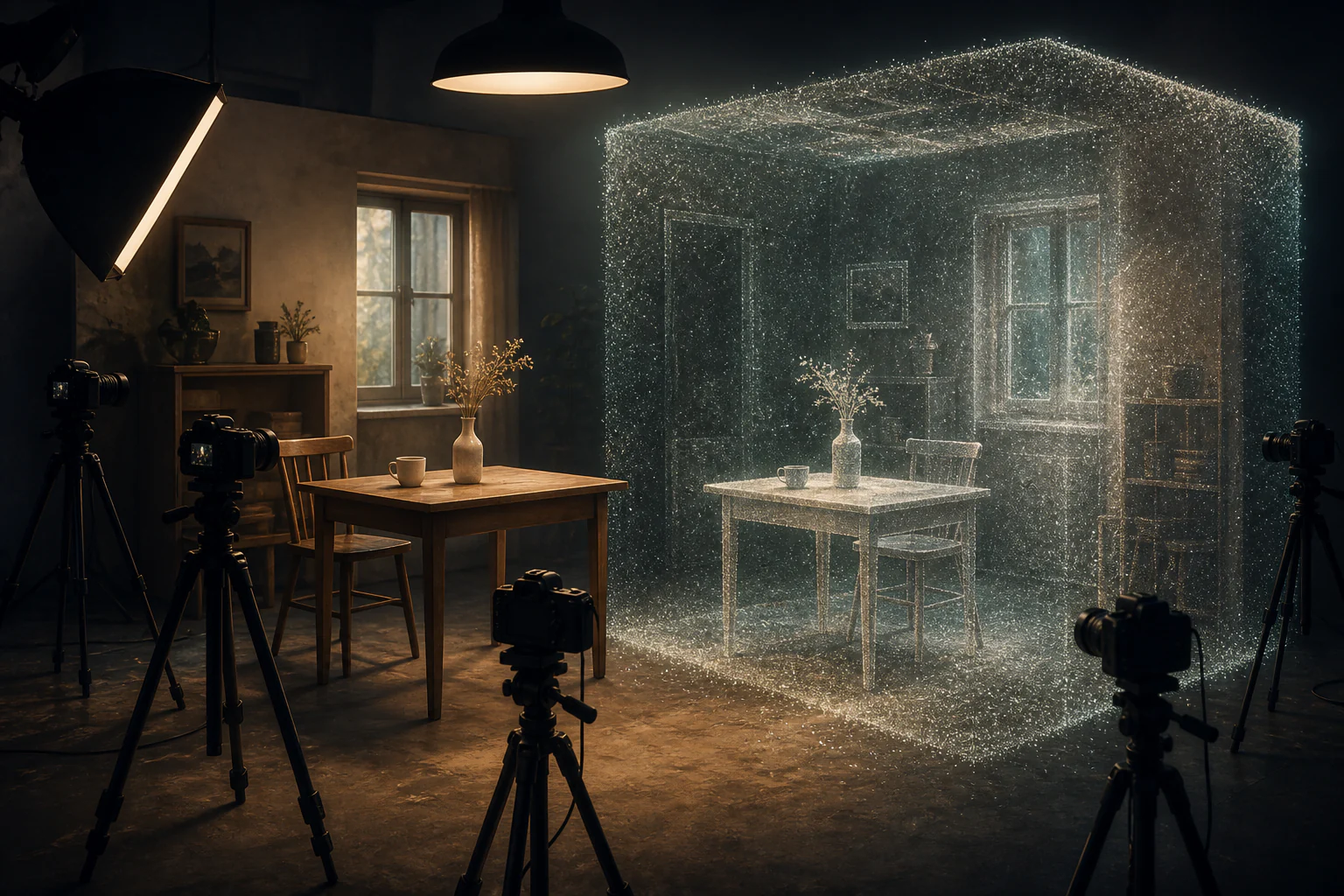
Editorial thesis
The method matters because it moves photography from obtaining frames to obtaining a scene: the camera stops recording a view and becomes a sensor of space.
Reader question
What changes when photographs yield not a surfaced model but a continuous function of colour and density?
Short answer
It becomes possible to reproduce translucency, reflection, and fine structure that classical polygonal reconstruction loses.
1. Definition and boundaries
The method describes a scene as a function returning colour and density for a point in space and a viewing direction. That function is stored in the weights of a small neural network.
2. Difference from a polygonal model
Classical reconstruction builds a surface from triangles. Here there is no surface at all: an image is obtained by integrating along a ray through a volume, as in tomography.
3. Origin of the method
The paper proposing the approach was published in 2020 and quickly became foundational for a whole direction. It joined volumetric rendering with a learned scene representation.
4. What goes in
A set of photographs with known camera positions is required. Positions are usually computed in advance by structure-from-motion methods, and the accuracy of that step determines the entire result.
5. Training as fitting to the photographs
The network is trained so that images synthesised from known viewpoints match the originals. The model does not understand a scene; it is fitted to observations.
6. View direction as an argument
The key decision is making colour dependent on direction. This is what allows a highlight that shifts as you walk around an object to be reproduced, which a simple texture cannot do.
7. Strong cases
The method handles well what breaks polygonal reconstruction: foliage, hair, mesh, smoke, glass, and translucent materials. The absence of a surface becomes an advantage here.
8. Weak cases
Reflective and untextured surfaces remain difficult: correspondences between photographs cannot be established reliably on them. A blank white wall reconstructs poorly.
9. The floater artefact
The characteristic defect is translucent clouds in empty space, appearing where data is insufficient. The method is recognised by them immediately.
10. Training cost
The original method required hours of computation per scene. This confined use to research and made practical application uneconomic.
11. Acceleration through data structures
Subsequent work reduced training to seconds by replacing part of the network with explicit spatial structures. Speed rose by orders of magnitude and the method became practical.
12. Capture as a new discipline
Quality depends on coverage: viewpoints from all sides and at varying heights are needed. A separate capture methodology has appeared, closer to photogrammetry than to photography.
13. Constant lighting as a requirement
All photographs must be taken under identical light, or the model averages contradictory observations. Shooting outdoors under variable cloud produces a visible defect.
14. Movement in frame as interference
Passers-by, branches, and any motion violate the assumption of a static scene. Extensions for dynamics exist, but the base method requires stillness.
15. Application in cultural heritage
The method suits documenting objects that cannot be touched: interiors, sculpture, archaeology. It records appearance without requiring contact.
16. Application in film
A reconstructed scene is used as background or as a base for further work. A real location enters production without moving a crew.
17. Application in retail
A product captured from all sides is presented to a buyer as an object that can be circled. For materials with complex surfaces this is more accurate than a photograph.
18. Documentary status
The result is not a photograph: it is synthesised and contains inferred regions. Using it as evidence without qualification is incorrect.
19. Editability
The chief practical limitation is that a scene is hard to edit. Network weights do not correspond to objects, so removing a single item is harder than in a polygonal model.
20. Surface extraction
For production use a conventional polygonal model is often extracted from the representation. This loses some quality but restores compatibility with existing tools.
21. Relation to splatting
The later method of three-dimensional Gaussian splats solves the same problem with an explicit representation and surpasses it in display speed. The two approaches coexist, addressing different parts of the task.
22. Storage and size
The representation is compact compared with a dense point cloud, which suits transmission. But the format is not portable between implementations, limiting archival value.
23. What is usually misunderstood
The error is to treat the result as a three-dimensional model. It is a way to synthesise views, not an object with geometry, and the confusion leads to wrong expectations in production.
24. Counterargument
The objection is that for most practical tasks photogrammetry is simpler, faster, and yields an editable mesh compatible with an existing pipeline.
25. Where the counterargument holds
It holds for objects with clear matt surfaces: buildings, products, terrain. There the classical method is genuinely more efficient.
26. Where it fails
It fails where there is no surface as such: smoke, moving fabric, vegetation, translucency. Photogrammetry does not solve these cases at all.
27. Privacy and legal status
Capturing a space records everything in frame, including people and private interiors. The legal regime for such data is less developed than that for photography.
28. Impact on adjacent fields
The approach has influenced robotics, mapping, and medical imaging, where reconstructing a scene from observations is the founding problem.
29. Current state
The method has moved from research into application but more often serves as an intermediate step than as a final format. Its main contribution is a problem definition taken up by other methods.
30. How to read the subject today
Check edges and empty space. Floaters and blurred boundaries show where data was insufficient and where the image was inferred rather than captured.