encyclopedia
Nylon
From industrial material to the language of luxury
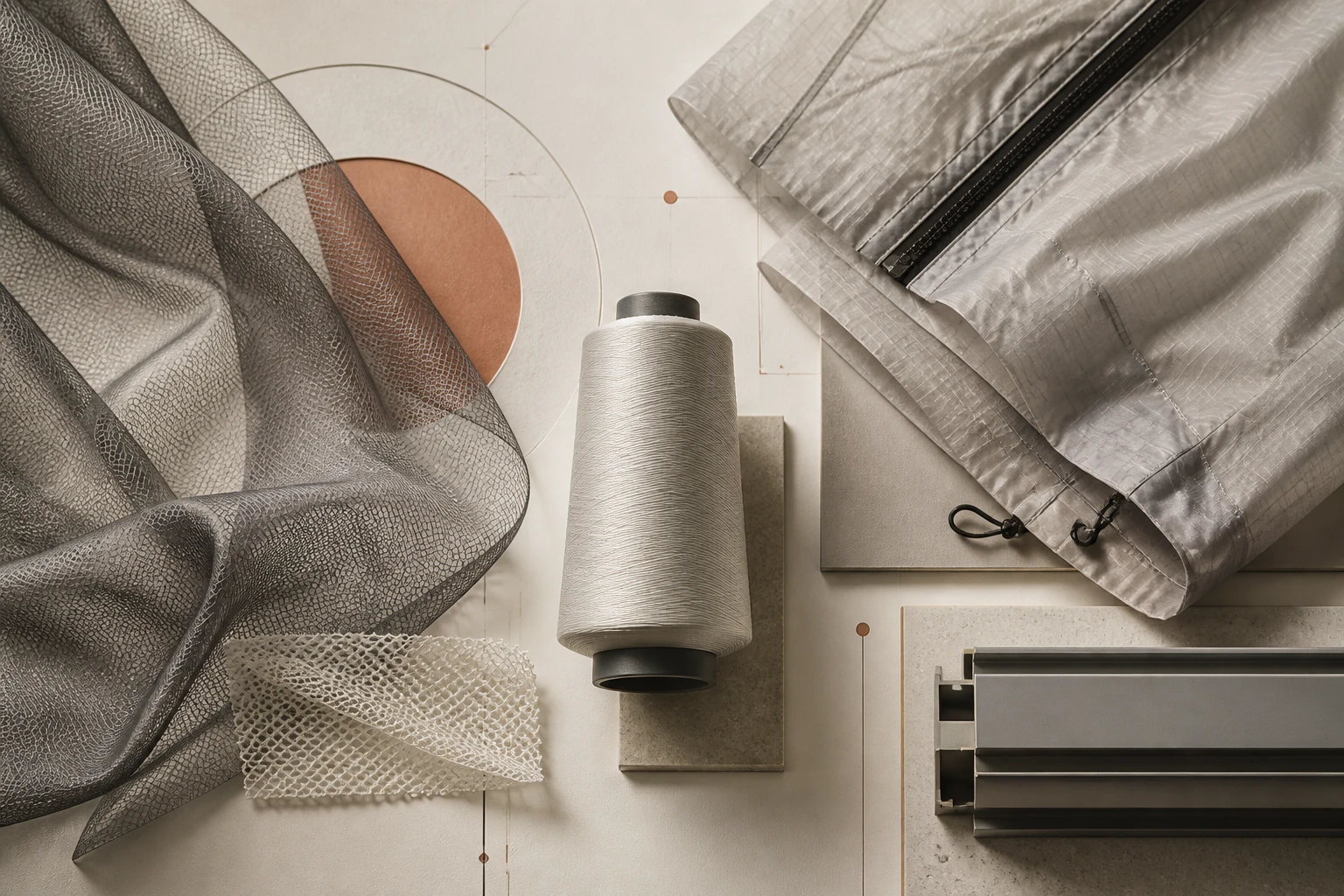
Nylon changed the meaning of material value: a laboratory filament designed for a mass future became a language of movement, function and intellectual luxury.
Editorial thesis
Nylon rarely looks expensive by itself — and that is precisely why it matters to modern luxury. It carries none of the geological age of stone, the warmth of timber or the inherited authority of silk. Its expression comes from another source: filament precision, weave density, a dry rustle, a technical sheen and the ability to survive real use.
The same polyamide can become an almost invisible mesh, a soft microfibre, a crisp ripstop or a dense bag fabric. Nylon should therefore be judged not by the fibre name on a label but by the entire production system: polymer type, denier, filament geometry, texturing, weave, coating and assembly. 18
Reader question
How did a material developed for laboratories, stockings and technical equipment move into the centre of intellectual luxury — and why can a black nylon bag feel more conceptually charged than costly leather?
This article reads nylon as a chemical system, an industrial technology and a cultural code. Its focus is how production changes light, form, sound, movement and perceived value.
Short answer
Nylon became the first fully synthetic fibre to enter mass consumer life. Melt spinning and filament drawing gave industry a fine, strong and repeatable yarn; stockings made it a symbol of the future, while wartime use gave it technical authority. 113
In the late twentieth century Miuccia Prada stopped disguising nylon as silk. Black technical fabric was paired with precise hardware, leather and disciplined construction. Luxury shifted from the cost of the raw material to the force of the idea, the quality of execution and the intelligence of the contrast. 136
1. Nylon is not a fabric but a family of materials
The word nylon sounds like the name of a single fabric, yet it describes a group of synthetic polyamides. They can become apparel yarn, monofilament, film, carpet fibre or engineering plastic. Their touch and appearance can differ so radically that the family resemblance is almost impossible to see. 81
Fibre content is therefore only the beginning. Behaviour is shaped by molecular structure, yarn size, twist, weave and finish. Nylon has no single aesthetic; production gives it character.
2. PA6 and PA66: similar names, different behaviour
Nylon 6 and nylon 6,6 are especially common in textiles and technical products. Both are polyamides, but their structures and processing conditions differ, affecting heat response, moisture uptake, stiffness and stability. 1
For a designer, the distinction appears not as a chemical formula but as the behaviour of a detail: one material may accept shaping more readily, another may hold load better; one can feel softer, the other drier and more technically precise.
3. How a melt becomes a filament
Polymer chips are melted and pushed through a spinneret containing many microscopic openings. The streams cool into continuous filaments. The yarn is then drawn, aligning molecular chains along its axis and turning a weak first filament into a strong material. 1
The stage is almost invisible, yet it determines the future fabric. Strength is not applied as a surface treatment; it emerges from order within the filament.
4. Denier, cross-section and surface character
Denier measures linear yarn density. A fine filament creates lightness and transparency; a larger one gives visible grain and greater physical presence. The number is not a quality scale: a dense weave of fine yarns may outperform a loose fabric made from coarse ones.
Cross-sectional geometry matters just as much. A round filament reflects light evenly, while a profiled one breaks the highlight and can create sparkle or dry matte diffusion. The surface is already being designed at a microscopic scale.
5. Thermoplasticity and shape memory
Nylon softens with heat and fixes a new configuration as it cools. This permits permanent pleats, crinkle textures, heat cutting, welded seams and three-dimensional surfaces.
The advantage is also a vulnerability. An iron that is too hot can leave shine, deform an edge or melt a local area. The material remembers not only the designer’s intended gesture but also a production mistake.
6. Strength, moisture, heat and ageing
Nylon resists abrasion and can recover its shape, which makes it effective in high-contact areas: bags, footwear, sportswear and linings. Yet coatings, prints and seams may fail before the fibre itself.
Polyamide absorbs some moisture, changing dimensions and hand; ultraviolet exposure weakens it over time, while excessive heat disturbs form. “Technical” does not mean invulnerable — it means the limits are specific and measurable.
7. Wallace Carothers and the birth of Fiber 66
In 1928 chemist Wallace H. Carothers joined DuPont’s research laboratory. His team investigated long molecular chains and on 28 February 1935 produced the polyamide later known as nylon 6,6. The working name Fiber 66 referred to the six carbon atoms in each of its two starting components. 1
The story matters for more than its date. Nylon emerged from a new idea of material: matter could be designed for desired properties rather than merely discovered in nature.
8. Stockings, Nylon Day and a new mass dream
Early commercial applications included toothbrush bristles, but stockings created the cultural explosion. On 15 May 1940 nationwide sales turned nylon into a promise of fineness, strength and modern femininity; hundreds of thousands of pairs were sold in a day. 113
The material was new, yet desire was built around the familiar image of silk smoothness. At this stage nylon still proved its value by imitating an established luxury code.
9. War, parachutes and technical authority
After the United States entered the Second World War, production was redirected towards military needs. Nylon was used wherever low weight, strength and repeatability mattered, from parachute systems to cordage and technical components. 1
War changed the material’s cultural biography. The promise of beauty acquired a second image: strategic technology — invisible, disciplined and reliable.
10. The 1960s: synthetics stop apologising
In the 1960s new fibres, plastics and films began to appear not as cheap substitutes for nature but as the language of the space age. Designers valued pure colour, low weight, formability and freedom from historical gravity. 1
Nylon could shine too brightly, rustle and hold an unfamiliar fold — and these qualities gradually stopped being treated as defects. Artificiality became part of the future image.
11. Sportswear and the language of function
Windbreakers, swimwear, sports bags and outdoor equipment made nylon the everyday language of movement. It dried quickly, weighed little and allowed compact products that folded easily and recovered their shape.
Sportswear taught fashion to see beauty in functional detail: a zip, webbing strap, mesh panel, contrast seam or adjustable volume. Luxury would later appropriate exactly this vocabulary.
12. How utility entered luxury
The shift did not happen when nylon learned to resemble an expensive fabric. It happened when designers stopped concealing its origin. Technical sheen, a light crease and a dry sound became carriers of meaning.
Luxury moved from material scarcity to the scarcity of the decision: exact proportion, an unexpected combination, intellectual context and impeccable assembly.
13. Miuccia Prada and black nylon
Miuccia Prada made black industrial nylon central to bags and clothing, setting it against traditional leather. The Met’s holdings from the 1990s record this relationship between a utilitarian surface, disciplined cut and a complex idea of modern femininity. 136
Prada’s black nylon does not try to look nobler. It remains cool, light and almost emotionally neutral — and this restraint turns it into a cultural code.
14. Anti-luxury as the new luxury
Classical luxury displays cost through rare material and labour-intensive decoration. Prada offered the reverse gesture: a familiar industrial fabric, an almost uniform colour and minimal external theatre.
Price and status came to depend on context, authorship and product precision. Nylon became ideal for a world in which luxury could be ironic, rational and deliberately unceremonious.
15. Leather, metal and material tension
Nylon is especially expressive beside materials carrying the opposite code. Leather adds weight, scent and craft memory; metal contributes cool precision and shine. Against them the textile appears even lighter and more technological.
The combination works when the details do not disguise nylon but sharpen it. Hardware becomes punctuation, leather a frame, while the soft body retains its functional honesty.
16. Taffeta, ripstop, ballistic and CORDURA
Nylon taffeta creates a smooth, dry and mobile plane. Ripstop introduces a visible reinforcement grid, turning fabric construction into graphic pattern. Ballistic nylon produces a dense, heavy surface associated with protection and wear resistance. 111
CORDURA is not the name of one universal cloth but a family of branded technologies and specifications. Density, coating, base fabric and intended use matter more than the familiar word alone.
17. Microfibre, knit, elastane and mesh
Microfilaments soften nylon’s character: the surface can become almost powdery and lose the look of early glossy synthetics. In knit form it works with the body, while elastane adds stretch and recovery.
Monofilament and mesh do the opposite by revealing structure. They admit air and vision, creating form with almost no visual mass.
18. Crinkle, calendering, coatings and lamination
Crinkle fixes intentional irregularity, as though the material has already lived part of its life. Calendering compresses the surface and increases reflection; coatings add water resistance, colour or rubbery touch; lamination joins layers into a complex composite.
Finishing can change nylon more dramatically than fibre type. Behind every seductive surface lies a practical question: how will it crack, delaminate, repair and age?
19. Form and movement
Light nylon responds to the smallest air current but does not fall like silk. Its fold is often shorter, drier and quicker to recover. Dense fabric can create almost architectural volume without great weight.
In clothing this produces mobility. In a bag it creates soft geometry that changes with its contents. The form remains alive, but never romantic.
20. Light, black, transparency and sound
Glossy nylon gathers light into long, cool bands; a matte surface breaks the highlight and reveals folds more quietly. Black intensifies the difference: a smooth plane recedes into depth while creases become almost graphic.
Transparent mesh depends on its background because space behind it creates the perceived colour. Rustle is also part of perception: nylon can be heard before it is touched.
21. Seams, edges, welding and bonding
A needle leaves a permanent hole, so stitch length, thread size and edge stabilisation must match fabric density. On fine nylon any error quickly becomes puckering or tearing.
Heat welding and bonding can remove the traditional seam, making a product lighter and cleaner. Yet the bonded layer creates its own ageing system: the textile may survive longer than the adhesive that holds it.
22. Care and honest ageing
There is no universal care instruction for “nylon”. Water temperature, cleaning and drying depend on coating, lining, leather, hardware and construction. Prada, for example, provides guidance for the particular product rather than for an abstract fibre. 13
With time the fabric may lose coating, soften, crease or develop shine at points of friction. Good design decides in advance which traces will feel natural and which will destroy the object.
23. Nylon in interiors and objects
In interiors nylon appears in mesh partitions, acoustic membranes, tensile structures, folding furniture and lighting. Its advantage is low mass and the ability to make a large surface from very little matter.
Domestic scale, however, makes sound, static and cool touch more noticeable. What is convincing in a backpack is not automatically comfortable on a chair or wall.
24. Fossil feedstock and the energy cost
Conventional nylon is made from petrochemical feedstock and requires energy. Strength and long service life can be advantages, but they do not erase production impacts. Textile Exchange assesses the material through feedstock, energy, chemistry and end-of-life conditions. 8
Sustainability therefore cannot be reduced to the word “recycled”. The full journey must be considered, from polymer production to repair and disposal.
25. Microfibres and the invisible trace
During wear and washing synthetic textiles can release microfibres. Their loss cannot be judged from appearance: a smooth and expensive product may also leave an invisible trace.
Fabric density, yarn type, edge treatment, washing conditions and service life all influence shedding. Environmental work begins with textile engineering, not only brand communication.
26. Mechanical and chemical recycling
Mechanical recycling shreds material and usually reduces fibre length and quality. Chemical regeneration aims to return the polymer to starting components or near-virgin quality, but it requires a clean feedstock stream and developed infrastructure.
Neither route is automatic. Fibre blends, coatings, adhesives and hardware can make a beautiful object almost impossible to separate.
27. ECONYL: regeneration as an industrial system
ECONYL is regenerated nylon 6 produced by Aquafil from collected waste, including industrial residues and a share of fishing nets. The system cleans and depolymerises the material before returning it to production. 1
It is important to separate a specific technological chain from the broad marketing image of “ocean plastic”. The credibility of the claim depends on feedstock traceability and a clear account of the process.
28. Prada Re-Nylon
Re-Nylon transferred a key house code to regenerated material and made the technological substitution part of Prada’s public story. Prada presents it as an update of its iconic nylon, while corporate reporting records the programme’s development. 1314
The project is not only about new feedstock. It suggests that heritage can reside not in one molecule but in an attitude to material: functionality, black colour, precision and intellectual distance.
29. Circularity begins with construction
A recycled fibre does not make a product circular when the object cannot be disassembled, repaired or returned to an appropriate stream. The more adhesives, coatings, mixed materials and concealed hardware, the more difficult the end of life.
A circular approach requires modularity, clear material labelling, replaceable components and service. Beauty must account not only for the moment of purchase but also for the moment of disassembly.
30. How designers, photographers and art directors should read nylon
A designer should identify polyamide type, denier, weave, finish, coating, seam and expected ageing. A photographer should decide what matters most: a cool highlight, dry fold, mesh, movement or density. A large soft source reveals a gradient; harder side light exposes relief and ripstop structure.
An art director should remember that nylon may signify war, sport, youth culture, anti-luxury, technology or sustainability. The material guarantees none of these meanings by itself; context creates them. Its power lies in the ability of industrial matter to be modest, intelligent and intensely contemporary.