encyclopedia
Pleating
From hand craft to Issey Miyake's technology
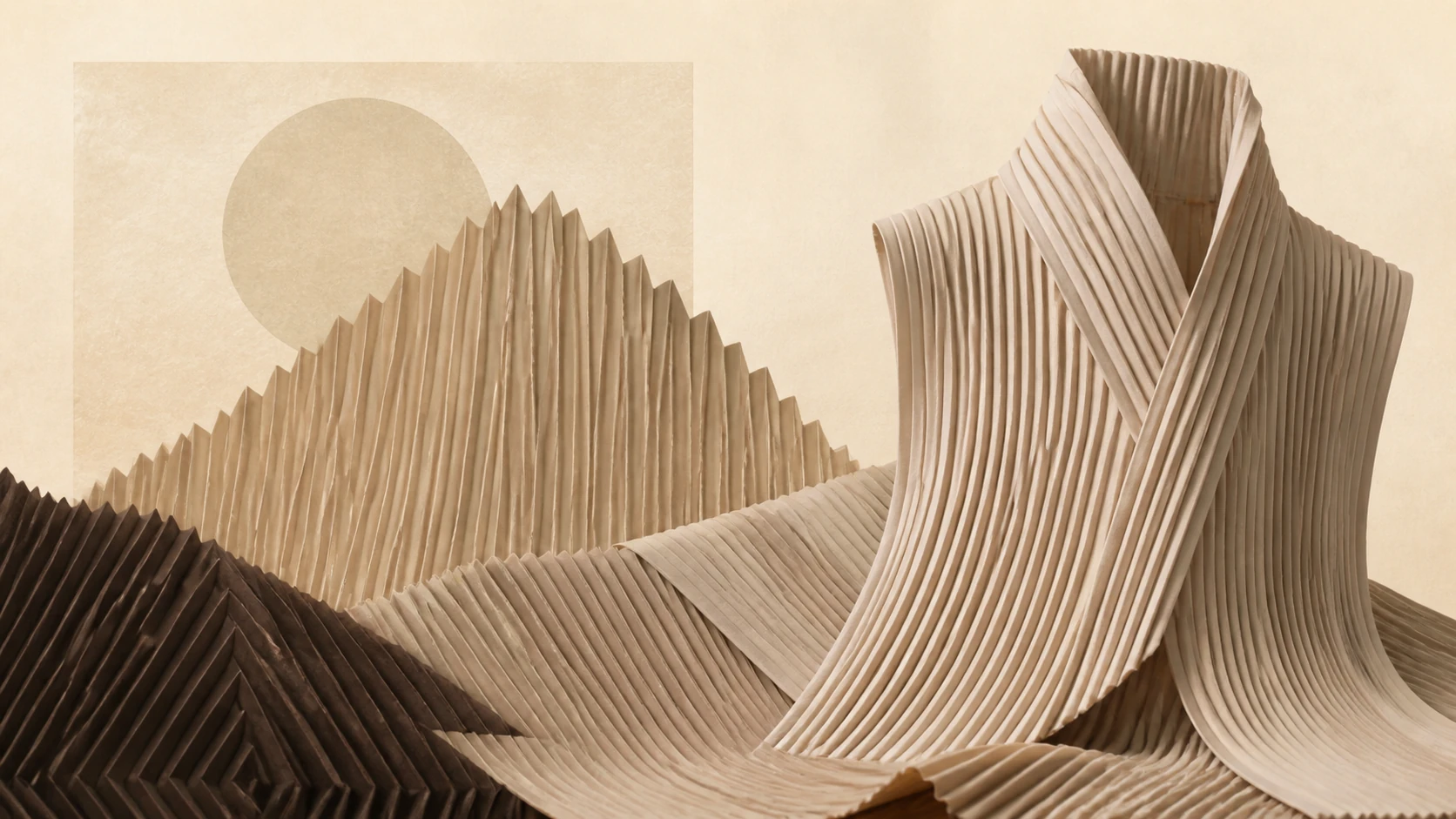
A pleat is not decoration applied to cloth but a geometric system that can store form, control light, and turn a plane into moving volume.
Editorial thesis
The history of pleating moves from labour-intensive hand folding toward technologies that give material a lasting memory. Issey Miyake radically changed the production sequence: in Pleats Please the garment form is created before pleating.1
Reader question
How does a fold become a construction system that controls form and movement?
Short answer
Classical pleating forms repeated folds by hand or machine; the result depends on fold geometry, fibre, and fixing method.
In PLEATS PLEASE, cloth is first cut and sewn into an enlarged garment and the finished piece is then pleated. The official brand site calls this garment pleating and traces its development to work begun in 1988.11
1. What pleating is
Pleating is the systematic formation of folds that alter area, thickness, direction, and the capacity of cloth to open. It is both surface treatment and a way of constructing volume.
2. Fold as geometry
Every pleat has a ridge, valley, depth, and pitch. Changing these parameters produces flat rhythm, fans, accordion structures, or dimensional surfaces.
3. Knife pleats
Knife pleats face one direction, creating clear rhythm while hiding substantial cloth inside a visually controlled surface.
4. Box pleats
A box pleat is built from opposing fold directions. It creates a more architectural rhythm and opens differently in motion.
5. Accordion pleats
Accordion pleats alternate ridges and valleys. They compress toward flatness and expand into volume, making movement especially visible.
6. Sunray pleats
Sunray pleats radiate from a narrow point toward a wider edge. Changing pitch converts flat material into a dynamic radial system.
7. Hand folding
Hand pleating begins with marking, precise folding, and fixing. It allows local control but demands time and repeatable accuracy.
8. Moulds and paper templates
Traditional workshops may place cloth between two folded paper moulds. Pressure, moisture, heat, and cooling transfer geometry to the material.
9. Fibre determines memory
Not every fibre retains a fold equally. Wool, silk, cotton, and thermoplastic synthetics respond differently to moisture, pressure, and heat.
10. Polyester and heat setting
Thermoplastic polyester can retain geometry set by heat. This material property became fundamental to the permanent pleating of Pleats Please.1
11. Before Issey Miyake
Pleating long predates modern fashion, from ancient dress to Mariano Fortuny. The Met explicitly connects Miyake's exploration with Fortuny's earlier success in classically inspired pleating.1
12. Miyake and movement
For Issey Miyake, pleats were not merely decoration. They allowed cloth to expand around the body and return toward compactness, creating space for movement.1
13. The 1988 experiments
The official PLEATS PLEASE history traces the project to pleated work shown in the women's collection in 1988.1
14. Reversing the process
Conventional practice often pleats fabric before cutting and sewing. Miyake reversed the sequence: material is cut, sewn, and shaped as a garment before the pleats are applied.1
15. The enlarged pattern
The Met describes garments constructed at roughly two or three times their final size because pleating subsequently contracts their width.1
16. Paper, folding, and heat press
The sewn garment is precisely folded, secured between paper, and placed in a heat press. Heat sets the folds into polyester.1
17. Garment pleating
The key term is garment pleating: the garment itself, not merely yardage, is pleated. The fold therefore becomes part of final garment geometry.1
18. Why seams change the result
Because the garment has already been sewn, seams pass through the pleating process with the cloth. The process acts on the whole construction and may leave characteristic manufacturing marks.1
19. Plane and body
Off the body, many pieces appear almost flat and geometric. On the wearer, folds open unevenly and transform two-dimensional form into volume.
20. Elasticity without elastane
Accordion geometry creates mechanical stretch as folds open. This is geometric elasticity of the surface, not necessarily stretch in the fibre itself.
21. Freedom of movement
The Met describes the elastic pleated cloth as creating space around the body and considerable freedom of movement—an 'architecture for the body'.1
22. Silhouette emerges in motion
The silhouette of Pleats Please is not fully defined on a hanger. It emerges through contact with the body as walking, turning, and gesture alter fold depth and direction.
23. Light
Alternating ridges and valleys create regular light and shadow. Side light makes pleats graphic; frontal light visually compresses relief.
24. Colour
A single colour reads differently on a ridge and inside a valley. Pleating effectively creates a tonal palette without adding another dye.
25. Printing before pleating
When imagery is printed on flat cloth before pleating, compression deforms it. The designer must anticipate the future geometry of the surface.
26. Guest Artist Series
In the Guest Artist Series, imagery became part of that transformation. For Cai Guo-Qiang's 1999 work, images were adjusted for printing on flat cloth before cutting, sewing, and pleating.1
27. Pleats Please as an independent brand
The official site states that PLEATS PLEASE began as an independent brand with the spring/summer 1994 season, developing from pleating research shown in 1988.1
28. Why 1993 also appears
The Met describes the line as launched in 1993 and associates the patented technique with that period.1 Publication should therefore distinguish development of the line, patent chronology, and the first independent brand season.
29. Everyday utility rather than couture ritual
The project was conceived as functional clothing: lightweight, easy to wear, machine-washable, and able to adapt to different bodies and movements.1
30. Storage
A pleated garment can compress into a small volume. Official care guidance recommends rolling it along the pleat direction and avoiding stretch or pressure during storage.1
31. Washing
For Pleats Please, the maker recommends cold machine washing up to 30°C on a short cycle, or gentle hand washing, without fabric softener.1
32. Why ironing is prohibited
Official care instructions prohibit ironing, steaming, and tumble drying because the material and pleated form are heat-sensitive.1
33. Why shortening is difficult
Altering length after production disrupts the established pleat geometry. ISSEY MIYAKE therefore does not recommend ordinary sleeve or hem alterations.1
34. Staircase Pleats
In Staircase Pleats, folding meets an almost paper-like panel geometry. The Met emphasises both the sculptural form and the essential flatness of the component panels.1
35. Architecture without rigidity
Pleating can create an architectural silhouette without a rigid frame. Volume emerges from repeated geometry in soft material.
36. Pleat scale
Fine pleats read as texture and allow substantial expansion. Large pleats become part of silhouette and interact more strongly with surrounding space.
37. Direction
Vertical pleats can visually lengthen form; horizontal pleats alter proportion; diagonals introduce movement. Actual effect still depends on body, weight, and pitch.
38. Curvilinear pleating
Pleats need not remain parallel. Radial, broken, and curvilinear systems can create surfaces that unfold like kinetic structures.
39. Hand versus industrial logic
Hand methods offer uniqueness and local control; industrial methods offer repeatability and scale. Value depends on the fit between technique and purpose, not simply the quantity of hand labour.
40. Defect or process trace
On Pleats Please garments, locally compressed areas may result from the post-sewing manufacturing process. The brand states that such marks are not necessarily defects.1
41. How to photograph pleating
To reveal structure, use one directional light at an angle. To reveal movement, allow the body to open the folds rather than freezing the surface completely.
42. Macro and full view
Macro reveals edge, thickness, and tonal relief but not kinetics. A wider view shows how pleats alter volume in relation to the body.
43. What a designer should analyse
Analyse fibre, material memory, pleat depth and pitch, contraction ratio, direction, seam placement, and behaviour after care.
44. What an art director should analyse
Pleating already generates a strong visual rhythm. Background, pose, and light should support it rather than introduce competing graphics.
45. Conclusion
Miyake's major contribution was not inventing the pleat but changing production logic. When an oversized finished garment is pleated after sewing, the fold becomes construction, material memory, movement system, and a method for turning plane into volume.