encyclopedia
Printing — the image as a reproducible surface
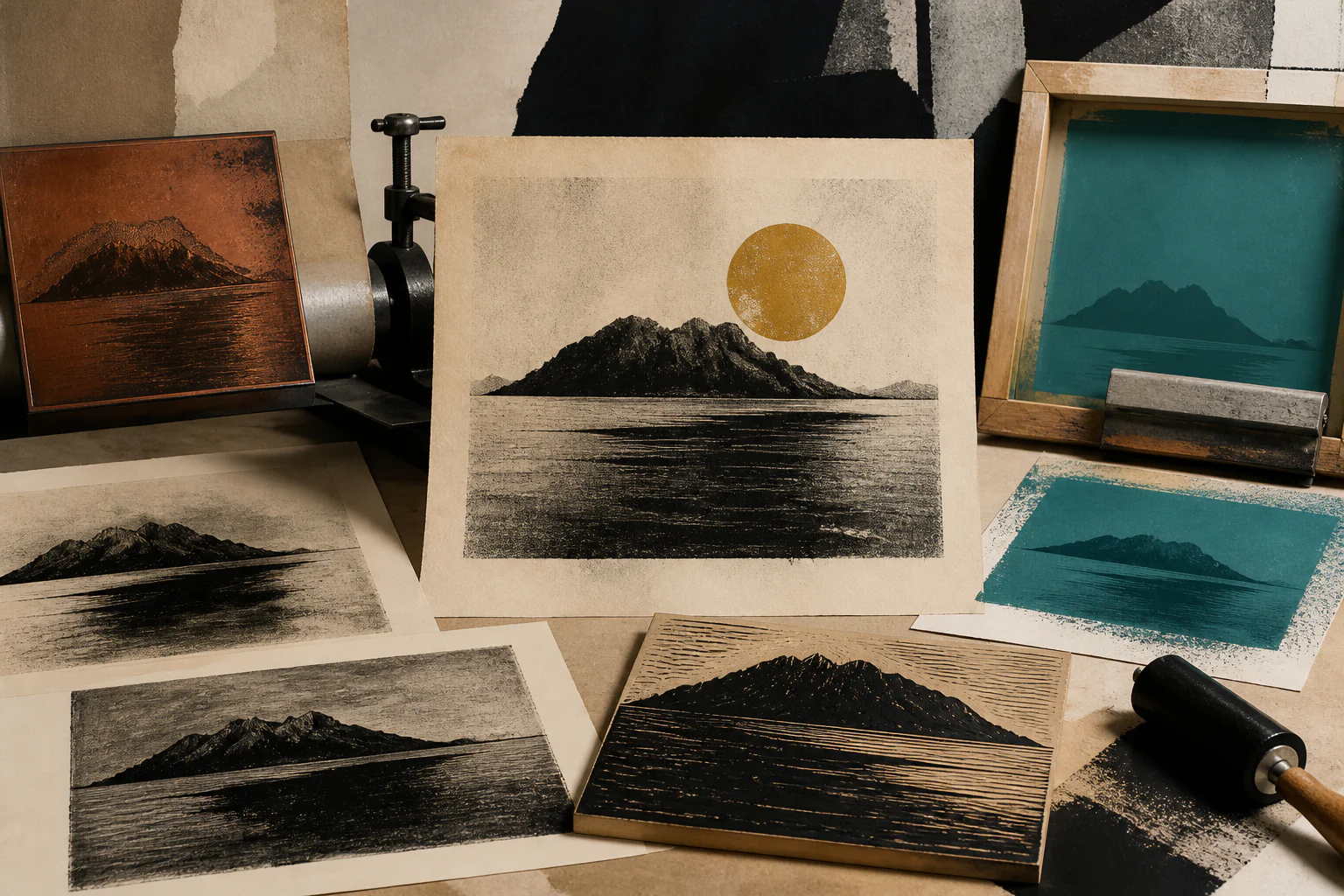
Printing turns an image into an edition, and each printing method leaves its own trace in the picture’s structure.
Editorial thesis
Printing matters not as a means of multiplication but as a set of physical constraints that entered visual language and stayed there after the technology itself disappeared.
Reader question
Why is a printing method visible in an image even to someone who does not know how it was printed?
Short answer
Because each method breaks continuous tone into discrete elements in its own way, and that structure stays visible in the image itself.
1. Definition and boundaries
Printing is the transfer of a colourant layer onto a substrate from a form permitting repetition. Repeatability is what defines it: a single impression without a form is not printing.
2. Four families of process
Relief printing impresses from raised elements, intaglio from recessed ones, planographic works on the repulsion of water and grease, screen forces ink through a mesh. Every subsequent difference follows from this.
3. Relief printing and its trace
The pressure of a raised element leaves a slight indentation in the paper and a thickening of ink at the edge of a character. That trace is imitated today because it reads as a mark of craft.
4. Intaglio and tone
Ink held in recesses gives a variable layer thickness and therefore genuine tonal gradation. It is the only family in which halftone comes from ink quantity rather than dot size.
5. Lithography as the invention of planographic printing
Working on stone without relief, based on the immiscibility of water and grease, made a freely drawn line possible in an edition. It freed the image from engraving technique.
6. Offset as industrial standard
Transferring an image from the plate to a rubber blanket and then to paper allowed printing on uneven substrates at high speed. It is the dominant mass-printing technology of the twentieth century.
7. The halftone screen as a solution
Printing either lays down ink or does not; there is no intermediate state. Continuous tone is simulated by dots of varying size, which the eye averages at a distance.
8. Screen ruling
Screen frequency determines the limit of detail and sets the minimum viewing distance. A newspaper is printed with a coarse screen because its paper cannot hold a fine dot.
9. Screen angle
Each ink is printed at its own angle, otherwise the dots combine into moiré. The standard set of angles is an engineering decision that became the invisible basis of colour printing.
10. Registration
Four inks must align to a fraction of a millimetre. A registration error produces a coloured fringe at edges — the most recognisable defect of colour printing.
11. The triad and black
Three coloured inks theoretically produce black and practically produce muddy brown. The fourth ink was added for reasons of cost and quality rather than colour theory.
12. Dot gain
A dot on paper is always larger than a dot on the plate, because ink spreads. The amount of gain depends on the paper and is compensated for in advance during file preparation.
13. Paper as co-author
Coated paper holds a dot and gives saturation, uncoated absorbs ink and mutes colour. The choice of paper affects the final image more than most decisions in the file.
14. Screen printing and layer density
Forcing ink through a mesh gives a thick opaque layer unattainable in offset. Hence the ability to print light on dark and the characteristic density of colour.
15. Screen and the flat area
The technology reproduces halftone poorly and flat areas well. That constraint shaped the language of the poster and of pop art: outline, flat area, a limited number of colours.
16. Limiting the number of inks as a language
Printing in two or three colours is cheaper than full colour and requires deciding which colours carry meaning. An economic constraint here directly produced a stylistic tradition.
17. Spot colour
A pre-mixed ink gives a colour unattainable by combining the triad and guarantees exact repetition across a run. A brand’s signature colour is usually a spot colour for precisely this reason.
18. Digital printing
The absence of a form removed dependence on run length and made variable data possible. In exchange, some of the gamut and density available in offset was lost.
19. Run length and unit cost
In traditional printing the unit cost falls with run length; in digital it is nearly constant. The intersection of these curves determines the choice of technology.
20. First turn: the image became an edition
The ability to repeat a picture separated it from a single carrier. Mass visual culture begins here, and every subsequent shift merely develops it.
21. Second turn: photography entered the edition
The halftone screen allowed photographs to be printed alongside text. That combination produced the modern press and the illustrated magazine.
22. Third turn: the form disappeared
Digital printing removed the physical form and with it the notion of an edition as an economic unit. Printing stopped requiring commitment.
23. What is usually misunderstood
The error is to treat printing as a neutral transfer of a file. Every process imposes its own structure on an image, and file preparation is work with those constraints.
24. Counterargument
The objection is practical: in a digital environment most images are never printed, and knowledge of printing constraints has become professional archaeology.
25. Where the counterargument holds
It holds for screen products. Screen ruling, registration, and dot gain have no on-screen equivalent, and attention spent on them there is wasted.
26. Where it fails
It fails as soon as an image reaches a physical carrier: packaging, book, signage, textile. Once an image acquires matter, printing constraints return in full.
27. The printed trace as style
Moiré, registration shift, and a visible dot are today reproduced deliberately as a sign of materiality. The defect has become a means of expression.
28. Link to typography
The size at which type stays legible is determined by process and paper. National typographic traditions are explained partly by available technology.
29. Current state
Offset remains the basis of long runs while digital printing has taken short series and personalisation. The division is stable and determined by economics rather than quality.
30. How to read the subject today
Look at an image under magnification. The structure of the dot, its shape and angle will tell you more about the picture’s origin than its caption.