encyclopedia
Production processes — the object as a sequence of operations
An object’s form is determined not by a sketch but by the order of operations, tolerances, and tooling cost.
Editorial thesis
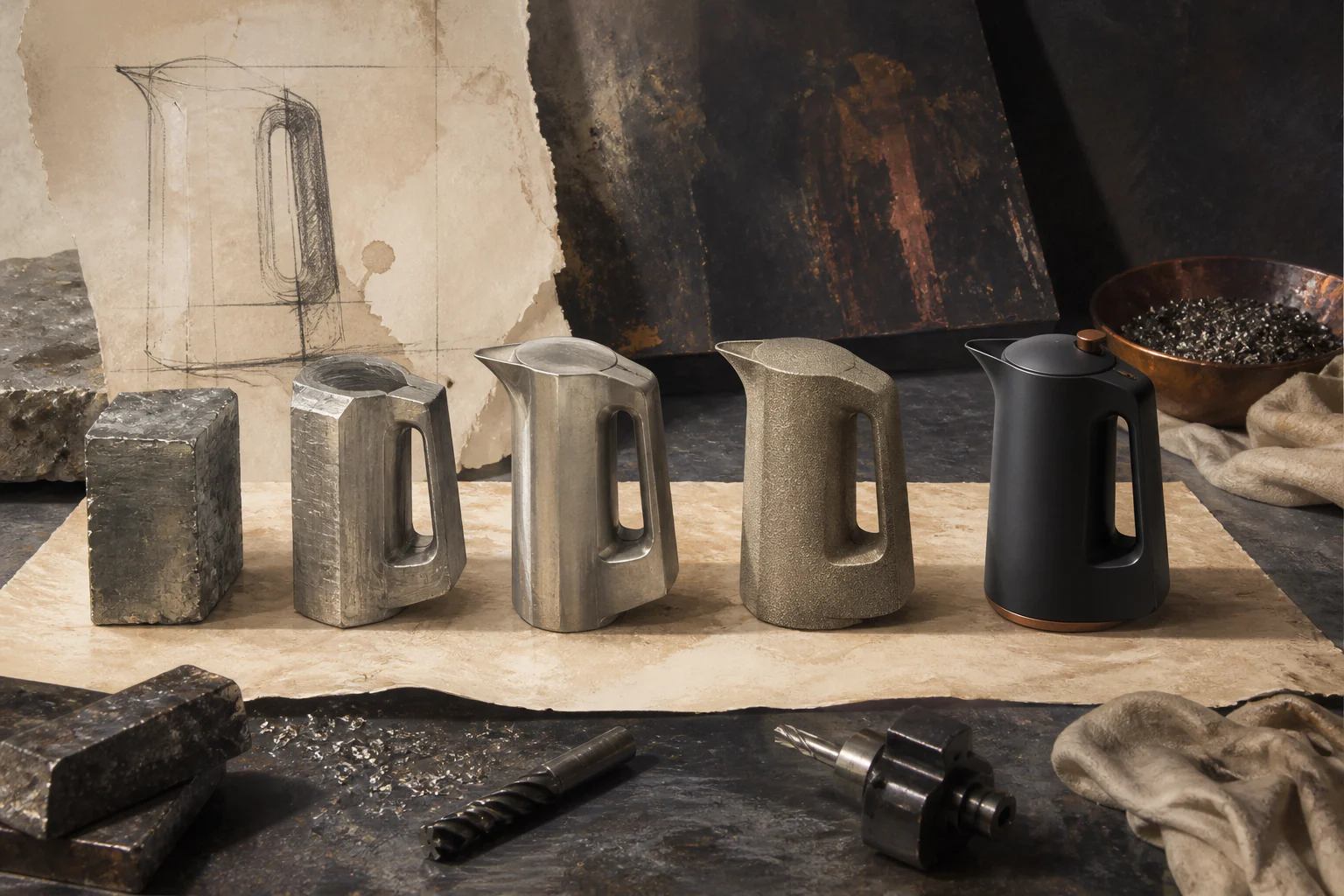
An object is better read as a sequence of operations than as a silhouette: every line on it is the trace of a particular way of making.
Reader question
Why are some forms cheap to manufacture and others impossible on the same budget?
Short answer
Because cost is determined not by visual complexity but by the number of operations, the precision of tolerance, and whether tooling pays back over the planned run.
1. Definition and boundaries
A production process is an ordered set of operations turning raw material into a product. Each operation imposes its own constraint on form, and the final geometry is the intersection of all those constraints.
2. Tooling as the main cost item
Moulds, dies, and fixtures are paid for once and do not depend on run length. This is why the question of how many units decides the technology before the question of how it looks.
3. The break-even point
Every process has a run length below which it is uneconomic. Injection moulding requires thousands of units, machining pays back on single pieces — the choice between them is arithmetic, not taste.
4. Moulding and draft
A part removed from a mould must have tapered walls. Hence the characteristic slightly conical geometry of plastic housings: a strictly vertical wall would jam in the tooling.
5. The parting line
Where the halves of a mould meet leaves a visible seam. The designer decides where to run it, and the decision reads on the finished object as a fine line around the perimeter.
6. Wall thickness as a rule
Uneven thickness produces sink marks and warping as material cools. The requirement of constant wall thickness explains the hollow ribs and recesses a user sees only from the underside.
7. Sheet metal forming
Sheet metal bends and is punched but does not stretch arbitrarily. Bend radius is bounded below by sheet thickness, and that limit sets the recognisable geometry of enclosure hardware.
8. Machining and cutter radius
An internal corner cut by a mill cannot be sharp: its radius equals the tool radius. Rounded internal corners on a metal part are the machine’s direct signature.
9. Additive manufacturing
Layer-by-layer building removes the constraint on formal complexity and introduces others: anisotropic strength between layers, the need for supports, and surface quality. Formal freedom is paid for in material properties.
10. Tolerance as a language
A tolerance states the permitted deviation of a dimension. Tightening it raises cost non-linearly, so competent design demands precision only where parts mate.
11. The gap between parts
A visible gap in a product is not a defect: it absorbs accumulated error and thermal expansion. Evenness of the gap, rather than its absence, is the mark of quality.
12. Assembly order
A product must assemble in one direction and disassemble for repair. Constructions requiring an impossible assembly sequence are discovered only in production.
13. Fastening as a decision about service life
A screw permits disassembly, a snap-fit cheapens assembly, adhesive makes a product non-demountable. The choice of fastening governs repairability more than any claim of durability.
14. Finishing as a separate operation
Polishing, anodising, painting, and texturing are added after forming and cost separately. A matt surface is often cheaper than gloss because it forgives defects.
15. Quality control
Inspection is sampled and statistical: not every unit is measured. Stated quality is a probabilistic claim rather than a guarantee for a particular example.
16. Scrap as a design quantity
A scrap rate is built into cost from the start. A complex form with a high rejection rate can cost more than a simple one even with identical tooling.
17. The supply chain as constraint
A part available from one supplier creates risk for the whole product. Designing around available components is normal and sensible practice, rarely stated aloud.
18. The standard component
A bearing, a screw, and a connector are taken from a catalogue rather than designed. Their dimensions set a product’s internal geometry before work on the housing begins.
19. First turn: interchangeability
The move to parts made within tolerance made assembly without fitting possible. It is the precondition of mass production and simultaneously the birth of the modern notion of quality.
20. Second turn: numerical control
A machine driven by a program broke the link between formal complexity and operator skill. Complexity moved from the workshop into the file.
21. Third turn: digital continuity
A model from which a machining program is generated directly eliminated the intermediate drawing. Translation error disappeared and responsibility moved entirely to the model’s author.
22. What is usually misunderstood
A common error is to think a complex form is expensive in itself. What is expensive is precision and short runs; a complex form at high volume can be cheaper than a simple one.
23. Counterargument
The objection is that submitting to technology impoverishes design: the designer begins drawing what is easy to make rather than what is needed.
24. Where the counterargument holds
It holds when technology is chosen before the problem is defined. The constraint then genuinely displaces intention, and the result becomes a description of the machine.
25. Where it fails
It fails as a general principle: almost every canonical object of the twentieth century grew out of a technological constraint rather than against it. A constraint generates form more often than it stifles it.
26. Link to logistics
Package dimensions and stacking method enter the brief on equal terms with tolerance. An object is designed for its whole route, not only for the machine.
27. Link to repair
Demountability is settled when fastening is chosen and can hardly be corrected later. It is one of the few places where a designer affects service life directly.
28. Link to materials
The same silhouette in metal, plastic, and wood requires three different processes and three different constructions. Material and process are chosen together, not in sequence.
29. Current state
Small-batch manufacture has become cheaper and the volume threshold has fallen. This has returned to circulation forms that were previously impossible outside mass production.
30. How to read the subject today
Look on an object for the traces of operations: the parting line, the internal corner radius, the direction of grain, the gate position. They describe an object’s origin more accurately than an author’s signature.