encyclopedia
Digital twin
A model of an object linked to it by a data stream and updated together with the original.
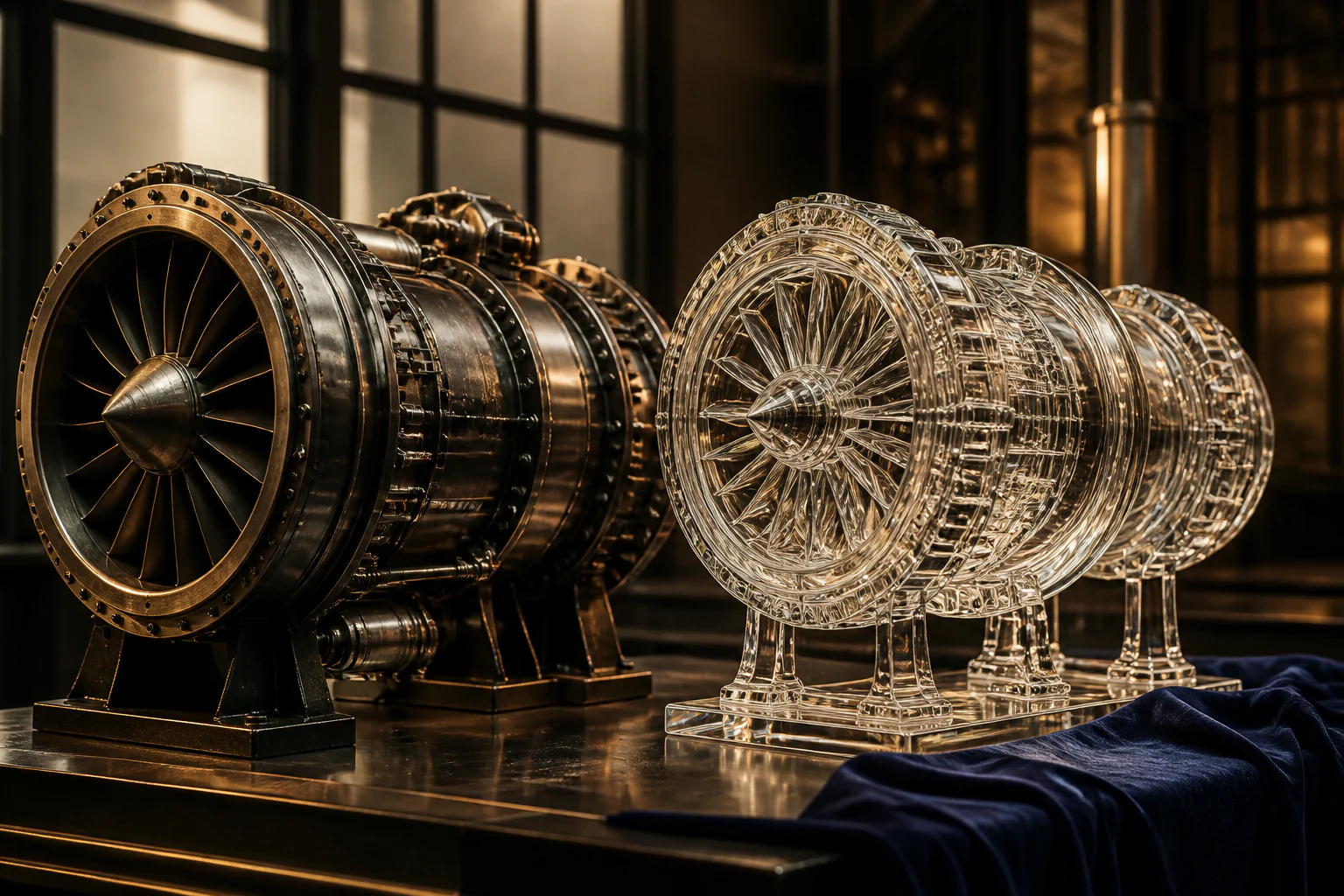
Editorial thesis
The digital twin matters because it introduces feedback into design: a model stops being an intention and becomes a report on the state of an existing thing.
Reader question
How does a model receiving data from an object differ from an ordinary three-dimensional model?
Short answer
By a live link: without a data stream it is merely a model. A twin is defined not by geometric accuracy but by updating.
1. Definition and boundaries
A digital twin is a model of a particular instance, linked to it by a stream of state data. The key word is "particular": a twin describes not a product type but an individual thing with its history.
2. Difference from model and simulation
An ordinary model describes an intention, a simulation tests a hypothesis, a twin reflects a fact. The difference lies in the direction of the link: in a twin data flows from object to model.
3. Origins in aerospace
The practice of maintaining an exact model of a particular vehicle on the ground grew from the need to diagnose faults at a distance. The term was established later than the practice.
4. Three mandatory elements
A twin requires an object, a model, and a channel between them. The absence of any one turns the construction into ordinary visualisation with an attractive name.
5. Sensors as a condition
A twin’s quality is determined by what is measured. A building model without temperature and occupancy sensors is not a twin, however accurate its geometry.
6. Update frequency
Different tasks require different frequencies: from milliseconds for a machine tool to months for a building. Choosing a frequency is a design decision determining the cost of the whole system.
7. Application in manufacturing
A twin of a machine or a line allows wear to be predicted and maintenance planned by actual condition rather than by schedule. The economic effect here is measurable.
8. Application in architecture
A building twin joins the design model with operational data: energy use, occupancy, microclimate. This moves a building from object to process.
9. Application in retail
A store twin combines layout with data on customer movement. A route stops being a designer’s assumption and becomes a measured quantity.
10. Application in fashion
A garment twin holds pattern, composition, supplier, and repair history. This is the technical basis for the product passport regulators are beginning to require.
11. The product passport as regulatory requirement
Traceability and repairability requirements are turning twin maintenance from voluntary practice into obligation. This changes the economics of the approach.
12. Link to building information modelling
Building information modelling supplied a ready data structure. A twin adds a temporal dimension to it: not as designed, but as it is now.
13. Divergence of model and object
The chief practical problem is drift: what was built differs from what was designed, and what is operated from what was built. Without regular reconciliation a twin quietly becomes a falsehood.
14. Scanning as a means of reconciliation
Laser scanning and photogrammetry are used to bring a model into line with actual state. The operation is expensive and is therefore performed less often than it should be.
15. The data ownership problem
Data about an object’s operation belongs to several parties: manufacturer, owner, service provider. Legal uncertainty slows adoption more than technical limitations do.
16. Privacy
A twin of a space records the behaviour of people in it. This makes the system an instrument of surveillance regardless of its original purpose.
17. Interchange standards
A twin’s durability is determined by format: a vendor’s proprietary format ties the owner to that vendor for the object’s entire service life, which may span decades.
18. Prediction as the goal
Value arises not from observation but from prediction: when it will fail, where it overheats, how much life remains. A twin without a predictive model is an expensive monitor.
19. The role of machine learning
Models trained on operating history give forecasts where physical simulation is too expensive. This complements rather than replaces engineering calculation.
20. Visualisation as interface
A three-dimensional presentation aids understanding but is not the essence. Many working twins have no visualisation at all and exist as tables and streams.
21. Cost of adoption
The main expense falls not on the model but on sensors, connectivity, and data maintenance. Projects most often stall at this stage.
22. What is usually misunderstood
A common error is to call any detailed model a twin. Without a data stream and a link to a particular instance it is visualisation, and the substitution of terms obstructs project assessment.
23. Counterargument
The objection is justified: in many cases sensors and reporting suffice, while a three-dimensional model adds cost without adding decisions.
24. Where the counterargument holds
It holds for simple objects with few parameters. There a table of indicators is more informative than a model and an order of magnitude cheaper.
25. Where it fails
It fails for spatial problems: heat propagation, pedestrian flow, structural clash. Such questions cannot even be posed without geometry.
26. A twin’s lifespan
A twin should outlive its object to be useful at decommissioning and recycling. This is an archival requirement that is almost never provided for.
27. Link to sustainability
Data on actual consumption and wear gives a verifiable basis for environmental claims. It is one of the few applications where a claim can be supported by a figure.
28. Impact on the profession
A designer receives feedback on how their decisions perform in operation. Historically this link was absent, and its appearance changes the nature of professional responsibility.
29. Current state
The term is used far more widely than the practice: most declared twins are models without a live link. The gap between word and implementation remains large.
30. How to read the subject today
Ask one question: what is measured, and how often. If there is no answer, you are looking at a model rather than a twin, whatever the project is called.