encyclopedia
Re-edition — the classic object as contemporary production
A re-edition creates a new legitimate object rather than a copy: the difference lies in rights and in production documentation.
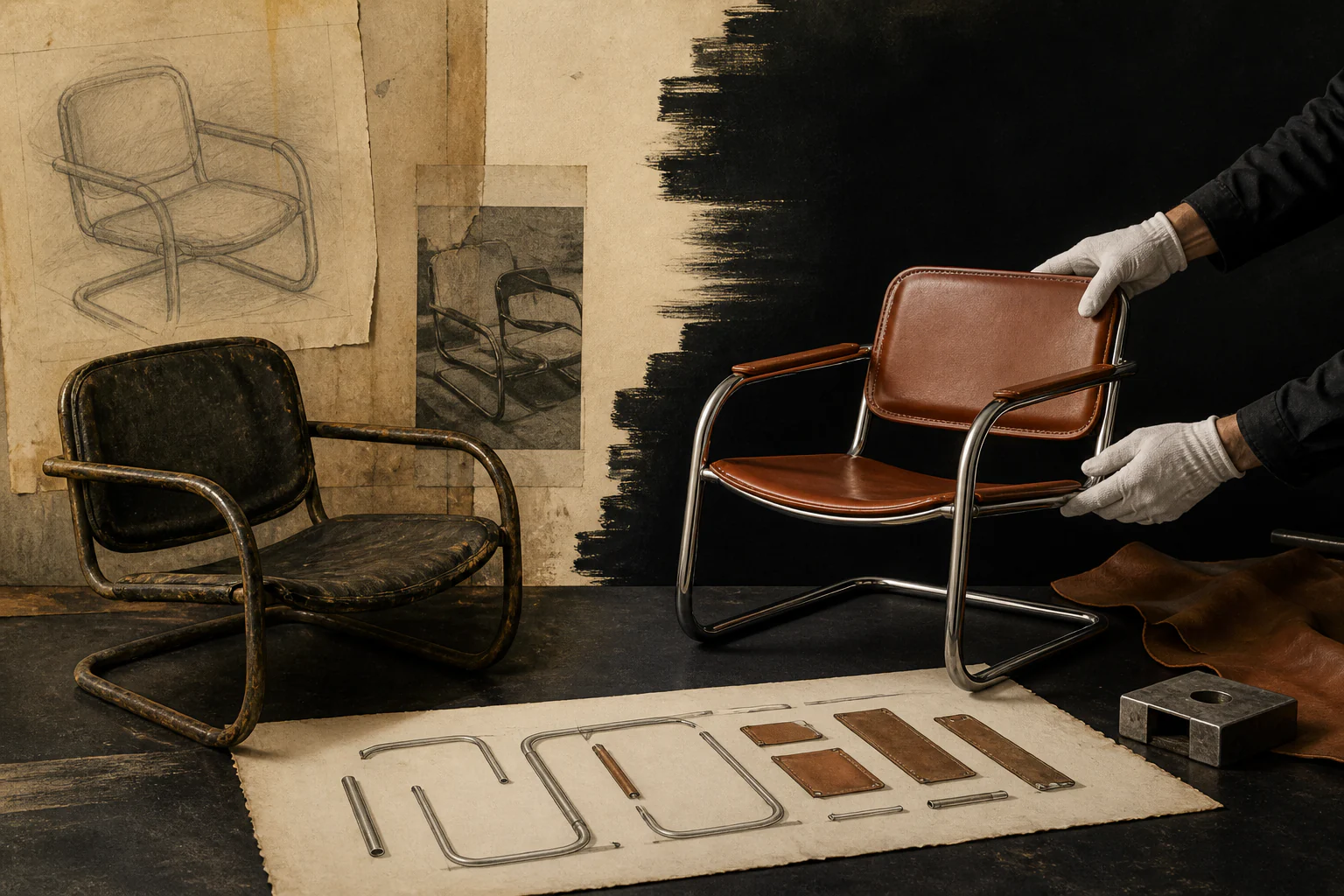
Editorial thesis
Re-edition matters as a case in which authenticity is secured not by an object’s age but by continuity of rights and recovered technology.
Reader question
How does an example of a historical model produced today differ from a counterfeit, if they look identical?
Short answer
By the declaration of origin: a rights holder produces a new object and says so, whereas a counterfeit asserts an origin it does not have.
1. Definition and boundaries
A re-edition is the production of a historical model by the rights holder from recovered or preserved documentation. It does not pretend to be an original and is therefore an object in its own right.
2. Four different things
Original, re-edition, unlicensed replica, and counterfeit form four distinct statuses. What separates them is not resemblance but the combination of rights and declaration.
3. Rights as the foundation
The ability to produce a model belongs to whoever holds rights, inherited or acquired. It is legal continuity, not technical accuracy, that makes production legitimate.
4. Term of protection
Rights in an industrial design are finite, and on expiry a model may be produced by anyone. Hence a market of lawful but unauthorised versions, legally clean and stripped of provenance.
5. Recovering tooling
Moulds and dies rarely survive decades. A re-edition usually requires new tooling made from drawings or from measuring a surviving example.
6. Measurement as reconstruction
When documentation is lost, an example is measured and the model reconstructed. The result is inevitably an interpretation: measurement records one particular example with all its deviations.
7. Which example is the standard
Early and late runs of one model differ. Choosing which to measure is an editorial decision determining which version of the history will be reproduced.
8. Material substitution
Some original materials are prohibited or unavailable. Substitution is unavoidable and changes an object’s weight, behaviour, and ageing while the silhouette is preserved.
9. Regulatory requirements
Contemporary standards for flammability, stability, and safety are frequently not met by a historical construction. A re-edition must depart from the original in order to be lawful.
10. Lost technologies
Some operations are no longer performed: machines, skills, or permitted compounds have disappeared. Certain objects are fundamentally irreproducible, and this is a technical rather than a legal problem.
11. Resizing for the contemporary body
Anthropometry has shifted, and historical proportions frequently feel tight. Manufacturers choose between accuracy and usability, and the choice is rarely stated publicly.
12. Marking the edition
Good practice is a stamp with date and number distinguishing a contemporary example from a historical one. It is the technical foundation of the entire authenticity market.
13. Effect on the collectors’ market
A re-edition usually raises interest in the original while complicating its identification. Both effects appear at once and pull in opposite directions.
14. The archive as production asset
A company that preserved drawings and samples can manufacture history. The archive here is not memory but a working department.
15. Selecting what is reissued
Models that sell are returned, rather than those that describe an era most accurately. A canon built on re-editions is systematically skewed toward the commercially successful.
16. Colour as a contemporary decision
Historical models are frequently reissued in palettes that did not exist in the author’s lifetime. This is an honest continuation of production and simultaneously a distortion of historical evidence.
17. Heirs’ consent
Beyond rights lies the question of the author’s intent. Heirs and foundations participate in decisions, and their position does not always coincide with legal possibility.
18. First turn: the archive became merchandise
Recognising that history sells turned a collection of samples into a source of revenue. This changed manufacturers’ relations with their own past.
19. Second turn: authenticity became a document
A certificate, a number, and a register entry replaced age as the mark of authenticity. Credibility moved from the object into paperwork.
20. Third turn: expiry opened the market
The end of protection on a number of landmark models produced lawful parallel manufacture. The dispute moved from law into provenance and quality.
21. What is usually misunderstood
The error is to treat a re-edition as a copy. Legally and industrially it is a new object; what makes something a copy is not its manufacture but a false claim of origin.
22. Counterargument
The objection is cultural: re-editions preserve a canon and occupy space that could go to new authors. A manufacturer chooses a safe past over a risky present.
23. Where the counterargument holds
It holds as a description of portfolios: re-editions account for such a share of revenue at some companies that new development is funded on a residual basis.
24. Where it fails
It fails as an objection to the practice itself. Continuous production preserves technologies and skills that would otherwise be lost irrecoverably.
25. Link to the museum
Institution and manufacturer present the same model differently: the museum shows an example with a history, the factory sells a working object. Both statements are true and do not coincide.
26. Link to citation
Re-edition relates to citation as performance relates to reference: both are legitimate when the source is named and both become appropriation when it is concealed.
27. Link to sustainability
A long-lived model with available parts is the opposite of a seasonal range. Re-edition has incidentally proved one of the industry’s most sustainable practices.
28. Restoration versus re-edition
Restoring a particular example and producing a new batch solve different problems. The first preserves evidence, the second continues manufacture.
29. Current state
The practice has become routine and commercially significant, and distinguishing versions has become specialist knowledge. The market now requires expertise where a glance once sufficed.
30. How to read the subject today
Ask three things: who holds the rights, from what documentation it was made, and how a contemporary example is marked. The answers separate continued manufacture from trade in resemblance.