encyclopedia
OpenUSD — the scene as a collaborative document
A format that lets several specialists edit one scene simultaneously without overwriting each other’s work.
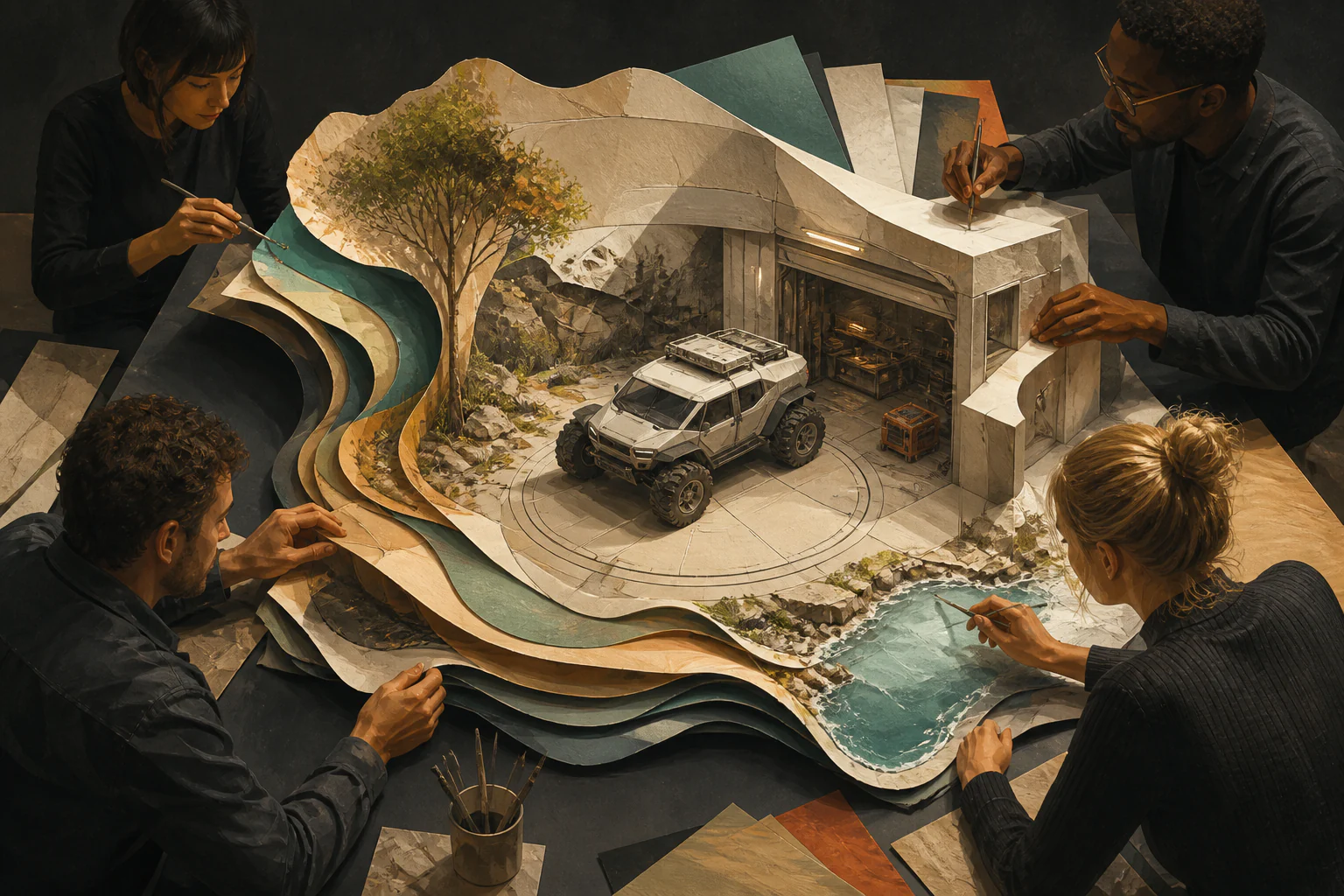
Editorial thesis
OpenUSD matters not as a file format but as a model of collaboration: it introduces for the three-dimensional scene what version control became for code.
Reader question
How can several departments change one scene simultaneously without blocking each other?
Short answer
Through layers: each works in their own layer, and the final scene is computed by composing layers according to priority rules.
1. Definition and boundaries
OpenUSD is an open system for describing three-dimensional scenes, developed for pipelines where dozens of specialists work on one scene. It is not a model storage format but a method of assembly.
2. Origins in an animation studio
The system grew from the internal toolset of a feature-animation studio, where the problem of concurrent work is most acute. Opening the source at the end of the 2010s made it an industry standard.
3. The problem it solves
In a classical pipeline a scene file belongs to one person: while they work, others wait. With hundreds of shots and dozens of departments this scheme halts production.
4. The layer as a unit of work
Each specialist edits their own layer containing only their changes. Layers do not overwrite one another but compose, removing access conflict.
5. Composition as computation
The final scene is not stored but computed by composing layers according to precedence rules. This is closer to building a program from sources than to opening a document.
6. References instead of copies
An object is included by reference rather than by copying. Fixing a model in one place propagates to every shot using it — the same advantage a component gives in a design system.
7. Override without destruction
A layer can change an object’s property without touching the source file. This allows a model to be adapted for a specific shot while keeping the link to the original.
8. Variants as a built-in mechanism
One object can contain a set of mutually exclusive variants — materials, states, levels of detail. Selection happens at assembly rather than at modelling time.
9. Lazy loading
The system reads only what the current task requires, allowing work with scenes that do not fit in memory as a whole. This is a precondition for large projects.
10. Separating description from rendering
The format does not prescribe what computes the image. The same file can be rendered by different systems, reducing vendor dependence.
11. Material description
An accompanying specification describes surfaces portably across renderers. This is the hardest part of interoperability, because systems differ in their lighting models.
12. Application beyond film
The format has been adopted in industrial design, robotics, and augmented reality. The task is identical: to describe a scene so that different tools understand it.
13. An industry alliance
Stewardship of the standard passed to an alliance including major companies. This is the usual mechanism: a format becomes infrastructure only when it stops belonging to a single owner.
14. Comparison with interchange formats
Earlier interchange formats transmitted a snapshot of a scene and lost its links and history. Here structure is transmitted, which fundamentally changes the character of collaboration.
15. Entry threshold
The system is complex: composition rules require study, and errors in layer precedence are hard to debug. For small teams the overhead often exceeds the benefit.
16. Organisational consequence
The format imposes discipline: conventions for naming, structure, and layer ownership are required. Adoption is an organisational project rather than a software installation.
17. Versioning and archive
The layered structure makes change history legible: it is visible who overrode what. This brings three-dimensional production closer to software development practice.
18. Longevity as argument
An open specification improves the chance of reading a scene in ten years. For archives and cultural heritage this is the decisive argument for the format.
19. Link to real time
Engines learned to read the format directly, removing conversion between stages. This is one reason virtual production became practical.
20. What is usually misunderstood
The error is to treat it as merely a new file extension. Its significance lies in the composition model, not in how geometry is encoded.
21. Counterargument
The objection is practical: complexity is high, and for a small team with a linear process the collaboration benefits do not materialise.
22. Where the counterargument holds
It holds for a single author and short projects. There a direct format is simpler and requires no study of composition rules.
23. Where it fails
It fails at scale: as soon as several departments work on a scene in parallel, there is no alternative to layered composition.
24. Parallel with design systems
Reference, override, and variant are the same mechanisms as component, token, and theme in interface systems. Both fields solve consistency under distributed execution.
25. Parallel with the typographic tradition
The separation of content and presentation, familiar from layout, is applied here to space. The idea is old; the carrier is new.
26. Impact on professions
A pipeline specialist role has appeared, responsible for scene structure rather than content. It is a technical profession inside artistic production.
27. The limits of interoperability
Full portability between systems remains unachieved: materials and effects are interpreted differently. The promise of a single format is only partly met.
28. Economic significance
The main benefit is reduced idle time between departments. Savings are measured not in image quality but in hours not spent waiting.
29. Current state
The format has become an industry foundation and continues to spread beyond film. The main obstacle is adoption complexity rather than technical maturity.
30. How to read the subject today
When assessing a pipeline, look not at file formats but at whether two people can change one scene simultaneously. That is the only substantive test.