encyclopedia
Silk
Properties, types, and applications
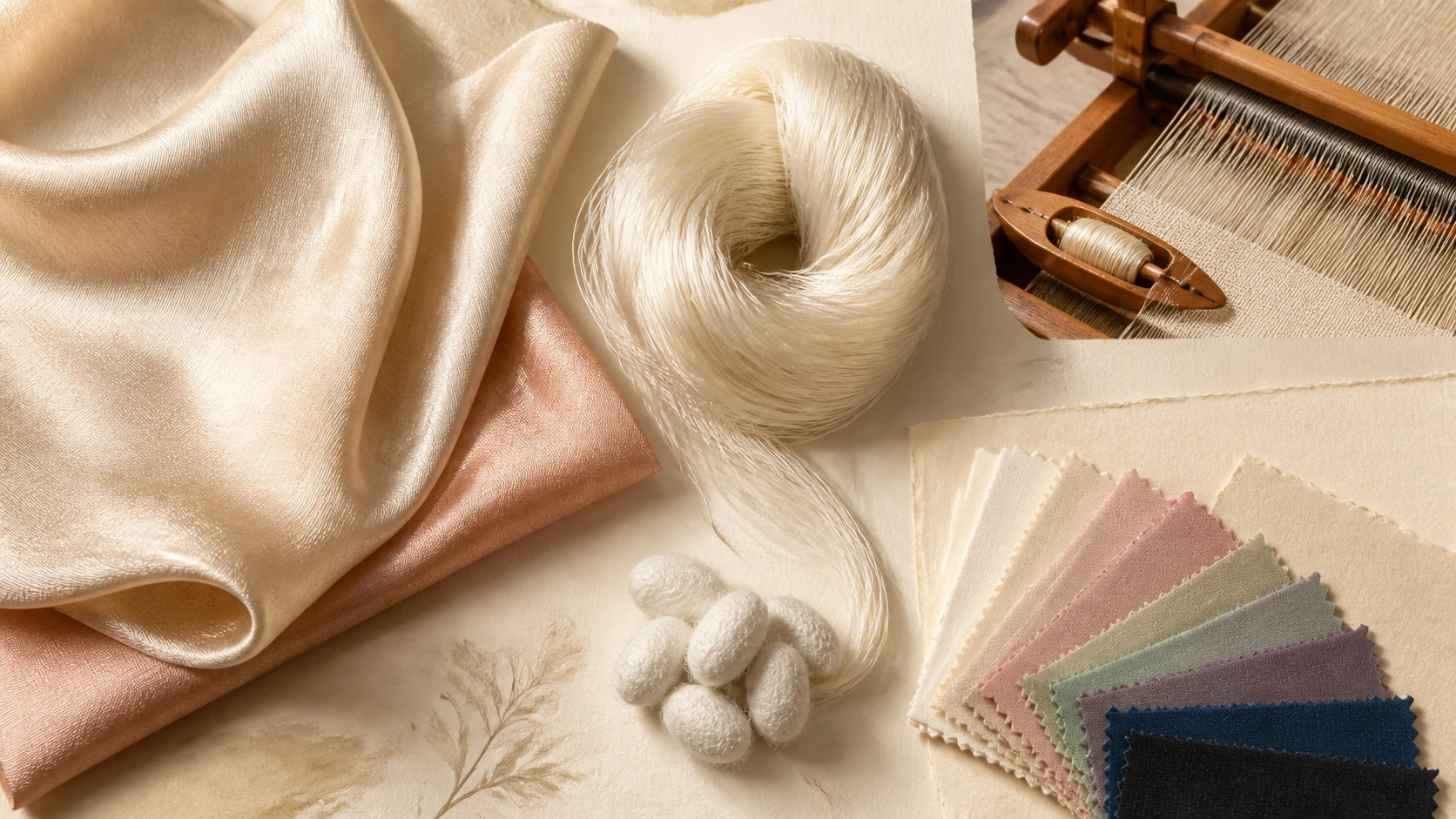
Silk is not an aesthetic of gloss but an entire material system: one fibre can become transparent architecture, fluid surface, crisp graphic form, or deep pile.
Editorial thesis
Silk is neither one fabric nor a synonym for shine. It is a protein fibre that, through yarn structure, weave, density, finishing, and dyeing, can become transparent organza, fluid crepe, mirror-like satin, soft charmeuse, or crisp taffeta. In design, the useful question is therefore not 'is it silk?' but 'which silk, in what construction, and what does it do to light and form?'1
Reader question
Why can organza, chiffon, crepe, taffeta, and satin all use the same fibre yet look and behave like entirely different materials?
Short answer
Finished fabric properties are determined by more than fibre. Silk fibroin forms the structural core of the filament while sericin coats it in the raw cocoon; degumming removes sericin, separates the filaments, and increases characteristic lustre.1
The yarn can then be twisted and woven in many ways. Satin weave creates long floats and strong reflection, organza transparency and resilience, chiffon lightness and motion, crepe a granular matte surface, and taffeta dry crispness. Construction is what turns one fibre into different visual tools.
1. Silk as a fibre
Silk is a natural protein fibre. Its continuous filament can form extremely fine, smooth yarn with a visually clean surface.
2. Fibroin and sericin
Raw silk filament consists of fibroin, the structural core, and sericin, the gum binding filaments together. The Met describes degumming as removing sericin, separating fibroin filaments, and increasing lustre.1
3. The cocoon
The cocoon is built from a continuous filament laid around the silkworm. The ability to reel long filament distinguishes filament silk from many staple fibres.
4. Sericulture
Sericulture includes raising silkworms, producing cocoons, reeling, and preparing yarn. Historically this technological chain created vast trade and manufacturing systems.
5. China and global history
The Museum at FIT describes silk as the ultimate luxury fibre for millennia and links its Chinese origins to trade networks that connected the Old World.1
6. Lyon
FIT highlights Lyon as a centre of the French silk industry from the fifteenth century and as a material base that helped Paris build its couture system.1
7. Filament silk
Long continuous filament produces smooth yarn with little hairiness. It is especially important where surface and reflection must remain clean.
8. Spun silk
Short residual fibres can be spun as staple. The resulting yarn is generally less smooth and lustrous but uses material that cannot be reeled as long filament.
9. Degumming
Removing sericin changes touch, lustre, and mass. Historically, weight lost through degumming was sometimes compensated with weighting agents, a practice discussed by The Met in its study of historic silk.1
10. Lustre
Characteristic lustre emerges from filament smoothness, fibre geometry, yarn structure, and weave. Not every silk fabric therefore looks glossy.
11. Strength and delicacy
A delicate appearance does not mean lack of strength, yet puncture, abrasion, perspiration, and poor storage can quickly damage fine cloth.
12. Moisture
Silk interacts with moisture and the body differently from hydrophobic synthetics. Finish, dye, and fabric construction strongly alter wearing comfort.
13. Light and ageing
Historic silks require caution with light: photo-oxidation weakens fibre and dyes. For museum objects, visual display must always be balanced against preservation.
14. Weave matters as much as fibre
The same silk yarn in plain, satin, twill, or complex weave produces radically different surface, stiffness, and light.
15. Satin
Satin is primarily a weave structure, not a fibre name. Long floats create a smooth surface and directional highlight; satin need not be silk.
16. Silk satin
Silk satin combines smooth filament yarn with the reflective structure of satin weave. In fashion it is especially sensitive to tension, creasing, and seam quality.
17. Charmeuse
Charmeuse is a lightweight satin fabric with a lustrous face and duller reverse. It is fluid and well suited to slip dresses, lingerie, and bias-cut construction.
18. Crepe
Crepe surface is produced through highly twisted yarn and/or related structure. Light is broken up, making the cloth quieter than satin and effective for showing volume without mirror-like glare.
19. Crepe de chine
Crepe de chine combines softness, restrained matte character, and fluidity. It is lighter than many dress crepes and suits blouses, dresses, and draping.
20. Georgette
Georgette uses high twist and has a dry granular surface. It is more transparent than dense crepe but carries more body than chiffon.
21. Chiffon
Chiffon is extremely light, sheer, and mobile. FIT documents numerous couture examples in silk chiffon where movement and layering become part of the silhouette.15
22. Organza
Silk organza is transparent yet retains crispness and volume. It can create form with almost no apparent visual mass.
23. Organza in couture
FIT documents silk organza across historical and modern designer dress, from sheer overdresses to complex evening constructions.11
24. Taffeta
Taffeta uses a dense plain weave and produces a dry, crisp bend. It holds volume, responds to movement with characteristic rustle, and creates graphic folds.
25. Dupioni
Dupioni is recognised by irregular slubs in the yarn. Its surface emphasises materiality and makes colour less uniform.
26. Shantung
Shantung is visually related to dupioni through irregularity, though exact yarn structure and origin depend on production. Designers value its dry texture and shape retention.
27. Habotai
Habotai is a lightweight smooth plain-weave fabric. Softer than organza, it is often used for linings, light garments, and dye work.
28. Silk twill
Silk twill has a diagonal rib, good drape, and stability. It is especially common in scarves where printing, colour saturation, and controlled movement matter.
29. Faille
Faille has a pronounced crosswise rib and a more architectural response to bending. It suits structured dresses, jackets, and decorative details.
30. Grosgrain
Grosgrain is a dense ribbed structure often used in ribbons and trim. In historical tailoring, silk grosgrain was used for lapels and formal details.
31. Silk velvet
Silk velvet builds colour through pile: pile direction changes tonal depth and reflection. It is one of the most visually light-sensitive surfaces.
32. Damask
Damask creates pattern within the weave, often through contrasting reflection of structures. The Met documents historic silk damasks alongside satin and brocade in complex textile objects.1
33. Brocade
Brocade introduces supplementary yarns for pattern and may include metal. The surface becomes image while gaining additional weight.
34. Printing
The smooth surface of many silks can carry fine printed detail, but absorption, dye migration, and edge definition depend on weave and pretreatment.
35. Dyeing
Silk can produce saturated colour, but results depend on dye class, pH, temperature, and finish. Historic and modern recipes are not interchangeable.
36. Silk and bias cut
Fluid satin, charmeuse, and crepe are especially expressive on the bias: cloth redistributes around the body while light reveals diagonal tension.
37. Silk and draping
Heavy crepe forms deep falls, chiffon creates airy layers, and organza produces volume with crisp edges. The material effectively selects the type of drape.
38. Silk and pleating
Silk can be pleated, but fold stability depends on structure and treatment. Natural fibre does not have the same thermoplastic memory as polyester.
39. Silk and embroidery
A fine ground may not support heavy embroidery without stabilisation. Organza is valued as an almost invisible base, while satin amplifies decoration through reflection.
40. Lining
Silk is often used for lining because of its smoothness and low bulk, but durability depends on fabric density and abrasion zones.
41. YSL and Halston
FIT's YSL + Halston exhibition demonstrates how differently silk crepe, hammered satin, chiffon, organza, and taffeta operate within two design languages of the 1960s–80s.1
42. The 1930s
In 1930s fashion, silk crepe-back satin and chiffon supported the new fluid silhouette and bias construction, clearly documented by FIT.1
43. Charles James
FIT holds a 1955 Charles James evening dress in silk taffeta and net, demonstrating that silk can behave architecturally rather than fluidly.1
44. Christian Dior
FIT's collection includes a 1954 Dior dress in satin, where sheen, density, and controlled volume become part of the couture silhouette.1
45. Weight and GSM
Fabric weight helps predict fall, but identical GSM does not guarantee identical behaviour: twist, density, and finish alter touch and volume.
46. Hand feel
Professional evaluation includes more than softness: dryness, slip, resilience, surface coolness, and recovery after crushing all matter.
47. Seams
Fine silk satin reveals seam tension, chiffon shifts easily, and organza exposes allowances. Construction technique must match the specific fabric.
48. Needles
An oversized or damaged needle leaves visible holes and may displace yarns. For fine fabrics, tool quality becomes part of surface quality.
49. Pressing
Heat, steam, and pressure can alter sheen, create water marks, or imprint seam allowances. Pressing requires testing on the exact cloth.
50. Care
There is no universal care method for '100% silk'. Dye, weave, finish, embellishment, and garment construction determine acceptable cleaning.
51. Storage
Light, humidity, acids, contamination, and mechanical stress affect ageing. Museum practice is particularly cautious with historic silks.
52. Silk and sustainability
Natural origin does not automatically make a material sustainable. Sericulture, energy, water, dyes, durability, and labour conditions all require analysis.
53. Peace silk and marketing
Terms such as peace silk require verification of the actual production chain. Ethical claims need traceability rather than a product name alone.
54. Synthetic satin is not silk
Satin describes a weave. Polyester satin can resemble silk satin visually but behaves differently in heat, movement, static, and ageing.
55. How to photograph satin
A large soft source creates a long controlled gradient. A small hard source can quickly turn the surface into clipped highlight bands.
56. How to photograph organza
Organza requires separation between foreground and background. Backlight reveals edges and transparency, while the background determines perceived colour.
57. How to photograph chiffon
Chiffon is best revealed in motion. A small airflow or model movement shows layers, transparency, and the cloth's delayed response to the body.
58. How to photograph velvet
Pile requires angled light: frontal illumination can flatten the surface, while side light reveals pile direction and colour depth.
59. What a designer should analyse
Identify not only fibre content but weave, weight, twist, transparency, resilience, slip, bias behaviour, seam response, pressing, and care.
60. What a photographer should analyse
First identify the fabric's dominant property: reflection, transparency, pile, grain, movement, or crisp volume. Lighting should explain that property.
61. What an art director should analyse
Silk is too diverse to function as one generic luxury symbol. Charmeuse, organza, taffeta, and velvet carry different visual and cultural codes.
62. Conclusion
Silk is a platform rather than a finished aesthetic. Fibre provides the potential for fineness and lustre, but yarn, weave, density, finish, and construction create its actual character. Good design therefore begins with understanding the behaviour of the specific silk fabric.