encyclopedia
Terrazzo
Fragment, binder, and the seamless surface
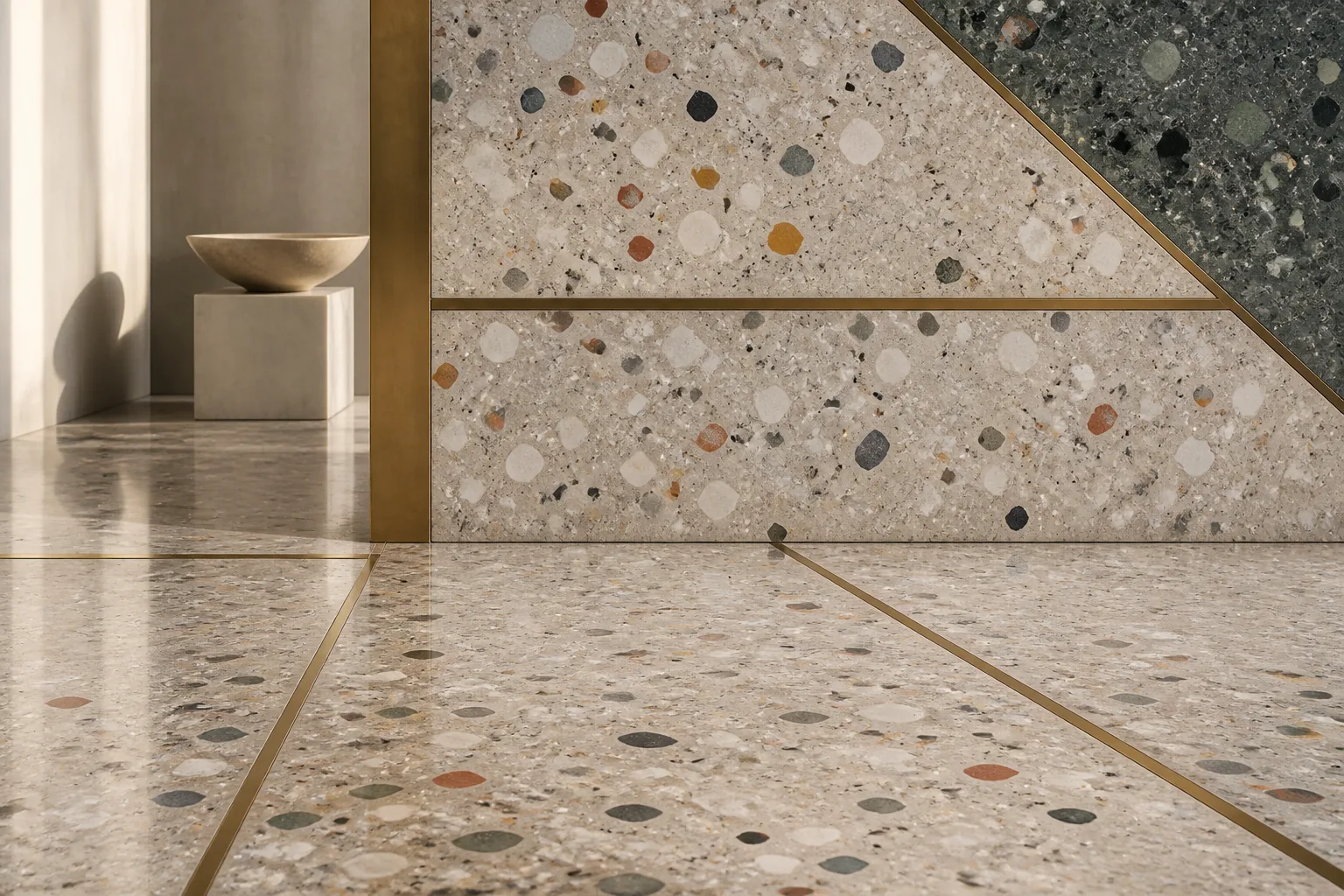
Terrazzo appears monolithic, yet its beauty is built from difference. Stone fragment, coloured matrix, metal line, and the trace of grinding join in a surface that seems calm from a distance and opens into a material map at close range.
Editorial thesis
Terrazzo should be understood not as a decorative speckled style but as a production system. Its visual language depends on the source and scale of aggregate, binder type, depth of grinding, divider-strip pattern, substrate quality, and light. The material may appear almost seamless, but it is never accidental.
Reader question
Why does one terrazzo floor resemble calm stone, another behave like bright graphics, and a third crack or lose its sheen even though all carry the same name?
Short answer
Terrazzo consists of hard fragments held in a binder and ground after curing into one surface. Traditional systems use a cementitious matrix; contemporary thin-set versions are often based on epoxy resin. Chip size, matrix colour, joint strategy, and level of polish alter not only appearance but also weight, thickness, repairability, and field of use.1
The material developed through the craft traditions of Venice and Friuli, passed through twentieth-century mechanisation, Art Deco public interiors, and contemporary airports, schools, and museums. Its strength lies in combining a durable finish and a graphic system within the same physical layer.1
1. What terrazzo actually is
Terrazzo is not merely a pattern of coloured specks but a composite system. Fragments of marble, granite, quartz, glass, or other hard materials are held within a cementitious or polymer binder, after which the surface is ground and finished to a specified sheen. The result reads as a whole even though its character is built from many separate inclusions.1
The material may be poured on site or made in advance as stair treads, panels, worktops, and other precast elements. Terrazzo therefore exists at once as flooring, cladding, and a way of forming objects.
2. Fragment and binder
The visual language of terrazzo emerges from the tension between particle and ground. A stone fragment retains its own colour, grain, and edge, while the matrix gathers those differences into one field.
When binder and aggregate are close in tone, the surface feels calm and mineral. A contrasting matrix turns each fragment into a graphic sign. The same stones can resemble mist, confetti, or a geological section depending on the ratio between inclusion and background.
3. Ancient precedents
Histories of terrazzo often begin with ancient floors in which stone and ceramic fragments were set into lime-based mortars. These surfaces matter as precedents for the idea: inexpensive or residual matter is transformed into a durable continuous finish.
An ancient floor should not, however, automatically be called modern terrazzo. Production chains, binders, grinding methods, and professional traditions differed. History is more useful here as a line of kinship than as a search for one date of invention.1
A disputed origin
Terrazzo has ancient predecessors, but the modern professional system emerged much later. The further the story travels into antiquity, the more cautiously the word “terrazzo” should be used.
4. Venice and the craftsmen of Friuli
The modern tradition of terrazzo alla veneziana developed in Venice and the Friuli region. Craftsmen pressed marble chips and fragments into a mineral bed, compacted them, and ground the surface over a long process. In 1583 Venetian authorities permitted a group of Friulian terrazzieri to establish a professional school, evidence of an already organised craft.1
The Venetian floor was more than a method of reusing remnants. It could cover large rooms without a grid of separate tiles and visually connect the interiors of a palazzo.
5. Seminato and pavimento alla veneziana
In seminato, small and medium fragments are scattered like seed across a wet matrix. After compaction and grinding, apparently random distribution becomes an even visual field.
Pavimento alla veneziana may contain more complex borders, patterns, larger pieces, and carefully controlled colour. Chance is directed: the maker does not draw every particle but determines density, scale, and overall rhythm.
6. Palladiana
Palladiana is organised around large irregular stone pieces separated by visible areas of binder. The surface resembles free stonework compressed into a single plane. Its name is associated with the Italian architectural tradition and Andrea Palladio, although the modern system developed through several historical layers.1
Large fragments change the scale of perception. Conventional terrazzo first reads as a colour field; Palladiana reads as a composition of individual stones, almost like an abstract map.
7. Cementitious matrix
Cementitious terrazzo retains mineral depth and a degree of natural variation. The matrix may be grey, white, or pigmented, but its colour always depends on cement, water, aggregate, curing conditions, and subsequent finishing.
The material can work indoors and, when the system is properly designed, outside. It is heavier and thicker than thin-set epoxy terrazzo, yet it ages more like stone and concrete.
8. Epoxy matrix
Epoxy terrazzo is a thin polymer system generally bonded to a prepared concrete slab. It allows saturated colours, fine lines, complex graphics, and lighter assemblies. NTMA describes typical thin-set systems at approximately 1/4 or 3/8 inch.1
Its principal limitation is dependence on the substrate and environment. A polymer matrix does not turn a poor slab into a perfect surface, while exterior use demands particular caution because of ultraviolet and thermal exposure.
A thin system is not a simple system
The terrazzo layer may be thin, but requirements for substrate flatness, moisture, and crack control become more exacting rather than less.
9. Monolithic and layered systems
Monolithic cement terrazzo is placed as a relatively thin veneer over a concrete slab and depends on the slab’s quality. More traditional systems with separating and underlay layers add thickness and manage movement differently.1
The system name matters as much as the selected colour. Two floors with the same visual mix may carry different weight, build-up, programme, loading capacity, and ageing behaviour.
10. Precast elements
Terrazzo may be formed away from the site: treads, risers, skirtings, panels, basins, worktops, and furniture components are made under controlled conditions and installed later.
Precast work makes the edge particularly important. Where a poured floor appears almost endless, a worktop reveals thickness, aggregate distribution, and casting quality. The cut section becomes part of the design.
11. Aggregates
Marble chip is the classical aggregate, but contemporary terrazzo may incorporate granite, quartz, glass, porcelain, mirror, shell, and other compatible materials.1
Each aggregate responds differently to grinding and light. Marble produces soft mineral depth, glass gives sharp colour flashes, and mirror creates point highlights. They should not be mixed as a decorative catalogue but as materials with different hardness and optics.
12. Fragment size and visual scale
Fine chip merges into an almost uniform tone from a distance. Medium aggregate creates recognisable grain. Large pieces turn the floor into a graphic field that may compete with furniture and architecture.
Scale must be assessed from the actual viewing distance rather than from a small hand sample. A fragment that looks large on a 20-centimetre plate may disappear in an airport; the same mix can dominate a small bathroom.
13. Matrix colour
The matrix is not neutral glue between stones. It occupies most of the visual field and sets the temperature of the entire surface.
Warm white softens cool marble, graphite makes pale inclusions sharp, and coloured epoxy can push a mineral material towards pop graphics. An error in the matrix is more visible than an error in one fragment.
14. Divider strips
Metal strips define pour boundaries, separate colours, and help coordinate the pattern with structural joints. Brass, zinc, aluminium, and other compatible materials are used according to the system.1
A strip may disappear into the field or become an autonomous line. In Art Deco it became geometry; in contemporary wayfinding, a route; in a minimal interior, an almost imperceptible grid.
15. Placing and compacting
The mix is distributed within prepared boundaries, compacted, and levelled. At this stage the surface looks heavy and opaque: the composition is still hidden by excess binder.
The craft lies in more than filling an area. Thickness must remain even, voids avoided, aggregate distribution preserved, and fine metal lines kept in position.
16. Grinding reveals the image
After curing, the upper layer is removed with abrasives. Grinding is the moment when the real composition first appears: stone fragments emerge from the matrix and chance inclusions begin to read as one field.
The depth of the first cut is critical. Too little leaves stone concealed; too much may alter the density of the pattern and expose defects. In terrazzo, the image is literally contained inside the material.
17. Filling pores and finishing again
Coarse grinding reveals small pores and voids. These are filled with a compatible material, after which the surface is ground and polished again.
This sequence explains the density of good terrazzo. Smoothness is not produced by one final pass but by repeated cycles of exposure, correction, and levelling.
18. Honed and polished surfaces
High polish intensifies stone colour and produces point reflections, especially where glass or mirror is present. A honed finish is calmer, emphasises mass, and is less likely to compete with lighting.
Gloss is not a quality marker in itself. On stairs, at entrances, or under strong grazing light, excessive reflectivity may reduce legibility and safety.
19. Seamlessness as a visual effect
Terrazzo is often described as seamless because it is not assembled from repeating tiles. Technical joints, pour boundaries, and structural breaks nevertheless remain.
A strong project does not hide every inevitable line but integrates it. Seamlessness here means that the surface is perceived as one continuous field, not that all boundaries have literally disappeared.
20. Substrate, cracks, and movement
Terrazzo records the life of its substrate. Concrete shrinkage, deflection, thermal movement, or a poorly coordinated joint may appear in the finish.
Epoxy systems may use membranes and crack-detailing strategies, but these do not replace engineering. NTMA stresses that divider strips should follow concrete joints and that project-specific movement details must be set by the architect or engineer.1
21. Stairs, skirtings, and vertical surfaces
The material is especially convincing when floor, tread, riser, and skirting continue as one system. Space begins to feel carved from a single composite.
Light works differently on a vertical plane: aggregate is no longer merely beneath movement but directly in view. A mix that is calm on the floor may appear excessively contrasty on a wall.
22. Worktops and objects
In product design, terrazzo becomes more bodily. It can be walked around, its edge seen, and its weight and coolness felt. A table or basin presents the material as an object rather than infrastructure.
Technological compromises are also more visible: thickness, reinforcement, radius, aggregate at the edge, and risk of chipping. A beautiful sample does not automatically produce a convincing object.
23. Light
Diffuse daylight combines matrix and aggregate into a calm mineral field. Low grazing light reveals micro-texture and any irregularity. Point sources fracture across polished stone and glass.
Terrazzo rarely reflects a room like a mirror, yet it constantly returns small signals of light. The same floor may feel almost still in the morning and begin to shimmer in the evening.
24. Colour
Terrazzo colour is built in layers: matrix tone, each aggregate, divider strips, finish, and illumination. The word “beige” explains almost nothing.
A successful palette is organised like photographic colour grading: first the overall balance, then supporting accents, and only afterwards rare bright inclusions. If every component demands attention, the surface loses depth and becomes noise.
25. Pattern and wayfinding
Terrazzo allows drawing inside the floor itself. Strips, colour zones, and waterjet elements may form a logo, map, route, or large composition.
Unlike applied graphics, such an image has the same physical depth and wear resistance as the surrounding surface. Wayfinding becomes part of the architecture rather than a temporary layer placed upon it.
26. Carlo Scarpa and the Negozio Olivetti
At the Olivetti showroom in Venice, Carlo Scarpa transformed the floor into a modern interpretation of Venetian terrazzo. Coloured elements and glass inserts are set into the surface with a precision that remains alive through small variations of tone and rhythm.1
The floor is not a passive background. It connects stone, glass, light, and objects into one scenography. It is a rare example in which a traditional technique is not quoted literally but translated into the language of the mid-twentieth century.
27. Art Deco and the public interior
Between the 1920s and 1940s, terrazzo aligned closely with Art Deco and Streamline Moderne. Metal strips enabled rays, waves, emblems, and coloured borders, while mechanical grinding made large areas more economical.
In stations, ships, theatres, and civic buildings, the material joined the ceremony of stone to the practicality of a public floor. It could appear luxurious without requiring continuous slabs of rare marble.
28. Schools, hospitals, and transport
Terrazzo is frequently selected for places with constant circulation: schools, hospitals, airports, and stations. Durability is only part of the reason. The continuous field supports cleaning, complex wayfinding, and institutional graphics.
Durability still depends on the correct system and maintenance. The name alone does not make a floor invulnerable; entrance grit, aggressive chemicals, and damaged joints gradually alter even a robust surface.
29. Institutional graphics
Logos and emblems in terrazzo possess unusual authority: they are not printed on the surface but assembled from the same material. The image becomes part of the building and may outlast furniture, signage, and interior fashions.
This permanence demands restraint. An overly detailed design may blur after grinding or feel visually heavy across a large area. Graphics must be designed for distance, movement, and inevitable ageing.
30. Restoration and matching an old mix
Repairing a historic floor requires more than finding a similar beige. The matrix type, aggregate size and source, degree of ageing, sheen, and joint pattern must all be understood.
GSA guidance recommends mapping cracks and delaminated areas, approving mock-ups, and involving specialists in historic materials. Exact matching is not always possible because natural stone and old cement change over time.1
31. Cleaning and maintenance
Routine care should remove abrasive dust before it begins to dull the surface. Neutral cleaners and effective entrance matting are generally more important than occasional aggressive polishing.
Sealer type and restoration cycles depend on the matrix and traffic. One universal maintenance recipe cannot serve cement, epoxy, and historic terrazzo equally.
32. Durability and environmental balance
Terrazzo can remain in service for decades and may incorporate local or recycled aggregate. Its long life, reducing the frequency of complete replacement, is its strongest environmental argument.1
Recycled glass alone does not make a surface automatically sustainable. Binder, system thickness, transport, repairability, and the likelihood that an interior will be removed before the material wears out must all be considered.
A recycled fragment is not the whole life cycle
Environmental assessment must include matrix, installation, service life, and repair, not only the origin of decorative chips.
33. Real terrazzo and imitation
Today the word terrazzo is applied to ceramic tile, vinyl, laminate, and printed panels carrying a speckled image. The visual reference may be convincing, but these are physically different materials.
NTMA proposes distinguishing terrazzo by system rather than appearance: aggregate is mixed into a binder, the surface is cast or formed, and it is then ground. An imitation may be appropriate, but its service life and repair should not be described through the language of genuine terrazzo.1
Pattern and material are not the same thing
Terrazzo has become such a recognisable aesthetic that its image has separated from its technology. Designers should state clearly where a composite is used and where only its graphic appearance is being borrowed.
34. Photographing terrazzo
Soft frontal light records the colour system well but may flatten the surface. Side light reveals grinding, sheen, and small level changes. In close views, unwanted reflections should be controlled without removing the natural glints of stone.
Scale needs two images: a wide view showing field and joints, and a close view showing fragment edges. A single macro can turn an architectural material into an abstract background.
35. What the designer must specify
Specification begins before choosing an attractive sample. The system, thickness, substrate, aggregate size, matrix colour, sheen, divider pattern, joints, slip resistance, skirtings, stairs, cleaning regime, and acceptable variation all need definition.
A full-scale mock-up is critical. Terrazzo changes as scale increases, and a small plate cannot show the true field density, response to lighting, or quality of transitions.
36. Conclusion
Terrazzo turns residue, fragment, and binder into a surface perceived as a whole. Its strength lies not in a fashionable speckled pattern but in its capacity to combine material, graphics, and architectural scale.
The best projects do not force terrazzo to imitate a single block of stone. They keep its principle visible: many parts are held together, and seamlessness emerges not from uniformity but from precisely controlled difference.