encyclopedia
Tweed
Structure, history, and the Chanel code
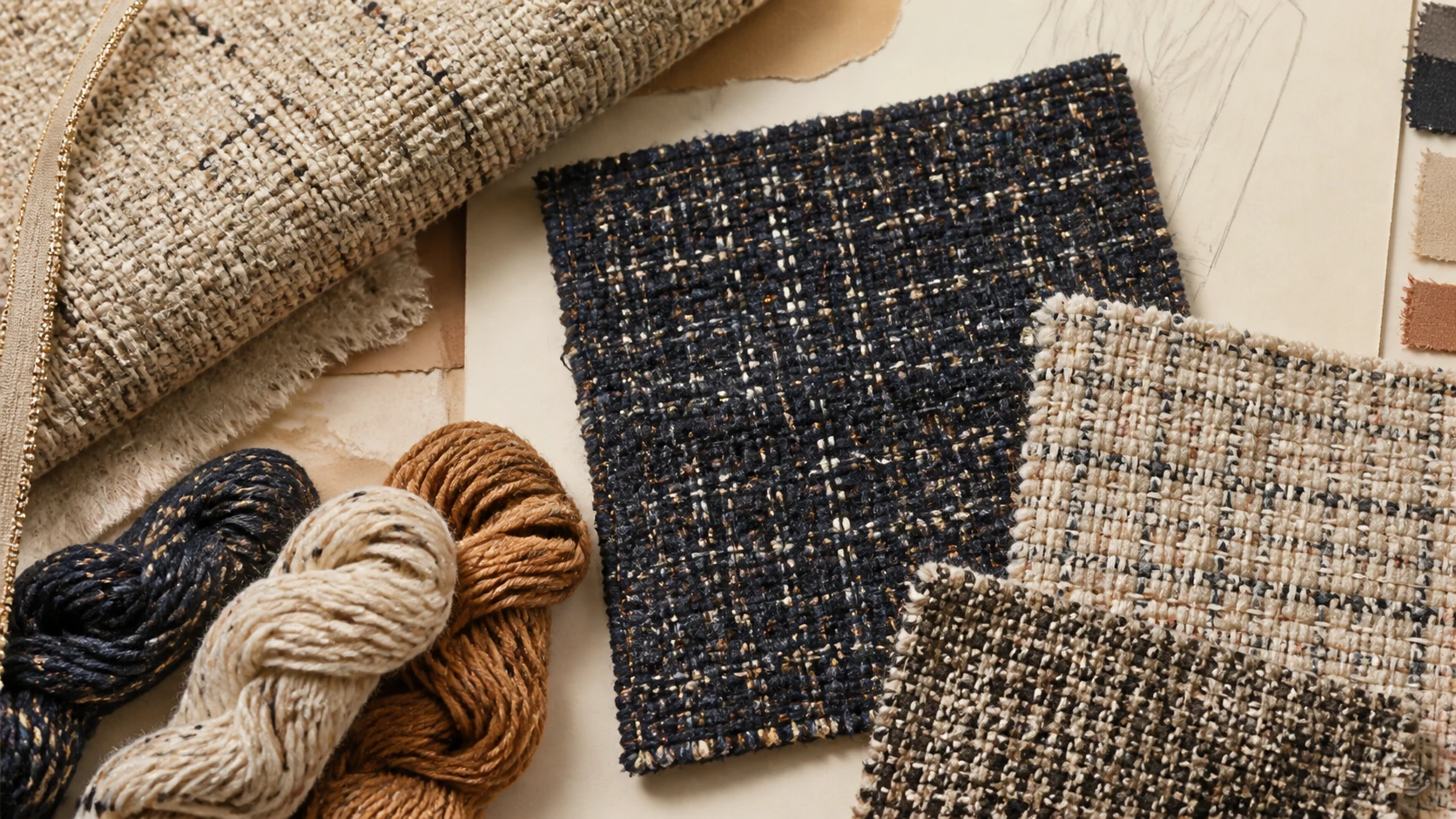
Tweed changes more than the surface of clothing: through weight, relief, optical colour mixing, and soft construction, it determines silhouette, movement, and the social reading of a garment.
Editorial thesis
Tweed is neither one material nor one pattern but a family of woollen and blended cloths whose behaviour is shaped by fibre, yarn, weave, density, finish, and the scale of colour mixing. At Chanel, tweed became more than suit fabric: soft construction, bodily movement, visual depth, fringe, braid, and contrasting lining operate as one code.10
Reader question
Why can one tweed appear dry, strict, and almost architectural while another feels soft, luminous, dimensional, and mobile?
Short answer
Tweed is commonly made from woollen or blended yarns and may use twill, plain, herringbone, or more complex combined weaves. Its character depends not only on weave structure but on yarn thickness, twist, nap, finish, colour blending, and surface irregularity.1
Harris Tweed is a legally protected designation: the cloth must be handwoven by islanders at their homes in the Outer Hebrides, finished there, and made from pure new wool dyed and spun in the islands.1
At Chanel, tweed became the basis of the soft suit after Gabrielle Chanel returned in 1954. The House dates the trimmed tweed suit to 1956; museum objects show how loose lightweight cloth, high-cut armholes, functional lining, and a chain at the hem produced freedom of movement and controlled hang.10
1. Tweed is a category, not a single cloth
The word tweed covers many fabrics that differ in fibre, weave, weight, density, and finish. It is inaccurate to describe all tweed as rough, heavy, or exclusively woollen: modern fashion includes light, open, cotton, silk, synthetic, and novelty versions.
2. The origin of the name
One widely repeated account connects tweed with the Scots word tweel, a form of twill. The Harris Tweed Authority notes that the word may later have been associated by mistake with the River Tweed, a coincidence that entered common usage.7
3. Twill and diagonal structure
Twill creates diagonal ribs because interlacing points shift progressively across the cloth. The structure often offers greater pliability and crease recovery than a rigid plain-weave grid.
4. Plain-weave tweed
Not every tweed is a twill. Plain weave can appear highly dimensional when built from irregular, looped, or multicoloured yarns; here the visual complexity comes from the yarn rather than a diagonal structure.
5. Herringbone
Herringbone reverses the direction of the diagonal to create a V-shaped rhythm. From a distance it organises the surface; at close range it reveals the complexity of the interlacing.
6. Checks and overchecks
Tweed checks are built through colour in warp and weft. A large overcheck acts like a graphic grid across the body, while a small check blends optically into a composite tone.
7. Fibre
Wool is valued for resilience, warmth, trapped air, and shape recovery. Yet final behaviour also depends on breed, staple length, spinning, blending, and finish, so the word wool alone says little about quality.
8. Pure new wool
Harris Tweed is legally required to use pure virgin wool and to be dyed and spun in the islands.1 This is a specification of a protected origin, not a universal rule for all tweed.
9. Blended compositions
Cotton, silk, viscose, polyamide, metallic yarn, and other fibres alter weight, sheen, stability, and touch. A blended tweed may be lighter, cooler, or more decorative than a traditional wool cloth.
10. Yarn and twist
Highly twisted yarn creates a clearer, drier surface. Low-twist or novelty yarn adds softness, volume, and visible irregularity but may snag or fray more easily.
11. Mélange
Mélange is produced by blending differently coloured fibres before spinning. The Harris Tweed Authority describes recipes in which several tones combine within one yarn, producing colour associated with the island landscape.7
12. Bouclé
Bouclé yarn forms loops and projections. Light strikes them unevenly, giving the surface greater depth and making colour appear less flat.
13. Novelty yarn
Ribbon, knots, chenille, metallic strands, and changing thickness create couture tweed. Such cloth may already resemble embroidery and requires particularly careful cutting.
14. Density and openness
A dense tweed holds shape and usually withstands wear more effectively. An open tweed moves more freely and allows light between the yarns, but frays more readily and often needs stabilisation.
15. Weight
Heavy tweed forms coats and structured jackets; light tweed suits softer tailoring, dresses, or summer garments. Weight affects not only warmth but the amplitude of movement.
16. Finishing
Fulling, washing, cropping, pressing, and raising change density, softness, and light reflection. Harris Tweed must be finished in the Outer Hebrides under its legal definition.1
17. Light and texture
A smooth cloth reflects light relatively evenly. Tweed breaks it across multiple yarns, loops, and colour points, allowing even a matte surface to appear visually rich.
18. Colour at distance and close range
From a distance, multicoloured yarns merge into a general tone. Close up, the eye separates fibres and contrasts. Tweed therefore changes with viewing distance.
19. Tactility
Tweed communicates quality before fitting: dryness, softness, loft, weight, and relief create expectations of warmth, protection, or luxury. Tactility is part of the design language.
20. Tweed and menswear
Historically, tweed is connected with outdoor clothing, hunting, rural life, and British sporting culture. That history gave it codes of practicality, status, and informal aristocracy.
21. Gabrielle Chanel and the appropriation of menswear
Chanel reworked fabrics and details from menswear as tools for women’s freedom of movement. In her system, tweed ceased to be only rural or sporting cloth and became material for an urban uniform.
22. The 1954 return
After the House returned to couture in 1954, the suit became central to the renewed Chanel system. The official House history dates the trimmed tweed suit to 1956.10
23. The soft jacket
The classic Chanel jacket is less rigid than a conventional tailored jacket. The Met describes it as soft and untailored and notes the frequent use of light, loosely woven tweed.10
24. High-cut armholes and movement
A high-cut armhole allows the arm to move without lifting the entire jacket. Combined with soft cloth, it produces a more natural relationship between garment and body.1
25. Lining
Lining stabilises open tweed, reduces friction, and helps the jacket slide over a blouse. At Chanel, the blouse often matched the lining, making internal construction part of the visual system.10
26. The chain at the hem
In the later jacket, ordinary dress weights were replaced by a gold-toned chain at the hem. It helps soft cloth hang evenly and return to position after movement.1
27. Braid and edge control
Braid outlines pockets, fronts, cuffs, and hem while organising the open surface and reinforcing the edge. It functions as both graphic contour and construction.
28. Fringe
Fringe may be created by controlled unravelling or added separately. It exposes the structure of the cloth and turns incompletion into a decorative code.
29. Pockets and buttons
Patch pockets support horizontal rhythm and maintain function. Metal buttons introduce shine and connect the soft textile with the House’s jewellery language.
30. The suit as a module
Jacket, skirt, blouse, chain, shoes, and bag form a modular uniform. The Met relates this principle to simple garments that can be altered by accessories while remaining appropriate.1
31. Karl Lagerfeld and the expansion of the code
After 1983, Karl Lagerfeld repeatedly reworked the tweed suit through new technologies, materials, proportions, and subcultural references.1
32. Tweed beyond wool
Contemporary Chanel uses cotton tweed and other blends. The official 2026 collection continues to present tweed and cotton tweed as central to a wardrobe designed for movement.10
33. Tweed as a ground for embroidery
An open grid and complex colour make it possible to add sequins, beads, ribbons, feathers, and supplemental yarns. In couture, the boundary between cloth and embroidery becomes unstable.
34. Cutting
Before cutting, the designer must identify repeat, directional pattern, face, and stretch. Misalignment across seams can destroy the visual rhythm.
35. Stabilisation
Open tweed is often supported with lining, organza, fusible materials, or hand methods. Stabilisation changes drape, so it should never be chosen without testing.
36. Fraying
An open weave can unravel rapidly at the cut edge. Seam allowances, binding, hand finishing, and assembly order must account for yarn loss.
37. Pattern matching
Checks, stripes, and colour blocks should move deliberately across fronts, pockets, and sleeves. Precise matching requires additional fabric.
38. Pressing
Heavy pressure can flatten bouclé and remove depth. Tweed generally requires a press cloth, a soft surface, and temperature testing.
39. Care
Wool and blended tweeds react differently to water, steam, and cleaning. Care depends on exact fibre content, finish, lining, and embellishment rather than the material name alone.
40. Authenticity and marketing
Not every rough cloth is Harris Tweed, and not every tweed is connected with Chanel. The Orb is a Harris Tweed Authority certification mark, while Chanel is a separate historical code of construction and brand identity.7
41. Environmental context
Wool’s durability and repairability can support long use, but environmental assessment must include fibre origin, dyeing, finishing, transport, and blended composition.
42. What the designer should analyse
Five levels matter: fibre, yarn, weave, finish, and garment construction. The same pattern made with different yarn or density produces a different form.
43. What the photographer should analyse
Tweed benefits from side or directional light when relief must be visible. Soft frontal light calms the surface but may conceal yarn complexity.
44. What the art director should analyse
In close-up, tweed becomes an abstract landscape; in a full figure, it functions as a code of status and silhouette. Image scale must follow the editorial purpose.
45. Conclusion
Tweed shapes form through weight and pliability, light through relief, colour through optical yarn mixing, and perception through cultural memory. At Chanel, it became both a structural and symbolic code because cloth, jacket, trim, and bodily movement were designed as one system.