encyclopedia
Virtual production
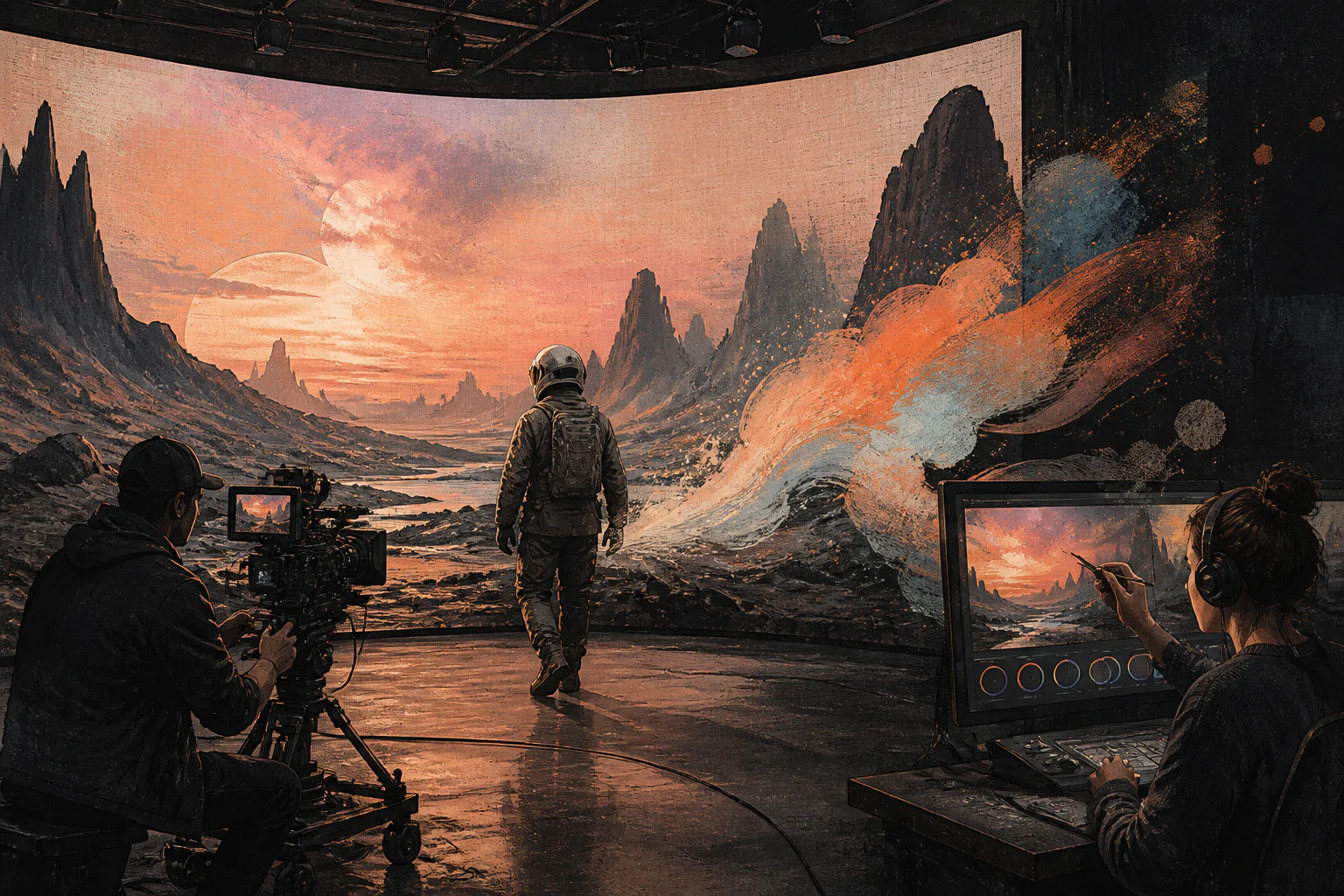
The background is computed on an LED wall during the shoot, and post-production moves onto the set.
Editorial thesis
Virtual production matters as an organisational change: it returns decisions about background, light, and composition to the moment of shooting, while actor and camera are still present.
Reader question
What changes when a background exists physically on set rather than being added months later?
Short answer
The actor sees the environment, the camera receives genuine reflections and light, and decisions stop being deferred to a stage where changing them is expensive.
1. Definition and boundaries
Virtual production combines shooting with real-time image computation. In the narrow sense it is filming against an LED wall displaying a three-dimensional scene that accounts for camera position.
2. Predecessors: rear projection
The method inherits from rear projection, where a pre-filmed background was projected onto a screen behind the actor. The task was the same, and so was the limitation: the background did not respond to camera movement.
3. The green screen and its cost
Chroma key moved work into post-production and gave flexibility at the price of two problems: green spill on the actor and the absence of any real environment for them.
4. Parallax as the decisive condition
The key difference of the contemporary technology is tracking camera position and recomputing background perspective accordingly. Without it the wall stays a flat picture and reveals itself at the first movement.
5. Inner and outer frustum
Only the area falling within the frame is computed with correct perspective; the remaining surface works as a light source. This division saves computation and is the basis of the method.
6. Light as the principal advantage
The wall illuminates the subject with the scene’s content, producing physically correct highlights and colour bounce. It is the only way to obtain environmental reflection on metal and in eyes without later painting.
7. Reflective surfaces
A car, glass, water, and a garment with sheen are the cases where the method gains most. In a green-screen stage such surfaces require complete replacement in post.
8. The actor’s work
A visible environment changes performance: the gaze is directed at an existing object rather than at a tennis ball. This is a professional argument, often weightier than the visual one.
9. Depth limitation
The wall is at a fixed distance, so a wide lens and near focus expose its flatness. The range of usable optics is limited, and this is accounted for in staging.
10. Moiré and refresh rate
Filming one pixel grid with another produces interference. The solution requires reconciling panel pitch, camera resolution, shutter, and refresh rate — a purely engineering adjustment.
11. Panel colour gamut
LED panels do not reproduce the full colour range, and calibration to a specific camera is mandatory. Without it the background acquires a systematic shift, visible in grading.
12. Preparing the scene in advance
The method moves the main work into pre-production: the environment must be built before shooting. This does not reduce the work but relocates it in the calendar.
13. Cost and its structure
Renting a volume and preparing scenes are expensive, but saving arises in logistics: no need to move a crew to location or wait for weather. The benefit depends on the number of locations rather than on shooting duration.
14. Weather and time of day as a parameter
A sunset can last an entire shooting day. Controlling time of day turns the principal natural constraint of filming into an adjustable quantity.
15. Location scanning
Real locations are brought into the scene by photogrammetry or laser scanning. Background credibility is frequently secured by capturing a real place rather than by modelling.
16. The production designer’s role
Set and digital environment are designed as one, with a precise join between physical and virtual. The boundary between built and computed becomes a design problem.
17. A new role on set
A virtual scene operator has appeared, managing the environment during the shoot. It is a post at the intersection of lighting artist, engineer, and three-dimensional specialist.
18. Application in advertising
Short schedules and the need for several locations make the method especially advantageous for commercials. Changing an environment takes minutes instead of a move.
19. Application in fashion
Photographing clothing against a computed environment gives control of light and background colour while keeping real material in frame. The fabric stays genuine, which matters.
20. Scene scale limits
Large crowd scenes and distant shots remain cheaper on location or in post. The method wins on medium shots with reflective subjects.
21. Planning failure as the main risk
If the scene is not ready when shooting starts, the advantage vanishes and the stage stands idle. The method demands stricter pre-production discipline than the traditional one.
22. Combination with post-production
In practice the background is often finished after the shoot, with the wall serving as light source and reference. Pure cases are rare, and this is a normal production compromise.
23. What is usually misunderstood
The error is to treat the method as a replacement for post-production. It redistributes work in time and changes its character, but the total volume of labour rarely falls.
24. Counterargument
The objection is practical: the cost of volume and preparation is high, and flexibility is lower than with a green screen, where a background can be wholly replaced after the shoot.
25. Where the counterargument holds
It holds for projects with an unsettled script and frequent changes. If a background will be redone, paying for it twice is pointless.
26. Where it fails
It fails where genuine reflections and real actor interaction with an environment are required. These qualities cannot be added later without substantial cost.
27. Link to game technology
The method became possible thanks to real-time engines developed for games. It is a clear case of technology transfer between industries.
28. Impact on budget structure
Costs shift from post-production into pre-production and stage rental. This changes the shape of a budget and requires different risk management.
29. Current state
The method has become a standard instrument but is applied selectively — where reflections and light are decisive. It has not become a universal replacement for earlier methods.
30. How to read the subject today
Look at reflections and at the actor’s eyes. That is where it shows whether an environment was physically present on set or added afterwards.