art director profile
Alexander Liberman
The eye, the magazine and editorial power
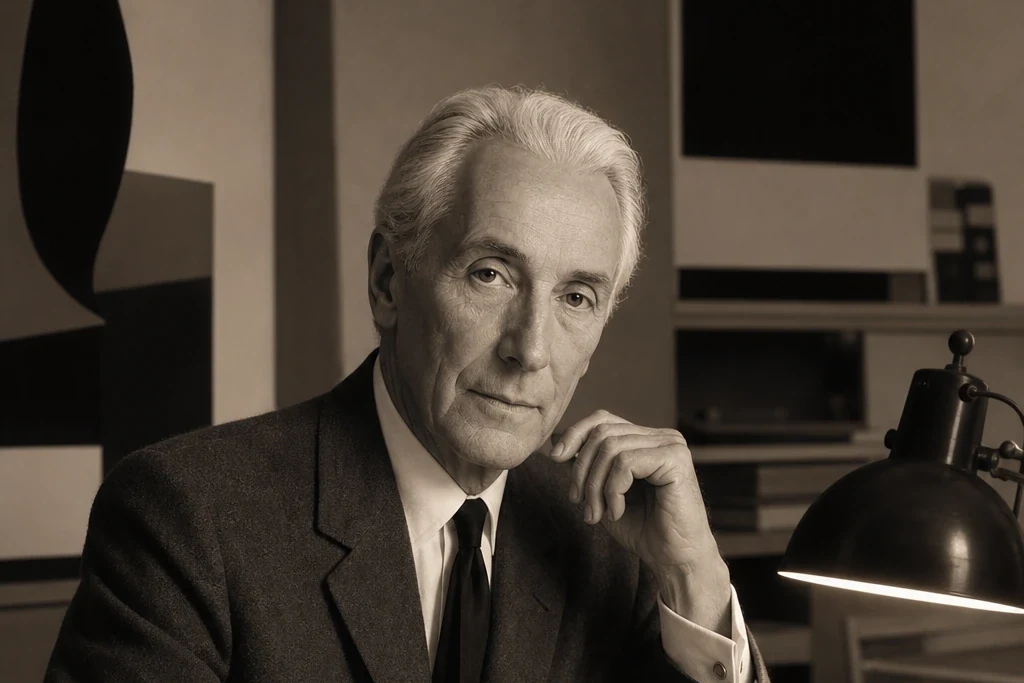
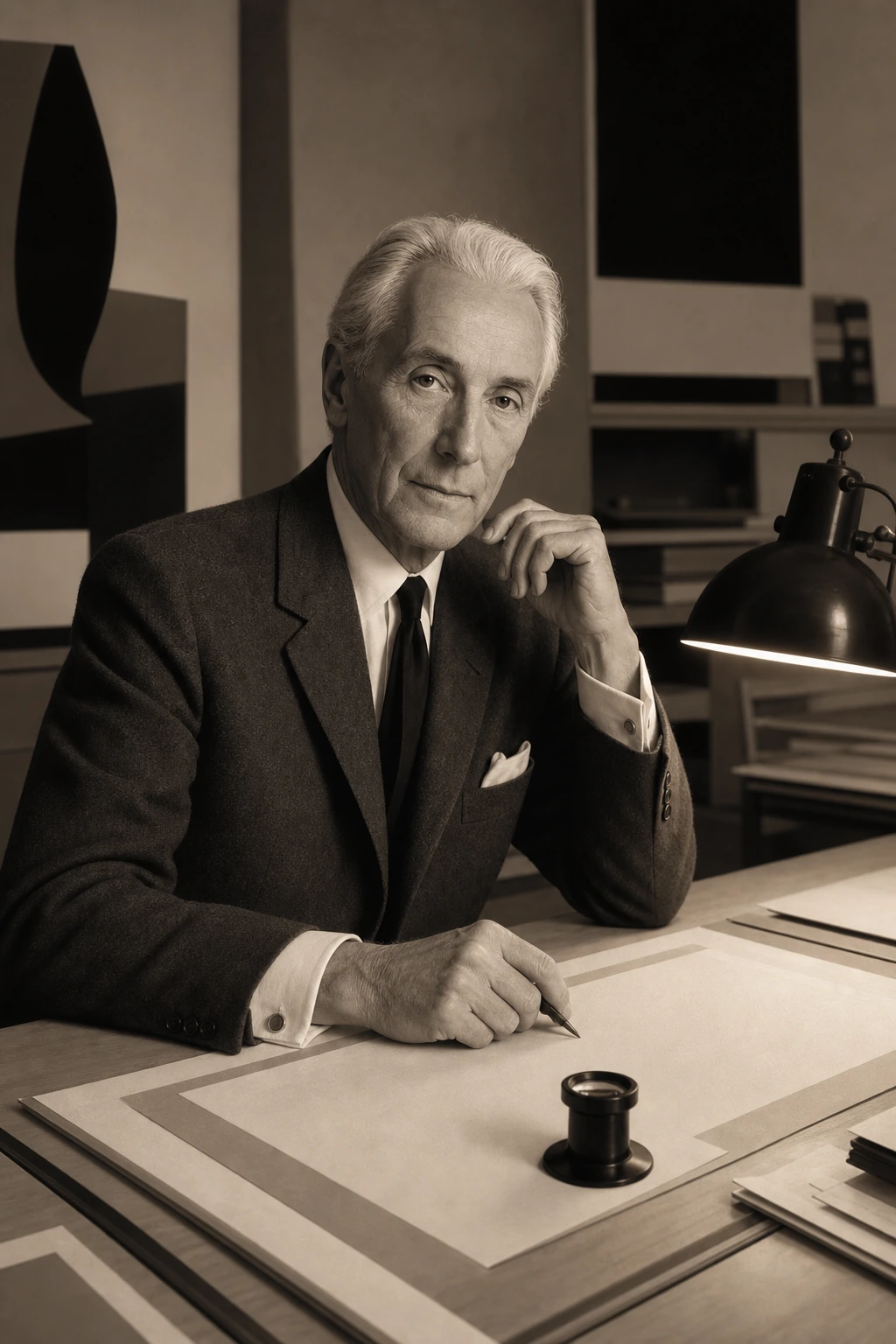
Liberman turned art direction into a system of power and discovery: he built Vogue, identified photographers, shaped Condé Nast visual standards and carried the logic of layout into his own painting, photography and monumental sculpture.
Editorial thesis
Alexander Liberman matters because he expanded the art director into the cultural editor of a system. His influence reached beyond layout into commissioning, photographic careers, magazine portfolios, museum culture and his own artistic practice. His legacy therefore has to be read both as a history of visual standards and a history of concentrated editorial power. [source]
Reader question
How could one person influence Vogue, Irving Penn, William Klein, Vanity Fair, Condé Nast and monumental sculpture across decades — and what does that reveal about the real role of a creative director?
Short answer
Liberman did not work as the stylist of a single page but as an editor of relationships. He selected people, created conditions for them, connected different visual languages and maintained a common standard. His strength was talent scouting and systems; the difficult side was the enormous power to decide whom that system would see at all. [source]
1. Kyiv, 1912: a biography between revolution and culture
Alexander Liberman was born in Kyiv in 1912. The Smithsonian and the Alexander Liberman Estate describe a family environment closely connected with politics, theatre and the cultural institutions of the early Soviet period. [source]
The biography matters less as a romance of innate taste than as an early experience of changing systems. Revolution, emigration and movement among countries made visual culture international and unstable from the beginning.
2. London and Paris: education before the editorial profession
After leaving the Soviet Union, Liberman was educated in England and then France; the Smithsonian notes London and the École des Beaux-Arts, while the Estate also records studies in Paris and at the Sorbonne. [source]
His education never resolves into a single profession. Philosophy, mathematics, architecture, drawing and European art culture formed someone who would later move easily between the magazine page, photography, painting and monumental sculpture.
3. VU, 1932: the illustrated magazine as a first laboratory
In 1932 Liberman began working at the Paris illustrated magazine VU. The Smithsonian identifies VU as the start of his journalistic career and notes his contact with Cartier-Bresson, Brassaï, Capa and Kertész. [source]
This was a crucial school. VU treated photography not as an illustration to copy but as a carrier of news in its own right. Liberman learned early that visual material needed independent informational and emotional force.
4. Collage, cover and the speed of news
At VU Liberman worked with covers, layout and photomontage. Vogue later remembered his Parisian collage-like covers as an early sign that he understood editorial imagery not as one photograph but as a construction. [source]
Photomontage is especially useful for understanding his method. An art director may not make the source photographs, yet can alter their meaning through scale, adjacency, cropping and rhythm. Authorship already sits between images.
5. 1941: escape from Europe and a new life in New York
After the German occupation of France, Liberman and Tatiana Yacovleff du Plessix left Europe and reached New York in 1941. The Smithsonian and the Estate date this transition to that year. [source]
The move was not an ordinary career migration. He rebuilt a professional identity inside a different industry and language. The ability to read a new cultural system quickly later became part of his power within Condé Nast.
6. Vogue: first as an assistant in the art department
Condé Nast hired Liberman into Vogue's art department in 1941. The Smithsonian specifies that he initially worked as an assistant to the art director. [source]
The sequence matters: the person who would later become one of publishing's most powerful figures started inside production. He saw printing constraints, deadlines, captions, layouts and negotiation, not only high-level concept.
7. 1943: art director of American Vogue
In 1943 Liberman became art director of American Vogue. The Smithsonian archive gives the date clearly. [source]
His role now moved from execution to selection. An art director determines not merely where a photograph sits, but which photographers a magazine needs, what assignments they receive, how much risk is acceptable and what visual language matches editorial ambition.
8. The page as an event rather than a neutral frame
Vogue's archive shows Liberman treating the spread as a visual event: images could split, repeat, collide or change scale abruptly. [source]
The page stops being a passive frame and becomes a stage on which photography gains movement after the shoot. Liberman continues a European modernist tradition while translating it into an American mass fashion magazine.
9. Scale, repetition and unexpected proportion
Vogue specifically notes Liberman's fascination with proportion — the interplay of large and small images, perspective and repetition. [source]
Hierarchy is created before a word is read. Large does not simply mean important, nor small secondary; their relationship establishes tempo and meaning. Contemporary digital art direction uses the same principle in feeds, carousels, landing pages and motion sequences.
10. The cover as an editorial thesis
For Liberman the cover was not packaging but a concentrated editorial thesis. His early VU work and Vogue practice show a consistent attraction to one strong visual proposition. [source]
A successful cover does more than look good. It promises the kind of magazine that follows: its level of risk, cultural range and definition of modernity.
11. Commissioning photography: art direction begins before the shoot
One of Liberman's central contributions was to understand art direction as commissioning. Strong photography begins before layout — with the choice of author, brief, subject, editor and degree of freedom. [source]
This is a fundamental distinction between an art director and a layout designer. The former shapes the conditions in which images appear; the latter may work primarily with material already produced. In practice the roles overlap, but commissioning changes the scale of responsibility.
12. Irving Penn, 1943: talent discovered before the profession was fixed
In 1943 Liberman hired Irving Penn as an associate to prepare layouts and cover ideas. The Irving Penn Foundation confirms the story, while Vogue documents how Liberman later pushed Penn toward fashion photography. [source]
The important choice was a person without a fixed identity as a fashion photographer. Liberman recognised graphic intelligence and the ability to create a powerful visual stop. This is talent scouting as the search for a new way of seeing rather than a repeatable genre skill.
13. 'Stoppers': the image that interrupts page-turning
Liberman called Penn's strongest photographs 'stoppers' — images that interrupt the habitual act of page-turning. Vogue preserved the term as part of its editorial vocabulary. [source]
The concept remains useful in an endless-scroll environment. A stopper is not necessarily a loud shock image; Penn could stop attention through silence and precision. What matters is breaking automatic viewing.
14. William Klein, 1954: inviting an author with no fashion experience
In 1954 Liberman invited William Klein to Vogue after seeing his experimental abstract photographs, despite Klein having no fashion experience. ICP emphasises that Liberman recognised an exceptionally strong vision and capacity for visual problem-solving. [source]
The choice reveals a core function of a strong creative director: identify an author not because the portfolio already matches the brief, but because the author may expand the language of the publication itself.
15. Vogue as a system of different photographic languages
Vogue under Liberman did not depend on one photographic style. Penn, Klein and other authors could be visually opposed and still belong inside one magazine. [source]
That is the difference between editorial identity and a rigid preset. Identity is built through selection, rhythm, cultural ambition and standards rather than identical pictures. Different voices can strengthen a system when the editor knows how to connect them.
16. Portraits of artists: the camera inside the art world
Liberman himself photographed artists in their studios. The Smithsonian lists Braque, Calder, Giacometti, Matisse, Picasso and others among his subjects, while The Met holds his portrait of Germaine Richier. [source]
His editorial eye therefore operated behind the camera too. These were not conventional celebrity portraits; they examined the relation between artist, workspace, materials and unfinished work.
17. The Artist in His Studio, 1960: the artist and the space of work
In 1960 Liberman published The Artist in His Studio, a book that grew from these encounters. The Smithsonian identifies it as one of his central photographic projects. [source]
The studio becomes a way to read the artist without direct psychological claim. Tables, walls, tools, the scale of canvases and working disorder communicate as much as the face. It is environmental editorial portraiture.
18. Picasso, Matisse, Braque, Giacometti: access as an editorial resource
Liberman's access to Picasso, Matisse, Braque, Giacometti and other major figures was simultaneously personal, professional and institutional. [source]
This introduces the harder question of editorial power. A cultural editor does not merely reflect an established canon; he helps produce it by deciding who receives pages, portraits, interviews and repeated visibility. Access itself becomes part of the manufacture of significance.
19. 1962: editorial director of Condé Nast
In 1962 Liberman was appointed editorial director of Condé Nast Publications and remained in the role until 1994. The Smithsonian confirms this thirty-two-year period of senior leadership. [source]
The scale of responsibility changed sharply. The problem was no longer the rhythm of one Vogue issue but the relationship among different magazines, editors and audiences inside a publishing house.
20. From one magazine to a portfolio of publications
As editorial director, Liberman influenced the Condé Nast portfolio rather than fashion pages alone. The Estate and the Smithsonian American Art Museum describe him as both publishing executive and artist across decades. [source]
The position resembles a contemporary chief creative officer more than a classical art director. Appointments, launches, photographic culture and visual standards could be shaped across multiple projects.
21. Editorial power: taste, resources and gatekeeping
Large editorial power always has two sides. Liberman could open careers for Penn or Klein, but the same system concentrated gatekeeping: who received budget, access, pages and institutional trust. [source]
His legacy should therefore not be reduced to infallible taste. Every canon reflects the social, commercial and cultural limits of its period. Contemporary creative direction must pair strong selection with a clearer understanding of who the system excludes.
22. Vanity Fair, 1983: relaunch as an institutional project
In the early 1980s Liberman participated in the relaunch of Vanity Fair within Condé Nast. Vanity Fair's own history of the revival describes him as a hands-on architect of the project alongside Si Newhouse. [source]
The relaunch shows institutional art direction: the task was not to draw a logo, but to define why the magazine existed, choose editors, assemble contributors and connect culture, celebrity, photography and commerce.
23. Painting: the circle as a repeatable system
Alongside publishing, Liberman maintained a serious painting practice. The Met and Whitney hold geometric works from the 1950s and 1960s built from circles, colour fields and repeated forms. [source]
The paintings are visually stricter and more abstract than his magazine work. They reveal another aspect of the same intelligence: a simple form is rearranged until scale and emptiness begin to generate their own tension.
24. Two Circles, 1950: geometry before sculptural fame
Two Circles, 1950 is in The Metropolitan Museum of Art. The museum notes that Liberman deliberately contrasted the repeatability of geometric forms with Abstract Expressionism's cult of the unique gesture. [source]
The idea is unexpectedly close to art direction. An editorial system also has to be repeatable and renewable: not one unique spread, but a principle capable of generating new solutions each time.
25. Sculpture: industrial form and public scale
Around 1950 Liberman began working seriously with sculpture, and in 1960 he held his first solo exhibition at Betty Parsons Gallery. The Estate and Smithsonian document this transition. [source]
Sculpture gave his geometry physical weight. Circle becomes cylinder, flat colour becomes painted steel, and composition becomes a space through which a viewer moves.
26. Adam, Adonai and Iliad: red steel as spatial architecture
Storm King holds the monumental works Adam, Adonai and Iliad. The centre describes them through industrial forms, architectural scale and brightly painted steel. [source]
They should not be treated as merely an editor's second career. The same visual logic returns: large element, pause, intersection, repetition and changing viewpoint. The landscape replaces the page.
27. Layout and sculpture: the same method of rearrangement
Storm King describes an unusual process for Adam: Liberman temporarily assembled elements with a crane, photographed them, cut up the print, rearranged the parts and drew over the composition with grease pencil — almost as if making a magazine layout. [source]
This is unusually direct evidence of the connection between editorial and sculpture. Layout was not a separate professional trick; it was a general thinking method: assemble, examine relationships, alter scale, rearrange and only then fix the structure.
28. Office and studio: two parallel careers
For decades Liberman maintained office and studio as parallel systems. The Smithsonian American Art Museum notes that he was wary of making art his only full-time occupation, fearing repetition and entrapment in one type of work. [source]
The position feels contemporary. Commercial practice does not automatically destroy authorial work; external constraints can prevent endless repetition of one successful formula. But keeping parallel careers also depends on discipline and resources that are not equally available to everyone.
29. 1994–1999: leaving Condé Nast, archive and late legacy
Liberman retired from Condé Nast in 1994 and died in Miami in 1999. His papers are held by the Smithsonian Archives of American Art; the Estate continues to represent his artistic legacy, while works remain in MoMA, The Met, Whitney, Storm King and other institutions. [source]
The archive is crucial because magazine layouts, correspondence, photographs, artworks and corporate material sit together. Only in combination do they show why Liberman cannot be contained by one profession.
30. The main legacy: the creative director as editor of talent and systems
Alexander Liberman's main legacy is not a specific Vogue grid or a red steel sculpture. It is a model of creative direction as the editing of talent and systems. [source]
He demonstrated that a strong visual leader needs to recognise an author before the market does, create conditions for risk, connect divergent aesthetics without averaging them out and maintain a shared standard. A contemporary version must add what his period often left unexamined: transparency of power, diversity of voices and the ethics of access.