designer profile
Philippe Starck
The designer as a public figure and media argument, selling an object together with their own name.

Editorial thesis
Starck matters as a case in which an author’s name became a production asset: a designer’s recognisability began selling an object as effectively as its quality.
Reader question
What happens to an object when its author’s name is better known than the object itself?
Short answer
The object begins doing two jobs at once: serving use and confirming its owner’s membership of the circle that knows the name.
1. Position
Starck works as a designer across an exceptionally wide range: from household object to interior, hotel, and vehicle. The absence of specialisation is part of his position.
2. Democratic design as declaration
He consistently frames the task as raising the quality of affordable objects. That rhetoric preceded mass collaborations and largely justified them.
3. The squeezer as an object of dispute
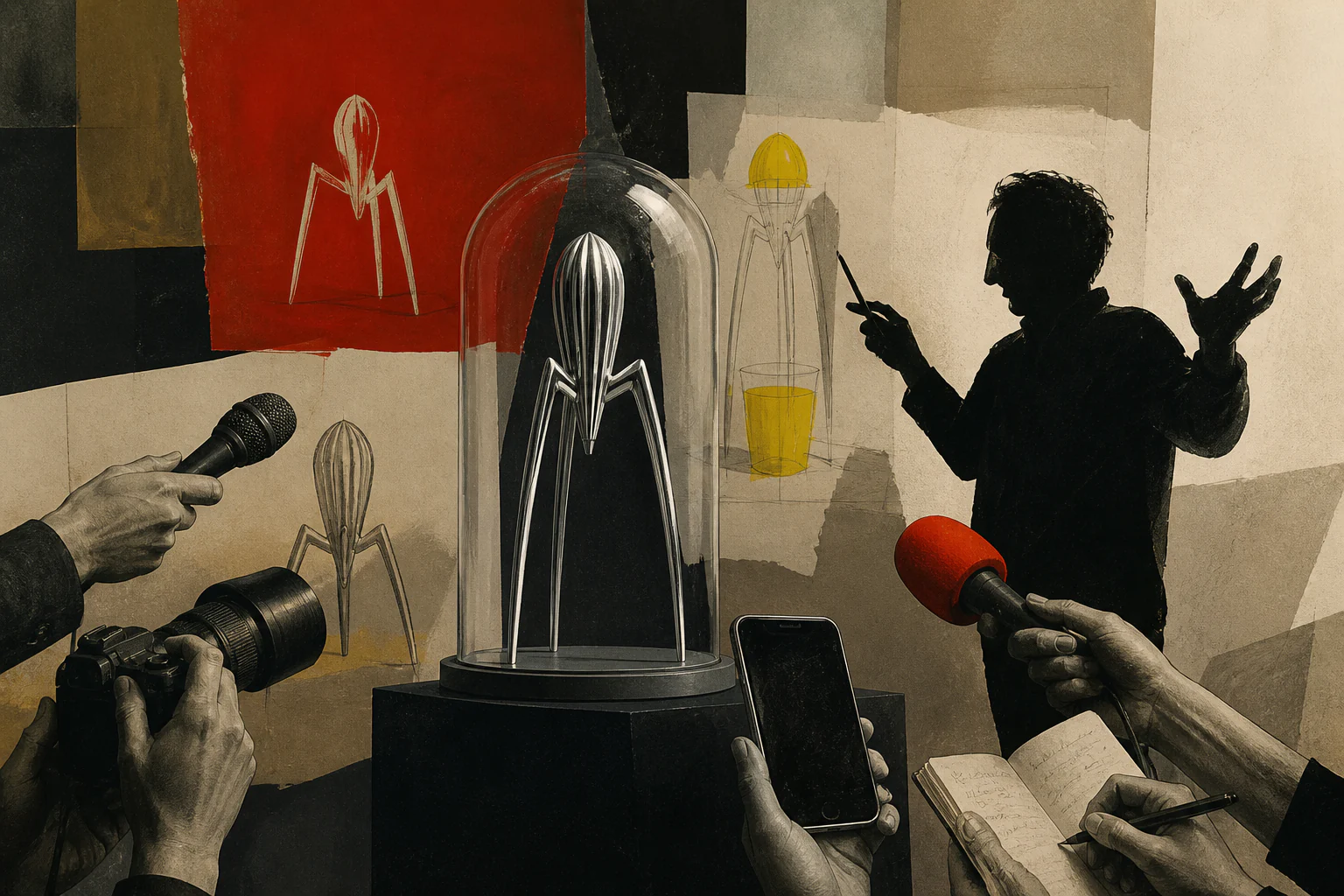
His most-discussed object is an aluminium citrus squeezer of the early 1990s whose form recalls an insect. It works worse than an ordinary one and sells better — and that is the substance of the case.
4. Function versus presence
The object is presented as something to look at rather than to use. The author spoke of it as a conversation starter, which honestly describes its actual function.
5. Transparent plastic
A chair of the early 2000s, moulded in transparent polycarbonate to the silhouette of a historical armchair, joined citation and technology. A form of the past executed in a material the past did not have.
6. Citation as device
Using a recognisable historical silhouette in a new material is a postmodern device. It allows modernity and familiarity to be sold at once.
7. The hotel as genre
A substantial part of his practice is hotel interiors, where the environment works as a set for a stay. Here his method fits: the task is precisely to produce an impression.
8. Mass collaborations
He worked with large manufacturers of inexpensive goods, carrying an authorial name into the mass segment. This is an early and influential model, later repeated by many.
9. The name as asset
The presence of a recognisable name raises price and press attention independently of a product’s properties. He used this mechanism earlier and more consistently than most colleagues.
10. The public figure
He deliberately built a media presence: interviews, television, provocative formulations. The designer became a character, and this changed the profession as much as his objects did.
11. Speed and volume
His catalogue is unusually large, implying studio work and delegation. Volume is part of the model: the name must be present in many categories at once.
12. Attitude to ecology
In a later period he publicly shifted toward a discourse of responsibility and materials. Assessing that shift is complicated by the same thing as everything else: declaration outruns verifiable indicators.
13. What transfers
The model transfers: the author as a media figure available to a mass manufacturer. It became an industry norm and is reproduced across every segment.
14. What does not transfer
The name effect itself does not transfer. It works for someone already known and is therefore not a strategy available to most.
15. Substantive critique
The principal objection is technical: some objects subordinate use to image. A squeezer that is awkward to wash and a chair that is uncomfortable do not perform their stated function.
16. A second objection
The rhetoric of accessibility sits badly with the price of much of the range. The democratic promise is kept in individual collaborations and not in the main catalogue.
17. The case for the defence
In his favour, he widened the audience for design. People with no interest in objects learned that a thing has an author — and that is a result in itself.
18. Historical position
He is a transitional figure between the mid-century designer-engineer and the contemporary designer-brand. His case is usefully read as the boundary between two models of the profession.
19. Link to the knowledge base
The material connects to the entries on postmodernism, citation, the store as media, and objects of Italian manufacture.
20. How to read this today
Separate two questions: does the object work, and does the statement work. Conflating these assessments makes discussion of him fruitless in both directions.