designer profile
Verner Panton
Colour and synthetic material as the load-bearing structure of an entire environment rather than an object’s finish.
Editorial thesis
Panton matters for designing not objects but inhabitable environments in which floor, wall, furniture, and light form one continuous surface.
Reader question
What happens to furniture when the boundary between it and the room disappears?
Short answer
It stops being a set of objects and becomes a relief: one can sit anywhere, and postures are set by surface form rather than by an object’s purpose.
1. Position
Panton worked in Denmark in the second half of the twentieth century and consistently diverged from the local tradition of wood and restraint. His materials were plastic, synthetic textile, and saturated colour.
2. A break with the Danish school
The Scandinavian tradition rested on wood, craft, and a muted palette. His choice of synthetics was positional rather than technical: he refused a national language in favour of an international one.
3. The single form as a task
The principal technical ambition was a chair made from one material as one element, without joints. The problem was formulated over years and solved together with a manufacturer.
4. A cantilever without back legs
The form relies on a cantilever principle: the seat projects forward of its support. This loads the material in bending and makes the choice of polymer a question of strength rather than appearance.
5. A long path to production
The model was reworked as suitable polymers appeared: early versions failed under load and ageing. The object’s history is a history of material rather than of form.
6. Stacking
The single-element construction allowed chairs to nest. The logistical advantage here follows directly from the formal decision.
7. Exhibition environments
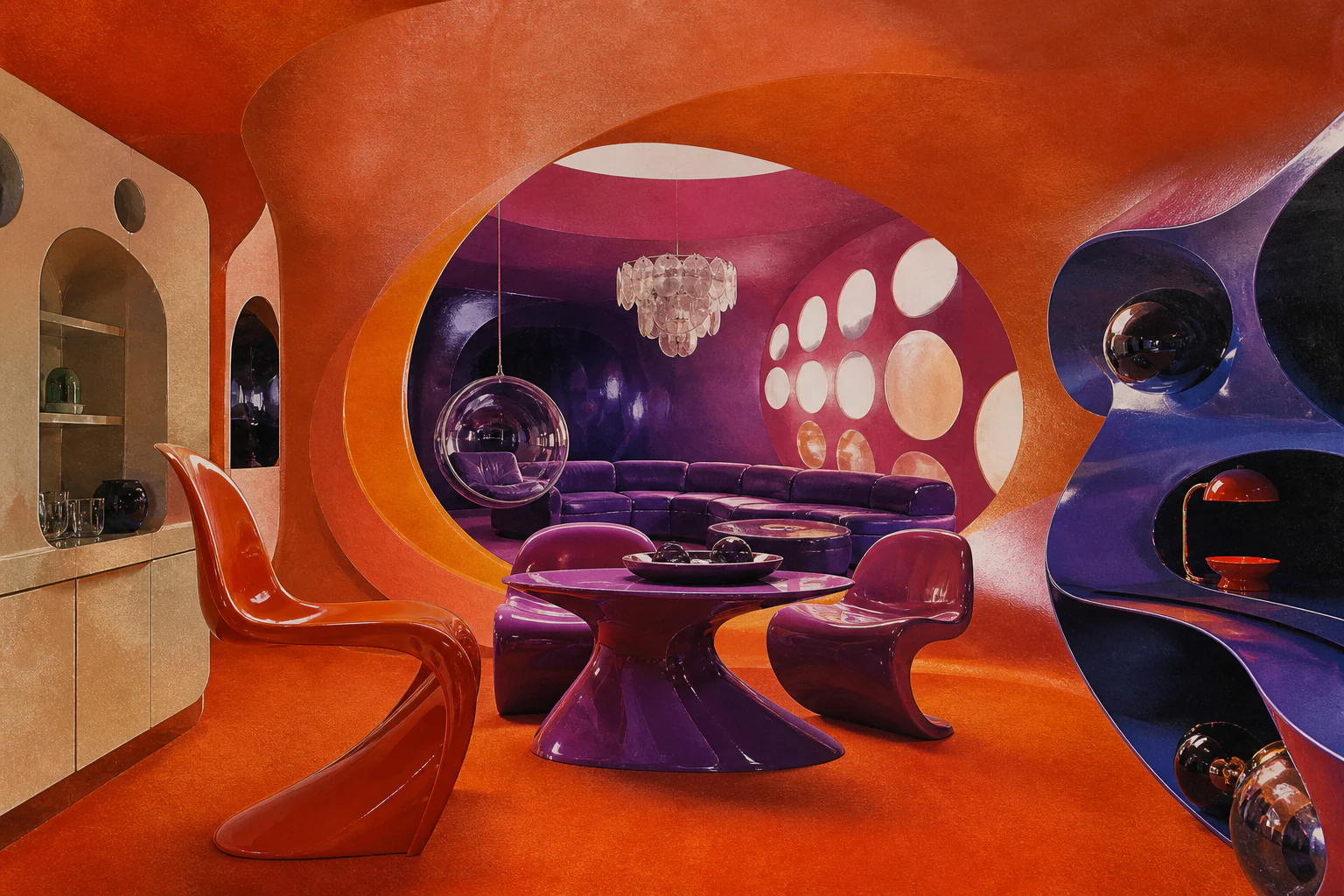
His most radical works are temporary domestic installations shown at trade fairs in the late 1960s, commissioned by a chemical company. They demonstrated the possibilities of synthetic materials.
8. The client as condition
Funding by a chemicals producer explains both the radicalism and the material. The environment was an advertisement for polymer capability, which does not diminish its significance but explains its appearance.
9. Landscape instead of furniture
Inside these environments furniture is dissolved into relief: niches, rises, and hollows replace chairs and sofas. The body chooses its own posture, unprescribed by an object.
10. Colour as system
He worked not with individual colours but with series of adjacent shades passing into one another. The palette was built as a scale, closer to a typographic grid than to a painterly choice.
11. Colour as a constructional quantity
Colour in his environments performs spatial work: it deepens, brings forward, and divides volume. It is an instrument of planning rather than of finishing.
12. Light as part of the surface
Luminaires were designed as volumetric elements of the environment and frequently assembled from repeating components. The light source became a body rather than a point.
13. Textile with geometric pattern
His fabrics were built on modular geometry with gradated shades. The pattern is calculated to work across a large wall or floor surface rather than on a single object.
14. Attitude to the body
The environments assume lying, reclining, and sitting at varying heights. This expansion of permissible postures relative to a conventional interior was a social gesture as well as a formal one.
15. The fate of the environments
The installations were temporary and almost all dismantled. They are known through photographs, and this matters: their influence spread by image rather than by experience.
16. What transfers
The thesis of continuity transfers: floor, wall, and furniture can be designed as one surface. The device returns regularly in exhibition and retail architecture.
17. What does not transfer
Domestic viability does not transfer. The environments accept other possessions, books, and the accumulation of daily life poorly: they are complete and not designed for addition.
18. Critique
A justified objection: a total environment leaves no room for its inhabitant. A project determining everything, including posture and colour, is closer to scenography than to housing.
19. Link to the knowledge base
The material connects to the entries on moulded plastic, pop art, colour as instrument, and the individual chair as a collection object.
20. How to read this today
Read his work as material research rather than as 1960s style. The question he posed — whether a load-bearing structure can be made from a single polymer — remains a technical one.