designer profile
Gaetano Pesce
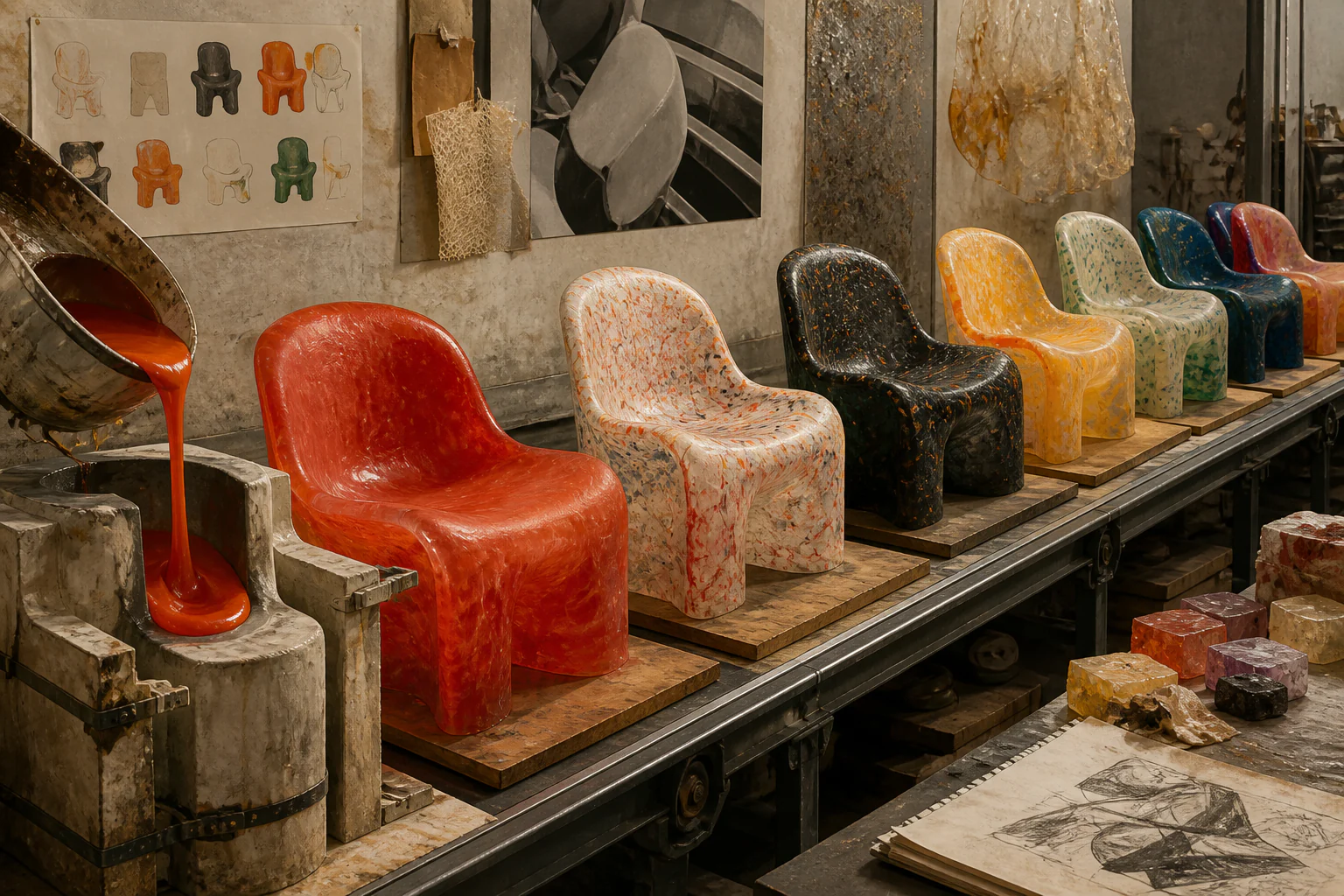
Industrial production tuned so that every example in a series differs from the next.
Editorial thesis
Pesce matters as an author who contested industry’s central promise — sameness: he built processes in which deviation is the result rather than a defect.
Reader question
Can serial production yield non-identical objects?
Short answer
It can, if a variable is deliberately introduced into the process: hand pouring, incomplete control of mixing, permitted deformation. Difference is then produced systematically.
1. Position
Pesce worked as a designer and architect and held a consistently anti-functionalist position. For him an object is a statement, political among other things, rather than the solution to a utilitarian problem.
2. Against sameness
The central objection of his practice is addressed to the modernist ideal of repeatability. He regarded identical products as an impoverishment rather than an achievement.
3. The diversified series
He formulated the notion of a series within which examples differ. This requires not abandoning production but retuning it: a variable is introduced deliberately and under control.
4. Resin as material of choice
Polyurethane and epoxy resin permit hand pouring with unpredictable colour mixing. The material was chosen precisely because it resists complete control.
5. A chair delivered compressed
His best-known work of the late 1960s is a polyurethane foam chair supplied in vacuum packaging. On opening it expanded to full volume in front of the buyer.
6. Unpacking as event
The object’s expansion turned delivery into a performance. It is a rare case of a logistical decision becoming a substantive part of a work.
7. The figure and its reading
The form of this chair with its attached sphere reads as a female figure with a ball and chain. The author spoke of it as a statement about the condition of women, and the object was programmatic from the outset.
8. The contested statement
Reading the object as a political statement has been disputed: critics noted that the metaphor reproduces what it criticises. That argument remains open and is part of the material.
9. Softness as construction
A significant part of his objects has no rigid frame: form is held by the foam itself. This moves structural work into chemistry rather than geometry.
10. The felt chair
In the 1980s he produced a chair of dense felt, resin-impregnated in its lower part and left soft above. One material performs two incompatible functions through a gradient of impregnation.
11. Imperfection as statement
Runs, uneven edges, and pouring marks are not removed. Preserving them asserts the value of the trace of a hand inside an industrial process.
12. Colour as chance
Mixing tinted resins produces an unpredictable pattern. The author sets a range while the specific result is determined by the process — governing probability rather than form.
13. Attitude to architecture
His architectural projects continue the same line: facades with irregular rhythm, vegetation as part of the envelope, refusal of the repeating module.
14. Production complexity
The manual component limits run size and raises cost. The method scales poorly, and this is not a side effect but a direct consequence of its central principle.
15. The Italian context
The practice sits within an Italian tradition in which industrial firms funded radical criticism of their own model. Without that context the work would not have appeared.
16. What transfers
The question itself transfers: where in a production process can a controlled variable be permitted. This is a constructive framing applicable well beyond furniture.
17. What does not transfer
The economics do not transfer. The model requires manual labour and a high price, and the promise of accessibility present in the rhetoric was not kept in practice.
18. Critique
A justified objection: the uniqueness of every example complicates repair, replacement, and valuation. What gains as statement loses as an object of long use.
19. Link to the knowledge base
The material connects to the entries on radical design, composites, moulded plastic, and individual objects of the Italian line.
20. How to read this today
Compare two examples of one model. The difference between them is the work; a photograph of one example conveys less than half of it.