fashion editor profile
Edward Enninful
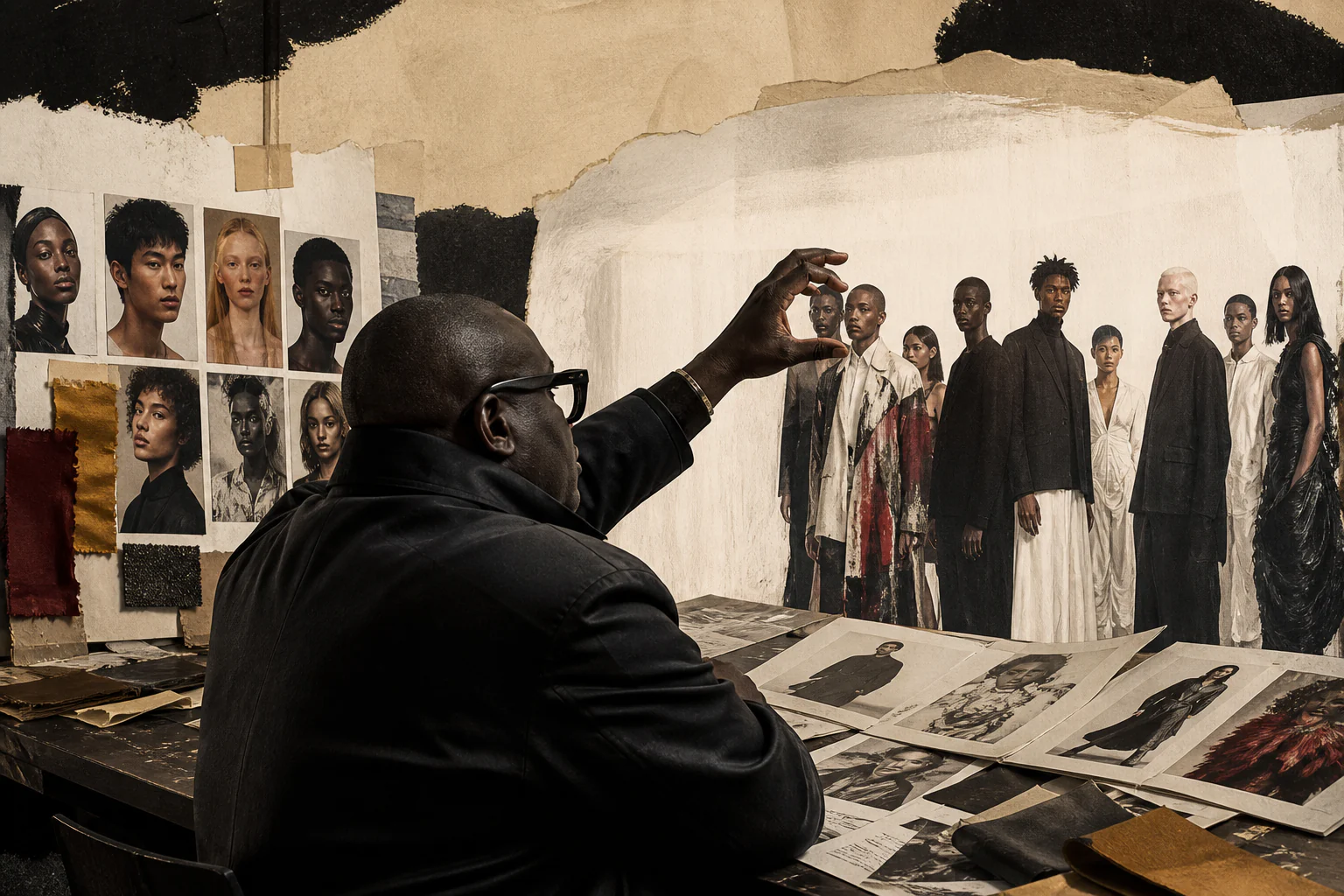
Casting as the principal editorial instrument: who is in frame determines what a publication is about.

Editorial thesis
Enninful matters for moving the question of representation from declaration into editorial procedure: what changed was not the text about diversity but the list of who gets photographed.
Reader question
How does an editorial team change a notion of the norm without publishing a single text about it?
Short answer
Through casting and repetition: a face appearing on the cover for several seasons ceases to be an exception and becomes part of the expected.
1. Position
Enninful works as an editor and stylist and led the British edition of a major fashion magazine. His practice began in styling, and this shaped his editorial method.
2. An early start
He took an editorial post at an independent title at a very young age. The British independent milieu allowed this, and his case is representative of how it worked.
3. Casting as editorial decision
Central to his method is understanding that choosing the person in frame is a statement. That decision is taken before the shoot and determines its meaning entirely.
4. Repetition instead of gesture
What distinguishes his approach from a one-off themed issue is its systematic character. Change is achieved not by a single issue but by a sequence in which a new cast becomes ordinary.
5. Why this works differently
A single issue names a problem and ends. A sustained change of casting alters reader expectation and advertiser requirement — that is, it acts on the system.
6. Working with a team
He consistently appointed to editorial posts people previously unrepresented in them. A change in the composition of an editorial team precedes a change in content.
7. The cover as instrument
The cover is the most visible and most commercially sensitive position. Using it to widen the cast is the riskiest and most effective move.
8. The group cover
Placing several figures on a cover presents a cast as an assertion rather than an exception. The format itself carries meaning.
9. Expanding the notion of the model
His issues included people outside the industry: activists, scientists, public-service workers. This redefines who can be the subject of a fashion image at all.
10. The commercial test
The changes were accompanied by commercial results, and this matters: without them the position would have been reversed by the next leadership. Durability is secured by outcome rather than by conviction.
11. The limits of the role
The editor of a national edition works inside an international network with requirements of its own. Freedom here is bounded, and some decisions are not taken in the editorial office.
12. Styling as foundation
His editorial decisions continue a styling logic: a look is assembled whole, including person, clothing, and setting. Casting is part of that assembly rather than a separate task.
13. What transfers
The procedure transfers: making cast composition a matter of editorial policy with verifiable measures. This applies to any publication and can be measured.
14. What does not transfer
Position does not transfer. The ability to pursue such a line is secured by a post at a title of international weight.
15. Critique
A justified objection: changing the cast on a cover does not change the industry’s structure — who owns houses, who shoots, who receives budgets. Visibility and power are distributed differently.
16. A second objection
Widening representation inside the luxury segment remains a widening inside a narrow economic frame. It does not touch the conditions under which clothing is made.
17. Historical position
His case documents the move of the representation debate from declaration into procedure. That is a substantial shift and it can be verified issue by issue.
18. Link to the knowledge base
The material connects to the entries on the cover, fashion photography, the magazine as system, and editorial photography as argument.
19. How to read this today
Count rather than judge. The composition of covers across twelve consecutive issues is a verifiable measure of editorial position; a single issue is not.
20. A test question
Ask not who is on the cover but who photographed and who styled it. A change in the composition of authors is a deeper measure than a change in the composition of models.