fashion editor profile
Franca Sozzani
A fashion magazine using its own circulation and authority to pose a public question.
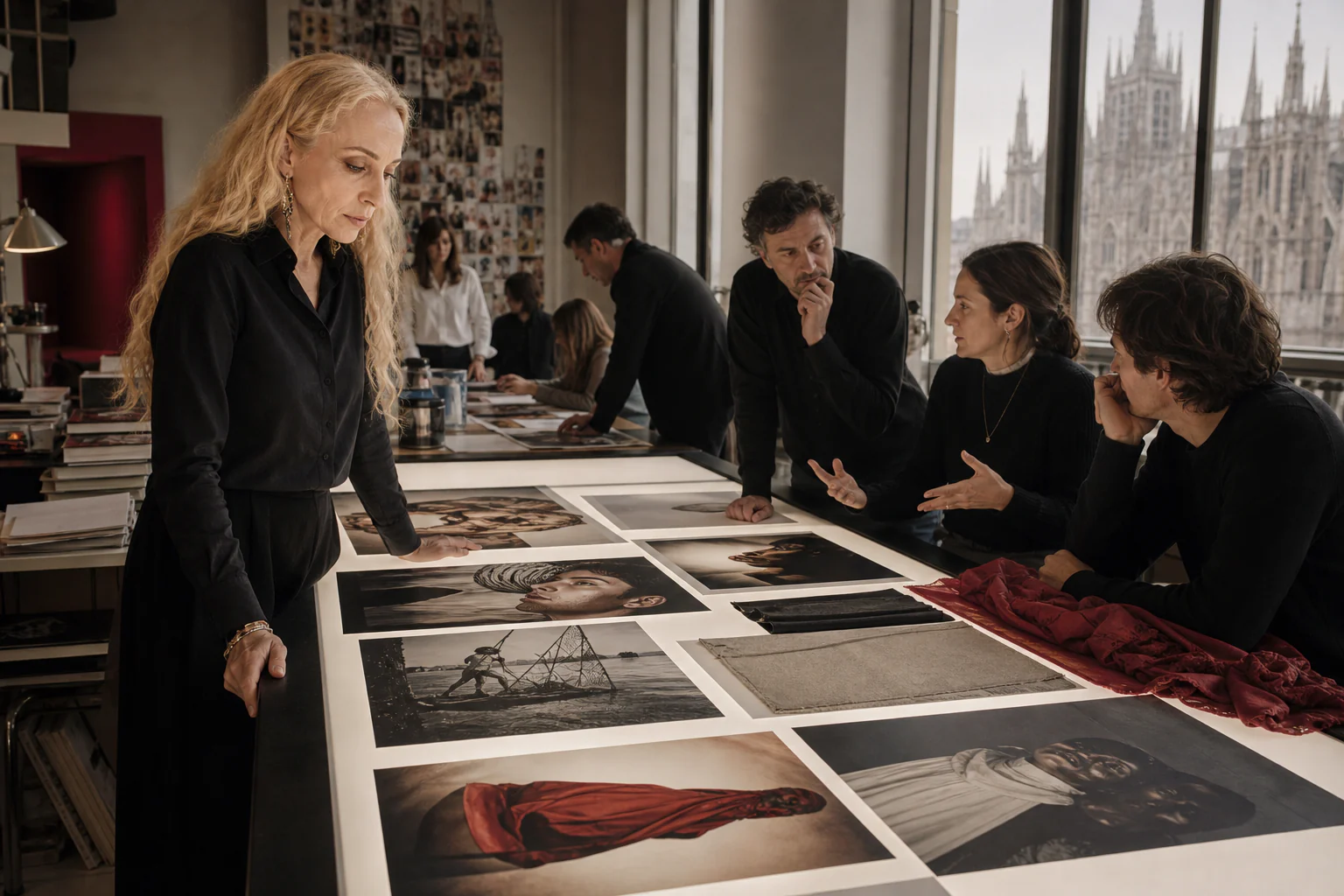

Editorial thesis
Sozzani matters for proving that a commercial fashion publication can conduct a substantive public conversation without ceasing to be a fashion publication.
Reader question
Can a magazine living on luxury advertising criticise the industry that sustains it?
Short answer
Within limits: the instrument is the themed issue, in which a statement is expressed through casting and photography rather than through text making a direct accusation.
1. Position
Sozzani led the Italian edition of a major fashion magazine for many years. Her work established that a national edition of an international title can hold a position of its own.
2. The Italian edition as a separate voice
Under her direction the title differed from other editions by sharing a name and not a content. This showed that editorial will can override a networked format.
3. Photography as principal language
She built issues around large photographic stories, giving authors unusually many pages. The image carries the argument here and the text accompanies it.
4. Long relationships with photographers
She worked with a limited circle of authors over many years. Consistency of personnel gave the title a recognisability unattainable through one-off commissions.
5. The themed issue as instrument
Her principal device is an issue wholly given to one subject. The format allows an extended statement and protects it from dissolving among other material.
6. The black issue
An issue of 2008 shot entirely with Black models became her best-known decision. It was commercially successful and required a reprint.
7. What that issue proved
It showed that the absence of diversity in the industry is explained by editorial and casting decisions rather than by demand. The commercial result removed the usual excuse.
8. The limits of the gesture
A single issue does not change a system: the next returned to the previous casting. The device named the problem without solving it, and that limitation was acknowledged directly.
9. The conversation about the body
She published shoots contesting the industry’s accepted norm of figure. This touched advertisers’ commercial interests directly and was therefore risky.
10. Contested issues
Some themed issues drew justified accusations of aestheticising catastrophe and violence. The device of presenting a social subject through fashion photography has a limit, and she crossed it.
11. The nature of the conflict
Fashion photography makes its subject desirable; applied to catastrophe, it makes catastrophe desirable. This is a structural property of the genre rather than an error of execution.
12. Relations with advertisers
Her position was possible thanks to the title’s stability and her personal authority. An editor without that resource could not pursue the same line, and this is an essential condition of the case.
13. The digital transition
She began writing an editorial blog and working with online formats early. The title acquired a second channel before this became an industry norm.
14. What transfers
The format transfers: the themed issue as a way of making an editorial statement undilutable. The device works in any periodical.
15. What does not transfer
Protection does not transfer. The ability to take risks was secured by the title’s market position and not by editorial courage alone.
16. Critique
A justified objection: isolated statements alongside unchanged daily practice function as an indulgence. A themed issue can substitute for systemic change rather than prompt it.
17. A second objection
Some of her decisions were assessed as exploiting others’ suffering for circulation. That assessment remains contested and is not settled by the issues’ commercial success.
18. Historical position
She marked the limit of how far a commercial fashion title can go in public argument. Subsequent editors work inside the boundary she drew.
19. Link to the knowledge base
The material connects to the entries on the cover, editorial photography, the magazine as system, and fashion photography as production.
20. How to read this today
Assess not a single issue but the one after it. Whether routine casting practice changed following a landmark issue is the only verifiable measure of influence.