fashion editor profile
Grace Coddington
Fashion editor, narrative image-making and the hidden authorship of the magazine image
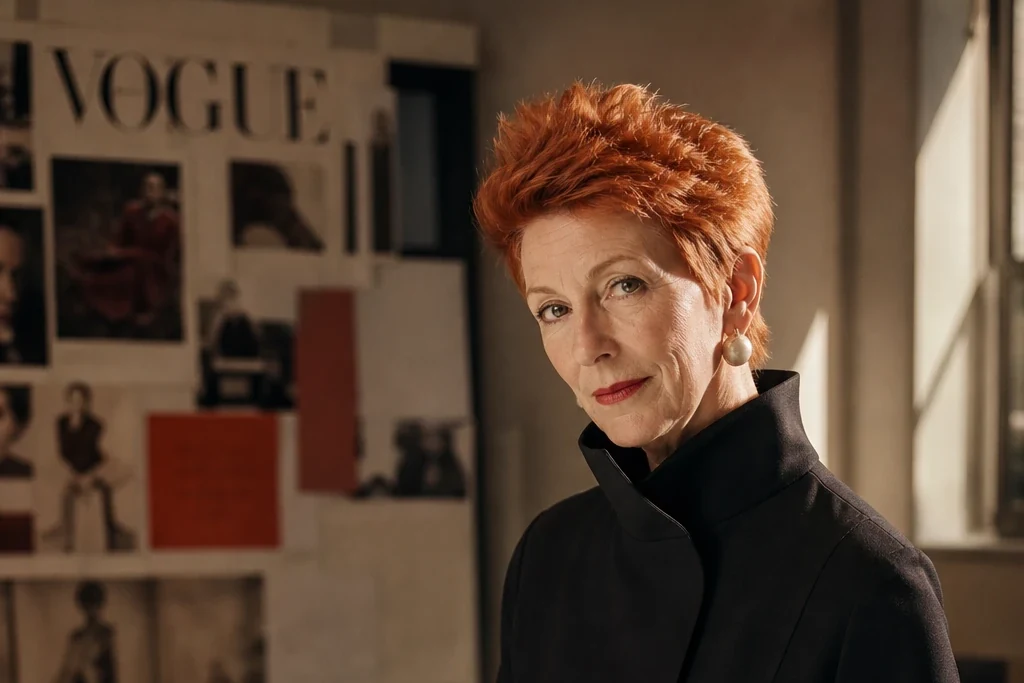
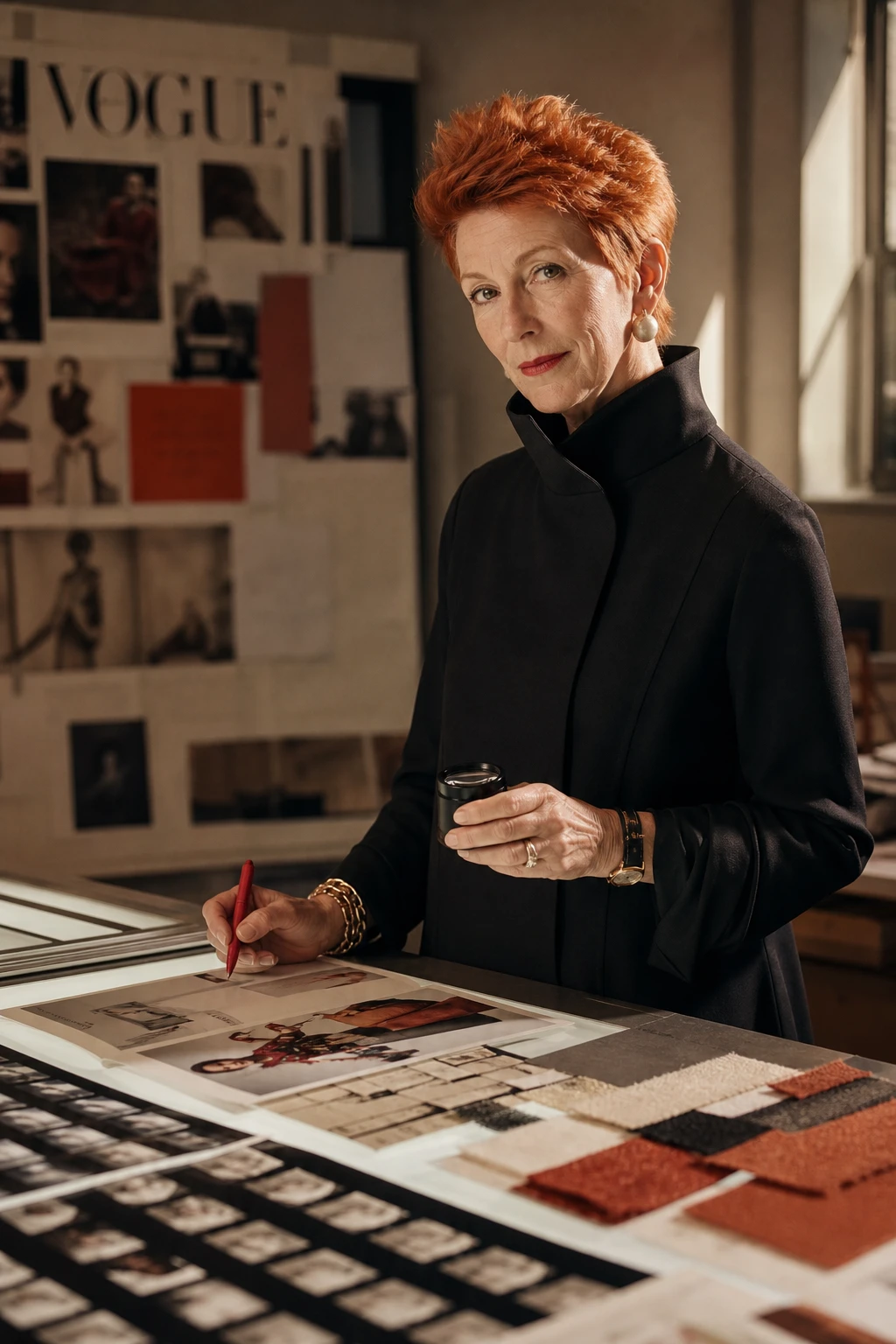
Coddington demonstrated that the fashion editor does not service a finished photograph. The role constructs the conditions in which clothes, model, photographer, space and editorial sequencing become one story.
Editorial thesis
Grace Coddington matters not merely as a symbol of an earlier Vogue or as the public figure revealed by The September Issue. Her career makes the fashion editor visible as an image author: someone who turns collections into narrative through clothing selection, casting, location, movement, photographer collaboration and severe editing. 2
Reader question
What does a fashion editor actually author when the photographer releases the shutter, the designer makes the clothes, and the editor-in-chief decides what reaches the issue?
Short answer
The fashion editor authors relationships among those roles. Coddington shows that a strong fashion image begins before the shoot and continues after it through research, fitting, narrative, casting, production and edit. 2
1. Anglesey: fashion first arrives as an image
Grace Coddington grew up on the island of Anglesey in Wales, far from the daily machinery of the London fashion industry. Her early relationship with fashion was therefore mediated by magazines: the page became a window onto another climate, another scale of life, another system of images. For a future fashion editor, that matters. Fashion entered her imagination not only as clothing but as a constructed world. 2
That distance later became part of her editorial strength. Her best stories invite the reader into an atmosphere rather than merely presenting a sequence of garments. The biography should not be romanticised into a simple provincial-to-fashion fairytale; the more useful point is that magazines taught her to treat the fashion image as a medium in its own right.
2. 1959: the British Vogue competition and entering through modelling
In 1959 Coddington won a British Vogue modelling competition and entered the industry from the other side of the camera. At the time, models often carried much of their own practical preparation: makeup, hair, accessories and the logistics of moving between jobs. Her education was physical and procedural rather than theoretical. 2
Modelling gave her an unusually precise understanding of how clothes behave on a body and what happens between an editor's instruction and a finished frame. Later, as a fashion editor, she understood not only the power of an image but the labour behind it: fittings, waiting, cold locations, movement, uncomfortable clothes and the need to preserve energy in front of the lens.
3. A model learns what the camera needs
Coddington worked with photographers of her generation, including Norman Parkinson and David Bailey, and observed how different authors controlled movement, distance, light and a model's character. Her modelling career became a form of photographic education without formal photography school. 2
The important point is not the celebrity list but the learning mechanism. From inside the frame she could see which decisions gave an image life and which reduced clothing to inert display. Her editorial work would later build on this inside knowledge of the camera.
4. Vidal Sassoon: the haircut as graphic construction
In 1964 Coddington was one of Vidal Sassoon's models and wore the celebrated Five-Point Cut. Vogue later remembered this moment as part of the shift from photographing a hairdo to treating the haircut itself as a graphic form. 2
For Coddington it was an early lesson in interdisciplinary image-making: hair, face, clothing, photography and silhouette have to work together. A strong frame does not belong to one object or one author. It emerges from coordination.
5. The accident and a change of position: from image subject to image author
A serious car accident disrupted Coddington's modelling career and became one of the circumstances behind her move to the other side of the camera. The episode is often told as a sharp turn of fate, but the professional point is more useful: by then she had accumulated knowledge that could be transferred from performance into editorial direction. 2
The transition did not erase modelling as an earlier chapter. Her bodily knowledge of shoots remained part of her editorial competence. She knew how models respond to clothes, space and instruction because she had lived the same process.
6. 1968: fashion editor at British Vogue
In 1968 Coddington became a fashion editor at British Vogue. This begins the central line of her career: not simply selecting clothes, but connecting collections, photographer, model, location, movement and emotional tone into one editorial story. 2
The term fashion editor matters. It is not merely a stylist assembling outfits, and not simply a production administrator. The role sits between editorial judgment and visual production: it helps decide why this image belongs on the page and how the reader should experience it.
7. The fashion editor is not the photographer's assistant
The history of fashion photography is often written around the photographer as sole author. Coddington's work reveals the limits of that model. A fashion editor researches collections, selects clothes, proposes narrative, casting and location, manages fittings and protects the visual logic of a story. 2
That does not diminish photographic authorship. A strong editorial structure creates conditions in which the photographer can make a more specific image. VANSMITHLAB therefore treats Coddington as an author of the editorial argument inside a collective production.
8. Clothing as dramaturgy, not inventory
Coddington rarely handled clothes as a neutral list of seasonal newness. In her strongest stories, a dress, coat or accessory has a function: it changes a character's movement, creates a historical association, sets the tempo of a scene or collides with a landscape. 2
Fashion editing becomes a form of montage. One look establishes tone, the next changes scale, another creates pause. A spread is read as a sequence of states rather than a rack transferred to paper.
9. Norman Parkinson: location becomes an actor
Coddington's collaborations with Norman Parkinson for British Vogue show how editor and photographer can use location as an active component rather than a decorative background. Vogue remembers their travel and location work as part of a broader tradition of adventurous fashion photography. 2
Space changes behaviour. A body moves differently in a street, desert, interior or open landscape. Coddington was especially strong in these conditions because clothing had to enter into a relationship with wind, distance, architecture and available light.
10. Newton and Bourdin: risk does not mean lack of control
Working alongside Helmut Newton, Guy Bourdin and other powerful authors of the 1970s taught Coddington that provocative imagery requires more, not less, editorial control. Photographers could be erotic, severe, theatrical or absurd, while the fashion editor still had to keep clothing and editorial purpose legible inside their visual language. 2
Her method therefore cannot be reduced to one aesthetic. She did not make every photographer look alike. The constant was her ability to choose clothes and situations that unlocked a specific author's strengths.
11. The model as character, not hanger
Coddington builds stories around behaviour. Women walk, travel, argue, perform, become part of groups or occupy a particular relationship to a room or landscape. This is a significant departure from the model as a static support for a garment. 2
The method does not remove idealisation from fashion photography, but it makes that idealisation narrative. Clothes begin to explain who a character might be and what she is doing rather than merely displaying price, brand or silhouette.
12. Open landscape and the feeling of movement
Accounts of Coddington's work repeatedly return to a love of wide landscapes, roads, fields and weather. In these shoots fashion stops being a fully controlled studio construction: wind, dust, distance and changing light intervene. 2
For an editor this is risk but also resource. Fabric becomes convincing when it actually moves. The model feels less isolated from the world. Visual luxury can come from the scale of a situation, not only from the cost of an object.
13. The ensemble: holding many figures inside one story
One of Coddington's recognisable strengths is her ability to organise complex group scenes. Several models, actors or characters can share a frame without becoming random extras. Vogue has noted her appetite for layered narratives and large ensembles. 2
This is editorial attention design: who sits forward, who recedes, where colour repeats, how silhouettes are distributed and who looks at whom. These relationships turn a fashion spread into a scene that rewards more than a few seconds of looking.
14. Historical reference without museum costume
Coddington frequently uses art history, film, literature and older photography as points of departure, but her strongest shoots are not literal reconstructions. A reference can alter pose, colour, setting or composition while contemporary clothes remain of their own time. 2
For editorial practice this is crucial: a reference should not be a copy. Its function is to give a team a shared field of associations from which a new image can be built.
15. Fantasy as a way of reading clothes
Coddington's fantasy is sometimes described as escape from reality, but its editorial function is more precise: fantasy can expose qualities of clothing that are difficult to read in a neutral studio. Scale, romance, humour, theatre and cultural memory become tools for interpreting a collection. 2
This helps explain why many of her stories outlive their seasons. An image built only on product novelty dates quickly. An image that places clothing inside a convincing world can persist as cultural memory.
16. British Vogue as a long school of editorial production
British Vogue gave Coddington not one signature look but a long practice: different photographers, models, editors and budgets; constant location work; and repeated adaptation as fashion shifted from the late 1960s into the 1980s. 2
Duration matters. A professional eye is not produced by a single iconic sitting, but by hundreds of decisions, most invisible to readers. That invisible labour is what makes an editorial system durable.
17. 1987: Calvin Klein and an attempt to leave magazines
In 1987 Coddington moved to New York to become design director at Calvin Klein. The short period matters as a test of the boundary between editorial freedom and work inside a single brand. 2
A fashion editor at a magazine can combine competing houses and build an independent picture of a season. A brand must concentrate attention around one identity and one commercial structure. Within a year Coddington returned to magazine work, where she had more freedom to assemble multiple authored worlds.
18. 1988: American Vogue and a new alliance with Anna Wintour
In 1988 Coddington joined American Vogue as Anna Wintour began her editorship. Phaidon identifies the move as the start of Coddington's American period; she later became the magazine's creative director. 2
Their relationship is too often flattened into 'business versus creativity'. Coddington herself rejected that simplification, noting Wintour's active role in creative decisions. A better model is mutual editing: one expands the image, the other tests its force and clarity.
19. 'Everyone needs an editor': conflict as part of the picture
In a Vogue interview around The September Issue, Coddington argued that everyone needs an editor and that Wintour's editing made her work stronger. The statement is central to editorial culture: authorship does not have to be weakened by criticism and selection. 2
A strong magazine depends on disagreement before publication. Not every expensive picture stays, and not every beloved garment survives the edit. The fashion editor is both an image author and someone who must accept a further edit.
20. Photographer as collaborator: changing method for a specific eye
Coddington's American period is connected to a wide range of photographers, from Annie Leibovitz and Peter Lindbergh to Steven Meisel, Bruce Weber, Mario Testino, Craig McDean, David Sims and others. Phaidon's books deliberately organise her archive through these collaborations. 2
The skill is not making everyone share one signature. With Leibovitz she can construct theatre; with Lindbergh, movement and psychological directness; with Meisel, exact transformation of a fashion code. Coddington's continuity lies in editorial narrative rather than a single lighting setup or colour palette.
21. Annie Leibovitz: fairy tale as large-scale collective production
The collaboration with Annie Leibovitz makes the scale of Coddington's method especially visible. Literary and fairy-tale structures became large fashion productions involving actors, models, costume and complex sets. Vogue repeatedly links Coddington with such narrative shoots. 2
Here the fashion editor can resemble a producer or world-builder, yet authorship remains collective. The photograph belongs to Leibovitz, clothes to designers, performance to models and actors, and sets to the production team. Coddington's role is to bind these elements into an editorial construction.
22. Peter Lindbergh and the road: a story can be simpler than the set
Not all of Coddington's fantasy requires elaborate scenery. In work with Peter Lindbergh, or in a road-movie register, space, movement, casting and clothes that survive weather can be enough. 2
The contrast is important: her method is not synonymous with decoration. Fantasy can be materially spare when a clear relationship exists between character, garment and place.
23. Whom the editorial system makes visible
Vogue connects Coddington with strong early images and support for models such as Amber Valletta, Shalom Harlow, Karen Elson and Stella Tennant. This reveals another form of editorial power: not only choosing clothes, but participating in which faces become part of the visual canon. 2
That power requires critical reading. A magazine can expand ideas of beauty while excluding others. An editor's legacy should therefore be assessed not only through memorable pictures, but through which bodies, faces and personalities were given high visibility.
24. The September Issue: an invisible profession becomes public
The 2009 documentary The September Issue made Coddington widely recognisable outside the professional fashion world. Viewers saw not just finished spreads but disagreement, selection, reshoots and the tension between a photograph and the final page. 2
The paradox is that a behind-the-scenes specialist became the film's breakout public figure. The film changed popular understanding of the fashion editor by making visible the layer of authorship between runway collection and published photograph.
25. The Editor's Eye: image editors enter Vogue's own history
Vogue's The Editor's Eye placed Coddington within a lineage of fashion editors whose work directed photographers and illustrators and shaped how readers imagined modern women. 2
For VANSMITHLAB this is a key distinction: the fashion editor is not a secondary credit. The work is a system of decisions that produces the conditions for an image.
26. Books as a self-built archive: 2002, 2012, 2016
Coddington repeatedly turned her own practice into an archive. Grace: Thirty Years of Fashion at Vogue collected British and American Vogue work; Grace: A Memoir added autobiography; Grace: The American Vogue Years focused on her US period and photographer collaborations. 2
These books are more than celebrity publishing. They allow fashion editing to be seen across time: models, technologies, photographers and clothes change, while a method of constructing editorial narrative remains legible.
27. 2016: from staff creative director to a more independent model
In 2016 Coddington stepped down as creative director of American Vogue and moved into a looser relationship described at the time as creative director at large / contributing work, allowing her to retain a connection to Vogue while taking outside projects. 2
The transition also marks a change in the profession itself. A senior image-maker no longer has to exist only inside one masthead; an editorial method can move between magazine, brand, book and independent commission.
28. Beyond the magazine: Tiffany, Comme des Garçons and authored objects
After the role change Coddington expanded her external practice. Notable projects included work with Tiffany & Co. and the fragrance Grace by Grace Coddington with Comme des Garçons. Vogue framed this period as part of her new freedom to work outside the magazine after decades inside it. 2
The point is not the collaboration list itself but the transfer of competence. She applies an editorial eye to object and brand, connecting narrative, image, packaging and her own drawing rather than simply attaching a famous name to a product.
29. 2025-2026: the relationship with Vogue continues
On Vogue's current masthead Coddington is listed among contributing editors. Her name also continues to appear in specific fashion credits, including Emma Stone's September 2025 story and the May 2026 Anna Wintour and Meryl Streep shoot, where she is credited as Fashion Editor. 2
This matters for dating the profile. Coddington should not be written only as a figure from American Vogue's past. Her practice remains active, even though its institutional form differs from her years as staff creative director.
30. The central legacy: the fashion editor as an author of relationships
In 2026 Phaidon continues to publish and reissue Coddington's archive, including Grace: Now, a third portfolio volume focused on her more independent chapter and recent editorial collaborations. 2
Coddington's legacy cannot be reduced to romantic fantasy, red hair or a few famous spreads. She demonstrates that the fashion editor authors relationships: garment to body, model to photographer, space to movement, history to the present, personal imagination to magazine discipline. Those relationships are what turn a rack of clothes into an image that survives its season.