fashion editor profile
Tonne Goodman
Fashion editing between image, clothing and environmental responsibility
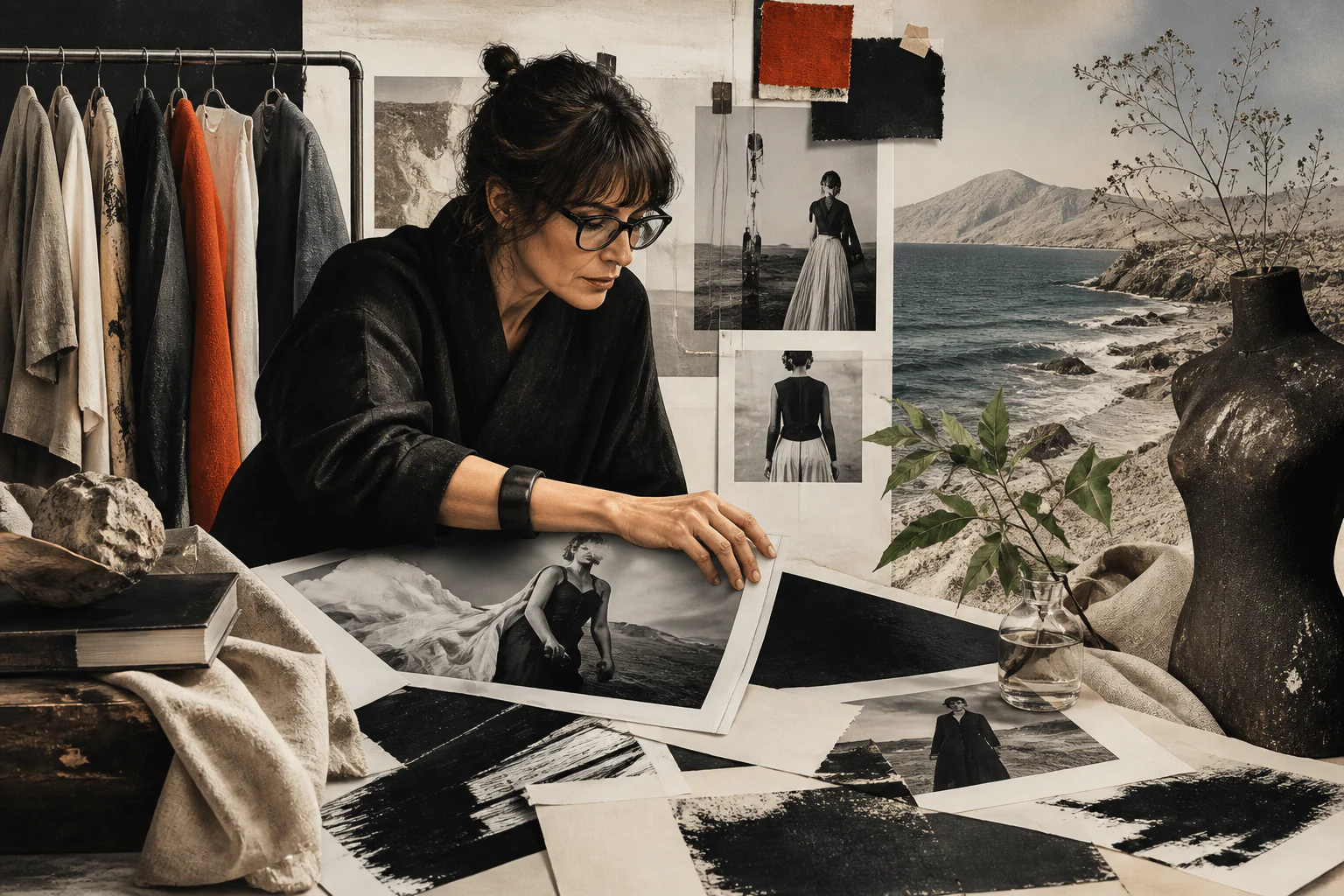

Tonne Goodman matters as an editor who connected the classical Vogue tradition with a later question: how fashion is made, used and discarded. Her career maps a shift from producing desirable images toward responsibility for the system that sustains them.
Editorial thesis
Tonne Goodman matters as an editor who connected the classical Vogue tradition with a later question: how fashion is made, used and discarded. Her career maps a shift from producing desirable images toward responsibility for the system that sustains them.
Reader question
Can a fashion editor who spent decades producing desire use the same authority to change a culture of consumption?
Short answer
Goodman moved from work around Diana Vreeland and Calvin Klein to a long career at Vogue. Later she focused on sustainability, showing that editorial work can include not only selecting an image but also the lifespan of a garment, reuse and brand responsibility.
1. Early path: art, modelling and the museum world
Before establishing herself in editorial fashion, Goodman worked across different parts of the visual industry and encountered Diana Vreeland during her museum period. [source]
2. Mechanism: clothing between museum and magazine
The route gave the editor an understanding of clothing as a commercial object, an image and a historical artefact at once. The point is not an isolated gesture but a way of organising practice. The decision connects author, material, institution, technology and audience, so it cannot be reduced to a personal signature or a polished result. For VANSMITHLAB this episode functions as a mechanism that can be compared across neighbouring practices. [source]
3. Significance: clothing between museum and magazine
This episode explains why Tonne Goodman belongs in VANSMITHLAB’s map of authors. The significance lies in changing professional rules: who decides, how authorship is distributed, what counts as the result, and how the work enters public culture. The profile therefore keeps context attached to achievement instead of turning biography into a list of milestones. [source]
4. Calvin Klein: learning the brand from inside
Goodman’s advertising work at Calvin Klein exposed her to the way a brand’s visual identity is built through a sequence of decisions rather than one photograph. [source]
5. Mechanism: brand as a system
Working inside a brand differs from observing it through a magazine: the editor sees production, market constraints and the need for long-term consistency. The point is not an isolated gesture but a way of organising practice. The decision connects author, material, institution, technology and audience, so it cannot be reduced to a personal signature or a polished result. For VANSMITHLAB this episode functions as a mechanism that can be compared across neighbouring practices. [source]
6. Significance: brand as a system
This episode explains why Tonne Goodman belongs in VANSMITHLAB’s map of authors. The significance lies in changing professional rules: who decides, how authorship is distributed, what counts as the result, and how the work enters public culture. The profile therefore keeps context attached to achievement instead of turning biography into a list of milestones. [source]
7. Vogue: decades of editorial influence
Goodman became one of the leading editors at American Vogue and helped create a large body of covers and fashion stories. In 2024 the magazine marked her 200th cover. [source]
8. Mechanism: long-term editorial system
Scale matters not by itself: a long career reveals the editor as someone who shapes an enduring image standard across generations. The point is not an isolated gesture but a way of organising practice. The decision connects author, material, institution, technology and audience, so it cannot be reduced to a personal signature or a polished result. For VANSMITHLAB this episode functions as a mechanism that can be compared across neighbouring practices. [source]
9. Significance: long-term editorial system
This episode explains why Tonne Goodman belongs in VANSMITHLAB’s map of authors. The significance lies in changing professional rules: who decides, how authorship is distributed, what counts as the result, and how the work enters public culture. The profile therefore keeps context attached to achievement instead of turning biography into a list of milestones. [source]
10. The cover as negotiation between person and clothing
In Goodman’s work a famous cover subject should not disappear behind styling, yet cannot be shown without an editorial construction of clothes, pose and setting. [source]
11. Mechanism: the cover as negotiation
A cover becomes a negotiation among recognisable identity, fashion relevance and the need to make a new image. The point is not an isolated gesture but a way of organising practice. The decision connects author, material, institution, technology and audience, so it cannot be reduced to a personal signature or a polished result. For VANSMITHLAB this episode functions as a mechanism that can be compared across neighbouring practices. [source]
12. Significance: the cover as negotiation
This episode explains why Tonne Goodman belongs in VANSMITHLAB’s map of authors. The significance lies in changing professional rules: who decides, how authorship is distributed, what counts as the result, and how the work enters public culture. The profile therefore keeps context attached to achievement instead of turning biography into a list of milestones. [source]
13. The turn toward sustainability
In her later Vogue period Goodman took on an editorial focus on sustainability and regularly wrote about materials, reuse, durability and changing consumer habits. [source]
14. Mechanism: editorial responsibility
It is a significant turn: someone professionally involved in producing desire begins to examine the consequences of that system. The point is not an isolated gesture but a way of organising practice. The decision connects author, material, institution, technology and audience, so it cannot be reduced to a personal signature or a polished result. For VANSMITHLAB this episode functions as a mechanism that can be compared across neighbouring practices. [source]
15. Significance: editorial responsibility
This episode explains why Tonne Goodman belongs in VANSMITHLAB’s map of authors. The significance lies in changing professional rules: who decides, how authorship is distributed, what counts as the result, and how the work enters public culture. The profile therefore keeps context attached to achievement instead of turning biography into a list of milestones. [source]
16. Rewearing as an editorial gesture
Goodman has emphasised the value of existing clothing and the possibility of wearing garments longer rather than treating each season as a reason to replace a wardrobe. [source]
17. Mechanism: the long life of a garment
The editor changes the criterion of novelty: interest can come from recombination and the memory of a garment, not only from buying something new. The point is not an isolated gesture but a way of organising practice. The decision connects author, material, institution, technology and audience, so it cannot be reduced to a personal signature or a polished result. For VANSMITHLAB this episode functions as a mechanism that can be compared across neighbouring practices. [source]
18. Significance: the long life of a garment
This episode explains why Tonne Goodman belongs in VANSMITHLAB’s map of authors. The significance lies in changing professional rules: who decides, how authorship is distributed, what counts as the result, and how the work enters public culture. The profile therefore keeps context attached to achievement instead of turning biography into a list of milestones. [source]
19. Material and provenance
Vogue sustainability coverage under Goodman’s editorial attention connects appearance with raw material, production and environmental impact. [source]
20. Mechanism: material as responsibility
Editorial judgement moves beyond the surface: fabric is read as evidence of a production chain. The point is not an isolated gesture but a way of organising practice. The decision connects author, material, institution, technology and audience, so it cannot be reduced to a personal signature or a polished result. For VANSMITHLAB this episode functions as a mechanism that can be compared across neighbouring practices. [source]
21. Significance: material as responsibility
This episode explains why Tonne Goodman belongs in VANSMITHLAB’s map of authors. The significance lies in changing professional rules: who decides, how authorship is distributed, what counts as the result, and how the work enters public culture. The profile therefore keeps context attached to achievement instead of turning biography into a list of milestones. [source]
22. Levi’s and the culture of durable clothing
Goodman’s participation in projects around Levi’s 501 and owners’ stories emphasised clothing as an object that changes with a person and records use. [source]
23. Mechanism: the biography of a garment
Durability becomes not a restriction on fashion but a source of individuality and biographical patina. The point is not an isolated gesture but a way of organising practice. The decision connects author, material, institution, technology and audience, so it cannot be reduced to a personal signature or a polished result. For VANSMITHLAB this episode functions as a mechanism that can be compared across neighbouring practices. [source]
24. Significance: the biography of a garment
This episode explains why Tonne Goodman belongs in VANSMITHLAB’s map of authors. The significance lies in changing professional rules: who decides, how authorship is distributed, what counts as the result, and how the work enters public culture. The profile therefore keeps context attached to achievement instead of turning biography into a list of milestones. [source]
25. An editor cannot solve the industry alone
Editorial sustainability initiatives operate inside a commercial media and fashion system still dependent on novelty, advertising and production volume. [source]
26. Mechanism: the limit of individual influence
Critical reading means not mistaking an editor’s personal position for proof that the entire industry has changed. The point is not an isolated gesture but a way of organising practice. The decision connects author, material, institution, technology and audience, so it cannot be reduced to a personal signature or a polished result. For VANSMITHLAB this episode functions as a mechanism that can be compared across neighbouring practices. [source]
27. Significance: the limit of individual influence
This episode explains why Tonne Goodman belongs in VANSMITHLAB’s map of authors. The significance lies in changing professional rules: who decides, how authorship is distributed, what counts as the result, and how the work enters public culture. The profile therefore keeps context attached to achievement instead of turning biography into a list of milestones. [source]
28. Legacy: from creating desire to editing consequences
Goodman’s career connects two eras: the power of print Vogue and the contemporary need to address the environmental cost of fashion. [source]
29. Mechanism: expanding editorial ethics
Her significance lies in expanding the editor’s profession: “how does it look?” is joined by “how was it made?” and “how long should it live?” The point is not an isolated gesture but a way of organising practice. The decision connects author, material, institution, technology and audience, so it cannot be reduced to a personal signature or a polished result. For VANSMITHLAB this episode functions as a mechanism that can be compared across neighbouring practices. [source]
30. Significance: expanding editorial ethics
This episode explains why Tonne Goodman belongs in VANSMITHLAB’s map of authors. The significance lies in changing professional rules: who decides, how authorship is distributed, what counts as the result, and how the work enters public culture. The profile therefore keeps context attached to achievement instead of turning biography into a list of milestones. [source]