fashion editor profile
Lucinda Chambers
Editing, Collaboration and Taste as a Transferable System
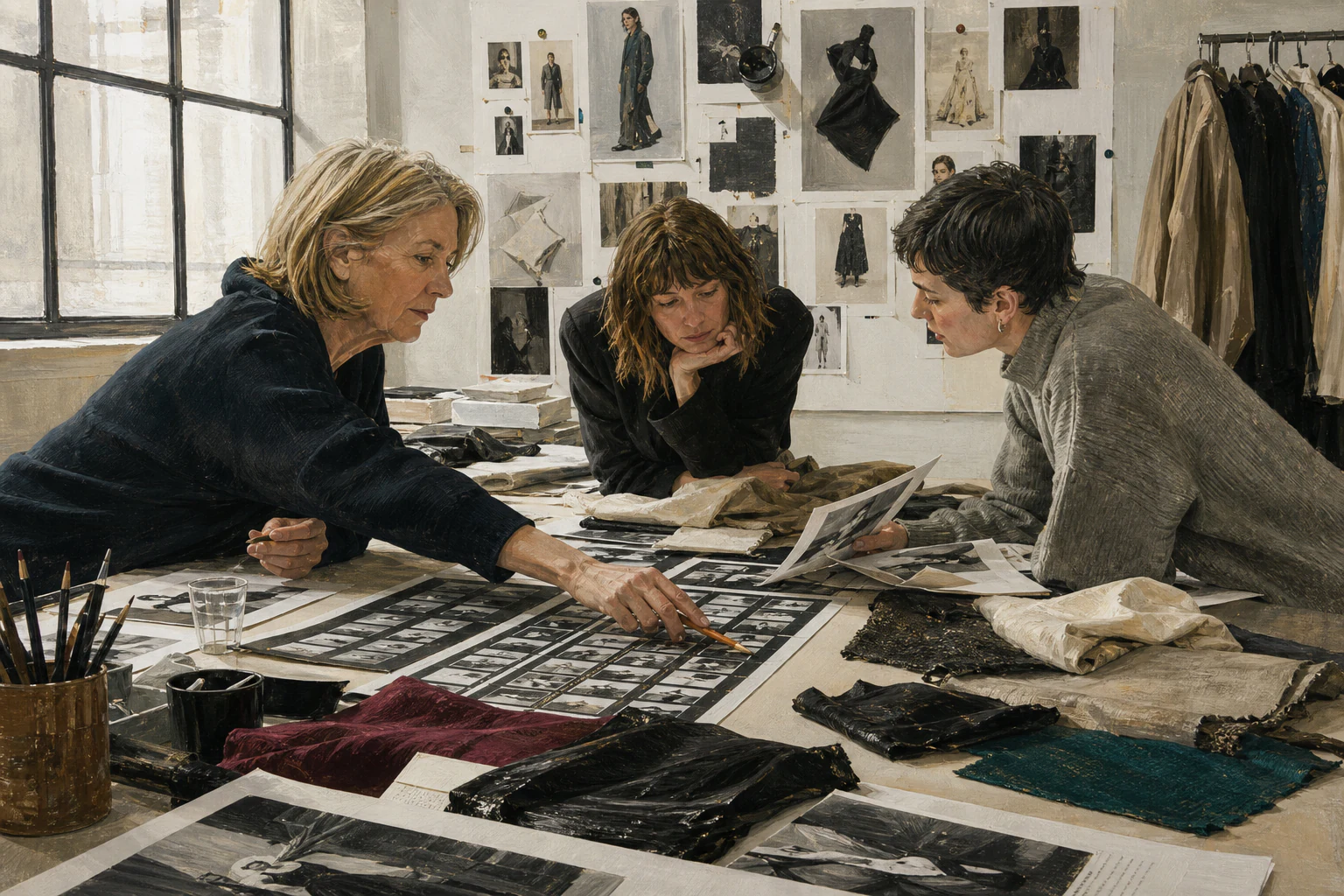
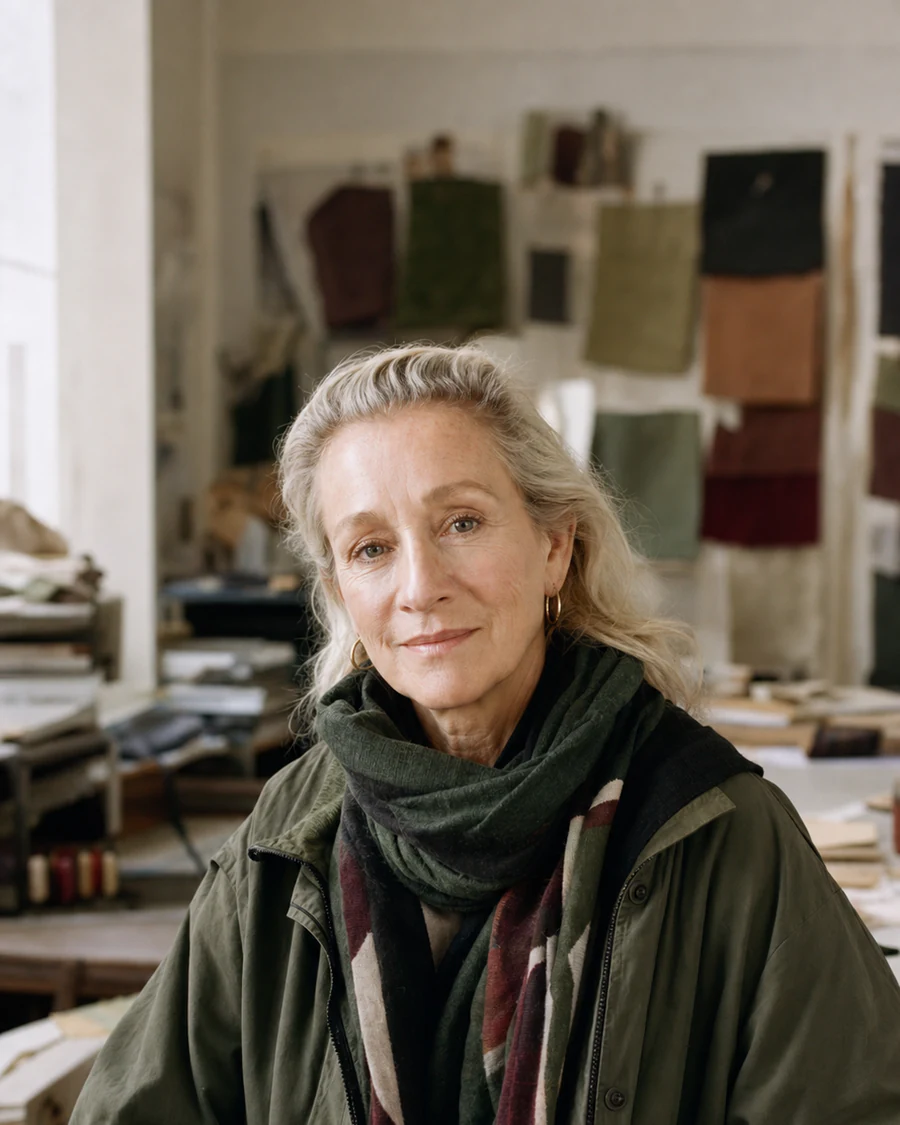
Chambers demonstrates the fashion editor as an author of relations: an idea becomes powerful not because one person controls everything, but because the editor connects photographer, model, clothes, place, brand and audience with precision—and can later transfer the same principle from magazine to product and digital curation.
Editorial thesis
Lucinda Chambers matters not simply because she has “good taste” or because she spent 25 years as fashion director of British Vogue. Her central contribution is a model of editorial authorship as a transferable system: observe, select, connect strong collaborators, build narrative and construct taste through relations among things rather than one price or status code.
Reader question
How did someone formed inside print Vogue carry the same authorial method into Marni, Colville, Collagerie and interiors after a harsh break with the magazine—without simply trying to restore the old status?
Short answer
Because Chambers’s profession was always broader than the title. Her main tool is editorial judgment: seeing a relation where others see separate things, then turning that relation into an intelligible image, collection, edit or space.
1. Before Vogue: the route does not begin at fashion school
Lucinda Chambers did not build her career from a pre-written professional plan. In her own account for British Vogue she remembered intending to become a secretary, but family circumstances led her and her mother to art college; Chambers attended Hornsey College of Art. [source]
The episode matters beyond biography. Her later method as a fashion editor follows the same logic: ideas often arrive from outside the official fashion system—a thing, colour, accidental scene, market, journey or someone else’s gesture.
2. Hornsey College of Art: fashion as an allegedly unserious interest
Chambers remembered feeling insecure at art college while her interest in fashion was treated as too frivolous. Rather than abandon it, she began making jewellery in the college workshops. [source]
For a future fashion editor this is an early lesson: visual interest does not require academic permission. Taste can form through material, wearability and other people’s reactions before it has the correct theoretical vocabulary.
3. Jewellery and Camden Lock: an object becomes a pass into editorial culture
Chambers sold jewellery to friends and at Camden Lock Market. When one piece appeared in a magazine, she wrote to Vogue asking for an interview. British Vogue links this episode directly to her entry into the magazine. [source]
The professional beginning is not a contemporary stylist portfolio. It is a chain: make an object, see it published, recognise the power of media, then actively ask to enter the system.
4. From petty cash to Beatrix Miller: the magazine as a social machine
Chambers’s first job at Vogue was not in fashion; she worked on accounts and administrative tasks. An internal chance connection led to an interview with editor Beatrix Miller, and Chambers became Miller’s assistant. [source]
The route reveals an older Condé Nast as hierarchical but porous. Administrative labour could unexpectedly open onto creative work. It also helps explain why Chambers understood a magazine not merely as beautiful pages but as an organisation.
5. Grace Coddington: the assistant learns to build an image, not merely pull clothes
After several years with Beatrix Miller, Chambers became Grace Coddington’s assistant. In later interviews she continued to call Coddington the “queen bee of fashion,” stressing the depth of that influence. [source]
The central lesson was not one visual style. Coddington demonstrated that a fashion story begins with an idea and that clothes, model, photographer, hair, makeup and location must become parts of one statement. Fashion editing becomes authorship of relations rather than ownership of the frame.
6. The first major chance: Patrick Demarchelier and trust before status
In memories of Beatrix Miller, Chambers described being given a shoot of her own and choosing Patrick Demarchelier, travelling to New York to work with him. [source]
The episode matters because editorial authority appears before job title. A fashion editor is tested not by the volume of clothes available but by the ability to choose a collaborator, formulate a task and persuade a team that an idea deserves risk.
7. Mario Testino: a long dialogue rather than “photographer plus stylist”
Chambers met Mario Testino early in her career, and their professional dialogue continued for decades. British Vogue repeatedly described them as long-term friends and collaborators; its Testino archive records his enormous role in the magazine’s visual history. [source]
One author should not dissolve into the other. Testino owns the photographic language of the frame; Chambers brings fashion direction, clothes, concept and the organisation of relations. Their strongest stories emerge when both extend the initial idea.
8. A brief stop at Elle: careers do not move in straight lines
Before returning to British Vogue, Chambers spent a short period at Elle. British Vogue records this as the intermediate stage before her appointment as fashion director. [source]
Fashion-editor careers rarely resemble a simple ladder inside one masthead. Moving to another publication can change the scale of responsibility, and returning can happen with new autonomy.
9. July 1992: Fashion Director of British Vogue
British Vogue states that Chambers returned in July 1992 as fashion director and remained in that position for 25 years. By her departure in 2017, her overall history with the magazine spanned 36 years. [source]
The job changes the unit of work: the question is no longer one shoot but how an entire magazine distributes fashion imagery, covers, designers, models, photographers and the rhythm of a season.
10. The fashion editor as the person who ignites a team
In her own writing Chambers describes the profession through collaboration: an idea may arrive almost complete, but after speaking to Mario Testino, Nick Knight or Paolo Roversi a new stage begins in which each participant carries it further. [source]
This precisely describes the hidden authorship of fashion editing. The editor does not release the shutter or make the dress. The work is to start a chain reaction in which different specialists understand why they belong in the same story.
11. Ideas do not come only from the runway: market, train, packaging, accidental colour
Chambers has described ideas arriving from a hairstyle on a plane, Shepherd’s Bush Market, a reflection on water or an unexpected colour combination. [source]
The method resists mechanical coverage of collections. A fashion editor translates the season into another visual language in which clothes remain current but are no longer the only source of meaning.
12. Colour Fest, 2012: a pinball machine built collectively
For British Vogue’s December 2012 issue Chambers styled Natalia Vodianova in Colour Fest, photographed by Mario Testino. Chambers first imagined manga; Testino introduced the pinball-machine idea, while set designer Jack Flanagan created the physical environment. [source]
The story is a clean example of distributed authorship. Fashion direction, photography, set design, model and collection cannot honestly be collapsed into one maker.
13. Travel as narrative device rather than expensive background
Across decades Chambers worked on fashion stories around the world. Later accounts of her career emphasise that geographic range and collaborations with photographers including Testino, Demarchelier and Josh Olins. [source]
Location matters only when it functions dramaturgically: landscape changes the scale of clothing, light, model behaviour and sequence. A weak shoot merely proves that an editorial budget bought a ticket.
14. Colour and pattern: eclecticism requires stricter editing than minimalism
Chambers is consistently associated with saturated colour, print, unexpected accessories and high/low mixing. Her own interiors and later projects show that this language was not a temporary magazine persona. [source]
Eclecticism does not mean adding everything. The more visual voices are present, the more hierarchy matters: one colour must answer another, pattern must hold scale, and accessory must complete rather than compete.
15. Marni and Consuelo Castiglioni: a stylist brings the weather of the street inside
Chambers worked with Marni and Consuelo Castiglioni for many years. In an interview about Weekend Max Mara she described the stylist’s contribution to a fashion house as bringing the outside in. [source]
This is the move from editorial styling to brand consultancy. A stylist need not rewrite the design; the value lies in testing how a collection lives beside other things, women, the street and the present.
16. Prada and Jil Sander: consultation inside strong authorial systems
Collagerie and Vogue list Prada and Jil Sander among Chambers’s professional relationships; in 2024 she herself referred to years of work with Miuccia Prada. [source]
Inside such houses the fashion editor cannot behave as an external corrector. The contribution is a precise response to an already strong design position: find proportion, context and image that intensify rather than erase it.
17. High street and luxury: taste does not have to equal price
Collagerie’s official biography lists Chambers’s work not only with Prada and Marni but with H&M, River Island and Warehouse. [source]
This helps explain her later business model. Style is produced by selection and combination, not by belonging to one price segment. High/low becomes a way of building an individual wardrobe rather than a democratic slogan.
18. The cover as compression of an editorial system
During her years as fashion director Chambers contributed to many British Vogue covers and major fashion stories. On her departure, Alexandra Shulman specifically highlighted her contribution to remarkable covers and her ability to bring the best out of teams. [source]
A cover tests fashion direction brutally: a complex idea must be compressed into one face, one look and one moment that functions simultaneously as fashion, editorial statement and commercial object.
19. The magazine system: creative freedom exists beside advertising and sales
Chambers’s long career took place inside a commercial magazine where editorial prestige, advertisers, circulation and luxury business are connected. Her public criticism after leaving Vogue made that conflict unusually visible. [source]
VANSMITHLAB should not romanticise old Vogue as pure art. Fashion imagery is always produced within an economy. The question is not whether commercial pressure exists, but how clearly an editorial system distinguishes commercial obligation from editorial vision.
20. 2017: official “stepping down” and a later claim of dismissal
On 17 May 2017 British Vogue announced that Chambers would leave the fashion-director role that summer after 36 years at the magazine. Weeks later, in a Vestoj interview, she said the decision had not been voluntary and that she had been dismissed very quickly. [source]
Both accounts belong in the history. The organisation’s public formula and Chambers’s testimony describe the same rupture differently. An editorial profile does not need to choose the convenient version and erase the conflict.
21. Vestoj: a rare insider description of the system from within
The Vestoj interview of summer 2017 was widely discussed for Chambers’s criticism of expensive clothes, advertiser influence and insecurity within the fashion system. The article was temporarily removed and then restored, which itself became part of the story. [source]
The importance lies beyond scandal. A fashion editor with decades of institutional experience publicly separated the authority of a magazine from the actual usefulness of a magazine.
22. After Vogue: dismissal does not become the final chapter
After 2017 Chambers did not simply reproduce her old role at another magazine. Her practice expanded into brand consulting, a fashion label, a digital curation platform and interiors. [source]
The transferable skill of the fashion editor becomes visible. If the profession truly consists of selection, combination and context-building, it can exist far beyond the printed masthead.
23. Colville, 2018: the stylist becomes a brand co-founder
In 2018 Lucinda Chambers, Molly Molloy and Kristin Forss launched Colville. Vogue described the label as a project by three former Marni colleagues built around colour, texture, individuality and resistance to fast-fashion logic. [source]
The move matters because the stylist now participates before the collection is complete. Yet Colville emphasised collective authorship from the start: Chambers does not become a lone designer but works alongside Molloy and Forss.
24. Colville after launch: collaboration matters more than corporate scale
By 2021–2024 Vogue continued to describe Chambers and Molly Molloy as Colville partners working with upcycling, artisan groups, rugs, objects and fashion. In 2024 Chambers referred to Molloy as her partner. [source]
Colville reveals another editorial logic: a fashion line can be built as a world of related things rather than a factory of seasonal novelty. Garment, bag, rug and interior object can share one visual grammar.
25. Collagerie, 2019: magazine instinct becomes digital curation
After Vogue, Chambers created Collagerie with Serena Hood. Vogue described the platform as a way to reduce the confusion of online shopping through a tightly selected mix of fashion, interiors and beauty; the official site identifies Chambers and Hood as the founders. [source]
This is a direct continuation of magazine logic. The user does not arrive for a complete database but for an edited field: someone has already looked at thousands of things and retained dozens.
26. “One thing over everything”: selection as a business model
Collagerie frames its purpose around finding “the one thing over everything” and explicitly celebrates shopping across price points. [source]
That proposition runs against infinite scroll. Value is created through limitation: editorial expertise absorbs part of the user’s decision burden. The fashion editor converts professional filtering into a digital product.
27. From print to digital: the editor learns infrastructure
Discussing Collagerie’s launch, Chambers described having to learn financing, trademarks, website design, accounting and marketing after decades inside Vogue. [source]
The contrast reveals the distance between magazine authority and platform ownership. Inside a magazine an editor inherits infrastructure; in a startup the infrastructure is part of the design problem. Curation becomes an operating system rather than an aesthetic gesture alone.
28. Weekend Max Mara, 2020: a stylist designs a capsule without claiming the designer title
For Weekend Max Mara Chambers developed Re-Find, a capsule using existing and upcycled fabrics. In Vogue she explicitly said she would not call herself a designer and described the project from a stylist’s point of view. [source]
That qualification matters for authorship. Professional confidence does not require taking over a neighbouring role. Chambers can influence product through combination, wearability, reversibility and wardrobe logic while preserving the work of a design team.
29. 2024–2025: interiors become a full extension of fashion curation
Collagerie expanded further into interiors, and its Zara Home collaboration returned in July 2025 with A Common Thread. Collagerie’s official project page describes a shared system of colour, craft and everyday objects, including textile work by artist Kavel Rafferty. [source]
This is not an abrupt professional switch. Chambers has long thought through colour, surface, object and high/low combination. The interior simply changes scale: the room replaces the body, while the problem of relationships among things remains.
30. The central legacy: fashion editing as a transferable way of thinking
Lucinda Chambers matters not only because she held a senior role at British Vogue for 25 years. Her career demonstrates that fashion editing is a transferable discipline: find the idea, select, remove excess, connect people and things, build context and allow distinct forms of authorship to work together. [source]
From Vogue to Marni, Colville, Collagerie and homeware projects, media and business models change while one principle remains: good taste is not a catalogue of expensive objects. It is the ability to construct relations among different elements until they begin to speak to one another.