illustrator profile
Antonio Lopez
Live Bodies, Multicultural Beauty and Fashion Illustration as a Social System
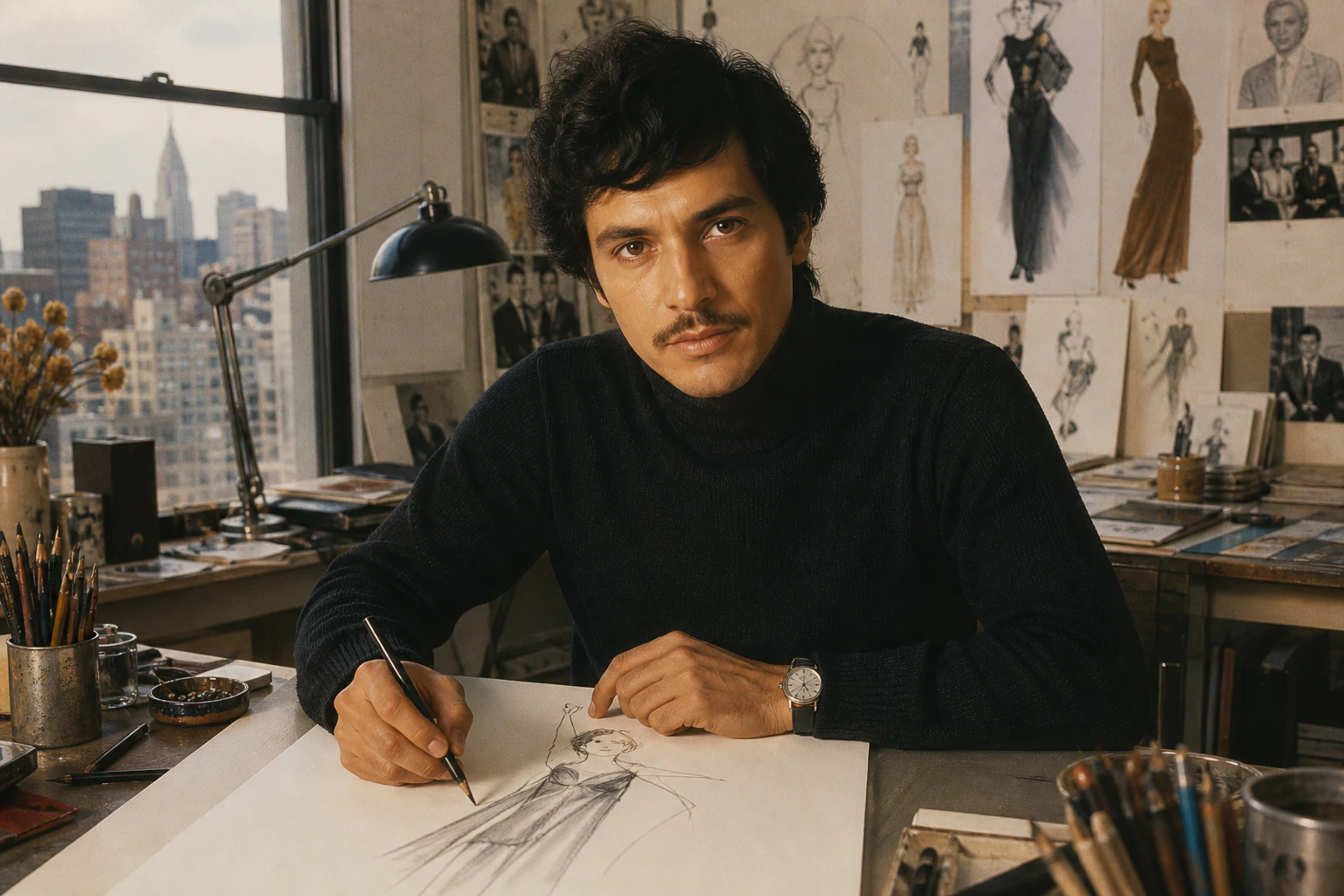
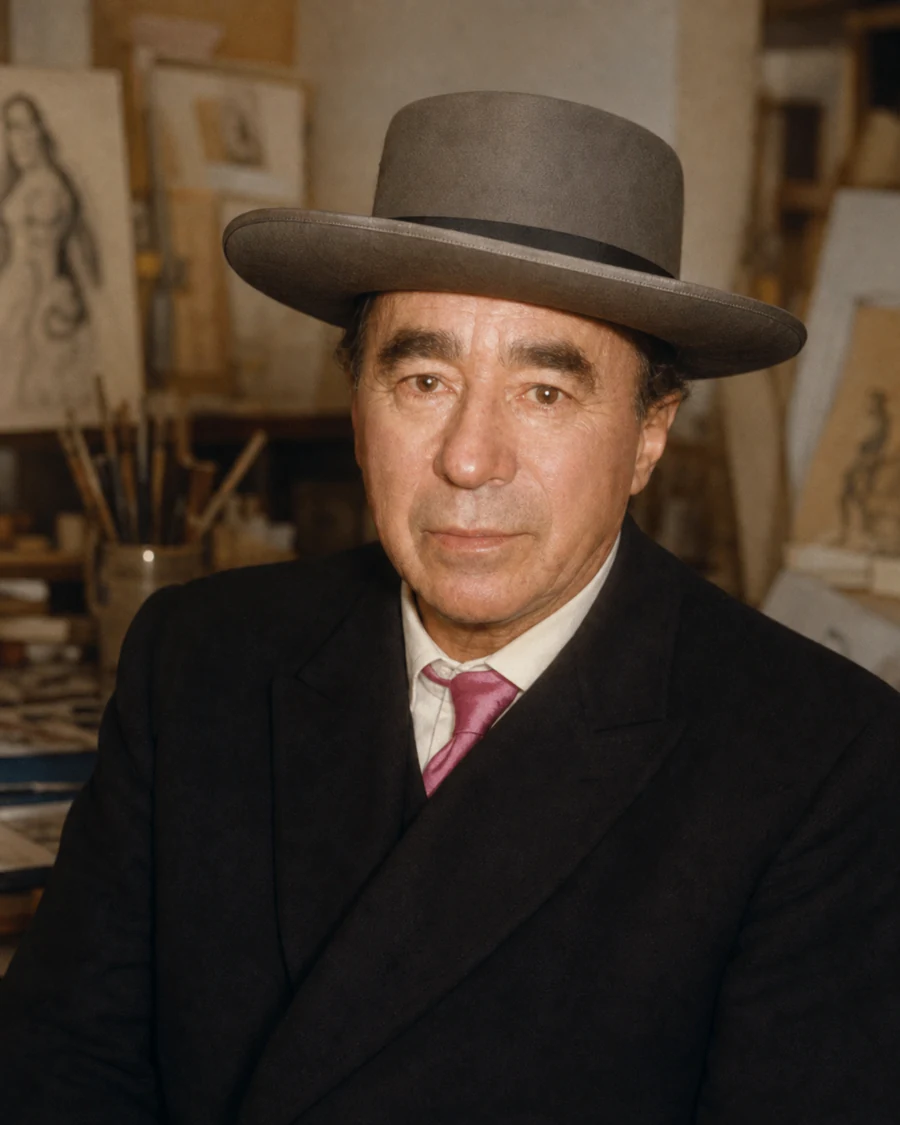
Together with Juan Ramos, Antonio turned fashion illustration from the rendering of clothes into the production of social visibility: drawing, casting, photography, nightlife, race, sexuality and editorial direction became one system.
Editorial thesis
Antonio Lopez matters not because he “saved” fashion illustration from photography. His more radical contribution was to turn the illustrator into the maker of an entire image ecology. With Juan Ramos he selected people, built a social scene, drew from life, photographed, shaped magazines and expanded the canon of fashion beauty.
Reader question
Why do Antonio’s drawings often feel more alive than perfectly executed fashion photography, and why can his history not be told without Juan Ramos?
Short answer
Because their images began not with clothes but with relationships. A real model, music, friends, movement, the drawing session, camera and editorial edit produced the image together; Juan Ramos was the art director and organiser of that system, not an invisible assistant.
1. Utuado, 1943: the fashion image begins with migration, not a fashion capital
Antonio Lopez was born on 11 February 1943 in Utuado, Puerto Rico. His family moved to New York when he was young; The Antonio Archives records his upbringing in the Bronx and an early interest in clothing, drawing and the appearance of people around him. [source]
The biography matters to his visual language. Antonio did not enter fashion illustration through the closed world of the European salon. His eye formed in a city of migration, mixed cultures, street style, dance and the constant collision of different bodies and identities.
2. The Bronx and High School of Art and Design: drawing people before brands
A teacher encouraged Antonio’s talent and helped him enter the High School of Art and Design; he later attended the Fashion Institute of Technology. FIT and the Society of Illustrators both confirm this educational trajectory. [source]
The central skill is not simply the ability to render a dress beautifully, but the ability to seize figure, pose and character quickly. In Antonio’s later work clothes almost always exist through a person rather than replacing the person.
3. FIT, 1961: meeting Juan Ramos changes the unit of authorship
In 1961 Antonio Lopez and Juan Ramos enrolled at FIT, where Antonio studied fashion design and Juan interior design. They met there and began both personal and professional relationships. [source]
This is fundamental to any history of Antonio: “Antonio” often describes not a lone illustrator but a two-person creative system. Juan brought art direction, colour, research, organisation and spatial thinking. Correcting Antonio’s history means restoring Puerto Rican and queer context without erasing Ramos.
4. Juan Ramos: the art director is not an invisible assistant
The Antonio Archives describes Ramos as art director and a key partner whose knowledge of art history, colour theory and composition shaped the drawings. In the 1960s the two left FIT and began operating under the shared signature “Antonio.” [source]
That signature creates a historical problem because museums and magazines can turn collaboration into a single-name biography. A more accurate account separates media and labour: Lopez is primarily the drawing and photographic author; Ramos is art director, researcher, editor and organiser of the production system.
5. Women’s Wear Daily, 1962: industry becomes a school of speed
In 1962 Antonio took an internship at Women’s Wear Daily and quickly became an in-house illustrator while also freelancing for The New York Times. The Antonio Archives and FIT document this early professional phase. [source]
Newspaper and magazine rhythm demands a different drawing from academic study: understand proportion quickly, choose what matters and discard the rest. Fashion illustration becomes an operational translation of new clothes into media.
6. From WWD to freelance: freedom matters more than a fixed style
By the early 1960s Antonio was moving away from a fixed editorial position into freelance practice. The pair’s clients grew to include Harper’s Bazaar, Elle, Saks Fifth Avenue and other major platforms. [source]
This allowed the visual language to keep changing. Marker, pencil, watercolour, collage and saturated colour shift with the assignment. Recognition comes not from one technique but from the energy of body and composition.
7. Carnegie Hall Studios, 1963: the studio becomes a social engine
Antonio and Juan moved into Carnegie Hall Studios in 1963. The archive describes the studio as both a workplace and a node in Manhattan’s art-fashion scene, bringing together models, photographers, designers and friends. [source]
The model stops being an anonymous figure delivered by an agency for two hours. A social circle becomes part of production, which helps explain why figures in the drawings often look present rather than posed.
8. Donna Jordan, Pat Cleveland, Corey Tippin: casting becomes authorship
Antonio and Juan scouted new models in New York and brought Donna Jordan, Pat Cleveland, Corey Tippin and others from their own milieu into editorial work. The Antonio Archives directly links this practice to the expansion of their visual world. [source]
This is already close to casting direction. The illustrator does not wait for a ready-made fashion subject; he helps determine whose body can become a fashion image at all. Drawing changes not only clothes but the social composition of visibility.
9. Charles James, from 1966: extreme clothes require structural knowledge
From 1966 Antonio and Juan worked closely with Charles James, documenting his sculptural garments and drawings. The archive describes a collaboration that continued until James’s death in 1978. [source]
James becomes a school of construction. To stylise a dress radically Antonio first has to understand weight, support, volume and fabric tension. Expressiveness is not the opposite of accuracy; it follows close observation.
10. Line, muscle and weight: the fashion figure stops behaving like a mannequin
Phoenix Art Museum describes Antonio as an exceptionally gifted illustrator and Ramos as art director, researcher and organiser. Together they moved fashion illustration toward a more modern and physically present figure. [source]
Instead of a thin generic mannequin, clothing receives a body with muscle, movement and attitude. Proportions can be exaggerated, but exaggeration does not erase the model; it makes presence more insistent.
11. Europe and Japan: fashion illustration becomes an international network
In the late 1960s Antonio and Juan travelled repeatedly to Paris on Elle assignments while expanding their work in Japan. The Antonio Archives records the role of Japanese contacts including curator-agent Charles Manzo and writer Nao Oishi. [source]
Global reach does not mean a neutral international style. Antonio moves people, poses and visual signals across New York, Paris and Japan while keeping the energy of each environment legible.
12. Paris, 1968: leaving the American fashion establishment
In 1968 Antonio and Juan relocated to Paris, frustrated with the restrictions of the American fashion establishment. They lived in a Left Bank apartment owned by Karl Lagerfeld and entered an international circle of designers, editors and models. [source]
Paris matters not as a centre that simply “recognised” them. The pair brought a different social rhythm: models of colour, camp, sexual freedom and a mixture of high fashion with street energy. Their presence changed the atmosphere of production itself.
13. Karl Lagerfeld: friendship and collaboration without becoming a court illustrator
Karl Lagerfeld became one of the pair’s durable professional relationships. The archive documents shared living, travel and work around Chloé and other projects, but Antonio and Juan never belonged to one designer alone. [source]
Antonio matters because he does not disappear into brand identity. Clothes by Lagerfeld, Valentino, Saint Laurent or Versace enter his visual world while retaining their structural distinctions.
14. Vogue, Elle, Marie Claire, Soen: drawing survives beside photography, not against it
Between 1970 and 1975 Antonio and Juan contributed regularly to Italian, German and French Vogue, Marie Claire, Soen and other publications. Commercial clients included Yves Saint Laurent, Shiseido and Laforet. [source]
Fashion illustration is often narrated as a medium defeated by photography. Antonio demonstrates another possibility: drawing remains necessary when it offers not a neutral record of clothes but a stronger interpretation of movement, sexuality, colour and time.
15. “Antonio’s Girls”: the model becomes a co-author of the image
Jerry Hall, Grace Jones, Jessica Lange, Paloma Picasso, Pat Cleveland, Tina Chow and other women entered the Antonio-Juan circle as models, friends and muses. El Museo del Barrio made this network central to Future Funk Fashion. [source]
The phrase “Antonio’s Girls” should not be read as ownership. It is more productive as a network of mutual formation: Antonio gave models a visual platform, while their bodies, faces, gestures and cultural audacity changed his drawing.
16. Race and the beauty canon: visibility becomes politics inside the fashion image
El Museo del Barrio directly connects Antonio’s work to new representations of ethnic and racialised bodies within high fashion. Phoenix Art Museum likewise emphasises the multinational perspective Antonio and Ramos brought to fashion illustration. [source]
This is central to his contemporary relevance. Diversity does not appear as a late corporate policy; it grows from the actual social circle of friends and models, changing not only the cast but the energy of the image.
17. 1972: the camera does not replace drawing—it becomes another way of looking
In the early 1970s Antonio began actively using Kodak Instamatic and later Polaroid SX-70 cameras. The archive describes portrait studies, reportage sequences and series that were often made without commercial assignments. [source]
Photography offers speed and repetition. Antonio shoots many frames, then edits them into grids that turn small shifts in gesture into character. Drawing and camera work beside one another rather than competing.
18. Grid and sequence: portraiture stops depending on one decisive moment
The Antonio Archives documents a characteristic device: Instamatic sequences assembled into 3×3 compositions. Repetition of the same person across different movements produces a psychologically layered portrait. [source]
This is the opposite of the single ideal fashion pose. Identity develops in time through nine small changes. In contemporary terms it anticipates the contact sheet, carousel and feed as forms of portraiture.
19. 1975: Interview and art direction expand the authorial platform
After returning to New York, Antonio and Juan were invited by Andy Warhol to art direct two 1975 issues of Interview: the Puerto Rico Issue and April in Paris. The Antonio Archives documents these as joint projects. [source]
The division of labour matters. Antonio does not become an art director alone; editorial thinking belongs to the duo. Illustration leaves the isolated page and begins to organise the rhythm of an entire issue.
20. Broadway beside the Factory: the studio becomes a stage again
In 1975 Antonio, Juan and Paul Caranicas returned to New York and took a large studio on Broadway beside Andy Warhol’s Factory. Both environments mixed fashion, portraiture, celebrity, queer culture and nightlife. [source]
Antonio’s method nevertheless differs from Warhol’s. His image often begins in live drawing sessions, physical proximity and prolonged observation of the model rather than mechanical repetition of an existing media image.
21. Fiorucci, 1976: the fashion image leaves the magazine and enters retail
Antonio and Juan consulted for Fiorucci in New York, working with window displays and introducing designers to store buyers. The archive dates the project to 1976. [source]
The profession has expanded. Illustrator and art director now shape not just the page but the cultural temperature of a shop. Retail acts as media: window, merchandise, music, people and graphics form one image.
22. Studio 54, 1977: nightlife becomes a production environment
For the opening of Studio 54 Antonio and Juan designed athleisure-inspired costumes for an Alvin Ailey Dance Theater performance choreographed by Kay Thompson. [source]
Nightlife should not be treated as entertainment after office hours. The club was a laboratory for pose, music, sexuality and new social mixtures. What happened at night could return the next day as drawing, casting or magazine imagery.
23. 1978: Anuan Ltd. and breakdance—the authorial system becomes a company
In 1978 Antonio and Juan formed Anuan Ltd., giving their joint practice a business structure. At the same time they looked closely at emerging breakdance and invited Rock Steady Crew and other dancers into the studio. [source]
The pairing is revealing: business structure and street movement arrive together. One side requires managing an international practice; the other keeps looking toward bodies and gestures not yet canonised by fashion.
24. Photo Cocktail Party, 1979: photography becomes a live event
In 1979 Antonio and Juan staged the Photo Cocktail Party at Robert Freidus Gallery. Guests posed for a large-format Polaroid camera and the resulting images were installed on the walls as the evening unfolded. [source]
This is neither a standard fashion shoot nor a conventional exhibition. Production, social event and display happen at the same time, and the audience becomes a participant in making the archive of its own night.
25. Vanity, 1980–1983: the magazine as a total illustration laboratory
Anna Piaggi invited Antonio and Juan to work on the new Vanity. The archive describes the first issue as an almost total portfolio, with dozens of drawings and hundreds of Polaroids used as both published and preparatory material. [source]
Vanity proves that illustration can organise an entire editorial world. Drawing, photography, styling, pose, typography and fashion references become one saturated system rather than separate pages.
26. Versace, Armani, Missoni: commercial success does not make the language safe
In the 1980s Antonio and Juan expanded their clients to Versace, Armani, Missoni and other major houses. FIT preserves, for example, a 1981 Antonio illustration of a Versace look for Italian Vogue. [source]
A successful commercial illustrator risks repeating a formula. Antonio maintains range by changing technique, format and model together with the commission. The client remains legible, but the image never becomes neutral product rendering.
27. Antonio’s Girls, 1982 and books: ephemeral editorial work becomes an authored archive
In 1982 Antonio and Juan published Antonio’s Girls, gathering drawings from 1973–1981. Antonio’s Tales from the Thousand and One Nights followed in 1985. The archive now treats these books as part of the pair’s core bibliography. [source]
The book changes the status of fashion drawing. An image once tied to season and magazine becomes a corpus that the authors themselves select, reorder and pass to a future audience.
28. Teaching: live drawing becomes a method that can be transmitted
Antonio and Juan taught drawing classes and seminars at FIT, Otis, Kent State, Bunka College and other institutions. The archive emphasises Ramos’s systematic documentation of the practice with future teaching in mind. [source]
This helps explain their importance to professional history: the practice was both production and method. Working from a live model, drawing quickly, building image through movement and editing continuously can be taught without reducing Antonio’s style to copyable tricks.
29. 1984–1987: AIDS, late portraiture and an interrupted career
Antonio was diagnosed with HIV in 1984 and continued to work, including projects for Oscar de la Renta and Norma Kamali, while developing more personal portraiture. He died in Los Angeles on 17 March 1987 from AIDS-related complications, aged 44. [source]
AIDS should not appear as a dramatic epilogue after the “real” career. The epidemic destroyed entire networks across fashion, art and queer culture. Antonio’s death is not a completed stylistic evolution but the loss of a possible future.
30. 2025–2026: the archive returns the duo to a history larger than fashion illustration
In 2025–2026 Antonio, estética exuberante (1962–1987) was presented at Museo de Arte de Puerto Rico after a showing at Museo Franz Mayer; The Antonio Archives also records the work’s presence in 2026 projects. [source]
Antonio Lopez’s legacy cannot be reduced to “the great illustrator before photography won.” With Juan Ramos he demonstrated a more radical model: fashion images emerge from social networks, live bodies, drawing, photography, collage, nightlife, race, sexuality and editorial direction. That is why the work still feels alive.