illustrator profile
Mats Gustafson
Watercolour, silhouette and silence: fashion illustration as reduction
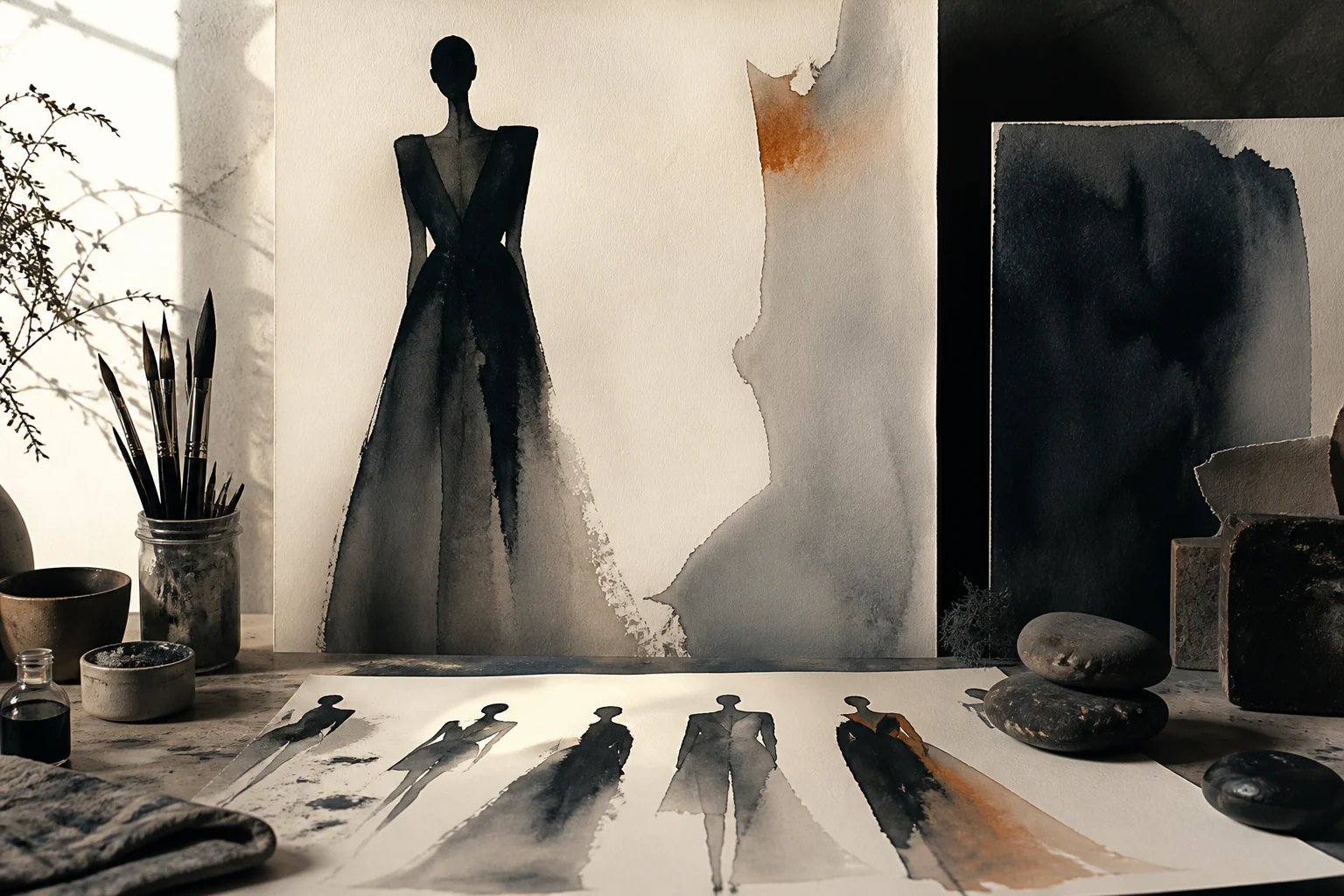
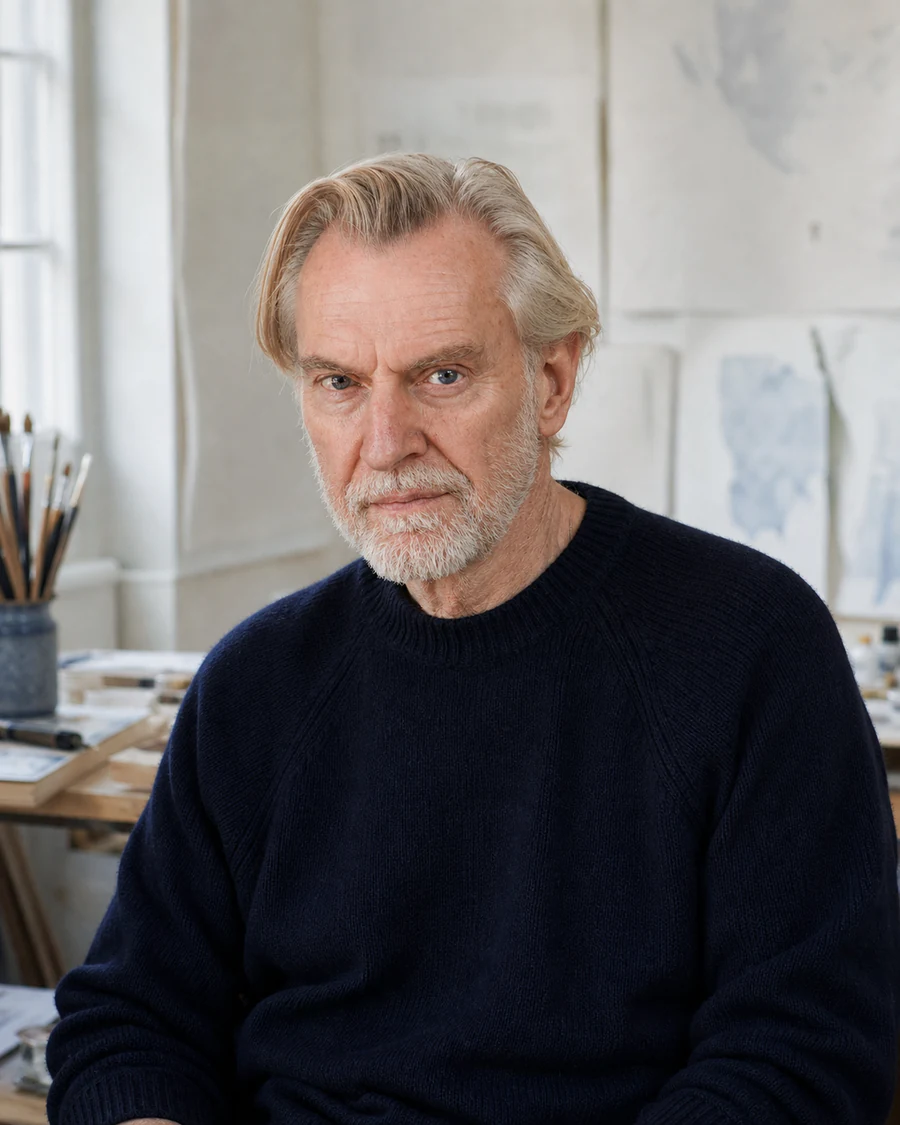
Mats Gustafson builds fashion imagery through reduction: watercolour wash, line, silhouette and empty field replace detailed description. His work shows that illustration can be both precise and indeterminate, capturing the character of a collection without becoming a technical drawing.
Editorial thesis
Mats Gustafson builds fashion imagery through reduction: watercolour wash, line, silhouette and empty field replace detailed description. His work shows that illustration can be both precise and indeterminate, capturing the character of a collection without becoming a technical drawing.
Reader question
Why can a few transparent washes sometimes convey a collection more precisely than a detailed rendering of every element?
Short answer
Swedish artist and illustrator Mats Gustafson has worked between fashion and art since the 1970s. Watercolour, pastel and graphite let him reduce the figure to rhythm and mass, while his long collaboration with Dior shows how drawing can accompany a contemporary fashion house without replacing photography.
1. Sweden and an early visual culture
Gustafson was born in Sweden in 1951 and entered professional illustration in the 1970s, gradually connecting editorial work with independent drawing. [source]
2. Mechanism: restraint and selection
A Nordic tradition of restraint does not fully explain his method, but helps illuminate the value of emptiness and precise reduction. The point is not an isolated gesture but a way of organising practice. The decision connects author, material, institution, technology and audience, so it cannot be reduced to a personal signature or a polished result. For VANSMITHLAB this episode functions as a mechanism that can be compared across neighbouring practices. [source]
3. Significance: restraint and selection
This episode explains why Mats Gustafson belongs in VANSMITHLAB’s map of authors. The significance lies in changing professional rules: who decides, how authorship is distributed, what counts as the result, and how the work enters public culture. The profile therefore keeps context attached to achievement instead of turning biography into a list of milestones. [source]
4. Watercolour: an image built from transparency
Watercolour became one of Gustafson’s central materials: colour is laid in transparent layers and often leaves the edge of the figure open. [source]
5. Mechanism: watercolour as method
The medium does not simply colour the drawing; its fluidity determines how fabric, skin and surrounding air are perceived. The point is not an isolated gesture but a way of organising practice. The decision connects author, material, institution, technology and audience, so it cannot be reduced to a personal signature or a polished result. For VANSMITHLAB this episode functions as a mechanism that can be compared across neighbouring practices. [source]
6. Significance: watercolour as method
This episode explains why Mats Gustafson belongs in VANSMITHLAB’s map of authors. The significance lies in changing professional rules: who decides, how authorship is distributed, what counts as the result, and how the work enters public culture. The profile therefore keeps context attached to achievement instead of turning biography into a list of milestones. [source]
7. Pastel and graphite: mass and line
Alongside watercolour, Gustafson uses pastel and graphite, changing image density according to the clothing and purpose. [source]
8. Mechanism: medium and density
Different materials allow movement among contour, mass and surface without losing the overall discipline of reduction. The point is not an isolated gesture but a way of organising practice. The decision connects author, material, institution, technology and audience, so it cannot be reduced to a personal signature or a polished result. For VANSMITHLAB this episode functions as a mechanism that can be compared across neighbouring practices. [source]
9. Significance: medium and density
This episode explains why Mats Gustafson belongs in VANSMITHLAB’s map of authors. The significance lies in changing professional rules: who decides, how authorship is distributed, what counts as the result, and how the work enters public culture. The profile therefore keeps context attached to achievement instead of turning biography into a list of milestones. [source]
10. The figure without a fully described face
In many works the face is minimally indicated or almost absent while pose, shoulders and silhouette retain individual character. [source]
11. Mechanism: character through pose
Identity can emerge through bodily movement rather than facial likeness alone. The point is not an isolated gesture but a way of organising practice. The decision connects author, material, institution, technology and audience, so it cannot be reduced to a personal signature or a polished result. For VANSMITHLAB this episode functions as a mechanism that can be compared across neighbouring practices. [source]
12. Significance: character through pose
This episode explains why Mats Gustafson belongs in VANSMITHLAB’s map of authors. The significance lies in changing professional rules: who decides, how authorship is distributed, what counts as the result, and how the work enters public culture. The profile therefore keeps context attached to achievement instead of turning biography into a list of milestones. [source]
13. Fashion as silhouette rather than inventory
Gustafson often reduces complex clothing to a few large masses and relations rather than cataloguing every decorative detail. [source]
14. Mechanism: silhouette as thesis
The drawing captures a collection’s principle and proportion before material becomes description. The point is not an isolated gesture but a way of organising practice. The decision connects author, material, institution, technology and audience, so it cannot be reduced to a personal signature or a polished result. For VANSMITHLAB this episode functions as a mechanism that can be compared across neighbouring practices. [source]
15. Significance: silhouette as thesis
This episode explains why Mats Gustafson belongs in VANSMITHLAB’s map of authors. The significance lies in changing professional rules: who decides, how authorship is distributed, what counts as the result, and how the work enters public culture. The profile therefore keeps context attached to achievement instead of turning biography into a list of milestones. [source]
16. Dior: drawing accompanies a contemporary house
Gustafson produced work around Dior women’s collections, including the Raf Simons period and later projects, with drawings gathered in a dedicated book. [source]
17. Mechanism: drawing as a second look
Illustration does not replace official photography; it offers a second, slower and more subjective reading of a collection. The point is not an isolated gesture but a way of organising practice. The decision connects author, material, institution, technology and audience, so it cannot be reduced to a personal signature or a polished result. For VANSMITHLAB this episode functions as a mechanism that can be compared across neighbouring practices. [source]
18. Significance: drawing as a second look
This episode explains why Mats Gustafson belongs in VANSMITHLAB’s map of authors. The significance lies in changing professional rules: who decides, how authorship is distributed, what counts as the result, and how the work enters public culture. The profile therefore keeps context attached to achievement instead of turning biography into a list of milestones. [source]
19. Magazine and gallery: one practice in two systems
Gustafson’s work exists both as editorial commission and in gallery contexts where drawing is treated as an autonomous work. [source]
20. Mechanism: editorial and exhibition contexts
Moving between systems changes the mode of reading: in a magazine the drawing enters a sequence; in a gallery the viewer remains with the sheet longer. The point is not an isolated gesture but a way of organising practice. The decision connects author, material, institution, technology and audience, so it cannot be reduced to a personal signature or a polished result. For VANSMITHLAB this episode functions as a mechanism that can be compared across neighbouring practices. [source]
21. Significance: editorial and exhibition contexts
This episode explains why Mats Gustafson belongs in VANSMITHLAB’s map of authors. The significance lies in changing professional rules: who decides, how authorship is distributed, what counts as the result, and how the work enters public culture. The profile therefore keeps context attached to achievement instead of turning biography into a list of milestones. [source]
22. Restraint against information overload
In digital culture, where fashion imagery easily becomes hyper-detailed and continuous, Gustafson’s drawings preserve large fields of silence. [source]
23. Mechanism: visual silence
Missing information becomes an active decision that returns space to the viewer’s imagination. The point is not an isolated gesture but a way of organising practice. The decision connects author, material, institution, technology and audience, so it cannot be reduced to a personal signature or a polished result. For VANSMITHLAB this episode functions as a mechanism that can be compared across neighbouring practices. [source]
24. Significance: visual silence
This episode explains why Mats Gustafson belongs in VANSMITHLAB’s map of authors. The significance lies in changing professional rules: who decides, how authorship is distributed, what counts as the result, and how the work enters public culture. The profile therefore keeps context attached to achievement instead of turning biography into a list of milestones. [source]
25. The book as an archive of observation
Publishing projects including Mats Gustafson: Dior assemble drawings across seasons and turn ongoing work into a historical layer. [source]
26. Mechanism: archive through the book
A book makes it possible to see a recurring method across changing collections rather than one successful illustration. The point is not an isolated gesture but a way of organising practice. The decision connects author, material, institution, technology and audience, so it cannot be reduced to a personal signature or a polished result. For VANSMITHLAB this episode functions as a mechanism that can be compared across neighbouring practices. [source]
27. Significance: archive through the book
This episode explains why Mats Gustafson belongs in VANSMITHLAB’s map of authors. The significance lies in changing professional rules: who decides, how authorship is distributed, what counts as the result, and how the work enters public culture. The profile therefore keeps context attached to achievement instead of turning biography into a list of milestones. [source]
28. Legacy: reduction as respect for the viewer
Gustafson shows that fashion illustration remains contemporary when it does not try to imitate photography’s capabilities. [source]
29. Mechanism: reduction and imagination
Reduction leaves work for the viewer: to see the unstated, sense material and assemble a figure from a few traces. The point is not an isolated gesture but a way of organising practice. The decision connects author, material, institution, technology and audience, so it cannot be reduced to a personal signature or a polished result. For VANSMITHLAB this episode functions as a mechanism that can be compared across neighbouring practices. [source]
30. Significance: reduction and imagination
This episode explains why Mats Gustafson belongs in VANSMITHLAB’s map of authors. The significance lies in changing professional rules: who decides, how authorship is distributed, what counts as the result, and how the work enters public culture. The profile therefore keeps context attached to achievement instead of turning biography into a list of milestones. [source]