industrial designer profile
Achille Castiglioni
Curiosity, Function and the Intelligence of Everyday Objects
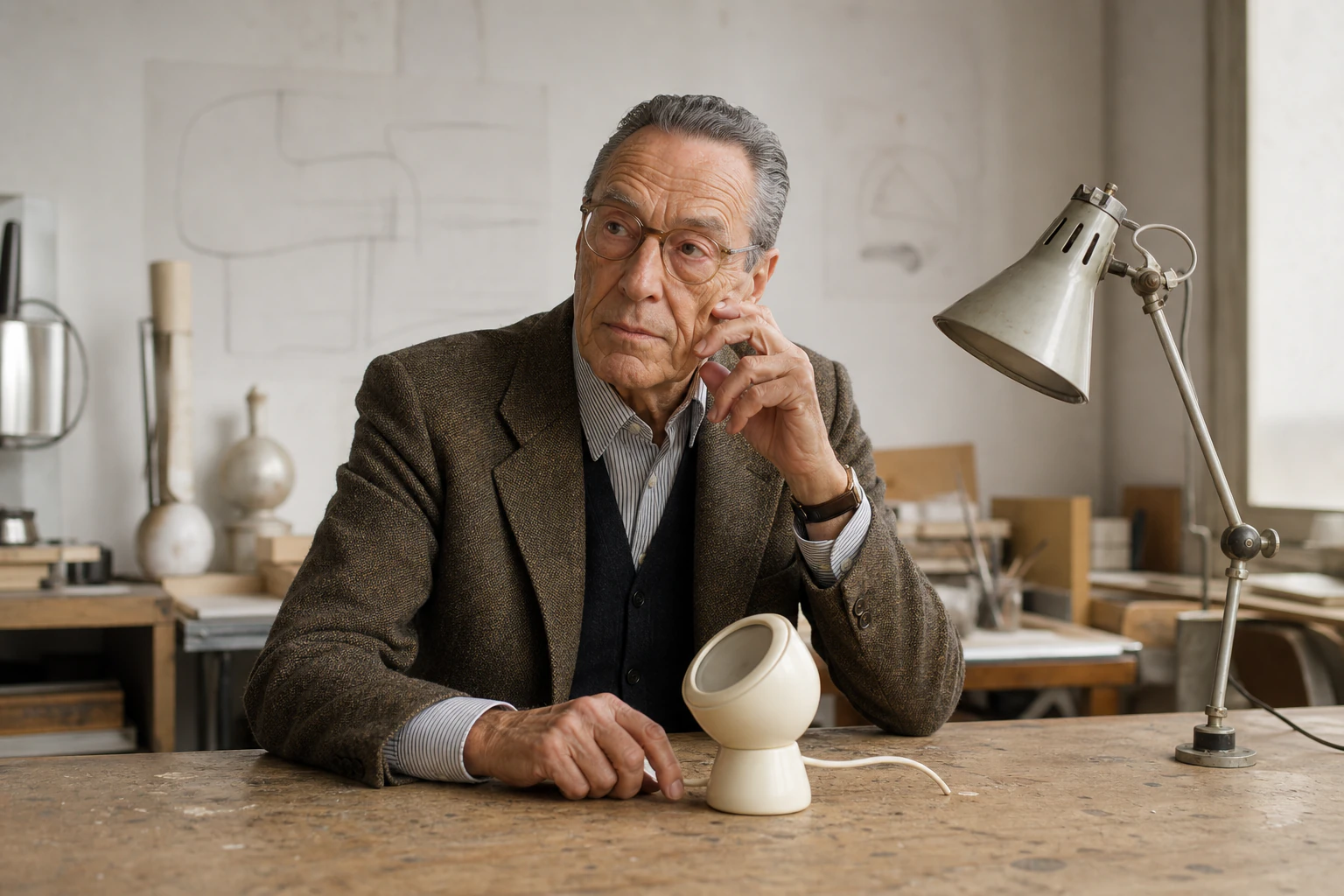
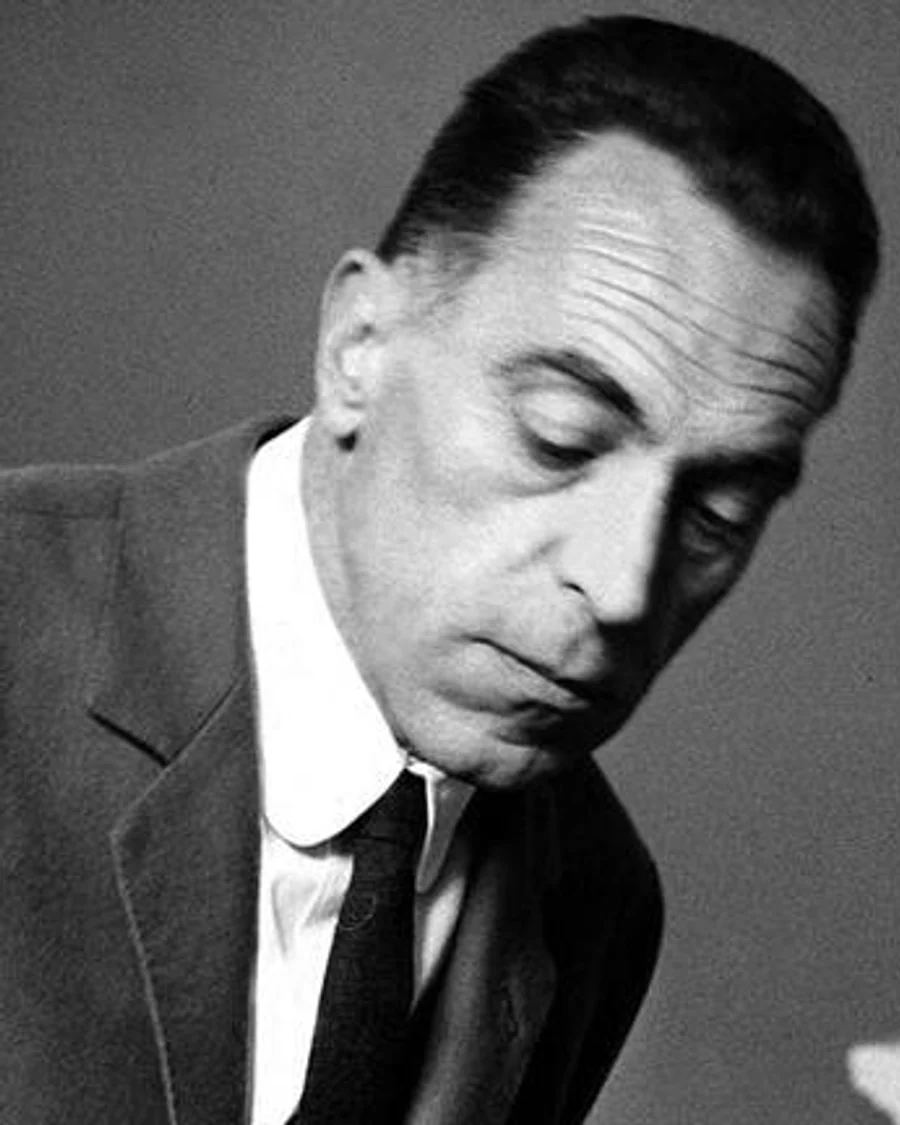
Castiglioni showed that industrial design does not begin with a beautiful form but with close attention to the existing world: function, typology, industrial component, error and human behaviour.
Editorial thesis
Achille Castiglioni’s central contribution is not Arco, Mezzadro or a list of museum icons in isolation. He turned curiosity into professional method: analyse behaviour, notice intelligent anonymous objects, identify the decisive component of a problem, and only then build a new typology.
Reader question
Why do Castiglioni’s objects feel both obvious and strange—as if the solution had always existed but no one had recognised it?
Short answer
Because he rarely began with form. He began with action and existing technical logic, removed the unnecessary, changed context and allowed function to generate visual character.
1. Milan, 1918: a designer grows up around art but chooses industry
Achille Castiglioni was born in Milan on 16 February 1918 and graduated in architecture from the Politecnico di Milano in 1944. His father Giannino was a sculptor, yet Achille’s practice quickly moved toward serial products, exhibitions and interiors. [source]
The distinction matters. Castiglioni did not oppose artistic sensitivity to industrial production. He treated modern form as something that had to survive tests of material, technology, use and repeatability.
2. Livio and Pier Giacomo: early Castiglioni is not a lone-author story
From 1940 Achille experimented with industrial products alongside his brothers Livio and Pier Giacomo. After the war he worked in their Milan studio; Livio later left the practice, while Achille and Pier Giacomo continued as an exceptionally close design pair until Pier Giacomo’s death in 1968. [source]
For VANSMITHLAB this is essential: many celebrated objects of the 1950s and 1960s are shared authorship. Salone del Mobile explicitly stresses that Achille and Pier Giacomo did not divide their roles rigidly.
3. Postwar Italy: design becomes part of rebuilding everyday life
Castiglioni’s career developed alongside postwar Italy’s transformation into an industrial and consumer economy. Manufacturers needed new typologies for the home, office, bar, shop and public environment. [source]
His objects therefore should not be read only as “Made in Italy icons.” They answered actual change: electricity became more mobile, interiors more flexible, public consumption more widespread, and industrial components gained permission to enter domestic space.
4. Curiosity as method: “if you are not curious, forget it”
The Fondazione Achille Castiglioni and Flos continue to cite his line, “If you are not curious, forget it.” Curiosity was not merely a charming personality trait; it was a working procedure. [source]
He collected overlooked objects, studied mechanisms, asked elementary questions and tested whether an existing solution could migrate into another context. Novelty often came not from trying to make a strange form, but from recognising functional intelligence in something already present.
5. Anonymous objects: the designer first learns from things without authors
The Studio Museo preserves the collection of “anonymous objects” that Castiglioni also used in teaching. The Foundation presents them as everyday solutions valued not for author prestige but for the precision of form and function. [source]
This weakens the cult of the designer’s name. Before inventing a new chair or lamp, Castiglioni asks us to inspect a clamp, agricultural component, spring, switch or household tool and understand why it already works.
6. Luminator, 1954–1955: reduction as an engineering gesture
Luminator, designed by Achille and Pier Giacomo and awarded the Compasso d’Oro in 1955, reduces a floor lamp to tripod, socket and directed light. MoMA holds the work, and Flos continues its production. [source]
Its minimal appearance is not a style. Everything not participating in stability, electricity or light distribution has been removed. It is a clear instance of design by subtraction long before minimalism became a marketing cliché.
7. 1956: ADI and design as professional infrastructure
Castiglioni was among the founders of the Associazione per il Disegno Industriale in 1956. The fact matters as much as any single object: Italian design was being built simultaneously as practice and professional infrastructure. [source]
The designer is no longer simply an artist who makes furniture. The role operates inside a network of manufacturer, engineer, exhibition, award, school and criticism. Industrial design becomes an autonomous cultural system.
8. Mezzadro, 1957: a tractor seat migrates into the home
Achille and Pier Giacomo developed Mezzadro for the Villa Olmo exhibition in 1957; Zanotta put it into production in 1970. Its starting point is a serial metal agricultural-machine seat joined to a new support system. [source]
The point is not the joke of placing a tractor in the living room. The object tests whether an already optimised industrial component can change context and function without disguising its origin.
9. Sella, 1957: sitting does not always mean settling down
Sella was developed alongside Mezzadro and used a bicycle saddle on a vertical support with a hemispherical base. Zanotta brought it into production much later. [source]
It is not a conventional chair but a device for brief support. Castiglioni distinguishes behaviours: sit, perch, wait, talk while nearly standing. A new typology emerges from exact observation of an action.
10. Toio, 1962: an automotive lamp becomes domestic light
Toio, designed by Achille and Pier Giacomo, is built around an automotive lamp and exposed electrical construction. MoMA and Flos preserve the joint 1962 attribution. [source]
The ready-made technical component is not concealed by a designer shell. Its origin becomes part of the object’s character. Domestic lighting shows its assembly and turns engineering into visual language.
11. Arco, 1962: ceiling light without a hole in the ceiling
Arco was designed by Achille and Pier Giacomo for Flos in 1962. A curved metal arm carries light over a table, while a heavy marble base avoids ceiling installation. [source]
Its significance is typological: it is not sculpture shaped like an arc but portable architecture for light. In 2020 ADI awarded Arco the Compasso d’Oro alla Carriera del Prodotto, explicitly recognising the endurance of its innovation.
12. Taccia, 1962: invert the logic of the lamp
Taccia, another joint work by the brothers, develops a reflected-light system. Its large bowl and reflector make the object resemble a ceiling fixture turned upside down and placed on a base. [source]
The design gains force from a simple conceptual inversion. Instead of adding decoration, it reverses an established typology and then adapts material and heat management to the new logic.
13. Splügen Bräu: interior and product are designed as one scene
In public interiors the Castiglioni brothers connected space, furniture, lighting, graphics and equipment. Splügen Bräu became one of the best-known examples of this integral approach; the Flos lights bearing the same name still preserve joint attribution. [source]
The interior is not a container for isolated icons. A product first emerges as part of a specific spatial problem and only later may enter serial production.
14. Exhibition design: temporary space as laboratory
The Foundation documents decades of Castiglioni exhibition and staging work for the Triennale di Milano, RAI, AGIP and cultural or commercial displays. [source]
A temporary exhibition allows faster risk than architecture: testing scale, suspension, visitor movement, sound, graphics and found objects. Many principles of Castiglioni product design become clearer when viewed beside his allestimenti.
15. Humor without decoration: irony works only after function
Castiglioni is often associated with humour, yet his strongest jokes are not decorative additions. They emerge from function: a bicycle saddle really supports a body, a tractor seat is genuinely engineered for load, and an automotive lamp actually produces powerful light. [source]
Irony therefore does not cancel engineering discipline. It helps the user see a familiar thing again, but it does not replace problem-solving.
16. 1968: Pier Giacomo’s death forces authorship to be redrawn
After Pier Giacomo died in 1968, Achille continued alone. The Foundation biography clearly separates the collaborative period from the later individual practice. [source]
That distinction matters for cataloguing. We should not automatically assign every “Castiglioni” product to Achille, nor treat later work as if the two-brother system continued unchanged. After 1968 both authorship and collaboration structures shift.
17. After 1968: curiosity remains while typologies expand
Achille’s individual career spans lighting, furniture, tableware, sanitary and medical equipment, exhibitions and many smaller devices. The Foundation’s regesto reveals the breadth of these typologies. [source]
He did not turn fame into a narrow signature collection. Method mattered more than visual similarity: each problem begins again with what a person actually needs and which part of the solution may already exist.
18. Parentesi, 1971–1979: collaboration with an unfinished idea
Parentesi is attributed to Achille Castiglioni and Pio Manzù. Flos preserves the joint credit, while ADI records its 1979 Compasso d’Oro. [source]
The project is especially important for authorship: Manzù died before final development, and Castiglioni continued from the originating principle. The result cannot honestly be reduced to “an Achille lamp” without preserving Pio Manzù’s name.
19. Teaching in Turin and Milan: anonymous objects enter the classroom
After receiving his teaching qualification in 1969, Castiglioni taught in Turin and later served as professor of Industrial Design at the Politecnico di Milano until 1993. The Foundation directly links his teaching method to the collection of anonymous objects. [source]
Teaching was not organised around copying a master’s style. Students were expected to see function, ask questions, inspect components and “start from scratch” rather than trust the first attractive form.
20. Compasso d’Oro: nine awards as a map of typologies, not a beauty ranking
The Foundation lists nine Compasso d’Oro recognitions, ranging from Luminator and the Pitagora coffee machine to a beer dispenser, simultaneous-translation headphones, Parentesi, medical equipment, Dry and a special professional award. [source]
The range matters more than the count. Castiglioni was not optimising one furniture category. Design quality had to work across lighting, public consumption, communication, healthcare and tableware.
21. Dry for Alessi: innovation may begin with a small problem at the table
The Dry cutlery system received the Compasso d’Oro in 1984. Alessi describes Castiglioni’s approach through two needs: solve practical problems of use and achieve a metal finish that also satisfies users aesthetically. [source]
This corrects the myth of the great designer producing only great icons. The scale of a problem does not define the scale of design intelligence: spoon, knife and server deserve the same discipline of observation.
22. The manufacturer as co-author: Flos, Zanotta, Alessi and others
The Foundation lists a long range of companies that worked with Castiglioni, including Flos, Zanotta, Alessi, Brionvega, Cassina, De Padova and Ideal Standard. [source]
A serial product does not emerge from one person’s sketch. Manufacturers determine technology, tooling, cost, testing, service and longevity. The brand therefore belongs to production authorship, not merely as a logo beside the designer’s name.
23. Prototype: thinking with the hands before final form
The Studio Museo preserves models, prototypes, drafting machines and test objects, and the Foundation makes the process part of its guided visits. [source]
For Castiglioni a prototype is not a presentation model but a way to catch error. Size, balance, cable movement, lamp temperature or body position often become clearer in a physical test than in an abstract statement.
24. The “Principal Design Component”: identify the decisive part of the problem
The Design Museum associates Castiglioni with the idea of a Principal Design Component: the technological or functional leap around which a project should be organised. [source]
This is more useful than beginning with form. In Arco the decisive issue is moving overhead light without fixing it to the ceiling; in Mezzadro it is the existing industrial seat; in Parentesi it is movement along a tensioned cable.
25. Retrospectives of the 1980s–1990s: products become historical canon
During the 1980s and 1990s Castiglioni received major solo exhibitions in Europe, and in 1997–1998 MoMA presented Achille Castiglioni: Design! with reconstructions of interiors from different periods. [source]
Museum status creates a risk: a product made for use can begin to look like autonomous sculpture. A strong retrospective has to recover function, context and production process rather than simply place the icon on a pedestal.
26. MoMA: shared authorship remains visible even in the museum database
MoMA currently shows 20 Achille Castiglioni works online; for Luminator, Toio, Arco, Snoopy and other early objects the museum keeps Pier Giacomo’s name beside Achille’s. [source]
This is a useful standard for digital archives. Popular culture prefers the short label “Castiglioni,” but a database must be more precise than legend, particularly when collaboration structured decades of practice.
27. 2001: an honorary degree returns design to the university as a mature discipline
In 2001 the Politecnico di Milano awarded Castiglioni an honorary degree in Industrial Design, still recorded by the School of Design. [source]
Symbolically the circle closes: an architecture graduate returns to the university as a representative of an autonomous design discipline that his generation helped institutionalise.
28. After 2002: re-edition should not erase original context
Achille Castiglioni died on 2 December 2002. Many of his objects remain in production through Flos, Zanotta, Alessi and other manufacturers, with some adapted to LED technology or current standards. [source]
Commercial longevity confirms typological strength, but original development, later technical adaptation and current product marketing should remain distinct. An “icon” is not an object frozen outside time.
29. Foundation and Studio Museo: archive as continuation of method
After the designer’s death, the studio at Piazza Castello 27 was opened to the public, and the Fondazione Achille Castiglioni was established in 2011. Its mission is to catalogue, archive, digitise and communicate projects, drawings, photographs, models, films and collected objects. [source]
It is a particularly productive model of legacy because it preserves not only finished products but the environment of thinking: prototypes, errors, tools and anonymous finds.
30. 2026: the legacy lives not as retro style but as a culture of attention
In 2026 the Foundation continues guided visits, archival work and exhibitions; during 2026 it announced “Achille e Bruno . liberi di giocare.” Salone del Mobile also returned to Castiglioni in January 2026 as a central figure in the culture of everyday design. [source]
The lesson is not to imitate Arco or Mezzadro. It is to look at ordinary things without snobbery, identify the decisive functional component, prototype, preserve humour and avoid confusing originality with mandatory novelty of form.