industrial designer profile
Charles & Ray Eames
A collaborative practice as laboratory: furniture, architecture, film, exhibitions and learning through play
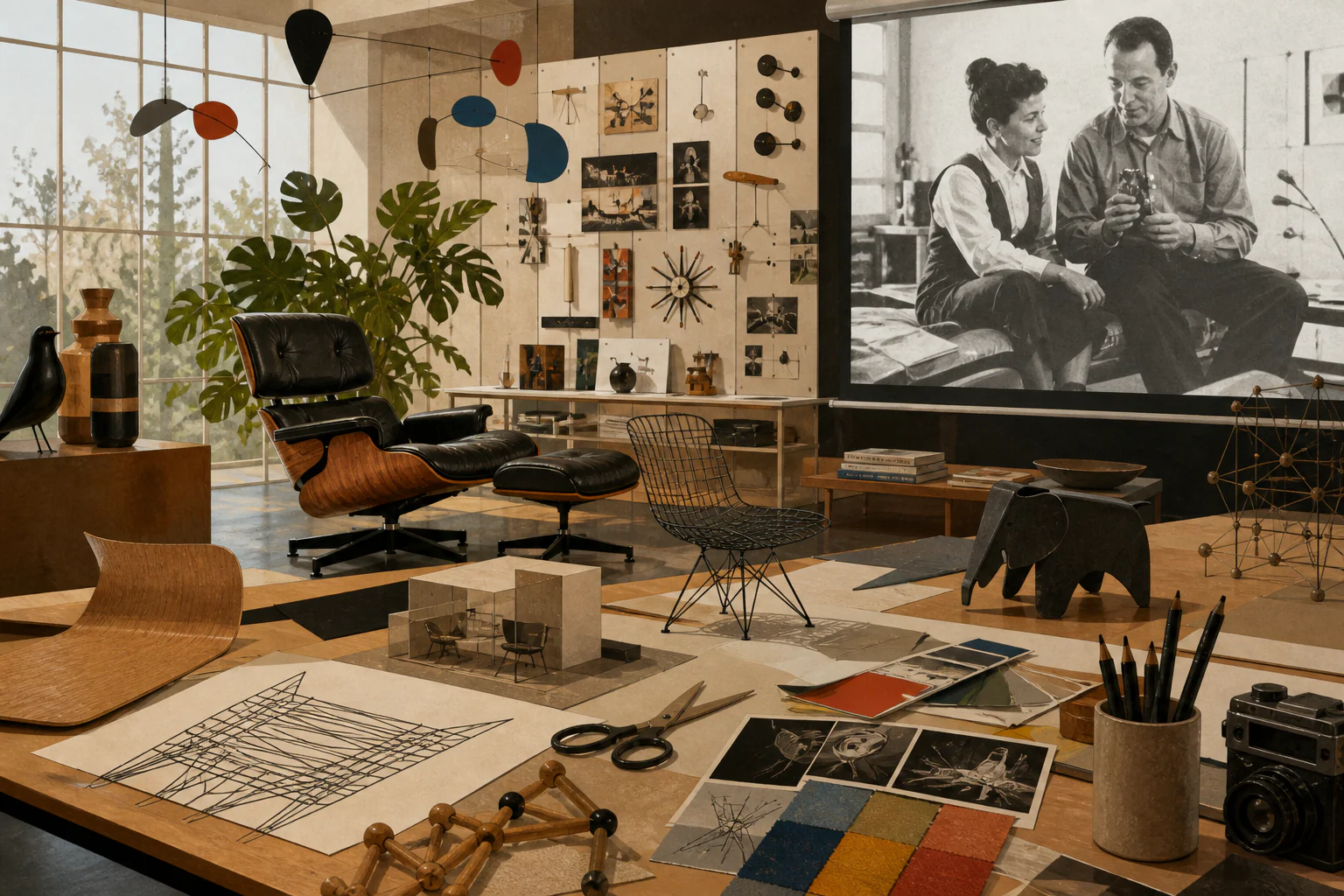
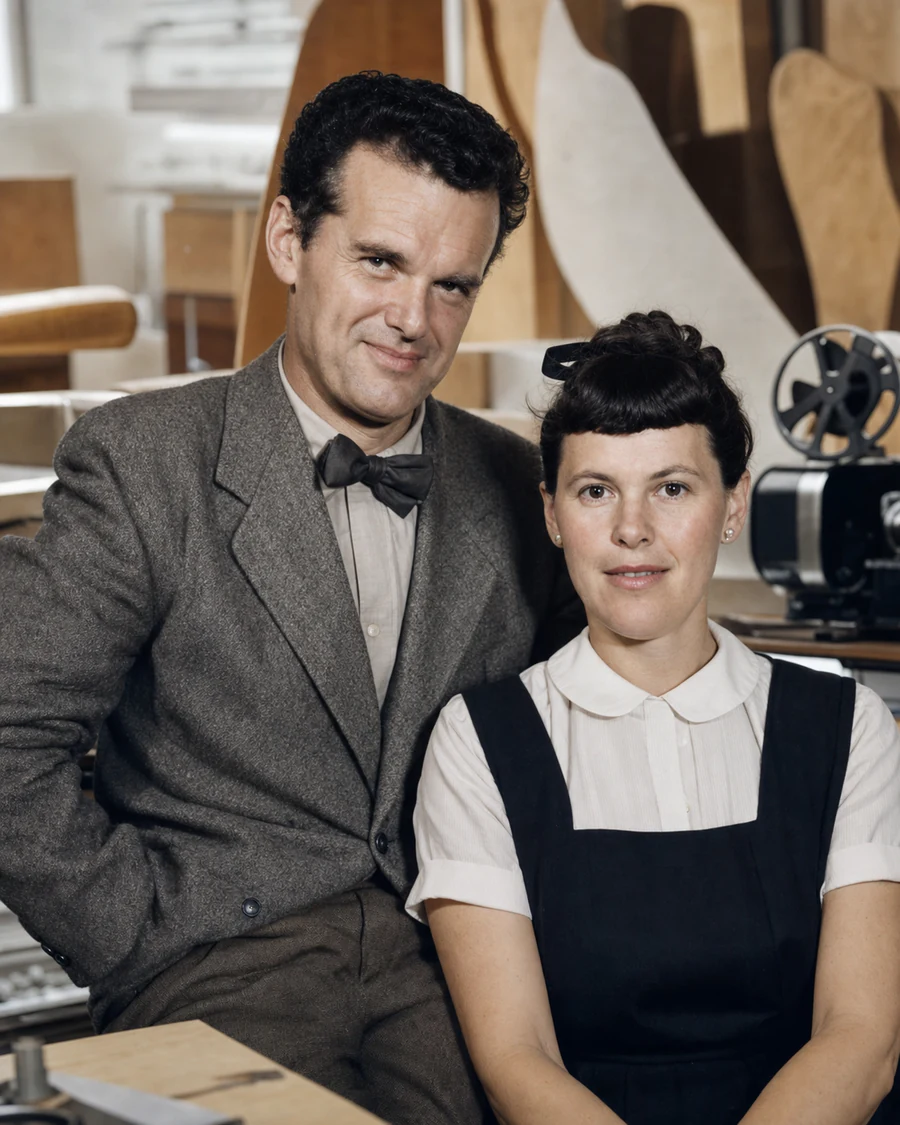
Charles and Ray Eames matter not as a collection of isolated icons but as a way of working. They connected material experiment, industrial production, architecture, photography, film, exhibitions and toys in one research practice in which ideas were repeatedly tested through prototypes and use.
Editorial thesis
Charles and Ray Eames matter not as a collection of isolated icons but as a way of working. They connected material experiment, industrial production, architecture, photography, film, exhibitions and toys in one research practice in which ideas were repeatedly tested through prototypes and use.
Reader question
How did a husband-and-wife studio turn different forms of design and media into one system for investigating everyday life?
Short answer
The Eames Office, established in Los Angeles in 1941, worked simultaneously across furniture, architecture, film, graphics, exhibitions and educational objects. Instead of separating disciplines, Charles and Ray built a continuous process: observation, model, test, production, feedback and another version.
1. 1941: Eames Office as a collaborative practice
Charles and Ray Eames established their joint Los Angeles office in 1941. From the beginning their work did not fit neatly within a single professional category. [source]
2. Mechanism: collaborative authorship
It is important to describe a collaborative practice rather than divide ideas through the simplified formula of architect-husband and artist-wife. The point is not an isolated gesture but a way of organising practice. The decision connects author, material, institution, technology and audience, so it cannot be reduced to a personal signature or a polished result. For VANSMITHLAB this episode functions as a mechanism that can be compared across neighbouring practices. [source]
3. Significance: collaborative authorship
This episode explains why Charles & Ray Eames belongs in VANSMITHLAB’s map of authors. The significance lies in changing professional rules: who decides, how authorship is distributed, what counts as the result, and how the work enters public culture. The profile therefore keeps context attached to achievement instead of turning biography into a list of milestones. [source]
4. Moulded plywood: material teaches design
Experiments in moulded plywood preceded mass furniture production and included wartime splints, shells and numerous technical trials. [source]
5. Mechanism: material as teacher
Form emerges from the possibilities of material and tooling rather than a silhouette drawn in advance. The point is not an isolated gesture but a way of organising practice. The decision connects author, material, institution, technology and audience, so it cannot be reduced to a personal signature or a polished result. For VANSMITHLAB this episode functions as a mechanism that can be compared across neighbouring practices. [source]
6. Significance: material as teacher
This episode explains why Charles & Ray Eames belongs in VANSMITHLAB’s map of authors. The significance lies in changing professional rules: who decides, how authorship is distributed, what counts as the result, and how the work enters public culture. The profile therefore keeps context attached to achievement instead of turning biography into a list of milestones. [source]
7. The wartime splint: design between body and production
During the Second World War the office developed moulded plywood splints for injured servicemen, connecting material experimentation with anatomical and production constraints. [source]
8. Mechanism: testing form against the body
The episode breaks the myth that the famous chairs emerged from aesthetic desire alone. The point is not an isolated gesture but a way of organising practice. The decision connects author, material, institution, technology and audience, so it cannot be reduced to a personal signature or a polished result. For VANSMITHLAB this episode functions as a mechanism that can be compared across neighbouring practices. [source]
9. Significance: testing form against the body
This episode explains why Charles & Ray Eames belongs in VANSMITHLAB’s map of authors. The significance lies in changing professional rules: who decides, how authorship is distributed, what counts as the result, and how the work enters public culture. The profile therefore keeps context attached to achievement instead of turning biography into a list of milestones. [source]
10. The chair as a series of versions, not a finished icon
The Eameses repeatedly changed shells, bases, joints and materials, creating families of chairs suited to different ways of sitting and manufacturing. [source]
11. Mechanism: a family of objects
Industrial design becomes a system of variants in which one principle can live through multiple configurations. The point is not an isolated gesture but a way of organising practice. The decision connects author, material, institution, technology and audience, so it cannot be reduced to a personal signature or a polished result. For VANSMITHLAB this episode functions as a mechanism that can be compared across neighbouring practices. [source]
12. Significance: a family of objects
This episode explains why Charles & Ray Eames belongs in VANSMITHLAB’s map of authors. The significance lies in changing professional rules: who decides, how authorship is distributed, what counts as the result, and how the work enters public culture. The profile therefore keeps context attached to achievement instead of turning biography into a list of milestones. [source]
13. Herman Miller and Vitra: the manufacturer as co-author
Long-term relationships with Herman Miller and later European production through Vitra allowed the office’s designs to enter serial culture. [source]
14. Mechanism: production and authorship
Iconic status should not erase engineers, manufacturing, distribution and the object’s afterlife. The point is not an isolated gesture but a way of organising practice. The decision connects author, material, institution, technology and audience, so it cannot be reduced to a personal signature or a polished result. For VANSMITHLAB this episode functions as a mechanism that can be compared across neighbouring practices. [source]
15. Significance: production and authorship
This episode explains why Charles & Ray Eames belongs in VANSMITHLAB’s map of authors. The significance lies in changing professional rules: who decides, how authorship is distributed, what counts as the result, and how the work enters public culture. The profile therefore keeps context attached to achievement instead of turning biography into a list of milestones. [source]
16. Case Study House No. 8: the house as an assembly of available elements
The Eameses’ own house, completed in 1949 within the Case Study Houses programme, combined an industrial frame, standard components and an environment dense with personal objects. [source]
17. Mechanism: standardisation and personal life
Standardisation does not have to produce impersonality; character can emerge through use, collections and change over time. The point is not an isolated gesture but a way of organising practice. The decision connects author, material, institution, technology and audience, so it cannot be reduced to a personal signature or a polished result. For VANSMITHLAB this episode functions as a mechanism that can be compared across neighbouring practices. [source]
18. Significance: standardisation and personal life
This episode explains why Charles & Ray Eames belongs in VANSMITHLAB’s map of authors. The significance lies in changing professional rules: who decides, how authorship is distributed, what counts as the result, and how the work enters public culture. The profile therefore keeps context attached to achievement instead of turning biography into a list of milestones. [source]
19. Film as a tool for explanation
The office produced dozens of films, treating moving image as a way to explain processes, scales, ideas and ways of seeing. [source]
20. Mechanism: explanation through film
The designer not only makes objects but also designs how objects and the surrounding world are understood. The point is not an isolated gesture but a way of organising practice. The decision connects author, material, institution, technology and audience, so it cannot be reduced to a personal signature or a polished result. For VANSMITHLAB this episode functions as a mechanism that can be compared across neighbouring practices. [source]
21. Significance: explanation through film
This episode explains why Charles & Ray Eames belongs in VANSMITHLAB’s map of authors. The significance lies in changing professional rules: who decides, how authorship is distributed, what counts as the result, and how the work enters public culture. The profile therefore keeps context attached to achievement instead of turning biography into a list of milestones. [source]
22. Powers of Ten: scale as an educational interface
Powers of Ten constructed a sequential journey from human scale to the cosmos and microscopic world, making an abstract exponential relation visually graspable. [source]
23. Mechanism: designing understanding
Good explanation does not flatten complexity into banality; it builds a route through which the viewer can enter it. The point is not an isolated gesture but a way of organising practice. The decision connects author, material, institution, technology and audience, so it cannot be reduced to a personal signature or a polished result. For VANSMITHLAB this episode functions as a mechanism that can be compared across neighbouring practices. [source]
24. Significance: designing understanding
This episode explains why Charles & Ray Eames belongs in VANSMITHLAB’s map of authors. The significance lies in changing professional rules: who decides, how authorship is distributed, what counts as the result, and how the work enters public culture. The profile therefore keeps context attached to achievement instead of turning biography into a list of milestones. [source]
25. Toys and exhibitions as serious forms of design
The Eameses created toys, card sets and exhibition environments without separating play from learning and investigation. [source]
26. Mechanism: play as research
Play becomes a way to model relationships and test curiosity rather than a secondary entertainment. The point is not an isolated gesture but a way of organising practice. The decision connects author, material, institution, technology and audience, so it cannot be reduced to a personal signature or a polished result. For VANSMITHLAB this episode functions as a mechanism that can be compared across neighbouring practices. [source]
27. Significance: play as research
This episode explains why Charles & Ray Eames belongs in VANSMITHLAB’s map of authors. The significance lies in changing professional rules: who decides, how authorship is distributed, what counts as the result, and how the work enters public culture. The profile therefore keeps context attached to achievement instead of turning biography into a list of milestones. [source]
28. Legacy: process over recognisable style
The Eames Office archive reveals the enormous volume of models, photographs, notes and intermediate decisions behind the familiar objects. [source]
29. Mechanism: process instead of style
The central lesson is not to copy Eames furniture but to preserve the habit of research, prototyping and changing a solution after it meets reality. The point is not an isolated gesture but a way of organising practice. The decision connects author, material, institution, technology and audience, so it cannot be reduced to a personal signature or a polished result. For VANSMITHLAB this episode functions as a mechanism that can be compared across neighbouring practices. [source]
30. Significance: process instead of style
This episode explains why Charles & Ray Eames belongs in VANSMITHLAB’s map of authors. The significance lies in changing professional rules: who decides, how authorship is distributed, what counts as the result, and how the work enters public culture. The profile therefore keeps context attached to achievement instead of turning biography into a list of milestones. [source]