industrial designer profile
Dieter Rams
Less, but better — industrial design as a system of responsibility
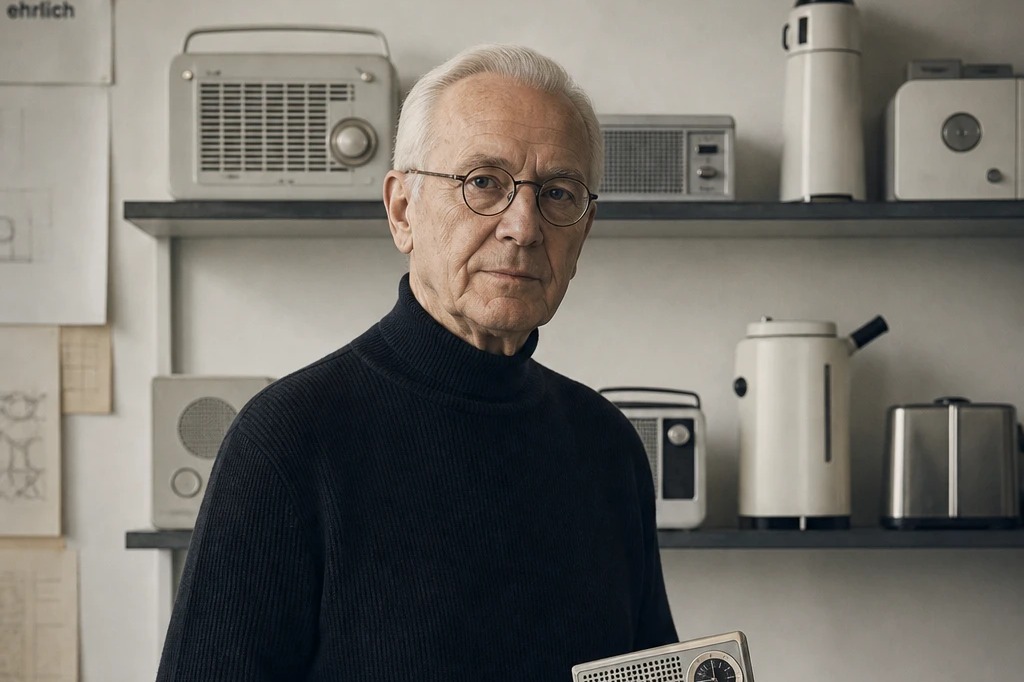
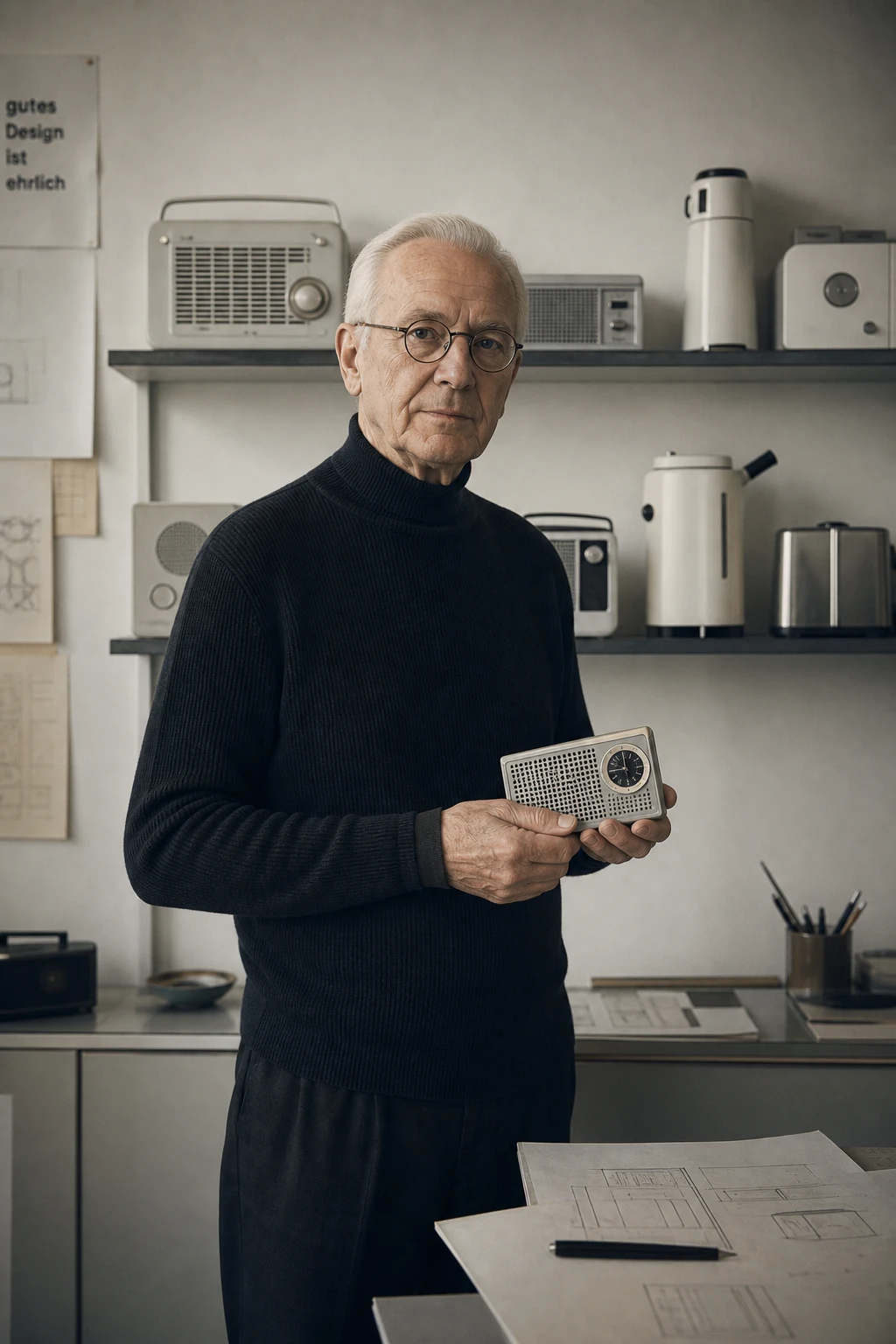
Rams matters not as the author of a “minimalist aesthetic,” but as a designer who connected object, interface, production, furniture, longevity and user behaviour into one discipline of decisions.
Editorial thesis
Dieter Rams matters not because he made Braun electronics pale and furniture restrained. His central contribution was to move design ethics from the isolated object into a system: a good thing should be understandable, unobtrusive, repairable, long-lasting and disciplined enough to outlive fashion.
Reader question
Why do Rams objects still look contemporary decades later—and why is copying their outer form not enough to produce “good design”?
Short answer
Because visual simplicity in Rams is the consequence of a more complex system: function, engineering, interface, production, environment, repair and time. Remove those foundations and “minimalism” becomes only a style.
1. Wiesbaden, 1932: design begins not with a brand but with a workshop
Dieter Rams was born on 20 May 1932 in Wiesbaden. Biographies often recall his carpenter grandfather, but the useful point is not a myth of “correct origins”; it is the early understanding that quality comes from the relationship among material, tool, proportion and use. Before Rams became a symbol of industrial modernism, he knew a world in which an object first had to be well made. 2
That craft foundation did not disappear when he moved into plastics and electronics. It changed scale: from one cabinet to a family of appliances, from a hand-worked detail to a rule for production. This is the essential transition in his career—from mastery of the individual object to mastery of a system.
2. Craft and interiors: carpentry before industry
In 1947 Rams entered Wiesbaden School of Arts and Crafts for interior design, then completed a carpentry apprenticeship from 1948 to 1951 before returning to school and graduating as an interior architect. The sequence matters: drawing and space, then resistance from real material, then design again. 2
Rams is therefore difficult to reduce to “the man who arranged buttons beautifully.” His thinking is spatial from the beginning. An appliance, a shelf and a chair exist as elements of an environment in which a person lives, stores, listens, works and changes habits.
3. Postwar Germany: the good object as part of a new everyday order
Rams formed his practice in West Germany, where 1950s design was tied not only to a market for new goods but also to a project of cultural reconstruction. The object was expected to distance itself from decorative heaviness and the rhetoric of the past, becoming understandable, contemporary and suited to serial production. 2
This atmosphere should not be simplified into the instant birth of “German minimalism.” Braun, Hochschule für Gestaltung Ulm, architects, engineers and graphic designers collectively built a new industrial culture. Rams entered that network and then made its principles unusually consistent.
4. 1955: Braun hires an interior architect
Rams joined Braun in 1955 specifically as an interior architect. Vitsœ preserves an early episode: he presented a sketch for modernising Braun interiors, and on the back wall one can already see the first notion of a track-based wall storage system. 2
The moment is revealing. Before the famous radios, the question is already spatial: where will technology sit, how will a person approach it, how can different objects form order? Industrial design begins not with the appliance shell but with relations among objects and space.
5. Braun changes the language of technology: team, Ulm and a new kind of trust
Braun’s new language was not the work of one person. Company leadership, Fritz Eichler, specialists from HfG Ulm, Hans Gugelot, Otl Aicher and Braun’s internal design team all participated in creating an environment in which product, graphics, exhibition and communication were expected to speak coherently. Braun itself describes this period as collaboration between external and internal designers. 2
Rams gradually became central, but the collective infrastructure should not be retouched away. His strength was the ability to establish rules, carry them through a product range and demand consistency. This is leadership of a system, not a lone-genius story.
6. SK 4: the transparent lid and the myth of the lone author
The SK 4 of 1956 is one of the best tests of attribution. MoMA credits the Radio-Phonograph model SK 4/10 to Dieter Rams and Hans Gugelot. The transparent lid, pale case and clear separation of functions made it visually radical, but the object belongs to a collaboration between Braun and Ulm rather than to one name. 2
Popular memory often turns SK 4 into a “Rams icon.” For VANSMITHLAB, the more useful point is that this collective object reveals how a new industrial language emerges at the intersection of engineering, architecture, material, typographic discipline and user scenario.
7. T3, 1958: the interface becomes almost flat
The T3 pocket radio of 1958 looks almost like an abstract diagram: compact rectangle, circular tuning dial, minimum visual signals. MoMA holds it as a Rams work in the context of Hochschule für Gestaltung Ulm and Braun. 2
Its importance is not simply that the object is “minimal.” What matters is how quickly the frontal logic is understood. The case does not dramatise technology; it organises it—where to look, where to tune, what is primary. Decades later this flat discipline feels natural partly because digital interfaces have trained us to read similar schemes.
8. TP 1, 1959: portability as a system, not a shrunken home appliance
The TP 1 of 1959 combined a transistor radio and record player in a portable system. The importance lies not only in compactness, but in the idea of components that work together while retaining a degree of independence. MoMA presents TP 1 as an example of a new mobility in domestic electronics. 2
Portability for Rams does not mean making a large object smaller. It requires a new hierarchy of functions, weight, casing, carrying and access to controls. The system has to remain legible while moving beyond the fixed living room.
9. 1961: head of product design and responsibility for a whole company language
Rams was appointed head of product design at Braun in 1961. From this point the task was not simply to design individual appliances but to sustain a common language across many categories. Braun lists him as Head of Design from 1961 to 1995; Vitsœ records his retirement from Braun in 1997, probably reflecting the distinction between title and final departure. 2
That discrepancy matters for VANSMITHLAB: even canonical biographies need source comparison rather than the mechanical copying of a single date.
10. Not isolated icons, but a family of objects
In the mature Braun system, different products do not have to look identical, but they have to feel related. Radios, record players, shavers, projectors, fans and kitchen appliances differ in technology while repeating principles: clear hierarchy, restrained palette, controlled visual noise, legible geometry and careful detail. 2
This is the key to Rams. Recognition comes not from a decorative trick but from a repeatable way of making decisions. Style becomes the side effect of a system.
11. Audio 1 and stacking logic: electronics learn to live with furniture
Audio 1 from the early 1960s shows Braun gradually turning hi-fi into an architecture of components. MoMA preserves the Audio 1 Radio-Phonograph as a distinct object, but for Rams its relation to speakers, furniture and the room is just as important. 2
Vitsœ explicitly notes that the 606 shelving system was dimensioned so that the Braun Audio 1 could sit within it. It is a rare example of furniture and electronics being designed as two expressions of one logic: not a “designer object on a designer shelf,” but coordinated domestic infrastructure.
12. The control panel: order before the user gesture
A Rams control panel is microscopic architecture. Buttons, scales, apertures, intervals and labels must create a route for the eye before the hand touches the appliance. A mistake in spacing or emphasis can turn a quiet surface into confusion. 2
Reduction therefore does not mean absence of information. The fewer means remain, the more precisely distinctions among them must work. A good panel does not theatrically explain its simplicity; it simply becomes understandable quickly.
13. Colour, material and the silence of the surface
White, grey, black, metal, transparent plastic and rare colour accents became part of Braun’s recognisable language, but reducing Rams to a palette is misleading. Colour is organisational: separating a function, indicating status, adding emphasis where emphasis is needed. Material is not hidden under unnecessary decoration. 2
The result is a particular “silence of the surface.” It is not culturally or politically neutral, but visually it refuses to compete with the user for attention.
14. Gerd Alfred Müller, Reinhold Weiss, Dietrich Lubs: Braun as a collective school
Braun was a strong collective design environment. MoMA separately records collaborations between Rams and Gerd Alfred Müller, Reinhold Weiss and Dietrich Lubs; many products are more accurately described as company design. 2
This corrects the convenient myth that every Braun product of the period was automatically “designed by Dieter Rams.” His leadership was enormous, but a mature design culture is defined by rules that can work through a team. Authorship is distributed among direction, specific design work, engineering and production.
15. 1957–1959: a parallel furniture line and the birth of Vitsœ
Alongside Braun, Rams began designing furniture. In 1957 Otto Zapf asked him to develop furniture for his family company; in 1958 Rams met Niels Vitsœ, and in 1959 Vitsoe+Zapf was founded to realise his furniture designs. 2
The parallel line matters. Rams was not an electronics designer who later “tried furniture.” Both practices developed together. Electronics and interiors answered the same question: how can chaos be reduced and a system created that people can maintain over time?
16. 606 Universal Shelving System: furniture as long-term infrastructure
The 606 Universal Shelving System was launched in 1960 and remains in production by Vitsœ. Its core is a set of tracks, shelves, cabinets and tables that can be rearranged and extended rather than freezing the room into one finished composition. 2
The radical part of 606 is not the look but the model of time. The system assumes life will change—more books, work, children, a move, a different room. Good furniture therefore does not lock one scenario in place forever; it allows reconstruction.
17. 620 Chair Programme: the armchair stops being a finished single object
The 620 Chair Programme of 1962 works as a kit of interchangeable parts. A single chair can become a sofa, a low back can become a high back, and bases can be exchanged. Vitsœ still makes it as a modular system. 2
This is the opposite of the sculptural chair that demands worship of its singularity. The 620 has character but permits reconfiguration and repair. Comfort and visual lightness cooperate rather than compete.
18. 621 Table: a companion rather than the hero of the room
The 621 Table was conceived as a small companion to the 620—a piece that can sit beside a chair, bed or sofa without demanding a separate stage. In Rams’s system, a supporting object is not less designed; its quality lies in performing a secondary role extremely well. 2
That lesson feels current in a culture where design is often expected to shout for the camera. An object can matter precisely because it refuses permanent theatricality.
19. Modularity: purchase becomes a long relationship with an object
Modularity in Rams is not the aesthetics of a grid but an economic and behavioural model. Vitsœ encourages customers to start with fewer components and add only when needed. The meaning of purchase changes: instead of repeated replacement, the user returns to the same system. 2
Such design requires long-term responsibility from the maker—compatible parts, service, stable dimensions and willingness to continue production. Without that infrastructure, the word “modular” remains a marketing promise.
20. “Less, but better”: reduction as selection, not poverty of form
“Less, but better” is often flattened into a universal slogan for minimalism. In Rams it is stricter. “Less” means removing what does not serve function, understanding, longevity or quality of experience; “better” means the remainder has to become more exact. 2
Reduction therefore demands more decisions, not fewer. Empty space, one button or a calm surface become convincing only when they are the result of difficult selection.
21. Ten Principles for Good Design: a manifesto grown from practice
During the 1970s Rams began formulating what later became known as the Ten Principles for Good Design. Vitra Design Museum connects them to a criticism of consumerism and to the desire to define design goals beyond permanent stimulation of novelty. 2
Innovation, usefulness, aesthetics, understandability, unobtrusiveness, honesty, longevity, thoroughness, environmental responsibility and “as little design as possible” are not a “Rams style” checklist. They are competing demands that have to be balanced.
22. Understandability: the object should explain itself before the manual
“Good design makes a product understandable” is one of Rams’s most contemporary principles. It does not mean every object must be primitive. Complexity can be high, but interaction must have a legible structure. 2
Today this connects industrial design directly to interface design. Button, menu, touchscreen or physical mechanism all solve the same problem: make the state of the system visible and action predictable.
23. Unobtrusiveness: the product leaves room for the person
Unobtrusiveness in Rams is not lack of character. It is a refusal by the product to occupy the whole space of identity. The object should behave like a tool and allow the person to build a life around it. 2
In an era of branded ecosystems, this principle can sound almost political: a product does not have to remind us constantly who made it. A strong system can become so natural in use that its designer stops being the protagonist.
24. Longevity: anti-fashion as design discipline
Rams argues that good design should be long-lasting and avoid fashion. This is not a promise of eternal taste but a strategy against accelerated replacement. When form is built around a short visual trend, its cultural life is limited in advance. 2
Longevity is technical as well: an object should be repairable, a system expandable, a maker willing to preserve compatibility. This is why continuing production of 606 and 620 matters more than museum status: the principle is tested by real time.
25. Ecology before “sustainability”: against visual and material waste
One of the ten principles explicitly addresses environmental responsibility: design should conserve resources and minimise physical and visual pollution throughout the product lifecycle. Vitra Design Museum notes that this position grew from a critique of consumerism long before “sustainability” became compulsory corporate language. 2
Rams should not be turned into a prophet of today’s circular economy. His work remained part of industrial production. The value lies elsewhere: he connected quality with the number of things, their lifespan and the responsibility of the producer unusually early.
26. Ulm and functionalism: Rams did not invent a “Rams style” in a vacuum
Rams is often presented as the autonomous source of “clean German minimalism,” yet his language emerged from a wider environment: functionalism, HfG Ulm, systems thinking, Braun’s engineering culture and postwar modernism. 2
Acknowledging the network does not diminish the author. It explains why his method proved durable: it did not depend on one decorative gesture but on institutions, teams and criteria that could be tested.
27. Apple and the inheritance of a language: influence without a simplistic copying story
Rams’s influence on Apple became a popular chapter in design history. Braun itself points to a legacy in products by Jonathan Ive, while MoMA describes the TP 1 as a precursor to modern families of music devices. 2
But “Apple copied Braun” is too simple. Influence moves through principles: frontal clarity, controlled geometry, quiet palette, reduced element count and careful interface design. Similarities between particular objects matter, but the more important inheritance is a way of thinking.
28. The critical limit: when “minimalism” becomes an expensive shell
Rams’s legacy carries a risk: its ethics can be turned into an expensive visual code. A white surface, thin grid and restrained typography do not by themselves make a product honest, durable or environmentally responsible. 2
When “minimalism” becomes a premium sign for an object with a short lifecycle and poor repairability, it preserves the shell of Rams while losing his argument. Critical reading must separate the aesthetics of reduction from the economics and responsibility of the product.
29. After Braun: exhibitions, archive and objects that remain in production
After his leadership career at Braun, Rams continued to shape design through books, interviews, exhibitions and especially through Vitsœ products that remain in production. Exhibitions such as Less and More and Modular World turned his practice from corporate history into museum subject and international research. 2
Yet the most persuasive Rams archive is not a display case. It is a shelf, chair or system still being used, repaired and extended decades later.
30. The central legacy: good design is a system of limits and responsibility
The central legacy of Dieter Rams is not “minimalism” and not a catalogue of cult Braun objects. He made visible a stricter proposition: design is responsibility for a system of decisions—from function and production to lifespan, interface and human behaviour. 2
“Less” has meaning only when paired with “better.” If unnecessary elements are removed without improving understanding, material, repair, longevity and the relationship with the user, the result is simply emptiness. Rams matters because he demanded evidence from reduction.