stylist profile
Camilla Nickerson
The stylist as editor of character: from British magazines to Vogue and global campaigns
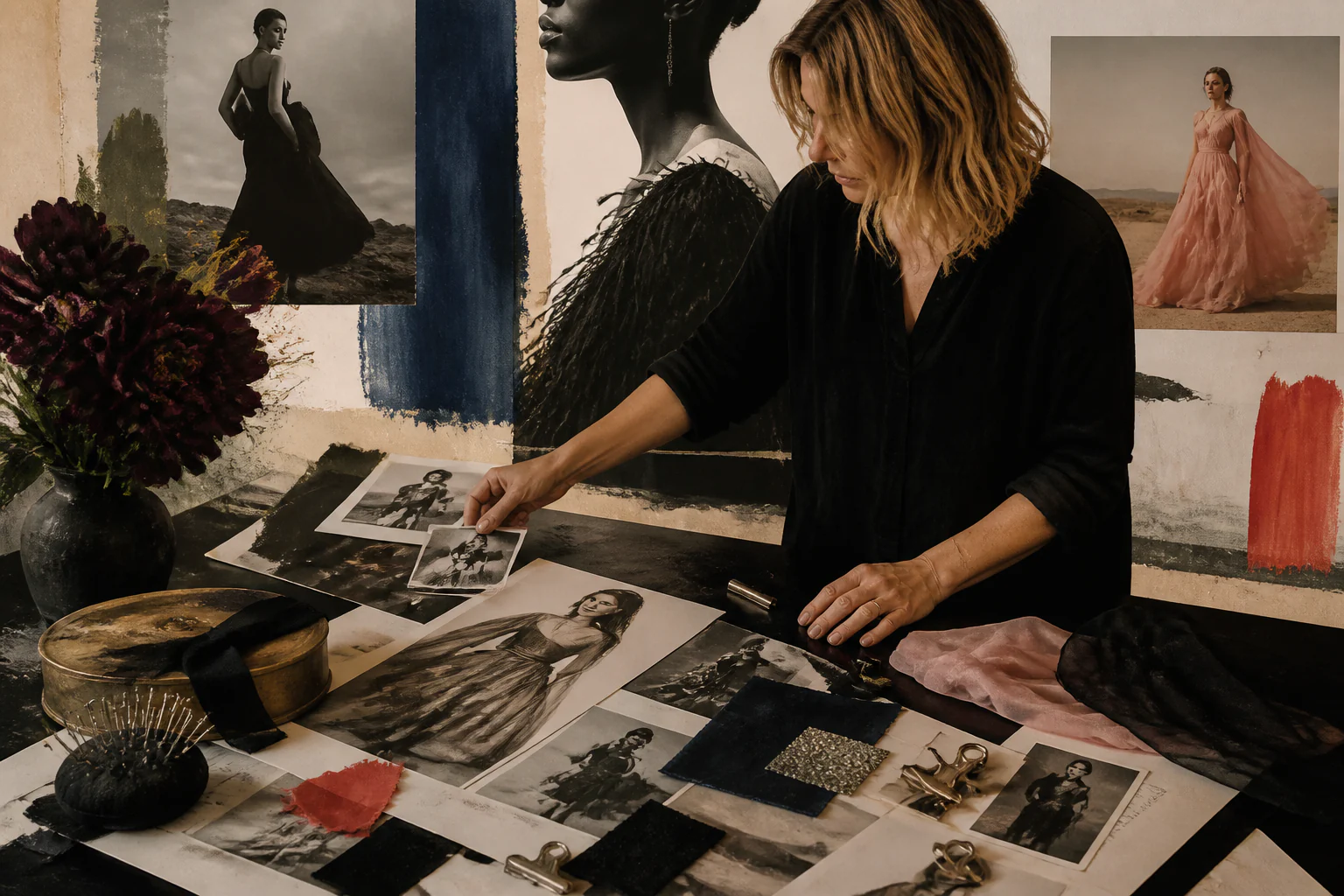

Camilla Nickerson shows that a strong stylist does not impose one signature on every subject. Her method reads the person, designer and photographer first, allowing clothes to intensify character rather than replace it.
Editorial thesis
Camilla Nickerson shows that a strong stylist does not impose one signature on every subject. Her method reads the person, designer and photographer first, allowing clothes to intensify character rather than replace it.
Reader question
Why can one stylist’s work look radically different while retaining the same editorial precision?
Short answer
Nickerson began in British magazines and joined American Vogue in 1992. She has worked with leading photographers and brands, connecting clothes, casting and subject character without turning every shoot into a display of personal signature.
1. British magazines as an editorial school
Nickerson began professionally in British magazines, working with Tatler, British Vogue and Harpers & Queen before moving to the United States. [source]
2. Mechanism: the magazine as a school
The magazine teaches a stylist to think through sequence, publication character and page constraints rather than a single outfit. The point is not an isolated gesture but a way of organising practice. The decision connects author, material, institution, technology and audience, so it cannot be reduced to a personal signature or a polished result. For VANSMITHLAB this episode functions as a mechanism that can be compared across neighbouring practices. [source]
3. Significance: the magazine as a school
This episode explains why Camilla Nickerson belongs in VANSMITHLAB’s map of authors. The significance lies in changing professional rules: who decides, how authorship is distributed, what counts as the result, and how the work enters public culture. The profile therefore keeps context attached to achievement instead of turning biography into a list of milestones. [source]
4. Vogue, 1992: entering the American centre
In 1992 Anna Wintour brought Nickerson to American Vogue, where she gradually became one of the magazine’s most influential editors and stylists. [source]
5. Mechanism: changing editorial environments
Moving between national editorial cultures requires not copying previous habits but reading a new audience and scale. The point is not an isolated gesture but a way of organising practice. The decision connects author, material, institution, technology and audience, so it cannot be reduced to a personal signature or a polished result. For VANSMITHLAB this episode functions as a mechanism that can be compared across neighbouring practices. [source]
6. Significance: changing editorial environments
This episode explains why Camilla Nickerson belongs in VANSMITHLAB’s map of authors. The significance lies in changing professional rules: who decides, how authorship is distributed, what counts as the result, and how the work enters public culture. The profile therefore keeps context attached to achievement instead of turning biography into a list of milestones. [source]
7. Freedom! ’90: clothing inside a music image
Nickerson contributed to the image-making of George Michael’s “Freedom! ’90” video, directed by David Fincher with leading models of the era. [source]
8. Mechanism: clothing inside the music video
Styling operates inside music, editing and celebrity personas rather than as an autonomous display of fashion. The point is not an isolated gesture but a way of organising practice. The decision connects author, material, institution, technology and audience, so it cannot be reduced to a personal signature or a polished result. For VANSMITHLAB this episode functions as a mechanism that can be compared across neighbouring practices. [source]
9. Significance: clothing inside the music video
This episode explains why Camilla Nickerson belongs in VANSMITHLAB’s map of authors. The significance lies in changing professional rules: who decides, how authorship is distributed, what counts as the result, and how the work enters public culture. The profile therefore keeps context attached to achievement instead of turning biography into a list of milestones. [source]
10. The photographer as partner, not image supplier
Nickerson’s long career includes work with Steven Meisel, Mario Sorrenti, Inez & Vinoodh and other photographers with very different visual languages. [source]
11. Mechanism: adapting to the author
A strong stylist changes tools according to the photographer while keeping the relationship between clothing and person precise. The point is not an isolated gesture but a way of organising practice. The decision connects author, material, institution, technology and audience, so it cannot be reduced to a personal signature or a polished result. For VANSMITHLAB this episode functions as a mechanism that can be compared across neighbouring practices. [source]
12. Significance: adapting to the author
This episode explains why Camilla Nickerson belongs in VANSMITHLAB’s map of authors. The significance lies in changing professional rules: who decides, how authorship is distributed, what counts as the result, and how the work enters public culture. The profile therefore keeps context attached to achievement instead of turning biography into a list of milestones. [source]
13. Campaign and magazine: different modes of authorship
Nickerson works across editorials and commercial campaigns for major brands including Calvin Klein, Celine, Chloé, Marni and Proenza Schouler. [source]
14. Mechanism: editorial and commercial work
An editorial image may pose a question, while a campaign must also sustain brand identity. The profession requires switching between these modes. The point is not an isolated gesture but a way of organising practice. The decision connects author, material, institution, technology and audience, so it cannot be reduced to a personal signature or a polished result. For VANSMITHLAB this episode functions as a mechanism that can be compared across neighbouring practices. [source]
15. Significance: editorial and commercial work
This episode explains why Camilla Nickerson belongs in VANSMITHLAB’s map of authors. The significance lies in changing professional rules: who decides, how authorship is distributed, what counts as the result, and how the work enters public culture. The profile therefore keeps context attached to achievement instead of turning biography into a list of milestones. [source]
16. Casting as part of styling
In fashion imagery the choice of person changes the meaning of clothes as much as the outfit itself. Nickerson is known for attention to the character of a model or subject. [source]
17. Mechanism: casting and character
The stylist works not with an abstract body but with a specific person; casting and clothing therefore form one system. The point is not an isolated gesture but a way of organising practice. The decision connects author, material, institution, technology and audience, so it cannot be reduced to a personal signature or a polished result. For VANSMITHLAB this episode functions as a mechanism that can be compared across neighbouring practices. [source]
18. Significance: casting and character
This episode explains why Camilla Nickerson belongs in VANSMITHLAB’s map of authors. The significance lies in changing professional rules: who decides, how authorship is distributed, what counts as the result, and how the work enters public culture. The profile therefore keeps context attached to achievement instead of turning biography into a list of milestones. [source]
19. Proportion instead of effect
Nickerson’s work often depends on exact proportion, combinations of ordinary and luxurious pieces, and control over volume and the way garments sit on the body. [source]
20. Mechanism: proportion and body
This approach cannot be reduced to a trend device; it requires knowledge of garment construction and observation of the person. The point is not an isolated gesture but a way of organising practice. The decision connects author, material, institution, technology and audience, so it cannot be reduced to a personal signature or a polished result. For VANSMITHLAB this episode functions as a mechanism that can be compared across neighbouring practices. [source]
21. Significance: proportion and body
This episode explains why Camilla Nickerson belongs in VANSMITHLAB’s map of authors. The significance lies in changing professional rules: who decides, how authorship is distributed, what counts as the result, and how the work enters public culture. The profile therefore keeps context attached to achievement instead of turning biography into a list of milestones. [source]
22. A long career without a fixed signature
Nickerson remains active in Vogue and commercial fashion decades after beginning her career. [source]
23. Mechanism: adaptive method
Longevity is tied to refusing one easily copied formula: the method evolves with designers, photographers and culture. The point is not an isolated gesture but a way of organising practice. The decision connects author, material, institution, technology and audience, so it cannot be reduced to a personal signature or a polished result. For VANSMITHLAB this episode functions as a mechanism that can be compared across neighbouring practices. [source]
24. Significance: adaptive method
This episode explains why Camilla Nickerson belongs in VANSMITHLAB’s map of authors. The significance lies in changing professional rules: who decides, how authorship is distributed, what counts as the result, and how the work enters public culture. The profile therefore keeps context attached to achievement instead of turning biography into a list of milestones. [source]
25. The stylist as editor of relationships
In a strong Nickerson shoot, clothing cannot be separated from model, photographer, place and editorial purpose. [source]
26. Mechanism: relationships instead of signature
Stylist authorship appears in calibrating relationships among elements rather than claiming ownership of the final image. The point is not an isolated gesture but a way of organising practice. The decision connects author, material, institution, technology and audience, so it cannot be reduced to a personal signature or a polished result. For VANSMITHLAB this episode functions as a mechanism that can be compared across neighbouring practices. [source]
27. Significance: relationships instead of signature
This episode explains why Camilla Nickerson belongs in VANSMITHLAB’s map of authors. The significance lies in changing professional rules: who decides, how authorship is distributed, what counts as the result, and how the work enters public culture. The profile therefore keeps context attached to achievement instead of turning biography into a list of milestones. [source]
28. Legacy: character over decorative excess
Nickerson occupies an important position between the print-magazine generation and contemporary multi-channel fashion. [source]
29. Mechanism: character as criterion
Her practice is a reminder that even as content accelerates, clothes should intensify person and idea rather than disguise the absence of a position. The point is not an isolated gesture but a way of organising practice. The decision connects author, material, institution, technology and audience, so it cannot be reduced to a personal signature or a polished result. For VANSMITHLAB this episode functions as a mechanism that can be compared across neighbouring practices. [source]
30. Significance: character as criterion
This episode explains why Camilla Nickerson belongs in VANSMITHLAB’s map of authors. The significance lies in changing professional rules: who decides, how authorship is distributed, what counts as the result, and how the work enters public culture. The profile therefore keeps context attached to achievement instead of turning biography into a list of milestones. [source]