stylist profile
Joe McKenna
Editing, Precision and the Stylist as Architect of the Fashion Image
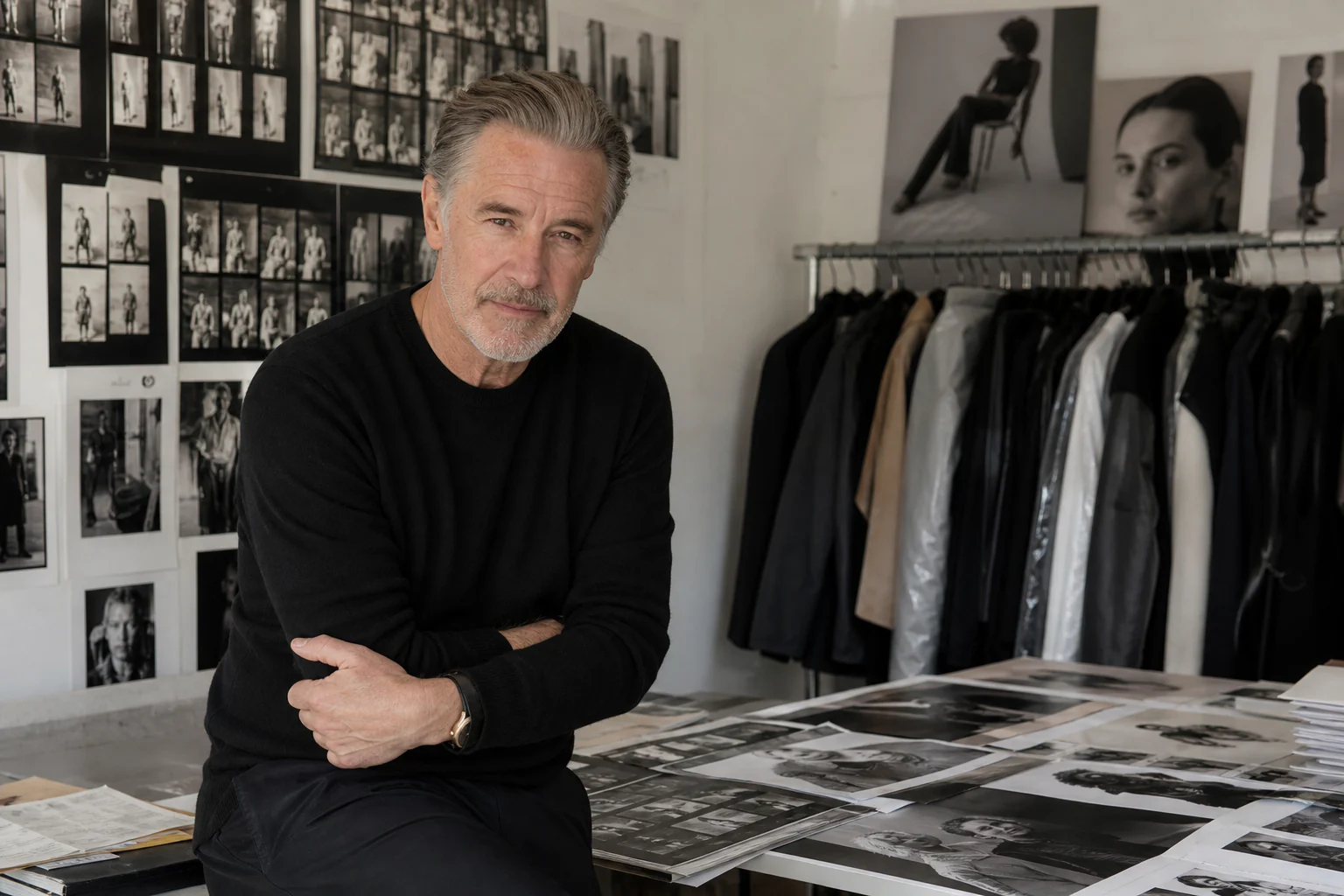
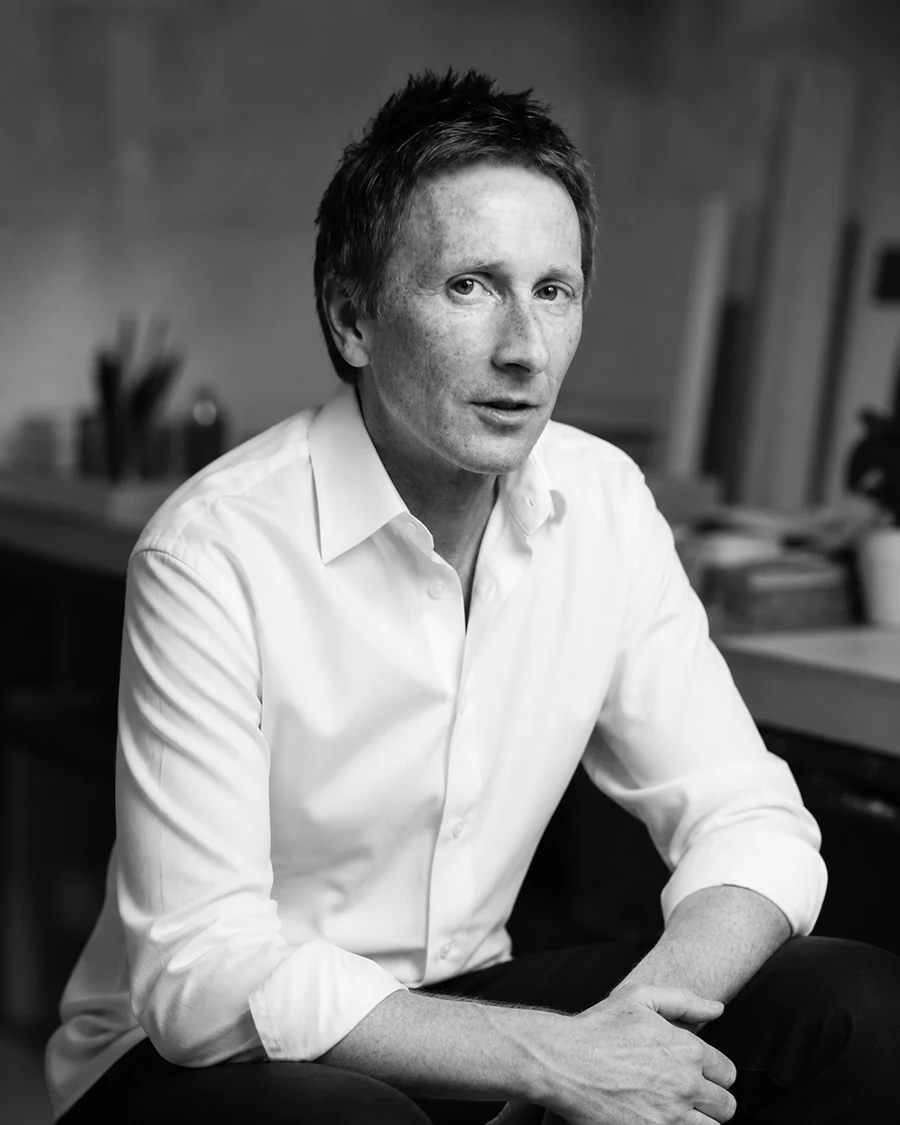
McKenna shows that styling can be almost invisible while determining the whole image: remove excess, tune proportion, choose the person, build sequence and leave the photographer room to make the photograph.
Editorial thesis
Joe McKenna matters not as the creator of one recognisable look but as an author of reduction. His styling shows that influence can become stronger as it draws less attention to itself: proportion, character, sequence and precise editing shape an image without turning the stylist into its protagonist.
Reader question
How can a stylist influence Calvin Klein, Jil Sander, Alaïa, Valentino and Balenciaga over decades without forcing every project into one personal aesthetic?
Short answer
Because McKenna works not from a fixed signature but from the relationships inside each assignment. He edits garment, body, casting, runway sequence and context so that designer and photographer become clearer rather than quieter.
1. Glasgow: a stylist begins not with a wardrobe but with a way of seeing
Joe McKenna grew up in Scotland and a 1998 Index Magazine interview identifies him through his Glaswegian accent. For this profile, that is more reliable than inventing a birth date that strong public sources do not consistently provide. 1
McKenna belongs to the generation in which the stylist became visible as a distinct creative author. His strongest trait is not a taste for spectacular wardrobes, but an ability to remove excess and see what clothes actually do to a person in an image.
2. London before status: taste is formed in a milieu, not a job title
Hamish Bowles's remembrance of Lucy Birley places a young McKenna in an early-1980s London world of actors, editors and people with strong personal style, before the later institutional status of the fashion stylist. 2
That context helps explain his later emphasis on character. A model is not an abstract support for a runway look. Even minimal clothing should appear to belong to a particular person and situation.
3. 1985: British Vogue gives an early professional break
Writing about Grace Coddington, McKenna recalls that in 1985 British Vogue editor Beatrix Miller sent him to New York to produce a front-of-book piece, “What’s Hot in New York.” He describes himself at that point as starting his career as a stylist. 3
The scene reveals how dependent the role was on editorial trust. A young stylist was not handed a formula; he was asked to observe a city and decide what counted as current. Styling begins with selection before the fitting starts.
4. The Face and independent magazines: the stylist becomes a cultural filter
Aperture includes Joe McKenna among the stylists who worked with The Face as the publication evolved from music magazine toward a new style-magazine model. Helen Roberts, Ray Petri, Michael Roberts, Caroline Baker and Debbie Mason were part of the same wider field. 4
For McKenna this was a school in using fashion to read youth, class, music and modern silhouette. Yet his own language would move away from Buffalo-style collision toward increasing discipline and reduction.
5. The stylist profession: authorship without the fantasy of total control
Index Magazine defines McKenna as a fashion stylist while also recording his reluctance to over-credit the profession. He insists that the finished image remains the photographer's picture even when styling, hair, make-up and model contribute enormously. 5
This is central to VANSMITHLAB's reading: McKenna expands stylist authorship without collapsing collaborative image-making into a single credit. His authority comes from precision of contribution, not ownership of everyone else's work.
6. Bruce Weber: long dialogue rather than one-off service
Index connects McKenna to sustained projects with Bruce Weber and specifically mentions O Rio de Janeiro. Such collaboration suggests a stylist learning a photographer's rhythm deeply enough that clothing no longer appears to arrive from outside the image. 6
In Weber's work body, group, sport, eroticism and informality often matter more than displaying a complete look. McKenna answers with choices that support character rather than overwhelm the photographic energy.
7. Calvin Klein: minimalism as a system of strict decisions
MA+'s current biography describes McKenna as helping form the stark minimalist aesthetic of the 1990s, especially through defining work for Calvin Klein. Models.com similarly treats Calvin Klein as a central chapter in his career. 7
This should not be reduced to white T-shirts and jeans. McKenna minimalism depends on proportion, body, fabric, fit and information density. When there are few elements, every error becomes louder.
8. CK One and Steven Meisel: simplicity is not neutrality
Index records McKenna styling CK One advertising photographed by Steven Meisel. The work belongs to a period when Calvin Klein transformed minimal wardrobes and young bodies into a mass cultural code. 8
The stylist's task is difficult precisely because the clothes must be legible without looking imposed by advertising. McKenna helps make constructed imagery feel as if the clothes already belong to the people inside it.
9. The 1990s: clean does not mean empty
McKenna is frequently associated with the simplicity of 1990s fashion, but his work shows that clean imagery requires dense internal structure. Shoulder line, trouser length, shoe, collar and group rhythm operate as compositional devices. 9
Weak minimal styling merely removes accessories. Strong McKenna styling makes fewer decisions, but makes each one more exact. That is why many of the images age more slowly than louder fashion stories from the same period.
10. Character before statement: clothes must belong to someone
In Index, McKenna resists the tendency to inflate styling into a grand conceptual statement. His work is more concerned with building a character than announcing a thesis. 10
This explains part of his influence: an outfit should not advertise how clever the stylist was. It should make the person believable. McKenna's hand is often clearest only after close looking, when one notices how precisely clothing has adjusted posture, age, class code and psychological distance.
11. 1992: Joe’s — the stylist becomes publisher
Harper's Books dates the first issue of Joe’s to 1992 and describes it as compiled and published by Joe McKenna. Index likewise treats Joe’s as McKenna's own magazine, combining fashion photography, essays and interviews. 11
This is a decisive move. The stylist no longer waits for a Vogue assignment or advertiser. He builds an editorial platform in which wardrobe is only one instrument inside a wider system of selecting people, photographers, texts and subjects.
12. Joe’s as a network: McDean, Teller, Sorrenti, Roversi, Meisel, Sims, Weber
The surviving complete run of Joe’s shows the breadth of its contributors: Craig McDean, Juergen Teller, Mario Sorrenti, Paolo Roversi, Steven Meisel, David Sims and Bruce Weber among them. 12
McKenna did not make a magazine in which every page imitates one house style. He made a frame broad enough for different photographic languages to coexist when the editorial level of selection remained consistent.
13. A second issue after a pause: independence does not require regularity
The late-1998 Index interview anticipates the second Joe’s after a gap of roughly six years, while Harper's Books now describes two issues as the complete run. 13
The irregularity matters. Joe’s did not pretend to be a monthly media machine. It appeared when McKenna had sufficient material and reason, closer to an authored book or exhibition than conventional periodical rhythm.
14. Jil Sander: long collaborator rather than external stylist
System Magazine calls McKenna a master stylist and long-time collaborator of Jil Sander. Their conversation reveals sustained work on shows and a deep understanding of the collection from inside rather than only at the final line-up. 14
Here the stylist operates as editor of a designer's thinking. McKenna does not add a competing aesthetic on top of Jil Sander; he helps make the collection's clean construction readable on bodies and across runway sequence.
15. “Edit, edit it down”: styling as the discipline of reduction
Speaking with Jil Sander, McKenna summarises the role plainly: “All we can do is edit, edit it down, put it together.” He also stresses that the designer was present at every step. 15
The phrase is almost a manifesto. A strong stylist does not always create more ideas. He removes noise, finds sequence and decides which strong pieces should not compete. Editing becomes visual direction.
16. Malgosia Bela, Spring/Summer 2000: casting is part of styling
PORTER recalls that McKenna noticed Malgosia Bela and selected her for Jil Sander; she opened and closed the Spring/Summer 2000 show and was then photographed by David Sims for the campaign. 16
The episode demonstrates that styling does not stop at clothing. Choosing the person can alter how a collection is read more radically than an accessory. Face, posture and temperament are editorial decisions.
17. Alaïa: a late-1980s relationship built on unusual trust
Fondation Azzedine Alaïa describes McKenna's friendship and long collaboration with Azzedine Alaïa from the early 1980s; McKenna himself told PORTER that he had worked with Alaïa every year since 1988. 17
This is a rare form of styling relationship: not a seasonal booking but a long dialogue with a designer who controlled cutting, fitting and timing intimately. McKenna's role was not to “improve” Alaïa, but to know when intervention had become unnecessary.
18. Alaïa and the body: styling works with construction, not over it
Alaïa built clothes around the body and refused the ordinary industry calendar. Within that system McKenna was not producing a trend look but helping reveal construction, movement and the character of a specific woman. 18
His minimalism gains material logic here. The more complex the garment internally, the less need there is to overload it externally. Styling becomes a method for opening the cut to view.
19. 2017: Alaïa by Joe McKenna — the stylist takes the camera
Fondation Azzedine Alaïa records the 25-minute documentary Alaïa by Joe McKenna, directed in 2017. Long trust gave McKenna access to the studio and ateliers; the film includes Nicolas Ghesquière, Carlyne Cerf, Naomi Campbell, Grace Coddington and others. 19
The move into film is logical. McKenna had long worked with how clothing lives on bodies. A camera can show what a still fashion image often hides: fabric in motion, working space and the pauses between public moments.
20. 2018: Design Museum — fashion film becomes exhibition architecture
British Vogue describes McKenna's short films within the Alaïa exhibition at the Design Museum and notes his insistence that the same footage be projected on three screens at the intended scale. 20
He is therefore thinking not only about content inside the frame but about conditions of viewing. Screen, repetition and scale become part of styling logic: clothes exist on bodies and inside spatial presentation.
21. After the designer: returning to Alaïa without freezing the archive
After Azzedine Alaïa's death, McKenna continued working with the house. Vogue identifies him as a longtime collaborator and returning stylist for Spring 2019 and Fall 2019, when archive Editions, demi-couture and ready-to-wear had to coexist without falsifying authorship. 1
This is a difficult heritage task: make the archive feel alive without turning it into the stylist's own collection of quotations. Editing becomes preservation of difference.
22. T Magazine, 2012–2015: the stylist enters major-media structure
McKenna joined T: The New York Times Style Magazine as fashion director at large in 2012; industry reporting records the end of that contract in 2015. 2
The title matters. The stylist is no longer only the supplier of clothes for a single shoot, but an editorial figure with influence over an overall fashion direction. McKenna's career charts the institutionalisation of a profession that had begun much more informally.
23. From editorial to brand vision: styling rises to identity level
Today MA+ represents McKenna within Image + Brand Vision and describes work with founders and leadership on identities, visuals and narratives. The biography names Jil Sander, Valentino, Victoria Beckham, Versace and especially Alaïa. 3
The extension is logical. After decades deciding how a brand should look in images, the stylist can contribute to what its visual character should be before the shoot begins.
24. Assistants: McKenna's practice becomes an informal school
Anya Ziourova, Carlos Nazario, Edward Bowleg III, Michael Philouze and other professionals connect early stages of their careers to assisting Joe McKenna. BoF, Financial Times, Vogue and The Gentlewoman document these lines of succession. 4
There is no formal “Joe school.” The pedagogy is production itself: rack order, fitting, research, moving clothes, set discipline and understanding why one centimetre of pleat can change a photograph.
25. Runway styling: a show is montage in time
McKenna's collaborations with Jil Sander, Valentino, Victoria Beckham and later houses show how runway styling differs from editorial photography. The task is to distribute ideas across a sequence so that dozens of looks read as one system. 5
The stylist works like an editor: the opener defines grammar, repetition produces rhythm, a strong look may need space, and the finale must complete the collection's argument. Dressing beautifully is not enough.
26. Valentino: styling, casting and public representation
Vogue describes Joe McKenna as part of Pierpaolo Piccioli's show team alongside Pat McGrath and Guido Palau; British Vogue records his participation in casting for Spring/Summer 2021. 6
This expands the role. When a stylist participates in deciding who carries the clothes down the runway, he affects the social image of a brand. VANSMITHLAB nevertheless preserves separate credits: casting remains collective work, not McKenna's sole authorship.
27. Victoria Beckham: the stylist as a continuing brand partner
In Vogue's Spring 2018 backstage diary, Brooklyn Beckham captions McKenna as “Mum and her incredible stylist Joe McKenna.” The casual phrase reveals how embedded he was in the brand's working process rather than appearing for a single editorial. 7
In this model the stylist becomes an external editor for the designer: close enough to understand repetition and weak points, distant enough to see them before the public show.
28. 2025–2026: Balenciaga and the transition between creative eras
Current MA+ and Models.com records place McKenna in Balenciaga projects across 2025–2026, including shows, campaigns and lookbooks. Business of Fashion specifically credits the Pierpaolo Piccioli Pre-Fall 2026 lookbook to photographer Robin Galiegue with styling by Joe McKenna. 8
For a stylist this is a sensitive assignment: a house changes creative regime without losing its memory. McKenna is useful here not for an obvious personal signature, but for controlling the relationship among archive, new designer and contemporary image.
29. 2026: the practice remains active rather than archival
Models.com records 2026 work including Balenciaga Haute Couture Fall 2026, Balenciaga Fall/Winter 2026, the Summer 2026 campaign, Zara Origins, Sandro and Lanvin. MA+ likewise presents an active editorial and brand practice. 9
McKenna is therefore not only a “1990s stylist.” His language transfers into the platform era precisely because it is based less on trend than on editorial discipline.
30. The central legacy: the stylist as editor of relationships, not owner of the picture
Joe McKenna's legacy is best described through a paradox. He helped make styling a more powerful profession while repeatedly refusing to claim the entire fashion image as his own. His authorship is editing: person, garment, proportion, designer, photographer, sequence and context become more exact in relation to one another. 10
From Calvin Klein and Joe’s to Jil Sander, Alaïa and Balenciaga, the same principle returns: a strong stylist does not necessarily add a sign. He removes what prevents the image from feeling inevitable.