stylist profile
Ray Petri
Buffalo, new masculinity and the stylist as cultural image-maker
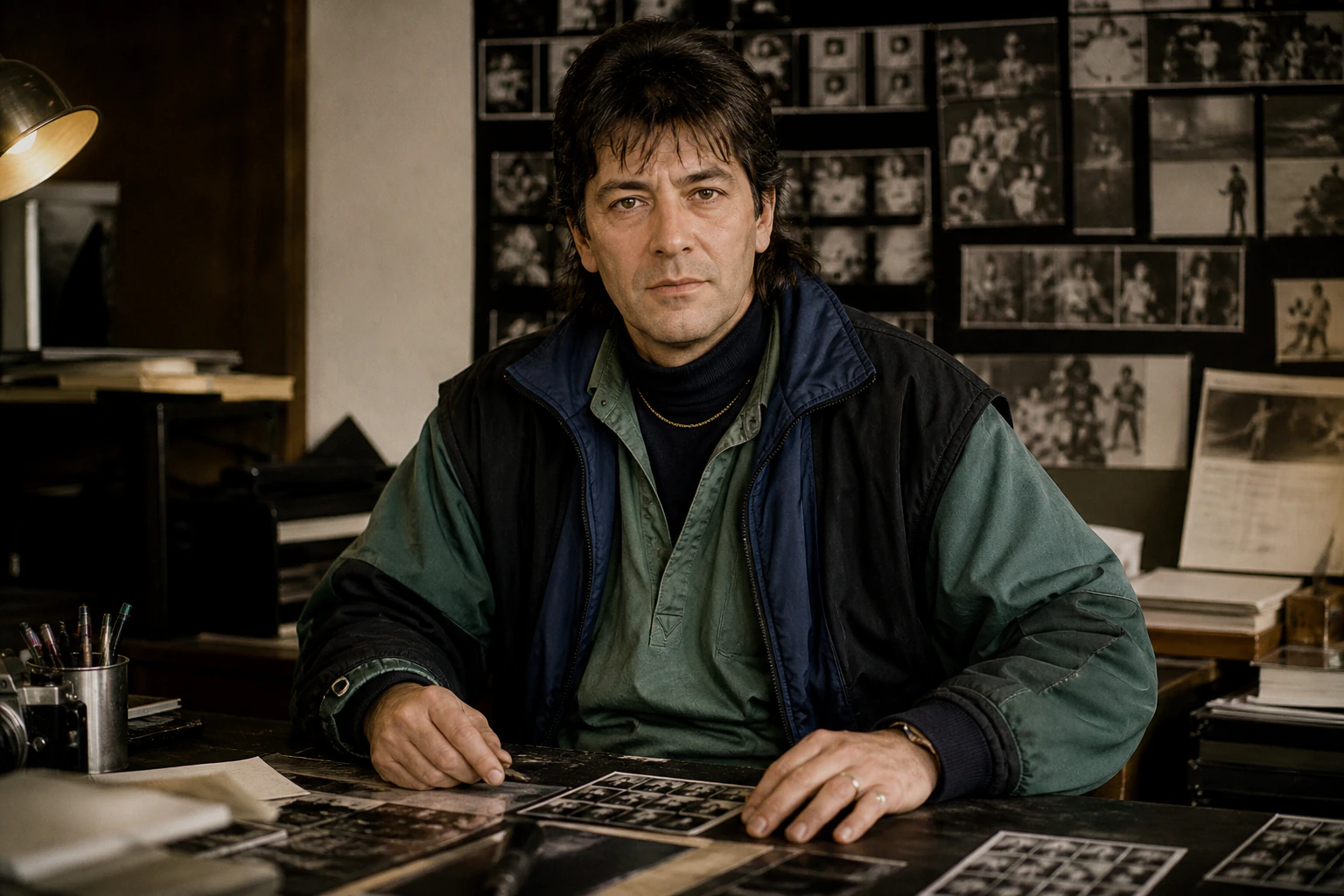
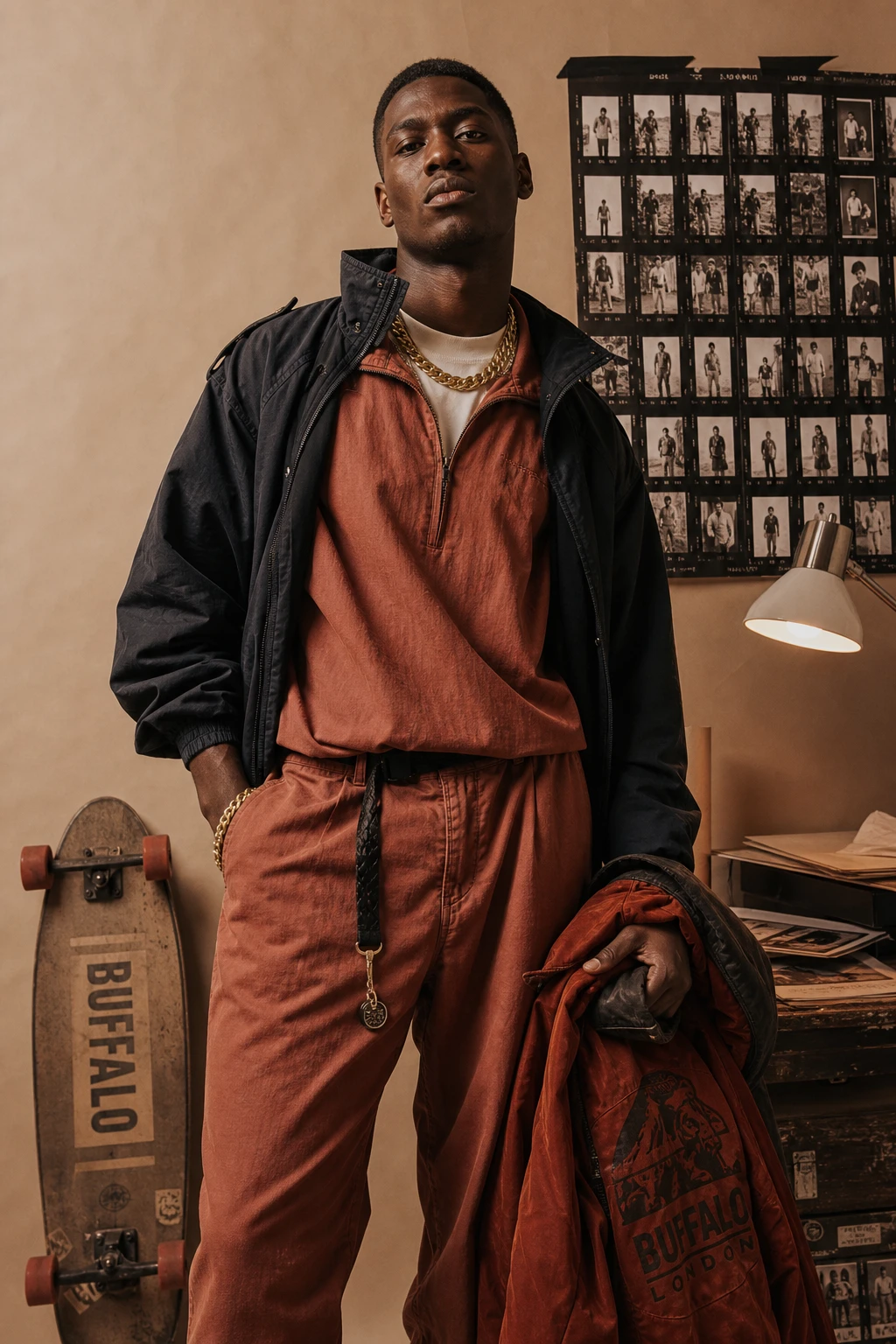
Petri turned styling from the selection of clothes into a form of authorship: casting, street culture, music, photography, gender and cultural memory become one image that can outlive the collection itself.
Editorial thesis
Ray Petri matters not because he produced a recognisable Buffalo look. His central contribution was to make the stylist an author of relationships among clothing, body, casting, music, magazine and photography. Buffalo demonstrated that styling could challenge the fashion system rather than simply service it, constructing its own social order inside the image. 2
Reader question
How could one stylist alter the image of menswear in the 1980s without being a fashion designer, photographer or editor-in-chief?
Short answer
Because Petri worked on what connects those professions: who enters the frame, how clothes redefine the body, which cultural codes collide, how much freedom the magazine allows, and how photography turns the result into an image. That connective authorship is what makes the stylist a distinct creative role. 2
1. Dundee, 1948: a biography begins outside fashion’s centre
Ray Petri was born in Dundee in 1948. For fashion history this matters less as a local fact than as a reminder that one of the most influential stylists of 1980s Britain did not emerge from a ready-made London fashion hierarchy. His route passed through migration, music, markets, nightlife and a network of friends before his activity gained a stable professional name. 2
Buffalo can look, in hindsight, like a finished visual style. Petri’s biography suggests the opposite: the language grew from a life spent between places, jobs and cultural codes. That is why the method cannot be reduced to one kilt, one bomber jacket or one famous photograph.
2. Australia and the return to Britain: displacement as part of the eye
As a teenager Petri moved to Australia with his family and later returned to Britain. Later accounts also describe wider travel and a sustained curiosity about India, Africa, music and art history. This should not be romanticised as automatic cosmopolitan authority; it is better understood as context for an eye that treated clothing as a portable cultural sign rather than a closed national system. 2
His later work repeatedly joined sources that were not meant to sit together: British tailoring, army clothing, sportswear, Caribbean music, cinematic myths and ceremonial references. The strength of the method was collision. Its limitation is equally important: cultural symbols are not neutral raw material, and later readers must examine what gets lost when a sign becomes styling.
3. Camden Passage: the object before the fashion system
By the mid-1970s Petri was back in Britain and working around antiques and vintage goods at Camden Passage. This stage matters because his understanding of dress developed through found objects outside the current collection: an old jacket, used suit or accessory with a previous life could carry more character than a complete seasonal look. 2
Buffalo later mixed second-hand clothing, army surplus and sports shops with expensive fashion. The object was judged by what it did to a body and a character, not by price or origin. That remains a foundational proposition for styling: editorial value is not the same as market value.
4. Music, clubs and the street as the stylist’s real school
Petri was closely connected to London’s music and club worlds. Reggae, post-punk, new wave and nightlife were not simply references; they showed how groups produce dress codes without a formal design brief, how gesture and hair transform ordinary garments, and how style becomes a declaration of belonging. 2
Buffalo therefore cannot be read from the wardrobe alone. The same MA-1 jacket, suit or boot loses much of its force without casting, music, posture and social environment. Petri worked with style as a situation in which clothes were one layer among rhythm, affiliation and the desire to be seen differently.
5. Before “stylist” became a profession: a job without a settled name
In the early 1980s the stylist was not yet as institutionally visible as the role is today. Research into styling history shows that selecting, combining and organising clothes had long existed under other names: fashion editing, editorial preparation or assistant work. V&A Dundee explicitly connects Petri’s legacy with the emergence of the fashion stylist as a central creative role. 2
That is why Petri belongs in VANSMITHLAB as a primary author node. He did not invent the act of styling; he made visible the authorship of the person between clothes and photography. The stylist became an image-maker responsible for meaning, casting and cultural tension rather than a technical intermediary.
6. Buffalo: not a brand or uniform, but a method for assembling people and codes
Buffalo is described as a group, a label and a movement, but none of those terms is sufficient. It was a network of friends and collaborators around Petri in which the name signalled independence, street hardness, mixed references and the right to look outside fashion hierarchy. Accounts connect the name to reggae culture and the idea of the rebel or rude boy. 2
It is important not to retrofit Buffalo into a conventional brand. There was no single proprietary uniform. Its strength was a repeatable process: find a person, assemble incompatible elements, test them through the camera, and allow the photographer, model, stylist, hair and makeup team and magazine to reshape the first idea.
7. Collective authorship: Jamie Morgan, Mitzi Lorenz, Mark Lebon and the Buffalo circle
Petri’s history can easily become a lone-genius myth, yet the sources repeatedly return to the group. Jamie Morgan, Mitzi Lorenz, Mark Lebon, Roger Charity, Jean-Baptiste Mondino, Nick and Barry Kamen, Neneh Cherry, Judy Blame and many others photographed, cast, wore, altered and circulated Buffalo. 2
VANSMITHLAB therefore records Petri as the central stylist without assigning every image to him alone. Buffalo demonstrates distributed authorship in fashion image-making: an idea may begin with one person, but its cultural force emerges through the relations among several practices and bodies.
8. The Face, i-D and Arena: niche magazines as infrastructure for a new image
The Face, i-D and Arena gave Petri a space in which risky styling could exist before the market recognised it as commercially safe. Mainstream fashion photography remained comparatively formalised, while new style magazines could place music, clubs, street life, photography and fashion on the same page. 2
The magazine was therefore not merely a distribution channel. It was production infrastructure for experimentation: an editor could accept strange casting, a photographer could build a series, and a stylist could organise an image around attitude rather than maximising garment visibility. Without that editorial permission, Buffalo might have remained a local circle of friends.
9. Winter Sports: the moment menswear begins to behave differently
Jamie Morgan remembers an early Face story, Winter Sports, as the moment he and Petri assembled a new menswear language in magazine form. Nick and Barry Kamen appeared not as neutral models but as characters, combining white lipstick, cycling jackets, sports beanies and aviator shades. 2
The key shift was not the shopping list. The male fashion subject stopped being only the carrier of a suit or conventional heterosexual confidence. He could be overtly beautiful, vulnerable, theatrical and androgynous while retaining a sense of power.
10. 1985: Buffalo reaches maximum density
1985 became Buffalo’s period of greatest concentration. Many images later treated as canonical were made then or close to that moment: The Face issue 59, the Felix Howard stories, early Naomi Campbell images, Nick Kamen portraits, Jamie Morgan’s black-and-white photography and Petri’s radical combinations. 2
The year matters again because the archive was reassembled in the 2025 book 1985 Buffalo. Contact sheets, rediscovered negatives and magazine images make the method visible without smoothing it into a contemporary retrospective design.
11. Character first, clothes second
In Buffalo the character is usually stronger than the individual garment credit. Petri and his collaborators could begin with a face, walk, musician, shop worker or person encountered on the street, then build clothing around that presence. This reverses the usual logic in which a collection dictates model and pose. 2
The professional implication is fundamental: a stylist does not only select things. A stylist determines who can make those things culturally convincing. Casting becomes part of styling and the body stops being a neutral carrier of product.
12. Street casting and the question of who gets to be a fashion body
Jamie Morgan’s recollections describe Buffalo turning to street casting when model agencies could not provide the range of people they wanted. They looked in Notting Hill, shops, streets and familiar communities. This broadened fashion’s visual field and made racial and social difference part of the image itself rather than a separate diversity statement. 2
The past should not be rewritten as a flawless progressive utopia. 1980s casting operated under different expectations around consent, age and representation. Buffalo’s legacy therefore includes both expanded visibility and material for critical discussion about editorial power over who is shown and how.
13. Nick and Barry Kamen: the muse as co-author of visual language
Nick and Barry Kamen were not simply recurring models for Buffalo. Their faces, bodies and ability to hold toughness and decoration at the same time helped Petri test new forms of the male fashion image. The muse becomes a co-author because repeated collaboration produces a shared visual vocabulary. 2
Buffalo often depended on this familiarity. The team knew which person could carry an unusual skirt, heavy boot, altered suit or sharp makeup without looking as though they had been placed in costume. The styling became believable because the character seemed to claim it.
14. Naomi Campbell: an early image and the politics of editorial visibility
The National Portrait Gallery holds a portrait of fifteen-year-old Naomi Campbell photographed by Jamie Morgan and styled by Ray Petri. The image already contains a Buffalo principle: a tailored jacket shares the frame with a charged religious-political symbol, while the young model appears as a confident cultural subject rather than a neutral fashion girl. 2
This material now belongs to a wider discussion of editorial power. Buffalo offered early visibility to Black and multiracial models in an industry with far less diversity. Contemporary republication, however, demands precise age, credit, context and rights information rather than retrospective claims of singular authorship.
15. Men in skirts: masculinity becomes a stage rather than a rule
One of Petri’s most visible gestures was the use of skirts, kilts, jewellery and decorative elements on men without turning the wearer into parody. Scholarship on styling history treats Buffalo as a key case in the construction of new masculinities, while V&A Dundee emphasises its challenge to gender norms. 2
The radical quality lay in combinations: an MA-1 and heavy boot could meet a skirt; a formal suit could carry softness; a boxer could wear a flower. Masculinity became a set of cultural signs open to rearrangement rather than a fixed fact of the image.
16. Sportswear plus tailoring: high and low stop being opposites
Buffalo repeatedly joined sportswear to tailoring: tracksuits with brogues, MA-1 jackets with Levi’s, Armani suits with Dr. Martens. High-low styling is now so normal that its original friction is difficult to recover. In the mid-1980s these combinations damaged the clean boundary between street, sport and luxury. 2
Petri did not simply mix everything. He built hierarchy inside the look: a heavy item could ground a delicate one, sportswear could remove the snobbery of a suit, and tailoring could grant a street-cast character a different authority. Styling became montage of social meaning.
17. Army surplus, second hand and DIY: style without buying a complete look
Army surplus and second-hand garments mattered to Buffalo not only as cheaper alternatives to designer fashion. They could be pinned, taped, tucked, cut or repositioned to create silhouettes that did not exist in shops. 2
This is what separates styling from shopping. If style is available only as a complete purchased outfit, authorship is small. Buffalo shows the opposite: an ordinary object can become new when it enters an unfamiliar system of scale, body and reference.
18. Borrowing cultural codes: the force of the method and its present-day problems
Petri worked with signs connected to reggae, Rastafari, Native American imagery, military history, cowboy mythology and other cultural systems. In the 1980s such eclecticism was often read as anti-hierarchical and anti-racist, allowing references excluded from fashion establishment to occupy the same image. 2
Some of those images now require a more critical frame. Admiration does not remove the question of who may use a symbol, how its meaning changes, or what happens when a religious or ethnic sign becomes an accessory. A serious history of Buffalo should hold its openness and the limits of its period at the same time.
19. Jamie Morgan: photography does not record Buffalo, it constructs it with styling
Jamie Morgan’s photographs show why stylist and photographer must be treated as co-authors. Petri could assemble a character, but light, film, distance, timing and the frame turned styling into an image. Morgan combined documentary photographic experience with cinematic staging, making Buffalo feel both found and deliberately constructed. 2
This distinction matters to editorial history. A fashion image is not a document of clothes. It produces a new reality in which photography and styling change one another. Without either layer, Buffalo would lose much of its authority.
20. Black-and-white photography and cinema: why the image outlives its fashion
Many of the best-known Buffalo pictures are black and white and carry associations with gangster films, westerns, documentary photography and classical portraiture. This places 1980s clothing inside a much longer visual history, helping the photographs outlive the season in which the garments were current. 2
Petri and Morgan used cinema less as literal costume reference than as a machine for producing character. Hat, suit, gaze and light can make a child inhabit a gangster myth or an urban model take on the charge of a western. Styling becomes a script before anything moves.
21. Buffalo stance: attitude matters more than a list of garments
Buffalo’s most durable inheritance is its resistance to a wardrobe checklist. Jamie Morgan later described it primarily as attitude: independence, outsider position and refusal of industry politeness. That is why copying an MA-1, kilt and brogues rarely reproduces the effect. 2
A Buffalo stance is a way of occupying space. The person should not look as though they have been dressed for a shoot; they should look as though they inhabited the image before the camera arrived. For a stylist this is harder than assembling a beautiful outfit because it requires a credible personality.
22. Gaultier, Armani and high fashion: when a subcultural method enters industry
Buffalo’s success quickly made its language visible to high fashion. Sources connect Petri with Giorgio Armani and Jean Paul Gaultier, while Morgan remembers a strong dialogue between their men-in-skirts images and Gaultier’s work. It is better not to reduce this to a simple chain of copying; several cultural developments were unfolding at once and amplifying each other. 2
The transition is typical of subcultural imagery: first it appears unprofessional or strange, then becomes editorial novelty, and finally becomes part of commercial fashion vocabulary. Authorship is most easily blurred at this point.
23. From page to music: Neneh Cherry and Buffalo moving into pop culture
Neneh Cherry belonged to the Buffalo circle, and her hit Buffalo Stance carried the word far beyond style magazines. Participants later connected the song with the group’s life and with Petri, while the visual language moved into music television, performance and everyday street style. 2
This shows that Petri was not operating inside a single-industry trend. Buffalo was a cultural network in which magazine photography, music, club life, models, advertising and personal dress supported one another. Its influence could therefore move faster than the distribution of any one fashion brand.
24. The AIDS crisis and 1989: a history inseparable from the visual legacy
Ray Petri died in 1989 from AIDS-related illness. Contemporary museum and scholarly accounts rightly place his work against the crisis that devastated queer communities while reshaping public discussion around the body, sexuality, fear and solidarity. 2
His death should not be romanticised as the perfect end to a brilliant decade. It was part of a medical and political catastrophe. For design history, this means reading Buffalo’s freedom alongside the vulnerability of the people who made that culture under conditions of stigma and loss.
25. The archive after Petri: a collective begins to build its own memory
After Petri’s death, friends and collaborators began to organise images and testimony. The Buffalo book curated by Jamie Morgan and Mitzi Lorenz became an important effort to preserve not only clothing but the group’s social character. In such an archive credits are essential: the photograph may belong to one author, styling to Petri, production to a magazine and memory to an entire circle. 2
Archiving turns ephemeral fashion imagery into historical documentation, but it also creates the risk of canonisation. A living collective can shrink into a few iconic pictures. VANSMITHLAB’s task is to restore process, disagreement and co-authorship around those images.
26. The 2000s and 2009: Buffalo returns through books, magazines and new generations
By the 2000s Buffalo was already operating as a reference system for younger stylists, photographers and designers. Books, features and special magazine projects returned Petri to professional memory. In 2009 Arena Homme Plus revisited his legacy, reconnecting Jamie Morgan’s archive with current menswear culture. 2
The return matters because it is not only a nostalgia cycle. Petri’s method proved transferable: later authors could avoid copying the exact silhouette while using street casting, cross-cultural montage, outsider attitude and the conflict between masculine and feminine as working tools.
27. 2025: museum canonisation at the V&A and National Portrait Gallery
In 2025 Buffalo entered major museum and exhibition contexts. V&A projects used the archive within the history of Naomi Campbell and fashion culture, while the National Portrait Gallery gave Buffalo a prominent place in The Face Magazine: Culture Shift. Fast magazine images had become museum objects. 2
Canonisation protects an archive but also changes its temperature. Behind glass it is easy to forget that Buffalo depended on cheap clothing, haste, nightlife and people who were not yet institutionally recognised. Strong museum interpretation must return the conditions that made the images risky.
28. 1985 Buffalo: the archive becomes a new book and new evidence of the method
In 2025 Jamie Morgan published 1985 Buffalo from rediscovered contact sheets, negatives and known images. The form of the archive is itself important: it shows variation, not just icons, making it possible to see how a face, pose and garment combination moves through several decisions before becoming a magazine image. 2
This is especially valuable for styling history. Styling often disappears from archives because the finished photograph survives while fittings, conversation and rejected versions do not. A contact sheet partly restores movement between decisions.
29. 2026: Ray Petri becomes a distinct subject of fashion scholarship
In August 2026 Anthem Press published Georgina Ripley’s Ray Petri in the Fashion Auteurs series. The study frames Buffalo through subcultural style, diversity, gender politics, masculinity, queer context and influence on contemporary practitioners. The existence of a dedicated monograph marks a shift: the stylist is now treated as a subject of history rather than a footnote to photographer or magazine. 2
This is also useful for VANSMITHLAB’s taxonomy. “Stylists” should not operate as an auxiliary professional list; it should be a full authorship line beside photographers, editors, designers and art directors.
30. The central legacy: the stylist as author of cultural relationships
Ray Petri’s central legacy is not a single Buffalo uniform. It is a change in what styling can mean. A stylist can author relationships among body, social identity, clothing, casting, music, cultural memory and camera. The stylist may not manufacture an object, but can manufacture the way it is read. 2
Petri remains relevant whenever fashion image-making risks becoming a catalogue of finished brands. His method insists that a strong image begins with a position. The clothes arrive later and gain meaning only inside the world that has been constructed.