analysis
History of Design
From ancient craft and the Roman Empire to design schools, the Industrial Revolution and digital systems
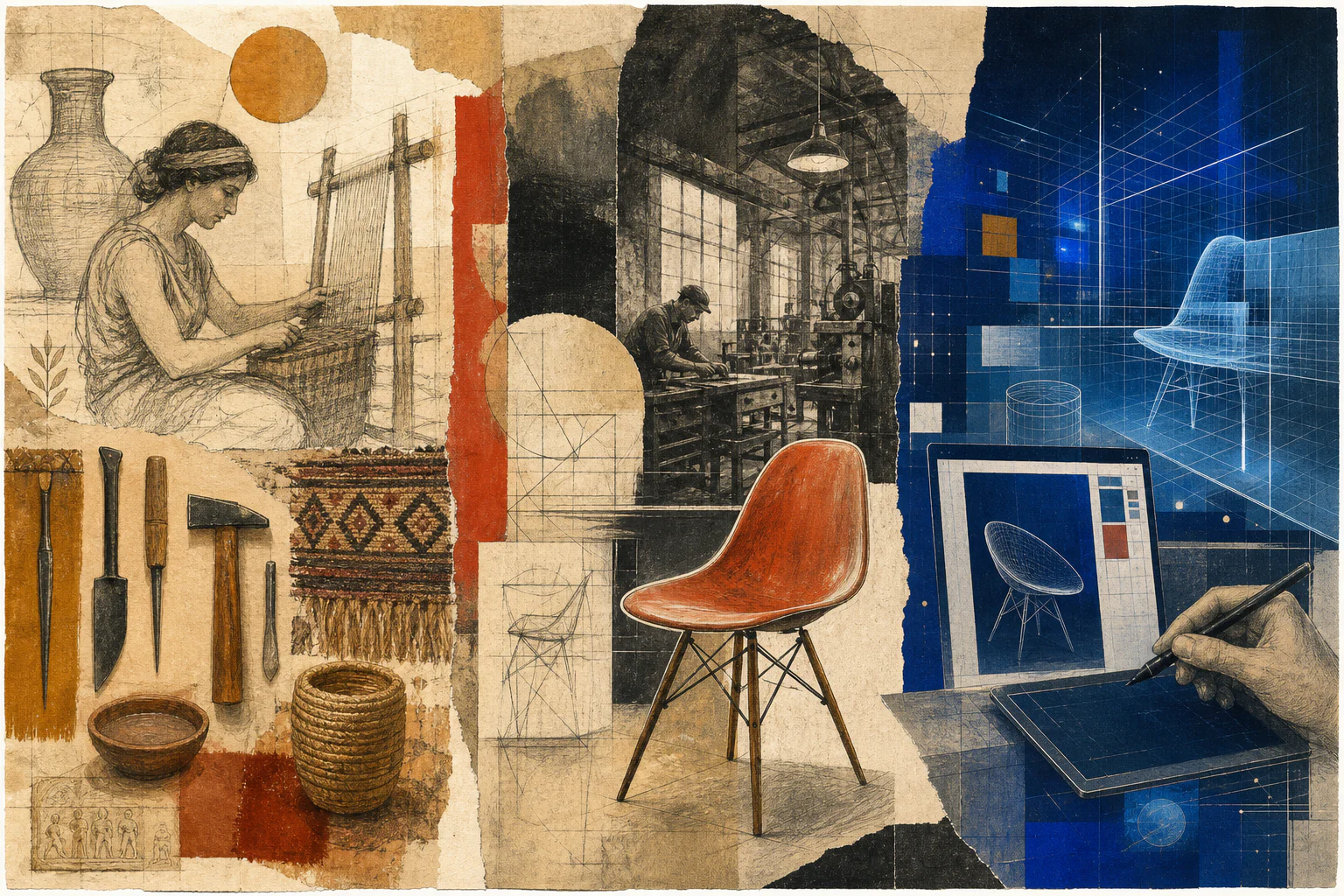
Design was not born in a single day and did not emerge from one beautiful chair. It was assembled over centuries from craft, trade, power, machines, schools, markets, interfaces and the human habit of improving the world around us.
Editorial question
Why did design become a separate discipline if people had been building houses, making furniture, clothing, vessels and ornament for centuries without using the word “designer”?
Short answer
In short: design grew out of craft, trade and architecture, but became an independent profession when industry began producing objects in series and society needed specialists who could connect function, form, production, market and culture. Rome gave scale, standardisation and infrastructure; medieval guilds gave craft discipline; the Renaissance gave project thinking and authorship; the Industrial Revolution created the mass problem of quality; design schools gave method; the digital age gave systems of interfaces, data and scenarios.
Thesis
Design history is not a straight line from a beautiful amphora to a smartphone. It is the story of how societies learned to turn material, craft, power, trade, machines, schools and screens into usable, readable forms. Design appears when an object is no longer merely made, but thought through: how it sits in the hand, how it meets the eye, how it signals status, how it saves labour and how it changes behaviour.
Design was not born in a single day and did not emerge from one beautiful chair. It was assembled over centuries from craft, trade, power, machines, schools, markets, interfaces and the human habit of improving the world around us.
Evidence and cases
Before the word “design”: the object as a contract between hand and world
Long before design became a profession, people were already arranging life through objects. A clay vessel had to hold liquid, a knife had to cut, a sandal had to stay on the foot, a coin had to make power believable. This was not yet design as a job title, but it was design as thinking: an object had to work, persuade and live with people. 1
The key is not to romanticise antiquity. An ancient maker did not work with a moodboard presentation, but understood proportion, material, repeatable form and the taste of the patron. In that sense, design history begins when an object stops being accidental.
The Roman Empire: when form gained scale
Rome matters to design history not only because of columns and arches. The empire produced large systems of standardisation: roads, aqueducts, ceramics, glass, furniture, military equipment, coins, inscriptions and public buildings. A Roman object was often part of infrastructure: it did not simply decorate a home, but served city, trade and power. 1
Glass makes this especially visible. The Roman glass industry drew on skills from metalworking, gem cutting and pottery production; luxury tableware could be both a technical object and a status signal. For design, the lesson is simple: technique almost always changes aesthetics.
Medieval guilds: design as a workshop secret
The medieval world relied on guilds, workshops and rules for passing on skill. A good object emerged not from a personal brand, but from discipline: apprentice, journeyman, master, material, commission, ornament, religious or civic code. The object was slow, but not chaotic.
Islamic, Byzantine and Asian contributions: ornament as system
Design history is not a purely European staircase. Islamic geometric patterns, Byzantine mosaics, Chinese porcelain, Japanese lacquer, Indian textiles and Persian carpets gave design what we might now call a visual system: repetition, module, rhythm, colour code and surface as language.
The Renaissance: project, drawing and author
The Renaissance strengthened the figure of the author and the role of the drawing. Architect, artist, engineer and maker began to come closer together. Objects were still made by hand, but increasingly preceded by a project: a mental model of future form.
Baroque and court culture: design as a theatre of power
The Baroque shows that design can be theatre. Palace, furniture, textile, garden, ceremonial staircase and table setting worked as one script: a person entered not merely a room, but a staged event. Power became visible through scale, gold, mirror, symmetry and movement.
The Enlightenment: classification, museum and taste
The eighteenth century matters because taste began to be studied, collected and taught. Museums, encyclopaedias, academies and model collections turned form into knowledge. An object could be compared, classified and used as an educational example.
The Industrial Revolution: the machine made design a problem
The Industrial Revolution changed the rules. The machine could produce more, faster and cheaper, but it also raised a new question: how could mass objects be accessible, useful, beautiful and recognisable? This is when design stopped being luxury finishing and became an industrial problem.
South Kensington and early schools: teaching form for industry
British design education did not grow from a romantic love of beauty, but from economic anxiety: industry needed people who could improve the form of manufactured goods. The Government School of Design was founded in 1837; around South Kensington a museum-and-school apparatus formed around what later became the V&A. 2
This is a major turn: design starts to be taught as a skill for national industry. The museum becomes not only a temple of rare objects, but a library of examples: come, look, learn, improve the product.
Arts and Crafts: a revolt against the bad factory object
Arts and Crafts can be imagined as the moment designers looked at factory furniture and said: “we cannot live like this.” The movement reacted to industrialisation and the low status of the decorative arts by restoring respect for craft, material and honest handwork. 4
William Morris and his circle were not merely covering wallpapers with leaves. They were arguing with the production system: who makes the object, under what conditions, why ornament should mean something and why a home should not be a showroom for industrial randomness.
Art Nouveau: line, plant and the urban poster
Art Nouveau turned line into a living organism. Poster, stained glass, metro entrance, furniture, jewellery, book cover began to flow in one wave. This was already the design of the mass city: form moved into streets, cafés, shops, magazines and advertising images.
Deutscher Werkbund: factory meets culture
The Werkbund matters as a bridge between the craft ideal and the industrial standard. The designer no longer simply protects the object from the machine, but negotiates with the machine: let us produce serially, but intelligently; let the product carry quality, order and modernity.
Futurism and early modernism: speed enters form
The early twentieth century brought excitement around the machine, electricity, train, car, airplane and urban noise. Form became dynamic: diagonal, rhythm, repetition, mechanical gesture. Design learned to speak the language of speed.
Bauhaus: the school as a laboratory for new life
Bauhaus was not just a school with beautiful chairs. It was a laboratory where craft, art, architecture, typography, textile, photography and industry tried to assemble a new model of life after the First World War. It existed from 1919 to 1933, but its influence was disproportionately large. 6
MoMA describes Bauhaus as a site of influential conversations about the role of modern art and design in society; exhibitions about the school show the breadth of its practice, from furniture and architecture to graphics, photography, textiles, ceramics and theatre. 7
What Bauhaus gave to design fields
Bauhaus gave design not one style but a set of habits: learn through material, think through the workshop, connect art and production, respect geometry, reduce excess, design for modern life. From that school grew lines still recognisable in graphics, furniture, interfaces and architecture.
VKHUTEMAS: a parallel avant-garde laboratory
VKHUTEMAS is often called the Soviet parallel to Bauhaus, but it was not a copy. Painting, architecture, production art, constructivism and new pedagogy all argued inside it. Its history shows that twentieth-century design education was born not from calm consensus but from conflict between academy, production and revolutionary ideas. 9
Art Deco and Streamline: luxury learns to be modern
In the 1920s and 1930s, design discovered that the machine could be glamorous as well as strict. Art Deco gave geometry, shine, skyscraper and display window; Streamline added smoothness, speed and aerodynamic dreaming. Toaster, train and radio began to look ready for take-off.
Postwar design: the home as a promise of normal life
After the Second World War, design became a language of recovery. Furniture, appliances, kitchen, transport, poster and packaging all needed to say: life is being put back together. Mid-century modern, Scandinavian design and new materials made modernity domestic, warm and relatively accessible.
Ulm: from beautiful form to systems thinking
HfG Ulm opened in 1955 and became one of the key schools of postwar design. If Bauhaus still kept a link with art and craft, Ulm turned design more strongly toward science, methodology, industrial products, visual communication and systems. 10
Ulm gave design a cold but useful thought: form is not the final picture, but the result of analysis, function, production, information and responsibility. From here it is a short step to corporate identity, interfaces and service thinking.
Braun, Lufthansa and the corporate system
Postwar design learned to work not only with a single object, but with a system. Radio, manual, logo, packaging, aircraft interior, ticket, poster and exhibition stand had to speak in one voice. This is design as a brand operating system.
The Swiss school and graphic discipline
Swiss typography gave design grid, clarity, neutrality and respect for information. The letter stopped performing emotion and began to serve structure. For modern UX, this is almost a family tree: grid, hierarchy, contrast, readability, order.
Pop culture: the supermarket enters design
The 1960s showed that design lives not only in museums and schools, but in supermarkets, advertising, television, packaging, magazines and record covers. Pop culture taught designers to work with desire, repetition, colour, icon and mass image.
Radical design and Memphis: when objects start joking
Radical design and Memphis seemed to ask: why must a chair behave politely? Form became toy-like, colour became loud, surface became artificial, interior became a stage. It was a revolt against overly correct good taste.
Postmodernism: quotation returns
Postmodernism returned the right to quote, joke, allude to history and assemble cultural fragments. After modernism’s “remove the unnecessary” came the question: what if the unnecessary is the meaning? An object could again be sign, joke, mask and commentary.
Design becomes a public profession
In the second half of the twentieth century, design definitively moved beyond the workshop. Design councils, professional associations, design museums, awards, standards and educational programmes appeared. Britain’s Design Council, for example, linked the improvement of industrial products to educational and economic agendas. 11
Design museums: the object gets a biography
When design enters the museum, the ordinary object gets a second life. Chair, kettle, poster, interface or sneaker becomes not only a product, but a document of its time. Cooper Hewitt, the Design Museum, MoMA and other institutions show that design is a history of decisions, not just a display of attractive objects. 12
Computer and interface: design moves onto the screen
With the personal computer, designers began to design not only objects, but behaviour on screen. Button, cursor, menu, window, icon, typeface and navigation became the furniture of the digital house. The user no longer simply looks at form; the user acts inside it.
Service design and design thinking: designing experience, not only objects
In the late twentieth and early twenty-first centuries, design increasingly worked with processes: how a patient moves through a clinic, how a passenger buys a ticket, how a person registers in an app, how a team makes a decision. The object remains important, but the scenario becomes the primary object of design.
AI and the generative era: a new industrial revolution of images
Today AI is doing to visual culture something like what the factory did to objects: it accelerates production, lowers entry barriers and forces new questions about authorship, taste and responsibility. It is no longer enough for a designer to “make it beautiful”; the designer must set systems, select, edit, verify and explain results.
Main conclusion: design is a way of thinking about the future
Design history is not a museum corridor lined with labels. It is a long story of people taming material, machine, market, information and the dream of a better life. Each school gave not only a style, but a new thinking tool: craft, standard, laboratory, system, interface, scenario.
Visual analysis
The article's visual logic can be tested through «Before the word “design”: the object as a contract between hand and world», «The Roman Empire: when form gained scale», «Medieval guilds: design as a workshop secret», «Islamic, Byzantine and Asian contributions: ornament as system», «The Renaissance: project, drawing and author», «Baroque and court culture: design as a theatre of power». Compare these signs within one object or sequence rather than judging them as an isolated style.
Practical implication
Practical use begins by testing the thesis against a specific object, frame, or production decision. For this subject, the working criterion is: From ancient craft and the Roman Empire to design schools, the Industrial Revolution and digital systems
Limitations
“History of Design” is limited to its stated subject: from ancient craft and the roman empire to design schools, the industrial revolution and digital systems. The analysis does not replace examination of a specific original, project, or production context.
Sources
The open sources for “History of Design” are listed in the page panel and define the boundary of its verifiable facts.