analysis
How logistics changes the form of an object
Packaging, stacking, weight, and delivery route design an object no less than its author does.
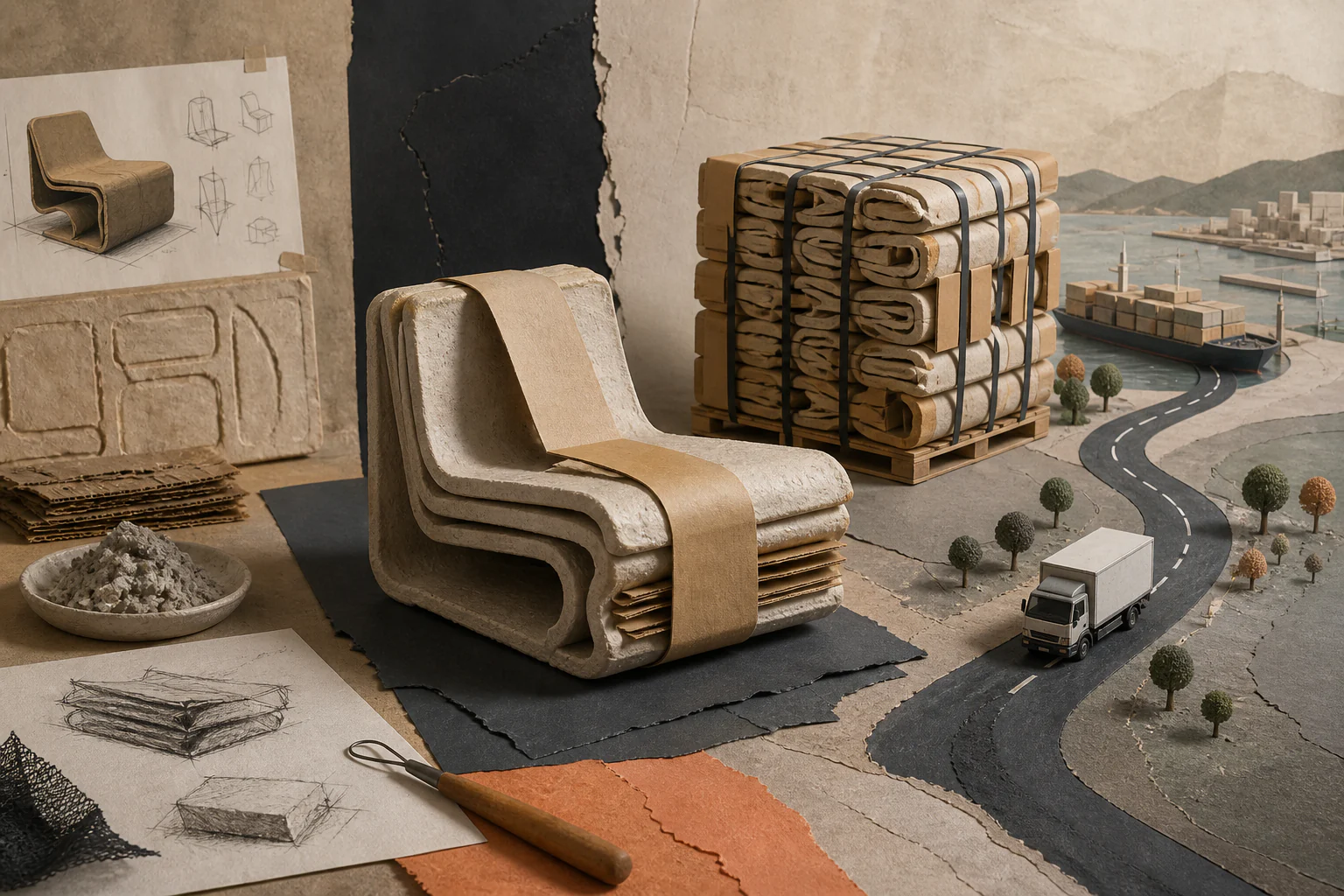
Logistics designs form as effectively as an author does: packaging, stacking, weight, repair, and delivery route change the body of an object.
Packaging, stacking, weight, and delivery route design an object no less than its author does.
Editorial question
How should we read this problem: packaging, stacking, weight, and delivery route design an object no less than its author does.
Short answer
Packaging, stacking, weight, and delivery route design an object no less than its author does.
Thesis
Package dimensions set the limits of an object before sketching begins. If a thing does not fit a standard carton, pallet, or lift opening, the form is changed — and not for aesthetic reasons.
Packaging, stacking, weight, and delivery route design an object no less than its author does.
Evidence and cases
Thesis: the box is also a drawing
Package dimensions set the limits of an object before sketching begins. If a thing does not fit a standard carton, pallet, or lift opening, the form is changed — and not for aesthetic reasons.
The standard sets the module
Standardised transport created a grid of dimensions to which almost all production conforms. Pallet and container dimensions work like a typographic grid: they determine which sizes are economical and which are not.
Air is the most expensive cargo
Volume is shipped, not only mass. An object that cannot be folded or nested carries emptiness with it, and that emptiness is paid for on every kilometre of the route.
Stackability as form
The requirement to place objects on top of one another dictates geometry directly: taper, offset axes, recesses. A stacking chair looks the way it does not by authorial choice but by warehouse condition.
Flat packing changed furniture
Moving assembly to the customer redefined construction: joints became demountable, parts flat, fixings standardised. It is the clearest case of logistics rewriting an entire typology.
The instruction became part of the object
When assembly is handed to the user, documentation stops being an appendix and becomes a component. A bad instruction breaks an object as reliably as a bad screw.
Weight drives material
Delivery cost tied to mass pushes toward lighter materials even where heavier ones performed better. Aluminium, polymers, and composites win the tender through tariff rather than through properties.
Fragility is designed for
An object must survive not use but transport: vibration, drops, a stack above it. Frequently it is these loads, rather than operational ones, that determine wall thickness and stiffening ribs.
Returns change construction
Online retail made returns a mass operation. An object must survive the journey back and repacking, so it is designed for two transport cycles instead of one.
The last mile dictates dimension
Delivery to a flat constrains size more than trunk transport does: a stair flight, a door opening, a lift. Many "unexpected" proportions are explained by exactly this stretch of the route.
The warehouse demands legibility
An object must be identifiable inside a box: marking, orientation, barcode. This adds a graphic layer designed alongside the form, and often constraining it.
On-site assembly returned to architecture
Prefabrication obeys the same rules: an element must travel by road, pass under a bridge, and be lifted by crane. Transport dimensions constrain architecture directly.
Fashion is logistical too
Clothing is designed with folding, packing, transport creases, and recovery after unpacking in mind. Cloth is chosen partly for its ability to survive the journey.
Lead times shape the assortment
Delivery duration determines planning depth and therefore how risky a decision may be. A short route permits experiment; a long one demands predictability.
Repair depends on parts logistics
Repairability exists only where a part can be obtained. A construction designed for component replacement is pointless without a stock and a route for that component.
First turn: the container unified the world
Standardised sea freight made distance cheap and turned dimension into a global constant. From that point design had to treat someone else’s infrastructure as a given.
Second turn: assembly moved to the customer
Handing the last operation to the user cut shipping volume and rewrote furniture construction. Saving on air proved stronger than arguments about joint quality.
Third turn: the route became two-way
Returns, repair, and recycling turned logistics into a loop rather than a line. An object is now designed for the journey out and back, and this requirement is only intensifying.
What is usually misunderstood
The error is to treat logistics as a constraint imposed after design. In practice it enters the brief from the start; it is simply rarely stated aloud as a design condition.
Counterargument: purpose determines form
The classic objection: an object is designed for function and for the user’s body, and transport is a secondary matter solved by packaging.
Where the counterargument holds
It holds for unique and local objects: a one-off made near the place of use is genuinely free of transport constraints.
Where it fails
It fails for serial production with a global chain. There the transport constraint is harder than the ergonomic one, because it is multiplied by the run and by every kilometre.
A test: look at the box
A practical method is to study the packaging before the object. The ratio of box volume to object volume, the presence of nesting, and the method of restraint reveal which decisions were taken and why.
Link to the material entries
The entries on plywood, aluminium, composites, and polymers explain why some materials gain from logistical requirements while others lose.
Link to the objects
The entries on individual chairs and storage systems show how stacking, demountability, and modularity became form-giving requirements.
What this changes in practice
Start a project from transport dimensions and the return scenario rather than from silhouette. This does not narrow the solution; it immediately eliminates options that would never reach the user anyway.
What stays with the author
Logistics sets boundaries but does not fill them. Within the same dimensions entirely different solutions are possible, and the quality of that choice remains authorial work.
The current state
Requirements for the return route are growing: repair, returns, and disassembly are becoming regulatory rather than voluntary. Logistical influence on form is intensifying, not weakening.
Editorial conclusion
Logistics changes an object’s form because it is the only constraint that acts on every unit of a production run. An author designs once; the route is applied a million times.
How to read the subject today
On meeting an odd proportion or an unexpected joint, ask about the route: how it travelled, how it packed, and how it will travel back. The answer usually explains the form.
Visual analysis
The article's visual logic can be tested through «Thesis: the box is also a drawing», «The standard sets the module», «Air is the most expensive cargo», «Stackability as form», «Flat packing changed furniture», «The instruction became part of the object». Compare these signs within one object or sequence rather than judging them as an isolated style.
Practical implication
Practical use begins by testing the thesis against a specific object, frame, or production decision. For this subject, the working criterion is: Packaging, stacking, weight, and delivery route design an object no less than its author does.
Limitations
“How logistics changes the form of an object” is limited to its stated subject: packaging, stacking, weight, and delivery route design an object no less than its author does. The analysis does not replace examination of a specific original, project, or production context.
Sources
- Design Museum — Collection
- Design Museum — Chairs of the 1950s
- Design Museum — Chairs of the 1960s
- Vitra Design Museum — Online Collection
- MoMA — Bauhaus 1919–1933: Workshops for Modernity
- VANSMITHLAB AI Master Content Plan — project master plan