analysis
How religion influenced the world of fashion
Modesty, ritual, craft and symbol: how religious systems shaped the language of dress
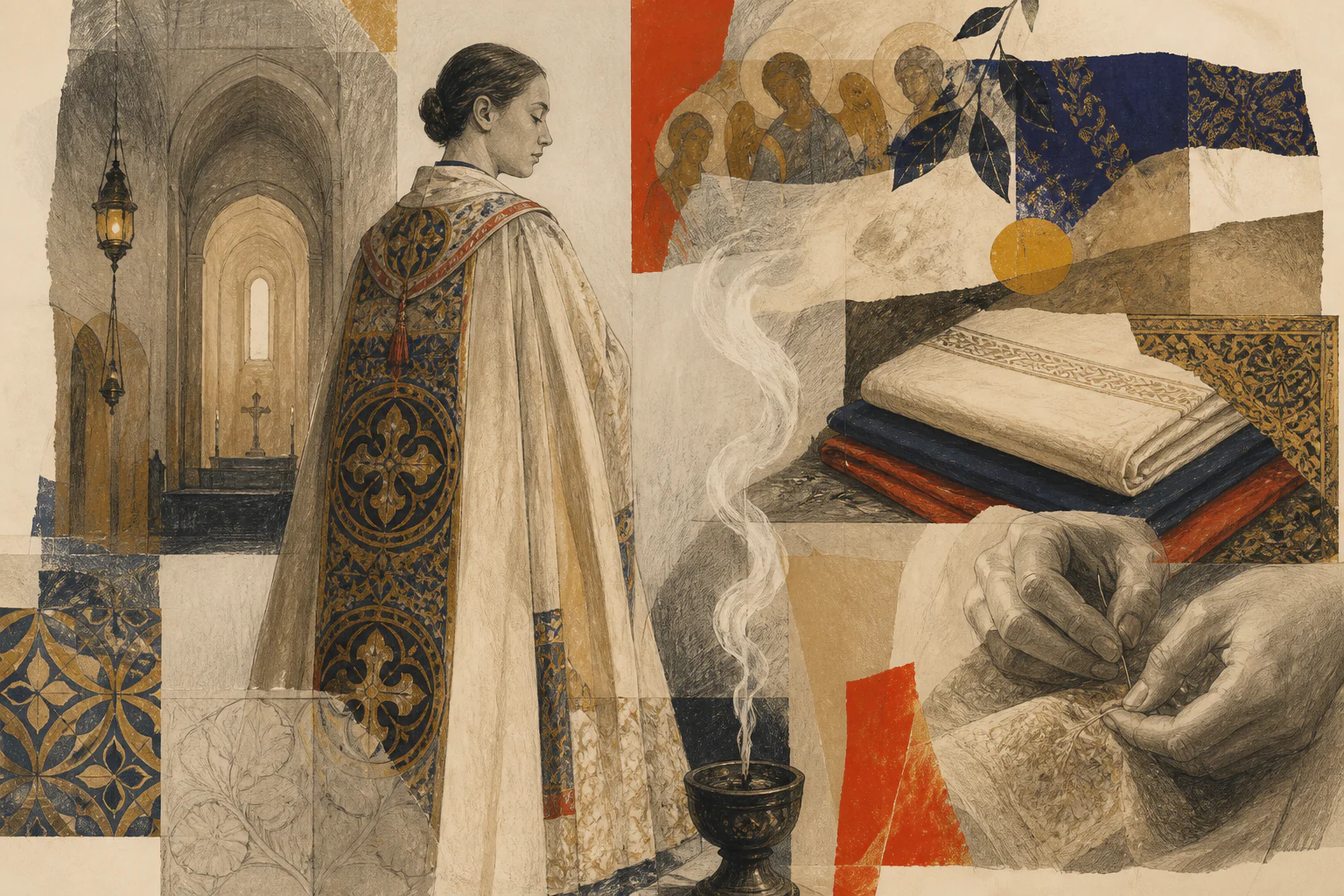
Clothing becomes fashion not when it ceases to be a necessity but when society begins to read it as a system of signs.
Editorial question
How have religious beliefs, institutions and rituals influenced the form of clothing, the attitude to the body, craft and the visual language of contemporary fashion?
To present religion not as a simple set of prohibitions but as one of the most durable systems that at once regulates clothing and creates forms, materials, symbols, crafts and ways of expressing identity.
The material does not attempt an exhaustive history of all world religions.
Religious norms are examined in historical and regional context, without claims about a single practice of all believers.
Ethnic, national and religious clothing are not automatically mixed.
Authorial conclusions are separated from verifiable historical facts.
Contemporary designer cases are examined only where the connection with the religious tradition is documented or clearly attributed by a museum, archive or the designer himself.
Short answer
Religious systems shaped fashion through several durable mechanisms: regulating how much of the body is shown, marking belonging, ritual form, the sacred status of a material, craft sustained by an institution, the symbolism of colour, and the calendar. Christianity fixed the architecture of vestments and liturgical colour; Islam produced the modern modest-fashion industry; Judaism showed how law adapts in diaspora; South and East Asian traditions preserved cloth as a sacred object in its own right.
Through the twentieth and twenty-first centuries these codes entered haute couture — from collections quoting vestments to the continuing argument about appropriation. Religion did not disappear from fashion: it stopped being a prescription and remained a form.
Thesis
Religion influenced fashion less through prohibitions than through durable forms: a cut that covers the body, ritual cloth, colour with fixed meaning, craft sustained by an institution. These forms outlived their own religious context and still work as a visual language — outside belief, but with the structure intact.
The right question is therefore not what religion forbade but which decisions it made durable. Modesty turns out to be a distinct system for designing the body, vestments an architecture, and sacred textile a source of techniques couture still uses.
Clothing becomes fashion not when it ceases to be a necessity but when society begins to read it as a system of signs.
Evidence and cases
Introduction: clothing between the body, society and the sacred
Clothing was never only protection from the cold or a way of adorning the body. It tells who stands before us, to which group a person belongs, what role he performs, whether he is admitted to a certain ritual and what place he holds in the social hierarchy. Religion added another level to this language: the relations between the body, morality, the community and the idea of the sacred.
Religious influence on fashion therefore cannot be reduced to prohibitions. Religious institutions did regulate the visibility of the body, luxury and the distinctions between sexes or estates. But they also created extremely complex systems of vestments, supported weaving, embroidery, jewellery and the production of ceremonial objects. Temples, courts and religious communities became clients of textiles; rituals preserved certain forms of clothing for centuries; symbols of faith turned into ornament, accessory and a sign of status.
Fashion, by contrast, works through change. It takes a stable sign and places it in a new environment: the monastic hood becomes an element of an avant-garde silhouette; liturgical gold becomes a code of luxury; the closed form becomes the basis of contemporary modest fashion; the cross becomes a piece of jewellery that can be confessional, cultural or simply decorative. In this transition meaning does not fully disappear. It becomes layered and sometimes conflicted.
It is more accurate to say not that religion 'created fashion' but that it was one of the most enduring forces that gave clothing meaning. Specific forms always arose at the intersection of faith, climate, materials, trade, politics, gender, class, colonialism and migration. This matters especially for global history: there is no single universal Christian, Islamic, Jewish or Buddhist clothing.
Seven mechanisms of religious influence
Religious norms determined which parts of the body must be covered, how the hair should be worn, whether the display of wealth is permissible, and how clothing distinguishes everyday life, prayer, mourning or celebration.
Clerical vestments, monastic garments, head coverings, ritual belts, bridal ensembles and pilgrim dress formed durable forms that outlived political and stylistic changes.
Colour, gold, embroidery, calligraphy, geometry, plant ornament, precious stones and strict symmetry received religious functions and later entered secular design.
Clothing communicated belonging to a community, office, marital status, region, age and sometimes the degree of religious learning or discipline.
Temples, monasteries, courts and charitable foundations commissioned textiles and ornaments, supporting highly specialised crafts.
Believers constantly interpreted the rules: they chose the fabric, colour, degree of decoration and ways of combining modernity with tradition.
Fashion extracts a religious image from its original context and turns it into style, commodity, provocation or a means of cultural memory.
Modesty: not the absence of fashion but a different design of the body
In the popular imagination religious clothing is often associated above all with modesty. Yet modesty is not a single garment and does not belong to a single religion. It is a changing system of norms that can concern length, transparency, fit, hair, neckline, legs, arms, jewellery, colour and even the manner of movement.
Late-antique Christian authors discussed women's clothing, jewellery and the covering of the head as questions of morality, status and behaviour. But even in strict texts clothing remained a means of action: through it women could display piety, marital status or social dignity. The European traditions of covering the head and face also had their own complex history and cannot be regarded as an exclusively Islamic phenomenon.
Islamic norms of modesty formed in various legal, cultural and political contexts. The terms 'hijab', 'niqab', 'chador' and 'abaya' are not interchangeable: they denote different garments and practices. Their form depends on the region, era, local fashion and personal choice. For some women covered clothing is a religious duty, for others a cultural norm, a sign of community, a political gesture or an aesthetic preference; often these meanings combine.
From a design point of view modest clothing does not exclude fashionability. On the contrary, the constraint creates a separate field of form-making: the designer works with volume instead of exposure, with layering instead of transparency, with the surface of the fabric instead of a direct accent on the body. Drapery, movement, the proportion of the sleeve, the interaction of the head covering and the silhouette, the complexity of texture and the colour combinations become important.
Contemporary modest fashion has become a transregional market. Studies of Muslim fashion show how forms perceived as 'authentic' in one region are adapted by designers and consumers in another. The abaya, for example, can keep its religious function and at the same time take part in the system of seasonal fashion, brands, influencers and luxury consumption. This creates internal disputes: when does aestheticisation strengthen religious identity, and when does consumer logic blur spiritual meaning?
Clothing as a sign of belonging
Religious clothing rarely communicates only faith. It can at once point to origin, family status, profession, rank, age and local tradition. Museum collections of Jewish clothing show especially clearly that diaspora communities often wore clothing similar to that of their neighbours. The distinction was created not necessarily by the general silhouette but by a separate detail, a way of covering the head, an ornament, a colour or a context of use.
The Jewish Museum exhibition Veiled Meanings: Fashioning Jewish Dress stressed the diversity of Jewish communities and how much their clothing depended on the surrounding culture. This breaks the idea of religious clothing as a closed, unchanging system. Tradition is preserved not only through repetition but through adaptation: a foreign form can be appropriated by a community and filled with its own meaning.
In the Ottoman Empire clothing could historically denote religious and class belonging. The state reforms of the nineteenth century, by contrast, sought partly to unify the appearance of the subjects. Museum research on late-Ottoman clothing shows how European forms — the fitted jacket, the skirt, the white wedding dress — gradually coexisted with local fabrics, ornaments and religious customs. The turn to 'European fashion' was not an instant abandonment of identity; it created hybrid ensembles.
The Sikh tradition demonstrates a different type of visibility. The turban can be at once a religious practice, a protection of uncut hair, a sign of dignity and a public identity. Historical images of the Akali warriors show the tower-like dastar bunga, on which steel chakras were placed. Here the headdress joined spiritual belonging, a military function and visual monumentality.
Ritual, power and ceremonial form
Ritual turns clothing into an instrument of transition. A person puts on a special garment not only because it is beautiful or expensive but because clothing makes him a participant in a certain action. The bridal costume marks a change of family status; monastic clothing marks a renunciation of the former social role; the vestments of a priest mark the right to perform a liturgical function; mourning clothing marks a publicly visible state of loss.
Ritual forms are marked by stability. Their construction can persist for centuries, even as fabrics, technique and decorative motifs change. That is why religious clothing becomes a kind of archive: it holds old proportions and ways of drapery that secular fashion long abandoned. When a designer turns to such an archive, he receives not just a form but a feeling of time, power and ceremony.
The luxury of religious vestments often seems to contradict the ideal of spirituality. But historically precious fabrics could be understood not as the personal consumption of the minister but as a gift to the deity, the temple or the community. Gold, silk and stones heightened the exclusivity of the ritual moment, creating a distance between the everyday and the sacred. At the same time they demonstrated the resources of the institution and the political status of the patron.
In other traditions, by contrast, demonstrative simplicity matters. Monastic garb can symbolise poverty, the reuse of fabric and the renunciation of worldly individuality. The Japanese Buddhist kesa is built as a rectangular patchwork vestment. Museum descriptions connect its composition with the idea of poverty and religious gift; the labour of joining fragments of fabric can itself be understood as an act of piety. At the same time historical kesa were sometimes made from luxurious court fabrics, turning the garment into a complex dialogue of asceticism and material value.
Christianity and the architecture of vestment
The influence of Christianity on European fashion is especially visible not only in symbols but in construction. Liturgical clothing creates an architecture around the body: vertical lines, long tunics, cloaks, hoods, rigid headdresses, symmetrical panels and rich embroidery turn the figure into a sign of office and ritual.
The Catholic tradition gave fashion a vast visual vocabulary: black and white as an ascetic contrast; red and purple as the colours of power and martyrdom; gold as light and triumph; lace, velvet and metallic embroidery as the material expression of sacred luxury. No less important are the images — the cross, the heart, the halo, the crown of thorns, angels, the Madonna, the reliquary and the stained-glass palette.
The Metropolitan Museum of Art exhibition Heavenly Bodies: Fashion and the Catholic Imagination was built as a dialogue between medieval art, papal vestments and the fashion of the twentieth and twenty-first centuries. The museum's curatorial position matters: many of the designers presented were raised in a Catholic environment and acknowledged the enduring influence of this imagery on the imagination. This makes it possible to speak not only of the borrowing of external symbols but of cultural memory — of how childhood impressions of ceremony, architecture, smells, colour and fear become material of creativity.
In Balenciaga religious influence is often read through severity, black and a volume recalling monastic or processional form. In Versace the Byzantine cross turns into a radiant decorative module. In Gaultier, McQueen, Galliano and Dolce & Gabbana Catholic imagery can be theatrical, sensual or provocative. Yet for each case one must separate the documented connection from critical interpretation.
Islam and the global system of modest fashion
Islamic clothing is not a single style. From North Africa to Southeast Asia the fabrics, silhouettes, head coverings, degree of decoration and the relations between the religious norm and local culture differ. The attempt to reduce everything to the black abaya or a single type of hijab reproduces an external gaze and erases the real diversity.
Historical Islamic societies were among the most important centres of textile production and trade. The Ottoman, Safavid and Mughal workshops created silks, carpets, embroideries and fabrics with gold and silver thread. The ornament was not always directly religious, but developed within cultures in which architecture, calligraphy, court ceremonial and ideas of beauty were closely connected with Islam.
Contemporary Muslim fashion arose not simply as an industry reaction to a 'new audience'. It was shaped by the designers, entrepreneurs and consumers themselves, who sought ways to combine religious practice, professional life and contemporary aesthetics. Social media strengthened this process: visual styling instructions, local brands and bloggers created an alternative centre of fashion authority.
Modest fashion should not, however, be automatically identified with religiosity. Closed silhouettes are worn by Muslim, Christian and Jewish women and by secular consumers. The commercial term unites different motivations and sometimes simplifies them. For research it matters more to ask: who calls the clothing modest, what norms does it perform, and how do the wearers themselves explain their choice?
Within Muslim communities there is a critique of turning the veil into a consumer product. Some consider the fashion industry a way to widen women's choice and public presence. Others see in luxurious branded clothing a contradiction of the ideas of moderation. This dispute shows that religion is not on 'one side' and fashion on 'the other': they interact within the community itself.
Judaism: diaspora, law and adaptation
The Jewish history of clothing is especially important for understanding the diaspora. Communities lived in different states and adopted local fabrics and forms while preserving religious distinctions. Identity could therefore be expressed not through a fully unique costume but through the way of wearing a common form, through the head covering, the details of male religious dress, the holiday context or a family custom.
In some Orthodox communities the covering of the hair by married women is connected with norms of modesty, but the practical forms differ: a scarf, a hat, a wig or a combination of items. Men's clothing is also heterogeneous: the head covering, the tzitzit fringes and the festive suit have different meanings and cannot be reduced to a single 'traditional image'.
Museum clothing from North Africa, the Middle East, Central Asia and Europe shows a constant exchange with neighbours. Sometimes a Jewish woman and a Muslim woman of the same city wore almost the same silhouette; the differences became visible only to a prepared viewer. This is an important lesson for the history of fashion: outward resemblance does not mean the same meaning, and visual difference is not always great.
Religious identity is supported not only by prohibition but by memory. Bridal clothing, family embroidery, a passed-down head covering or a holiday fabric can connect generations. When such objects enter a museum or a contemporary collection, they change their mode of existence: from a personal and ritual object they become cultural evidence and a source of design.
South and East Asia: fabric as a sacred object
In South Asia textiles take part in religious life not only as human clothing. Fabrics are placed on images of deities, offered to temples and shrines, and used as curtains, flags, covers and protective objects. The V&A notes that Hindus, Muslims, Jains, Buddhists and Christians of the region widely use fabrics in worship — in ritual, as offering and as the decoration of sacred space.
Such a context widens the notion of fashion. Fabric need not serve the human body in order to influence clothing. The colour systems, the technique of gold embroidery, the ornament, the ways of drapery and the ceremonial value pass between the temple, the court and the wardrobe.
Talismanic shirts with Qur'anic inscriptions, mirror embroidery, bridal covers and fabrics to which protective power was attributed show that clothing can be understood as a physical boundary between a person and danger. Here the pattern is not only decoration: it acts — at least in the wearers' conception — as protection, blessing or a carrier of text.
In the Buddhist tradition monastic vestment stresses the distinction between clergy and laity and can embody the idea of renouncing property. But the surviving Japanese kesa demonstrate that a religious form can include expensive silks and fabrics received as gifts. The simple scheme and the luxurious material do not destroy each other; their tension creates meaning.
For contemporary fashion Asian religious textiles represent at once an enormous archive and an ethical complexity. One cannot separate the technique from its bearers and turn a sacred object into an 'exotic print' without context. Responsible design requires an understanding of function, the consent of the makers, correct attribution and an honest economic connection with the craft environment.
When the sacred code enters haute couture
Fashion turns to religion for different reasons. Sometimes a designer works with personal memory; sometimes he uses a religious image as a universal symbol of power, death, purity or sin; sometimes he creates a visual scandal. These modes must not be mixed.
The designer reproduces the atmosphere of the tradition in which he grew up: the colours, the ceremony, the silhouette, the fear, the solemnity or the feeling of prohibition.
On the clothing appears a recognisable symbol, the image of a saint, a text, a cross, a halo or the form of vestment.
The religious form is translated into cutting: a mantle, a vertical tunic, a hood, a closed volume, a processional train.
Used are brocade, velvet, metallic embroidery, lace, beads, enamel and stones connected with ceremonial luxury.
The sacred is placed beside the erotic, the commercial or the anti-religious in order to provoke a conflict of interpretations.
The symbol turns into a recognisable decorative code without a deep relation to tradition.
The peculiarity of haute couture lies in its resemblance to a ritual system. Exclusive clothing is made by hand, presented in a strictly organised ceremony, requires a prepared viewer and exists at a distance from mass everyday life. That is why religious forms look natural in couture: they strengthen the feeling of exclusivity and symbolic power.
But the runway is not neutral. When a religious object becomes a fashion commodity, the circle of people who determine its meaning changes. To the believers, spiritual institutions and historians are added the designer, the brand, the buyer, the photographer, the editor and the social-media audience. The same image can be perceived as respect, a personal confession, an aestheticisation or an insult.
Appropriation, commercialisation and the conflict of meanings
The term 'cultural appropriation' is often used too broadly. For precise analysis one must distinguish influence, quotation, collaboration, commercialisation and appropriation. Not every use of another's image is exploitation, but aesthetic appeal does not cancel inequality either.
Does the object have an active sacred function or is it a historical motif?
Who creates the work and what is his connection with the tradition?
Is the source indicated and the meaning explained?
Do the bearers of the culture or the makers take part in the production and receive fair remuneration?
Is the meaning changed in a way that the community considers degrading?
Is the symbol used only for shock and sale?
Is there a difference between the museum interpretation, the artistic statement and the mass commodity?
In the religious sphere the conflict is especially sensitive, because a symbol can be perceived not as cultural property but as an object of living faith. Its meaning is not exhausted by the history of art. An image that is a form for the designer can be for another person an object of prayer or a prohibition.
At the same time one cannot give a single organisation the right to speak on behalf of all believers. Reactions within any tradition differ. An editorially correct article must therefore attribute the assessments: not 'the collection offended Christians' but 'certain religious representatives and critics called the use of the symbol offensive', with an indication of the source, date and context.
Conclusion: religion did not disappear from fashion — it changed form
Contemporary fashion often describes itself as a secular and individualistic system. Yet its visual language preserves the memory of religious forms. Long processional clothing, the closed monastic volume, the gold of the altar, black mourning, the white bridal suit, the covered head, the amulet, the cross and sacred calligraphy continue to take part in how we read the silhouette.
Religion influenced fashion not in a single direction but through a network of relations. It constrained and inspired; preserved forms and produced innovations; demanded modesty and created exceptional luxury; erased individuality and gave the community a recognisable image. The wearers of religious clothing were never only passive executors of rules: they interpreted the norm, chose the material, colour, degree of decoration and the way of joining faith with modernity.
When the sacred code moves into fashion, it changes function but does not become empty. Even detached from theological content, it carries the memory of power, belonging, prohibition, protection, death and hope. It is precisely this residual force that makes religious images so attractive to designers — and so sensitive for society.
Visual analysis
The article's visual logic can be tested through «Introduction: clothing between the body, society and the sacred», «Seven mechanisms of religious influence», «Modesty: not the absence of fashion but a different design of the body», «Clothing as a sign of belonging», «Ritual, power and ceremonial form», «Christianity and the architecture of vestment». Compare these signs within one object or sequence rather than judging them as an isolated style.
Practical implication
Practical use begins by testing the thesis against a specific object, frame, or production decision. For this subject, the working criterion is: Modesty, ritual, craft and symbol: how religious systems shaped the language of dress
Limitations
“How religion influenced the world of fashion” is limited to its stated subject: modesty, ritual, craft and symbol: how religious systems shaped the language of dress. The analysis does not replace examination of a specific original, project, or production context.
Sources
The open sources for “How religion influenced the world of fashion” are listed in the page panel and define the boundary of its verifiable facts.