analysis
Why Dazed and i-D Matter More Than Youth Magazines
How two London publications turned street culture, identity and cultural risk into a system of early visibility
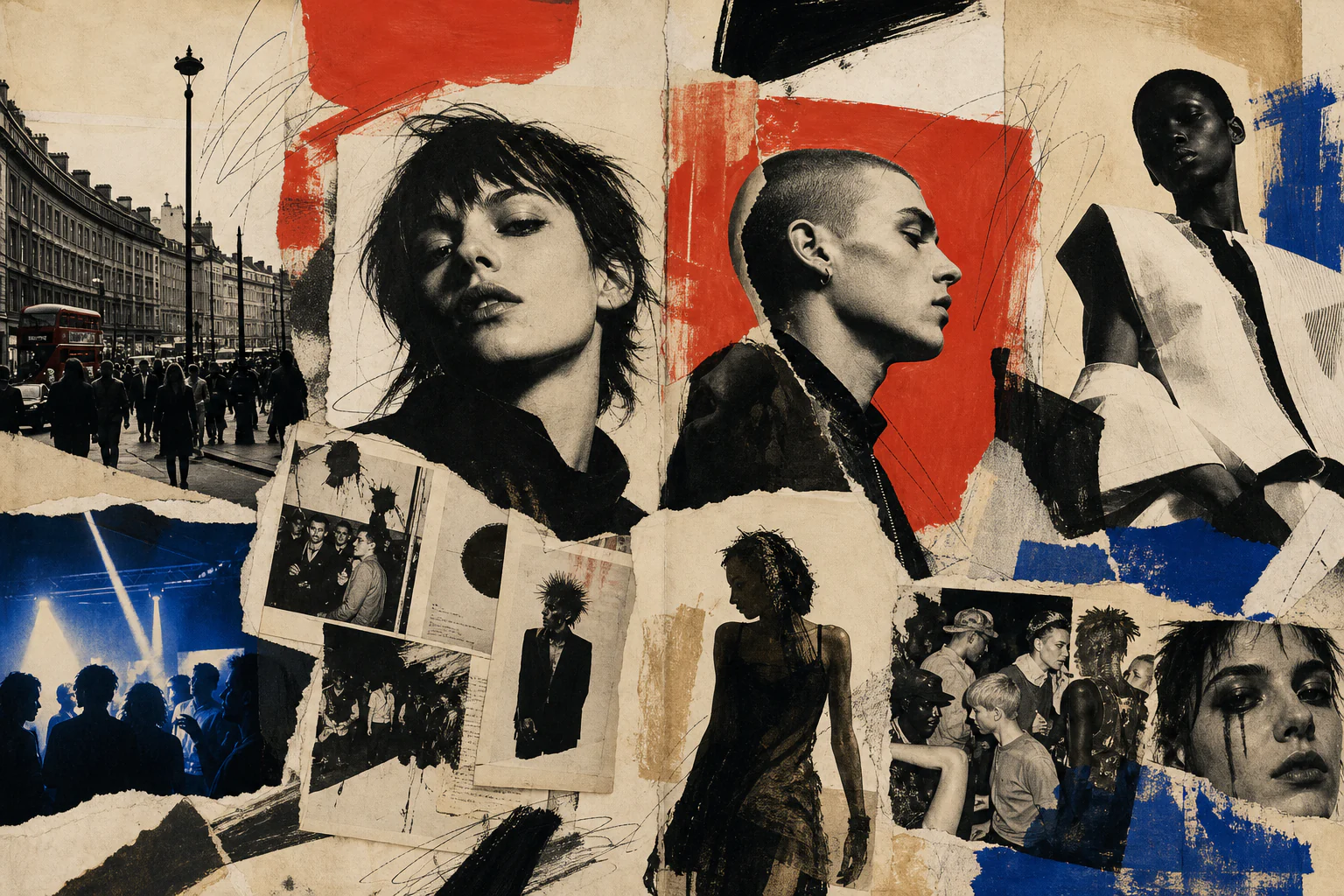
Their strength was not knowing what young people wanted. It was creating an editorial situation in which culture that had not yet stabilised could become visible before the market learned how to sell it.
Editorial question
Why do magazines born from streets, clubs and DIY print continue to shape fashion and visual culture decades later, even when the category "youth magazine" has almost lost its meaning?
Short answer
Because they built not an age-defined product but an infrastructure of visibility. i-D turned personal identity, street style and gesture into editorial document; Dazed turned cultural conflict, interdisciplinarity and talent discovery into a production method. In 2026 both already operate as multi-format media systems, yet their value still depends on an old skill: seeing what has not yet proven its popularity. 1
This is the central VANSMITHLAB thesis: a cultural magazine becomes important when it does more than reflect youth and instead risks distributing attention before consensus.
Thesis
i-D and Dazed matter not simply as two successful "youth magazines" but as two models of cultural detection. They taught the magazine to look not for a finished trend but for a weak signal: a face, posture, photographer, local scene, conflict or visual code that had not yet acquired mass language.
That is why their power is double-edged. Editorial selection can open space for new people while accelerating the conversion of their culture into product. The analysis must hold both sides at once: the ability to detect the future and responsibility for what happens after detection.
Their strength was not knowing what young people wanted. It was creating an editorial situation in which culture that had not yet stabilised could become visible before the market learned how to sell it.
Evidence and cases
Before the feed, there were the street, the club and the newsstand
London, 1980. The first issues of i-D did not wait for readers to enter a major bookstore: Terry Jones recalled leaving copies in King's Road fashion shops, Kensington Market, Camden Lock and record stores such as Rough Trade. Eleven years later, the first Dazed & Confused was assembled in the corridors of the London College of Printing as a four-page handmade publication, almost a pamphlet, declaring: "This is not a magazine." 2 [source]
These stories matter for more than pre-internet DIY romance. Both publications emerged beside places where culture had not yet settled into a category: street, club, record shop, college, tiny studio. They were not given a finished trend report; they had to notice weak signals before the market named them as style.
The central question, then, is not which title was "cooler." It is why two publications about young people became more important than the audience category they appeared to serve.
"Youth magazine" is too small a definition
The phrase "youth magazine" sounds demographic: reader age, music, clothing, entertainment. i-D and Dazed became more consequential when age stopped being the main criterion. Their subject was culture before stabilisation - the moment when a new silhouette, face, club, photographer, gesture or political conflict had not yet acquired a shared name.
i-D officially describes itself as a voice of identity, style and culture that grew out of punk-era London in 1980 with a commitment to emerging talent. Dazed describes itself today as an independent fashion, culture and arts publisher operating across print, online, social channels, campaigns and events. 1 [source]
Their editorial value is therefore not identical with "youth." It lies in recognising an unstable cultural form, giving it space, image, language and audience - while accepting responsibility for what that selection makes visible.
i-D: the street becomes a document of identity
One of early i-D's strongest ideas was almost anti-gloss: a person in the street could be important enough on their own. The straight-up portrait turned clothing, shoes, posture, hair and relation to the camera into a social document. The subject did not need to be a model or celebrity; style already existed on the body before the industry explained it.
The graphic system intensified the principle. Turned sideways, i-D reads as a face - a closed eye and a smile - and the wink later became a repeated cover gesture. The code was recognisable without requiring every subject to become visually identical. 3 [source]
This is where i-D exceeds ordinary fashion press: identity becomes not merely an article topic but a way of constructing the image itself. The editorial question is not simply "what are you wearing?" but how a person assembles themselves from clothing, city, music, gender, subculture and private gesture.
Dazed: provocation becomes a method of investigation
The first Dazed was even more radical in defining its role. The four-page 1991 issue called itself not a magazine and spoke of "urban ideas for creative people." Within a few years that attitude became an editorial method: fashion, music, art, politics and photography could collide in the same issue because culture itself did not arrive in clean departmental boxes. 11
Provocation matters here not as the aesthetics of scandal. Dazed's own archive includes controversies and censorship conflicts as part of its 25-year history. Strong provocation works only when it reveals a real tension around the body, power, sexuality, class, race, war, technology or the right to be seen. 11
If i-D often begins with an individual and their way of inhabiting the world, Dazed more often builds a field of conflict around the image. This is not an absolute distinction, but it is a useful editorial lens: one turns identity into document; the other turns cultural instability into event.
The main production is not content but new authors and subjects
i-D and Dazed became schools without issuing diplomas. They created situations in which a young photographer, stylist, editor, designer or musician could gain real cultural visibility before becoming a safe name for a larger industry. Rizzoli and i-D describe the magazine's history through decades of pages and contributors, while Dazed ties its own legacy to photographers, designers, musicians and artists who grew alongside the publication. 14 [source]
At Dazed this mechanism is now almost explicit infrastructure. Dazed 100 turns editorial selection into a public list of emerging talent, ideas and causes, with global and regional editions. It is not a neutral ranking: inclusion changes the distribution of attention. 14
The magazine therefore acts less like a mirror than an optical device. It does not create a subculture from nothing and does not own it, but it can magnify, isolate, name and connect what previously existed in fragments. That is what turns editorial selection into cultural power.
Photography does not illustrate culture here - it helps culture exist
Without photographic language, both projects would have been far less influential. i-D built an archive of faces, bodies and gestures in which the cover, straight-up and fashion story became evidence of changing ideas of beauty and normality. Dazed developed its own visual scene in the 1990s through Rankin and a widening network of later photographers, stylists and art directors. 4 [source]
This is a crucial mechanism: new culture becomes publicly legible not only through text. It needs images that can be remembered, repeated, rejected, cut from a magazine, pinned to a wall, stored in an archive or rediscovered twenty years later. Photography makes an unstable moment transportable through time.
The same mechanism creates the risk of canonisation. Once an image becomes iconic, it is easy to forget that its force once depended on real uncertainty. An archive can teach method, but it can also become a catalogue of safe effects for imitation.
In 2026 both magazines already operate as media systems
In 2026 Dazed exists simultaneously as a print magazine, Dazed Digital, social channels, international editorial nodes, Dazed 100, Dazed Studio, Dazed Club and an events programme. Dazed Media's official structure makes the move from publisher to network of editorial, commercial and community formats explicit. 10 [source] [source]
After a pause, i-D returned to print in 2025 under editor-in-chief Thom Bettridge and by 2026 again connects a physical issue with a website, shop, archive, Substack channel and separate print experiments. Spring 2026 issue 376, The Lore Issue, explicitly framed itself around anti-algorithmic behaviour, while April brought i-D Beauty's first print zine. 10 [source] [source] [source]
This makes them especially relevant to VANSMITHLAB Series 03. A magazine no longer ends at the page: its editorial voice is distributed across print, platform, event, community and commercial production. The question is whether expansion preserves the ability to make risky choices.
The central conflict: opening culture or turning it into a product
Every system for discovering culture contains a contradiction. An editorial platform can give an unknown person visibility while making them legible to the market. It can support a local scene while accelerating that scene's conversion into aesthetic resource for brands. It can speak the language of independence while selling its cultural knowledge as a commercial service.
Dazed Studio makes the contradiction unusually visible: officially it offers brands strategy, branded entertainment, visual direction, talent and community work, experiences and production. This is not evidence that editorial work is "impure" - commerce has historically financed magazines. It is a reason to keep asking where discovery ends and extraction of value begins. 13
VANSMITHLAB interpretation: the value of i-D and Dazed does not come from proximity to youth. It comes from willingness to spend editorial capital on something that has not yet guaranteed success. Once a magazine shows only what has already proven efficient in an algorithm or market, it stops behaving like radar and starts behaving like a shop window.
Anti-algorithmic editing: why an old skill feels new again
The paradox is especially visible in 2026. An algorithmic feed can measure reaction instantly, amplify an already successful format and produce an endless supply of similar signals. That makes editorial selection newly valuable: it can stop the flow and argue that one unknown person, one strange photograph or one local story deserves more attention than the numbers can yet justify.
i-D states this almost literally in The Lore Issue through the phrase anti-algorithmic behaviour. Dazed, meanwhile, continues print issues in 2026 while maintaining a constant digital stream, international channels and live events. The models differ, but both attempt to preserve an editorial frame in an environment where publication itself is no longer scarce. 10 [source]
Contemporary editorial independence is therefore not measured by the absence of platforms or brands. It is measured by the ability not to reduce a decision to platform metrics. An editor must sometimes see before the data - and remain accountable for the consequences of that gaze.
They matter not because they know youth, but because they notice the future
i-D and Dazed should not be turned into a myth of a golden age of magazine culture. Both have histories of commercial compromise, leadership change, canonisation of their own visual archives and the recurring need to prove relevance again. Past achievement does not guarantee future importance.
Yet comparing the two systems explains why "youth magazine" remains inadequate. i-D made everyday identity, street style and gesture into editorial knowledge. Dazed made cultural conflict, interdisciplinarity and the search for new talent into a production method. Both turned the magazine into a mechanism for distributing visibility.
For VANSMITHLAB the conclusion is simple: a strong cultural magazine does not have to be first every time, but it has to risk seeing before the majority. Its task is not to look young. Its task is to remain sensitive to what has not yet become normal and to give that signal form before the market turns form into a template.
Visual analysis
The article's visual logic can be tested through «Before the feed, there were the street, the club and the newsstand», «"Youth magazine" is too small a definition», «i-D: the street becomes a document of identity», «Dazed: provocation becomes a method of investigation», «The main production is not content but new authors and subjects», «Photography does not illustrate culture here - it helps culture exist». Compare these signs within one object or sequence rather than judging them as an isolated style.
Practical implication
Practical use begins by testing the thesis against a specific object, frame, or production decision. For this subject, the working criterion is: How two London publications turned street culture, identity and cultural risk into a system of early visibility
Limitations
“Why Dazed and i-D Matter More Than Youth Magazines” is limited to its stated subject: how two london publications turned street culture, identity and cultural risk into a system of early visibility. The analysis does not replace examination of a specific original, project, or production context.
Sources
The open sources for “Why Dazed and i-D Matter More Than Youth Magazines” are listed in the page panel and define the boundary of its verifiable facts.