analysis
Why the Fashion House Now Resembles a TV Network
Shows, films, podcasts, archives and cultural programmes as a continuous brand broadcast
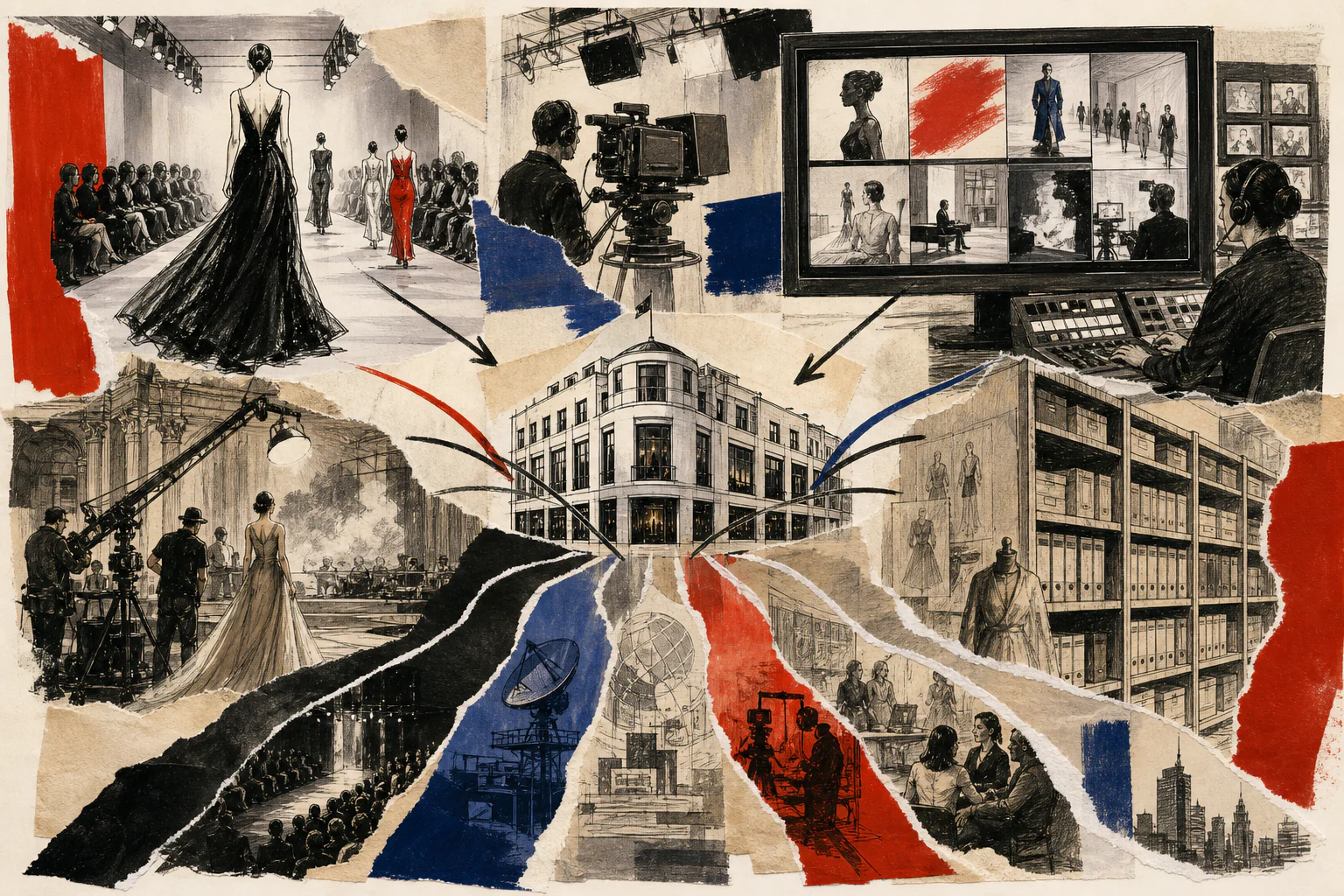
A fashion house still sells objects, but its visual power is increasingly built between collections: through live shows, film series, podcasts, archive chapters and cultural programmes that hold attention even when nothing is being directly sold.
Editorial question
Why is a strong collection and one campaign no longer enough for a fashion house—and why does it need films, podcasts, cultural programmes, archive series and recurring live broadcasts?
Short answer
Because a collection lives for months while digital attention refreshes continuously. Owned media lets a house sustain its visual world between shows: CHANEL turns history and culture into serial formats; Miu Miu has commissioned Women’s Tales short films for more than fifteen years; Gucci turned a collection into the seven-part GucciFest; Louis Vuitton stores and broadcasts shows as a recurring programme; Prada gathers shows, campaigns, films, events and special projects within Pradasphere. 1
The point is not that advertising disappeared. The opposite is true: the boundary between advertising, editorial format and cultural production has become harder to see—which is exactly why the house’s own “broadcast” deserves analysis.
Thesis
A contemporary fashion house depends less on one seasonal campaign and increasingly behaves as its own media system. It programmes attention: a collection is streamed live, a film is released, an archive returns, a conversation is recorded, a cultural initiative begins, the material is broken into platform fragments and then gathered again inside the house’s own digital archive.
The phrase “a fashion house resembles a TV network” is an editorial metaphor, not a literal business classification. It describes a change of logic: a brand no longer only buys space inside other media; it creates recurring formats, publication rhythms, hosts, protagonists, series and archives of its own.
A fashion house still sells objects, but its visual power is increasingly built between collections: through live shows, film series, podcasts, archive chapters and cultural programmes that hold attention even when nothing is being directly sold.
Evidence and cases
Pradasphere: a shop opens like a programme schedule
Open Pradasphere in 2026 and Fashion Shows sits beside Campaigns, Special Projects, Events, Films and Places; the current feed connects collections with Prada Mode, Prada Frames, collaborations and other projects. This is no longer the structure of a single advertisement. It resembles an editorial hub with several recurring formats. 1
That makes Prada a useful entry point. In conventional advertising, the product is the message and the platform belongs to someone else. In an owned media hub, the brand controls message, sequence and archive: it decides what sits next to what, what returns from the past and which theme comes next.
Prada Films maintains a distinct archive of short works, from Thunder Perfect Mind and A Therapy to Past Forward and Re-Nylon. Prada Frames works differently, building a programme around design, environment and critical conversation; in 2026 it reached its fifth edition. One house can therefore act at once as advertiser, producer, archivist and organiser of cultural discourse. 1 [source]
A campaign ends; the broadcast has to continue
A classic campaign behaves like a flash: new collection, photographer, model, media plan, several key images, then the next season. Digital culture does not erase that model, but adds another demand—continuity. Between major launches there are weeks and months in which the audience still opens a screen.
So the brand begins to ask not only “what will our next image be?” but “what is our next format?” A show becomes a live broadcast; backstage becomes a short episode; the archive becomes a series; a designer becomes a recurring voice; an ambassador becomes a returning character; a cultural partnership becomes a programme strand. This is where network logic appears: not one masterpiece, but a system of return.
Research on luxury marketing has long documented the importance of social media and visual strategy for audience engagement. For VANSMITHLAB, the more interesting consequence is cultural rather than metric: the brand shifts from supplying advertising material to owning the stage on which it publishes. 6
CHANEL: archive becomes a series and the house becomes a voice
Inside CHANEL shows how heritage can become episodic structure. The official series is organised in chapters on N°5, the jacket, Gabrielle Chanel, cinema, literature, music and other elements of the house mythology; the current page leads to 32 chapters. History is not left inside a chronology—it is programmed as content that can be revisited. 5
CHANEL Connects goes further: the house is not speaking only about itself. Season 6 of the flagship arts and culture podcast assembles conversations with artists and cultural figures recorded across institutions and cities. The CHANEL Culture Fund extends the same cultural frame through partnerships and initiatives. 5 [source]
The role changes. The archive constructs the brand’s past, the podcast discusses the cultural present, and the fund links the house name to future projects. A garment may not be central to a given episode at all, yet CHANEL’s symbolic territory keeps expanding.
Miu Miu Women’s Tales: a brand commissions cinema as a long format
Miu Miu Women’s Tales makes the difference between campaign and programme especially clear. The official site describes it as the longest-running commissioning platform for female-led short films: more than fifteen years and more than thirty individual episodes, beginning in 2011. 8
The scale matters, but so does the principle. Each filmmaker is given a distinct world, while Miu Miu clothing lives inside characters, conflicts, interiors and directorial language. The house repeats the frame without demanding one repeated visual voice. Recognition comes not from identical images but from a stable format built around difference.
The creation of the Women’s Tales Committee shows that the series is treated as an evolving cultural platform: its mandate explicitly addresses new audiences and creators, the development of the mission and critical reframing of the project’s narrative. In television terms, this is no longer a commercial spot but stewardship of a long-running programme. 1
GucciFest: a collection becomes a seven-part event
In 2020 GucciFest offered another way to turn a fashion release into a media event. Ouverture of Something That Never Ended was structured as a seven-part film collaboration by Gus Van Sant and Alessandro Michele; Gucci Stories still holds individual pages from the first episode through the seventh and final one. 11
The collection stops behaving only as a sequence of runway exits. It is distributed across a protagonist’s day, apartments, cafés, streets, music, cameos and ordinary actions. To see the clothes, the viewer is invited not simply to “look at the looks” but to enter a serialised world.
GucciFest does not prove that every show should become a series. It demonstrates something more useful: when a brand owns the format, it can change the basic unit of fashion communication. The unit becomes an episode rather than a photograph or even a show—and the collection begins to behave like a season.
Louis Vuitton: the runway becomes a live broadcast and an archive
At Louis Vuitton, broadcast logic is visible in the infrastructure of the show itself. The Fashion Shows section inside Louis Vuitton Magazine stores a continuing stream of men’s and women’s shows, while individual pages offer a full recording alongside the looks. New 2026 shows keep entering the system as new instalments. 13
The runway acquires two lives. At the moment of the event it is a live broadcast with a fixed start time; afterwards it is an archive episode from which the viewer can move to looks, details and other house material. A show no longer disappears after the finale: it becomes a catalogued media object.
This changes fashion time. The season still matters, but the viewer can enter the house history according to personal demand rather than the industry calendar. The archive begins to function like an episode library—and every new show expands not only the clothing collection but the media collection.
What changes when a brand acquires its own editorial desk
An owned channel requires editorial functions even if the company never calls them an editorial desk. Someone chooses the subject, protagonist, director, duration, publication order, headline, cover, premiere time and what remains available in the archive. A brand media system is therefore more than a social-media department. It is a way of managing relationships among product, culture and memory.
Sequence matters most. One beautiful film does not create a channel. A channel appears when the viewer understands that the format will return: another Women’s Tales episode, another CHANEL Connects season, another Louis Vuitton show, another Pradasphere entry. Expectation of the next instalment becomes part of the brand.
Repetition is what makes the house resemble a media institution. It produces not only objects, but the context in which those objects are meant to be understood.
The central conflict: cultural programming or advertising without an external editor
The model has an obvious advantage: the brand no longer depends entirely on someone else’s page, airtime or editorial calendar. But this is also where the central conflict appears. If a fashion house funds a film, podcast, interview or cultural project and owns the publication platform, who draws the boundary between cultural statement and promotion?
Interpretation
The strength of brand-owned media is that a house can build a complex cultural environment without turning every release into direct advertising. The risk is the reverse: aesthetic freedom can produce the feeling of independent media even though final editorial control still belongs to the brand. These formats are therefore more useful to read neither as “hidden advertising” nor as “pure art”, but as a hybrid territory of authorship, capital and cultural legitimation.
An independent magazine can criticise the brand, place a competitor next to it or reject the material. A house-owned platform works differently: it builds the world from inside. That does not make it automatically less interesting, but it requires another kind of literacy—knowing who speaks, who funds the format and who controls the archive.
Platforms fragment the broadcast but make the brand continuous
The television metaphor has a limit: a contemporary brand does not live on one channel or require the viewer to arrive at eight o’clock. The same material is broken into a live stream, full film, vertical fragment, still image, quotation, backstage clip, archive card and short edit. Each platform receives a different version.
The paradox is that fragmentation strengthens continuity. A major show happens once, but its visual residue can circulate for weeks. A film has a final cut, yet a gesture, garment or phrase can receive a second life in short form. The archive stops being the end of communication and becomes raw material for the next publication.
Research on fashion-brand visual strategies in social media shows that image type and publication structure matter for engagement. For our argument, the more important point is that platforms force the house to design not one final image but a family of versions of the same cultural signal. 1
A fashion house is not a TV network—but it has learned to think like one
A fashion house does not literally become a television network. Its economics, product and responsibilities are different. But it has adopted a fundamental media logic: sustain an audience through a sequence of formats rather than one event; turn premieres into archives; create returning protagonists and programme strands; programme the silence between major releases.
So competition is no longer only bag against bag or show against show. Worlds compete for the ability to return to the screen. CHANEL builds chapters and conversations, Miu Miu a film anthology, Prada a Pradasphere, Gucci a serialised event, Louis Vuitton a stream of shows and their archive.
The central change is not the quantity of content. It is that the brand has begun to design the viewer’s time. When a fashion house decides not only what we will see but what the next instalment will be, it stops being merely an object of media—and becomes one of its producers. 1
Visual analysis
The article's visual logic can be tested through «Pradasphere: a shop opens like a programme schedule», «A campaign ends; the broadcast has to continue», «CHANEL: archive becomes a series and the house becomes a voice», «Miu Miu Women’s Tales: a brand commissions cinema as a long format», «GucciFest: a collection becomes a seven-part event», «Louis Vuitton: the runway becomes a live broadcast and an archive». Compare these signs within one object or sequence rather than judging them as an isolated style.
Practical implication
Practical use begins by testing the thesis against a specific object, frame, or production decision. For this subject, the working criterion is: Shows, films, podcasts, archives and cultural programmes as a continuous brand broadcast
Limitations
“Why the Fashion House Now Resembles a TV Network” is limited to its stated subject: shows, films, podcasts, archives and cultural programmes as a continuous brand broadcast. The analysis does not replace examination of a specific original, project, or production context.
Sources
The open sources for “Why the Fashion House Now Resembles a TV Network” are listed in the page panel and define the boundary of its verifiable facts.