analysis
Why Fashion Stopped Trusting Photography
Fashion film, platforms and AI video as a new dramaturgy of the fashion image
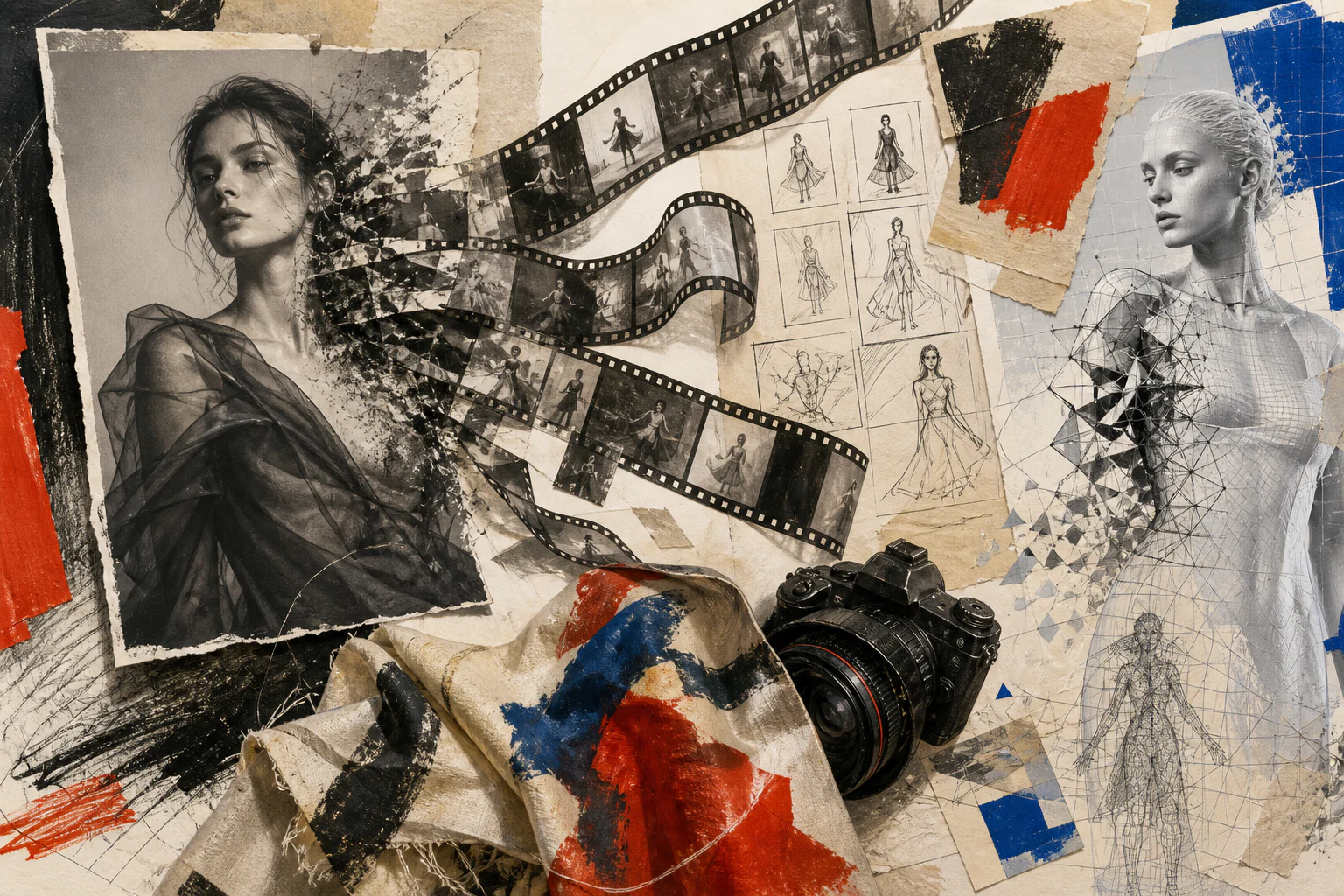
Photography gave fashion the icon. The screen demanded behaviour: fabric in motion, the body as voice, montage as rhythm, repetition in the feed and a new kind of control over how an image lives after the shoot.
Editorial question
Why does fashion, after decades of building its power through photography, increasingly need motion, sound, platforms and screen time?
Short answer
Photography gave fashion the icon: a still frame in which garment, body, light and brand name meet at one point. But digital culture changed the regime of attention. The image now competes not only with other photographs, but with video, series, clips, stories, vertical shorts, live streams and synthetic motion.
Fashion film became not an ornament to the campaign, but a way to show what the still frame is forced to conceal: how fabric stretches, how the body breaks the pose, how sound sets the temperature of a brand, how editing creates desire, and how a platform turns a collection into an event. The question, then, is not whether film will replace photography. The question is what part of the fashion image photography can no longer hold alone. 18
Thesis
Fashion stopped trusting photography not because photography became obsolete, but because the contemporary brand no longer sells only silhouette. It sells the behaviour of the image over time: the movement of fabric, the voice of the body, the rhythm of editing, the atmosphere of a platform and the possibility of endless repetition.
Photography remains one of fashion’s strongest languages, but it no longer holds the entire system of desire on its own. In screen culture, a garment must do more than look compelling. It must move, sound, enter a sequence and a feed, withstand repetition and become a fragment that can be sent on.
Photography gave fashion the icon. The screen demanded behaviour: fabric in motion, the body as voice, montage as rhythm, repetition in the feed and a new kind of control over how an image lives after the shoot.
Evidence and cases
Photography gave fashion the icon, but not its behaviour
In 2000, a visitor to SHOWstudio could encounter more than a finished fashion photograph. The platform exposed what a printed magazine normally concealed: a model entering the light, fabric changing shape between two poses, and a photographer making decisions before the final frame. Nick Knight established the platform to reveal the creative process from conception to completion. Fashion had acquired not another showcase, but an outward-facing studio; the image no longer ended at the fraction of a second selected for print. 18
Photography was long fashion’s sharpest weapon. One frame could make a dress feel eternal, turn a face into the symbol of an era and transform a brand into desire. In a strong fashion photograph, everything stops at the right moment: fabric catches the light, the body holds the pose, the gaze becomes a promise and the object becomes a sign. Yet the SHOWstudio scene exposed the limit inside that power: photography creates the icon, while the screen reveals behaviour — what happens to body, fabric and attention between poses.
Fashion film appears where one frame is no longer enough. This is not a rejection of photography, but an admission of its boundary: fashion wants to be not only seen, but experienced in time. 18
Fabric asks for time
A still photograph can show colour, texture, silhouette and the drama of light. But material in fashion often reveals itself not in stillness, but in change. Silk flows, leather resists, knit stretches, fur carries its own weight, metal flashes at the turn of a body. Every fabric has not only a surface, but a distinctive way of moving.
This is why fashion film gives material what the printed page can only promise: duration, inertia, sound, delay, fall and disruption. In motion, fabric becomes almost an actor. It can obey the body, resist it, reveal the gesture or create its own rhythm.
This is the first reason fashion is drawn toward screen time: clothing does not fully reveal itself as an object until we see how it behaves. 4
The body leaves the pose
Classical fashion photography is often built around control: the pose, the shoulder line, the tension of the neck, the angle of the knee, the precision of the gaze. The body becomes a structure that holds the garment at its best. But the screen allows the body to disturb that discipline.
In fashion film, a person can walk, stumble, dance, freeze, lie down, disappear from the frame, return, look away, or break the runway line. Clothing begins to be read not only through ideal form, but through gesture, pause, breath, fabric resistance, awkwardness or acceleration.
The camera also changes role. It does not simply record the model; it becomes a tactile observer: moving toward a seam, sliding along a sleeve, pausing on a hand, following a shoulder. At that point, the fashion image stops being a surface and becomes bodily behaviour. 4 4
SHOWstudio: when process became part of the image
Fashion film's turn was made possible by more than a camera. By 2000, digital capture and editing had accelerated moving-image production; web publishing could distribute video without a printed page or broadcast slot; and an online archive could keep the process available after the event. When Nick Knight launched SHOWstudio, these technologies met an editorial idea: reveal the making of the fashion image from conception to completion, rather than present only the approved final frame. 18
This matters: fashion film is not just a beautiful clip released after the shoot. It becomes a new kind of outward-facing studio. The viewer sees how a pose is built, how light appears, how decisions are made and how an image gathers itself in real time. Production stops being invisible backstage activity and becomes part of fashion’s message.
In the old system, the magazine showed the final photograph. In the new screen system, the process can itself become an image. This changes the viewer’s position: they no longer only look at the finished icon; they watch how it is made. 18
NOWNESS and the short cultural form
The next shift is that fashion film stopped being only a fashion format. Platforms such as NOWNESS present short video as a cultural form: fashion sits beside art, food, music, travel, portraiture, architecture and beauty. In that setting, the film works less as a direct advertisement and more as an editorial mood. 14
That changes brand strategy. Advertising says: look at the product. The short cultural form says: enter a world where this product feels natural. The object may appear only briefly, yet an atmosphere is built around it: colour, room, face, voice, pause, strangeness, gesture.
Fashion film thus becomes closer to a magazine than to a conventional commercial. Only this magazine no longer sits on a table. It moves, sounds, opens in a browser, lives in an archive and returns through a link. 14
Women’s Tales: the brand as a series, not a single campaign
Miu Miu Women’s Tales shows another possibility: a brand can build not one seasonal gesture, but an ongoing series. Miu Miu describes Women’s Tales as a long-running platform of female-led short films in which collections become part of characters, actresses and directorial worlds. 9
In this format, clothing does not need to shout in every frame. It can live inside a role, a room, a walk, a light, a line of dialogue, an awkward scene or an inner state. The brand becomes not only a producer of things, but an organiser of screen memory: the series accumulates faces, directorial voices, themes and atmosphere.
Here, fashion stops depending on the single perfect frame. It works through return: a new story continues the previous ones, the viewer recognises the frame but expects another voice. The brand begins to think not only in campaigns, but in series. 9
Prada and GucciFest: the object becomes scene and character
In Prada A Therapy, the garment takes on an almost psychological role. Roman Polanski’s short film with Helena Bonham Carter and Ben Kingsley centres on a Prada coat that becomes not merely a wardrobe object, but a vehicle of desire, power, strangeness and transference. The object is not displayed like an e-commerce card; it intervenes in the characters’ behaviour. 12
GucciFest and Ouverture of Something That Never Ended take another route: the collection becomes part of a serialized screen world. Gucci describes the project as a seven-part film collaboration between Gus Van Sant and Alessandro Michele, where characters, city, cameos, music and garments exist inside one extended atmosphere. 12
Both examples show the same change: the luxury brand increasingly invests not only in a frame, but in a cinematic regime. The garment becomes a scene, a story trigger, a psychological object or part of a world. It is sold indirectly, through a situation that asks what kind of person one might become — or imagine oneself becoming — through that object.
The vertical screen and the economy of the first seconds
Social platforms accelerated the shift. The fashion image now has to live not only in a film, but in a short fragment: the first seconds, the vertical crop, sound-off viewing, repetition, clipping, sharing, entry into the feed. This is a different economy of attention.
Vertical video does not destroy fashion film, but it changes its conditions. The image has to read faster. Silhouette, gesture, colour, face, camera movement and editing rhythm must work almost immediately. Where a brand once could expect the viewer to watch a campaign as a whole, it now often meets the viewer in the act of scrolling.
Contemporary fashion therefore lives between two speeds: the slow image that builds myth, and the fast fragment that has to stop a finger from swiping on. 13
AI video: photography moves again, but not through the camera
Artificial intelligence returns the story to the original paradox. If fashion film once answered the question of how to animate fashion photography through camera, body and editing, image-to-video models ask something different: can a still image move without a new shoot? DreamPose, for example, is described by its authors as a method that synthesises fashion video from one image and a sequence of poses, including human and fabric motion. 16
This is not only a technical novelty. For fashion it is a new conflict: movement can be produced after the fact, but who is responsible for fabric plausibility, model consent, stylist authorship, body physics, photographer rights and image trust? The easier it becomes to make a photograph move, the more important control becomes.
Interpretation
AI video does not cancel fashion film or make direction unnecessary. It shows that movement has become an expected condition of screen culture. But if movement can be synthesised, the work of directing shifts elsewhere: into the control of body, fabric, source, consent, authorship and the boundary between document and reconstruction.
Fashion is no longer still
Photography does not disappear from fashion. Strong photography remains one of the few formats able to compress a season, a face, a garment and a mood into one exact image. But it is no longer the only centre of the system.
The contemporary fashion image lives in several states at once: as photograph, film, backstage, vertical fragment, archive, series, meme, AI reconstruction, platform and repeated movement. Fashion stopped trusting photography not because it betrayed photography, but because the visual environment itself expanded.
Return to the outward-facing studio of 2000. Its decisive innovation was not that a photographer picked up a video camera, but that the viewer gained access to the image's time — its decisions, pauses, movements and missteps before the final icon. Platforms and AI have since expanded that time even further, while making authorship, consent and trust more urgent. Photography did not lose to the screen; it ceased to be the only place where a fashion image could be considered complete. Photography gave fashion the icon. The screen showed how that icon lives after the pose. 13
Visual analysis
The article's visual logic can be tested through «Photography gave fashion the icon, but not its behaviour», «Fabric asks for time», «The body leaves the pose», «SHOWstudio: when process became part of the image», «NOWNESS and the short cultural form», «Women’s Tales: the brand as a series, not a single campaign». Compare these signs within one object or sequence rather than judging them as an isolated style.
Practical implication
Practical use begins by testing the thesis against a specific object, frame, or production decision. For this subject, the working criterion is: Fashion film, platforms and AI video as a new dramaturgy of the fashion image
Limitations
“Why Fashion Stopped Trusting Photography” is limited to its stated subject: fashion film, platforms and ai video as a new dramaturgy of the fashion image. The analysis does not replace examination of a specific original, project, or production context.
Sources
The open sources for “Why Fashion Stopped Trusting Photography” are listed in the page panel and define the boundary of its verifiable facts.