analysis
Why the museum changes the meaning of an ordinary object
A museum does not store an object; it changes the regime in which the object is read, turning it into argument, document, and canon.
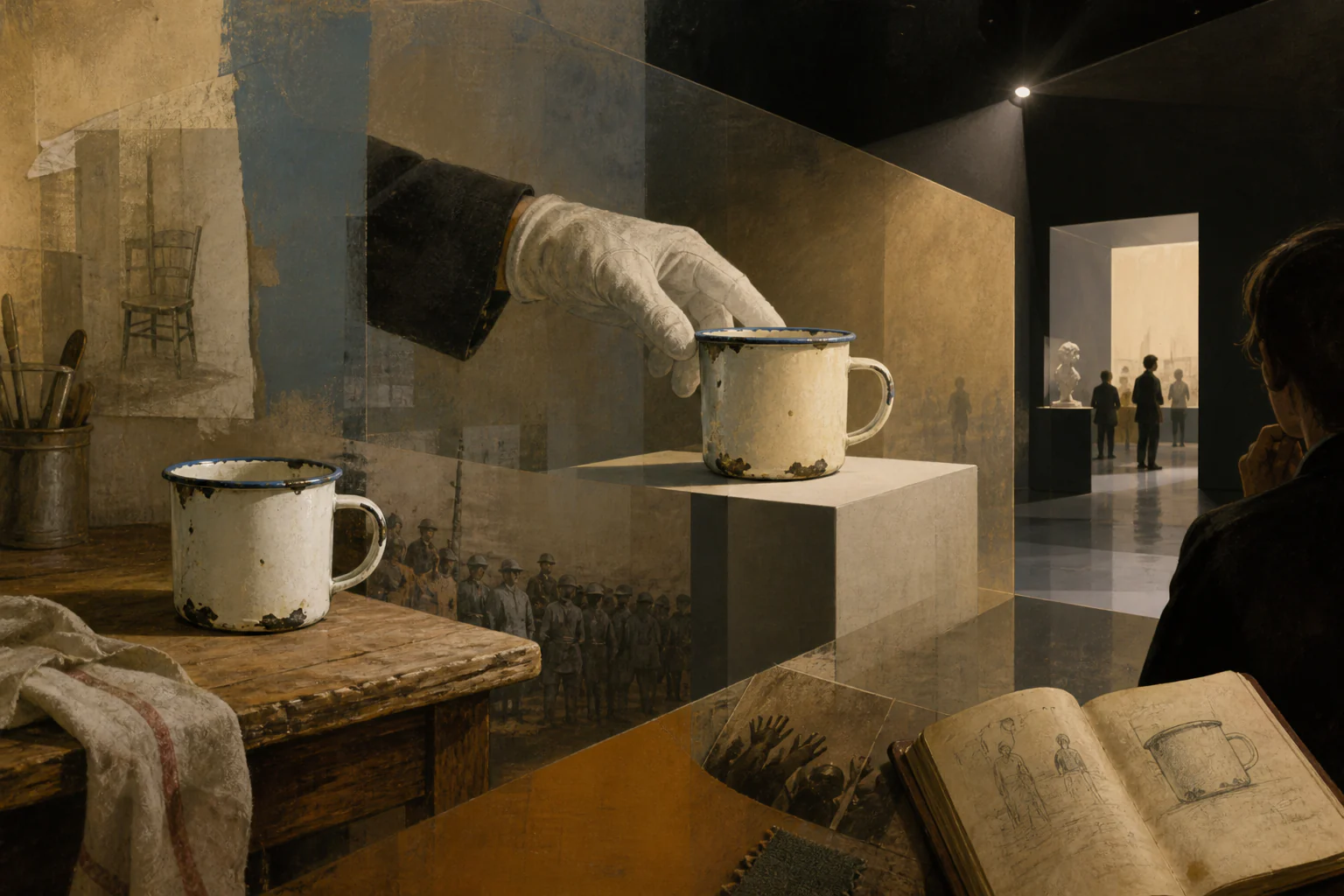
A museum does not simply keep an object: it changes the regime of its reading, turning a thing into argument, document, and part of a canon.
A museum does not store an object; it changes the regime in which the object is read, turning it into argument, document, and canon.
Editorial question
How should we read this problem: a museum does not store an object; it changes the regime in which the object is read, turning it into argument, document, and canon.
Short answer
A museum does not store an object; it changes the regime in which the object is read, turning it into argument, document, and canon.
Thesis
A chair in a flat and the same chair in a museum vitrine are physically identical. What changes is the set of permitted actions: you may not sit, you may not touch, you must look from a set distance. The museum redefines an object by restricting access.
A museum does not store an object; it changes the regime in which the object is read, turning it into argument, document, and canon.
Evidence and cases
Thesis: the frame changes, not the object
A chair in a flat and the same chair in a museum vitrine are physically identical. What changes is the set of permitted actions: you may not sit, you may not touch, you must look from a set distance. The museum redefines an object by restricting access.
Suspension of function
The museum’s first operation is the suspension of function. An object stripped of use is released for reading: proportion, joint, and traces of working become visible where daily purpose used to obscure them.
The readymade as limit case
The readymade took this operation to its limit: an industrial object moved into an exhibition context without alteration showed that meaning is produced by the institution rather than by the author’s hand. This is not a curiosity but a description of the mechanism.
The label as document
A label makes an object legible: date, author, manufacturer, material, mode of acquisition. It turns a thing into a record that can be cited, which is exactly why an argument about a label is an argument about meaning.
The accession number
An accession number is a legal and scholarly act. It records that this particular example is henceforth distinct from every identical copy off the same line. Mass production does not prevent the uniqueness of the record.
The vitrine sets distance
Glass does more than protect. It fixes the single available viewpoint, removes smell and sound, and leaves only sight — thereby moving the object into the regime of the image.
Light as editing
Museum lighting is an editorial decision. Level, direction, and colour temperature determine which texture will be visible and which will disappear. Conservation limits themselves become part of the statement.
Adjacency creates argument
An object is read through its neighbours. The same chair beside other chairs means a history of typology; beside posters and tableware from the same school it means a coherent programme. Arrangement is the exhibition’s thesis.
Route as the order of the argument
The order of rooms works like the order of paragraphs. What is shown first sets the criterion by which the visitor will judge everything after — and that criterion is rarely stated aloud.
Permanent display versus temporary
A permanent display asserts a canon; a temporary exhibition tests it. The difference lies in commitment: a canon is harder to revise, so entering it changes an object’s status more decisively.
Public access as a condition
The Louvre, opened to the public in 1793, established the model of a state collection with a permanent display and general access. It is publicity that makes an institutional judgement binding: it is presented to everyone and can be contested.
Design acquired its own institutions
The emergence of specialised design museums moved the everyday object from ethnography into a history of authored decisions. A chair stopped being domestic evidence and became a work with attribution.
Clothing in the museum
Costume collections showed how difficult this operation is for clothing: an object designed for movement is displayed motionless on a form. The museum must replace the lost movement with label and context.
Conservation changes the object
Storage is an active intervention. Climate, restoration, replacement of losses, and the ban on use physically change an object and its ageing. Over time a museum example ceases to be a typical representative of its production run.
The catalogue extends the effect
Publication distributes the institutional judgement beyond the gallery. A catalogue entry is cited, enters textbooks and auction descriptions — and so a curator’s local decision becomes common knowledge.
First turn: from treasury to argument
Early collections demonstrated the rarity and wealth of an owner. The shift to the museum consisted in arranging objects by idea rather than by value — and from that point the display began to assert something.
Second turn: the ordinary became admissible
Admitting industrial, serial, and everyday objects into collections widened the subject of history. It was a contested decision: it meant that significance does not coincide with rarity.
Third turn: the frame became visible
Contemporary display increasingly shows its own mechanisms: how an object entered the collection, who paid, what is not shown. The museum began to publish not only the object but its judgement of it.
What is usually misunderstood
A common error is to think the museum merely confirms pre-existing quality. In fact it produces it: before the collection record there is no carrier of "significance" that anyone can cite.
Counterargument: quality comes first
The objection is serious: a good chair was good before the museum, and a bad one will not improve inside a vitrine. The institution merely notices what already exists.
Where the counterargument holds
It holds at the level of construction and material. Joint strength, material behaviour, and comfort can be tested regardless of who exhibited the object and where.
Where it fails
It fails for meaning. Why this particular chair represents an era while dozens of competent rivals do not is explained by a history of selection, not by measurable quality. Selection is always institutional.
A test: remove the label
A simple test: mentally take away the label and the glass. If the object still holds attention on its own, construction is doing the work; if not, the frame was. Both answers are useful.
Link to the typology entries
The entries on the museum, the exhibition, and the Neue Nationalgalerie analyse the spatial mechanisms: route, light, distance, and mode of presentation.
Link to the iconic objects
The entries on individual objects — from the Barcelona Chair to the Panton Chair — show how institutional selection turned a serial product into a reference point in design history.
What this changes in practice
For a designer the conclusion is applied: document the decision. Drawing, date, supplier, rationale — these are what will later let an institution read the object. Without a document it stays anonymous.
What stays with the object
Part of the meaning does not transfer to the museum at all: wear from daily use, an owner’s repair, smell, sound. This half of an object’s life is documented only indirectly and is almost always lost.
The current state
Institutional boundaries have blurred: stores, brands, and platforms use the exhibition regime without accepting obligations of conservation and openness. The form of museum judgement turned out to be separable from its responsibility.
Editorial conclusion
The museum changes an object’s meaning because it produces a citation for it: a record, a date, an adjacency, and publicity. The meaning of an ordinary thing changes exactly when it becomes possible to cite it.
How to read the subject today
In a gallery, look not only at the object but at the decision about it: why it is here, beside what, and what is left unsaid. A display is a text, and it can be read critically.
Visual analysis
The article's visual logic can be tested through «Thesis: the frame changes, not the object», «Suspension of function», «The readymade as limit case», «The label as document», «The accession number», «The vitrine sets distance». Compare these signs within one object or sequence rather than judging them as an isolated style.
Practical implication
Practical use begins by testing the thesis against a specific object, frame, or production decision. For this subject, the working criterion is: A museum does not store an object; it changes the regime in which the object is read, turning it into argument, document, and canon.
Limitations
“Why the museum changes the meaning of an ordinary object” is limited to its stated subject: a museum does not store an object; it changes the regime in which the object is read, turning it into argument, document, and canon. The analysis does not replace examination of a specific original, project, or production context.
Sources
- MoMA — Readymade
- MoMA — Bauhaus 1919–1933: Workshops for Modernity
- Vitra Design Museum — Online Collection
- Design Museum — Collection
- The Met — The Costume Institute
- V&A — Museum
- Bauhaus-Archiv — Collection
- VANSMITHLAB AI Master Content Plan — project master plan