research
Vitra: factory, museum, campus, and the production of canon
Factory, collection, museum, and authored architecture together produce not only furniture but the design canon itself.
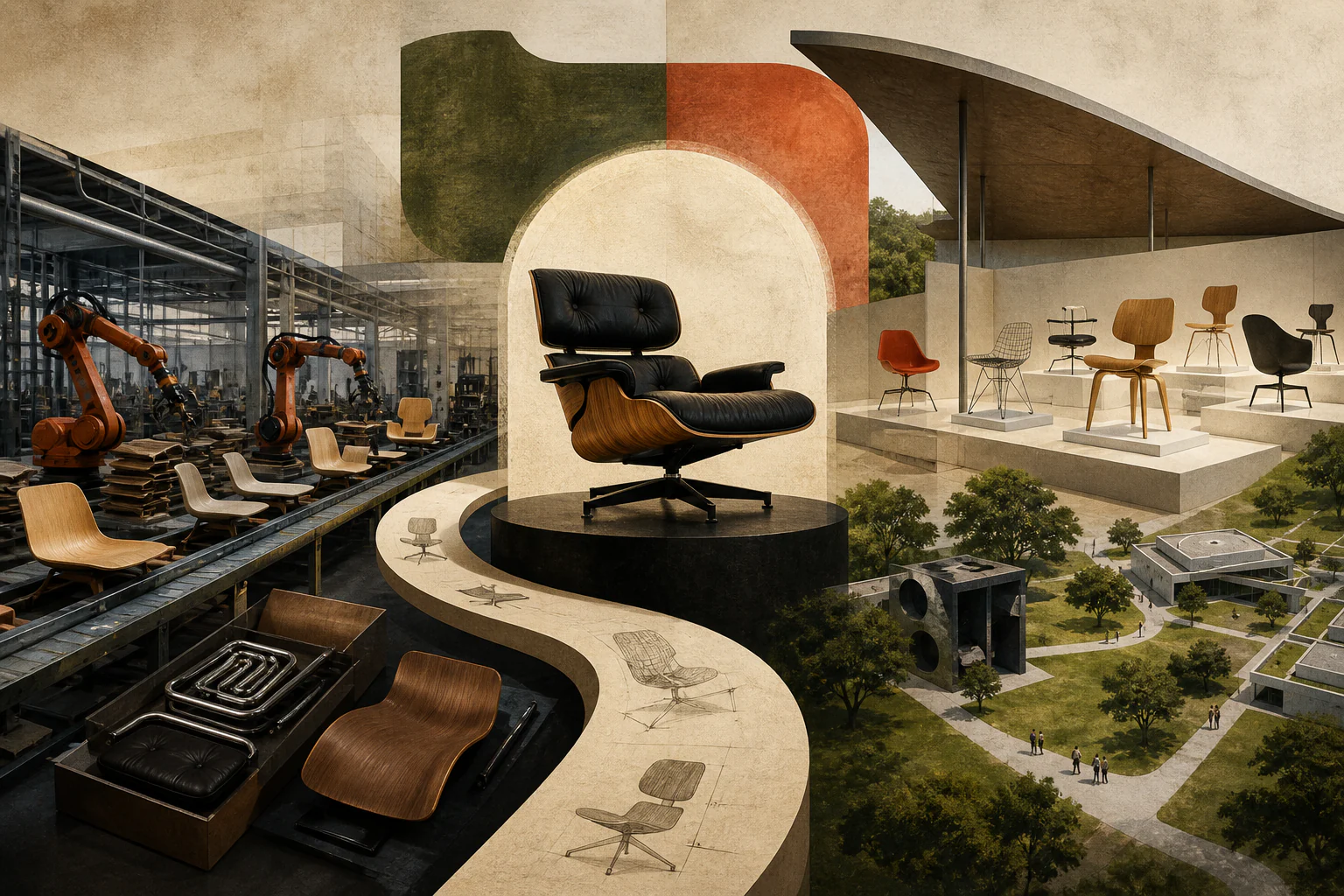
Vitra shows how factory, collection, museum, campus, and authored architecture can produce not only furniture but design canon itself.
1. Research thesis
Vitra is interesting because a furniture manufacturer simultaneously maintains a museum, a collection, and an architectural campus. This lets it participate in defining what counts as significant in design rather than merely making products.
2. Why this is more than a manufacturer profile
The combination of manufacturer and institution is a rare configuration. It creates an obvious conflict of interest and simultaneously provides a resource an ordinary museum lacks: access to production and to rights.
3. Historical setup
The company began as a manufacturer in a border region of southern Germany and obtained licences to produce American modernist furniture for Europe. Hence its early connection to the postwar canon.
4. The fire as a turning point
A destructive factory fire in the early 1980s required complete rebuilding. The decision to develop the site with projects by different architects instead of a standard shed turned reconstruction into a long-term programme.
5. The company as a system
Production, collection, museum, exhibitions, and publishing are in the same hands. This allows an object to be taken along the whole chain: from drawing to display case to catalogue record.
6. The spatial layer: the campus as a collection of buildings
The site brings together buildings by different authors from different decades. The campus works as a three-dimensional catalogue of architectural positions, where buildings are comparable because they stand side by side.
7. A museum on factory grounds
The museum building, designed by Frank Gehry and completed in the late 1980s, placed an exhibition hall beside a workshop. The adjacency is itself a statement about the status of the industrial object.
8. The fire station as manifesto
The fire station, designed by Zaha Hadid in the early 1990s, was a utilitarian building that became an architectural manifesto. It later changed function and became exhibition space — a fate characteristic of the whole campus.
9. The showroom house
A building assembling a stack of archetypal house forms works as an inhabited display: furniture is shown in interiors rather than on a plinth. It is a retail instrument executed as an architectural experiment.
10. Open storage
The open-storage format presented the collection whole rather than as a selected top layer. Seeing hundreds of chairs in a row changes perception: typology becomes visible instead of the masterpiece.
11. The collection as a production resource
A collection of originals gives access to construction, tolerances, and traces of wear. For a manufacturer of reissues this is a technical as well as a cultural resource.
12. Reissue as a legitimate operation
Production of a historical model by the rights holder creates a new legitimate object rather than a copy. The distinction is legal, and it is what separates a reissue from a knock-off.
13. Media and publication
Exhibitions, catalogues, and touring projects distribute the company’s judgement far beyond the campus. The institutional form gives claims a weight that corporate communication does not carry.
14. Canon and museum
Here canon is produced literally: the decision to include an object in the collection and the decision to manufacture it are taken within one organisation. This is the sharpest point in the case.
15. Archive and reproducibility
The existence of an archive and open access to part of the collection makes claims verifiable. This substantially mitigates — though does not remove — the conflict-of-interest problem.
16. Where the myth begins
The myth begins with an image of a disinterested patron. The campus and the museum perform commercial work: they justify the price of reissues and create cultural rent.
17. Where the myth blocks analysis
Admiration for the architecture prevents the main question being asked: who besides the rights holder participates in determining these objects’ significance. The answer matters more than the list of buildings.
18. First key example
The campus is worth analysing as a way of making architectural positions comparable. It is a full-scale exhibition whose exhibits cannot be rearranged.
19. Second key example
Open storage is worth analysing as an editorial decision: to show everything instead of a selection. It transfers part of the curator’s work to the viewer and changes the character of judgement.
20. Comparison with adjacent systems
Unlike a public museum, the collection here lacks independence from commercial interest. Unlike an ordinary manufacturer, there is a research and custodial function. The hybrid yields both advantage and vulnerability.
21. Link to fashion
Fashion houses arrived at the same configuration later: an own foundation, an exhibition venue, an archive, and reissues drawn from it. The model has been reproduced almost literally.
22. Link to the image
The campus produces images continuously: the buildings are recognisable and photograph well. Architecture here performs the same work as a shop window in retail.
23. Link to architecture and space
The adjacency of workshop, museum, and retail building erases the boundary between typologies. A visitor passes through all three regimes in one visit, and the transitions are barely marked.
24. Link to technology
A reissue requires the recovery of lost technologies: tooling, adhesives, moulding regimes. Some historical objects cannot be reproduced exactly, and this is a technical rather than a legal problem.
25. Link to materials
Substitution of original materials with contemporary equivalents is unavoidable for regulatory reasons. This changes an object’s behaviour and ageing, though the silhouette is preserved.
26. Market and logistics
The campus works as a destination: it draws professionals and tourists, turning an industrial site into a point on an itinerary. This lowers the cost of attracting an audience.
27. Critique and limits
The main objection is justified: the organisation simultaneously determines the value of objects and sells them. The absence of independent assessment is a structural weakness of the model, not remedied by its openness.
28. What has changed today
The model has spread: corporate museums and foundations have become common practice in design and fashion. As it spread, its capacity to distinguish weakened.
29. What to connect next
The material links to the entries on the museum, the exhibition, citation and copying, individual objects in the collection, and the campus as a typology.
30. Editorial conclusion
The case shows that canon is produced by organisations rather than discovered. Here that work is simply more visible than in public institutions, because it is not separated from commercial interest.
31. How to read this case today
When reading any corporate collection, ask who else ratifies the significance of these objects. A single source of judgement is a position, not a history.