research
IKEA: flat pack as a cultural and logistical system
Flat packing changed not delivery but the form of the object, the role of the customer, price, and the idea of home.
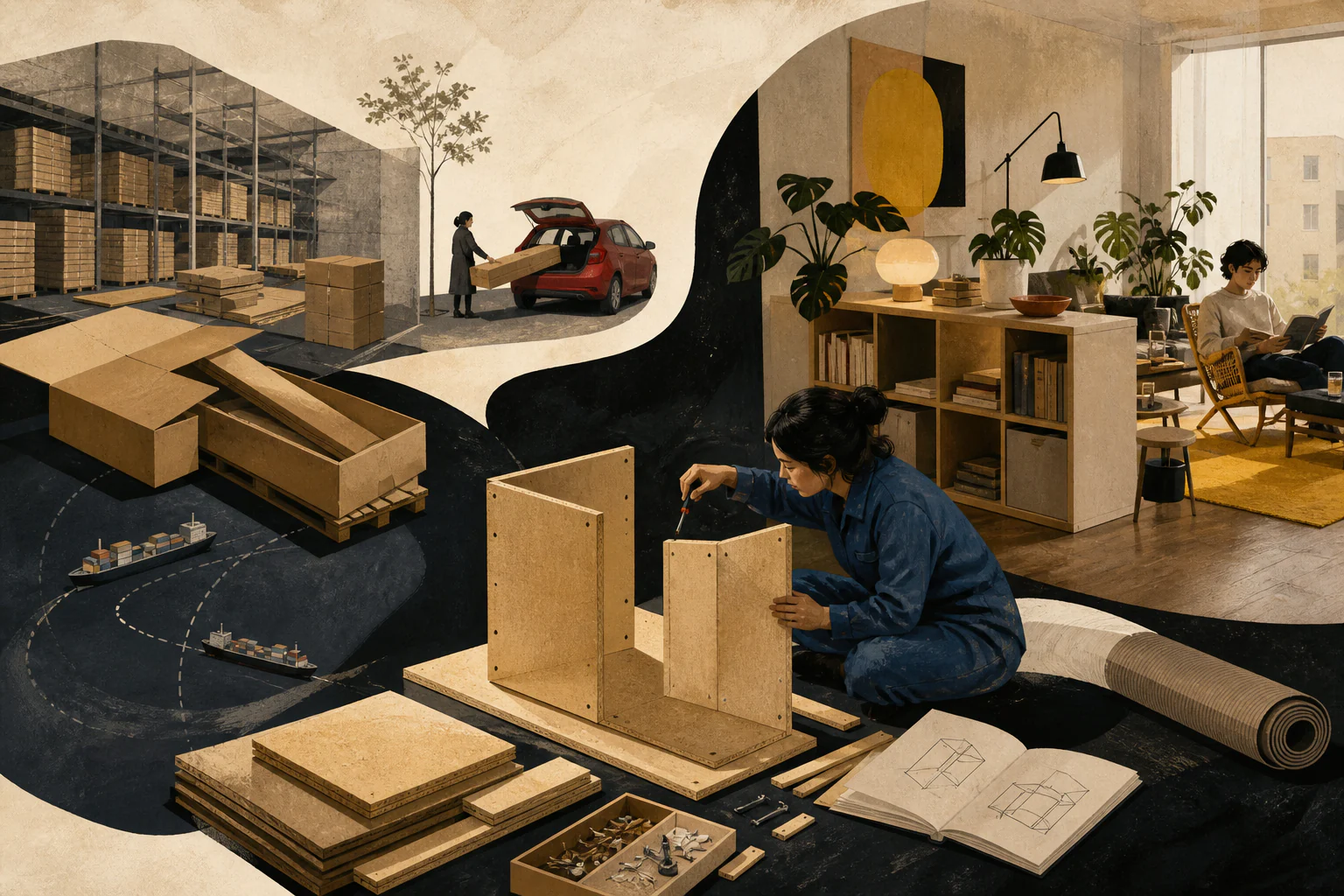
IKEA matters because flat packing changed not only delivery but the form of the object, the role of the customer, price, the catalogue, and the idea of home.
1. Research thesis
Flat packing is usually presented as a way to save on transport. In fact it is a constructional requirement that rewrote furniture: joints, materials, tolerances, and the customer’s role all changed to accommodate it.
2. Why this is more than a company history
What is interesting is not the growth of a chain but that a logistical constraint became form-giving. It is the best available example of a transport condition designing an object.
3. Historical setup
The company was founded in Sweden in the 1940s and began in mail order. It was the postal channel that made parcel dimension and weight the principal design constraint from the outset.
4. The origin of the device
The well-known story of removing a table’s legs to fit it into a car describes the essence accurately, even if the retelling’s details are imprecise. The device was born from a physical obstacle rather than from a design idea.
5. Air as a cost item
Assembled furniture transports emptiness. Broken down into flat parts it occupies many times less volume, and the whole economics of the model rests on that difference.
6. The joint as bottleneck
Demountability required joints that assemble without skill or tools. The cam lock, the dowel, and standardised fixings are answers to the requirement of assembly by an untrained person.
7. Material for the task
Board materials displaced solid timber for non-aesthetic reasons: they are more stable geometrically, cheaper, and more predictable in machining. Furniture form followed the properties of the board.
8. The right angle as consequence
The dominance of rectangular forms is a direct consequence of flat packing and board material. A curved part packs badly in a box and is expensive to obtain from a panel.
9. The instruction as component
When assembly is handed to the customer, the instruction becomes part of the product. Abandoning text for drawings solved international distribution without translation — an editorial decision with a logistical rationale.
10. The customer as participant in production
The final assembly operation is transferred to the consumer and its cost removed from the price. This is a transfer of labour that usually goes unstated, though it constitutes a substantial part of the saving.
11. Labour as attachment
Effort expended increases attachment to an object — an effect described in behavioural research. A by-product of cost saving turned out to be a communicative advantage.
12. The store as route
The sales floor is organised as a compulsory route through room settings to a self-service warehouse. The customer travels from image to box — a designed sequence rather than a floor plan.
13. The room setting
Full-scale rooms show not a product but a scenario of living. It is an exhibition device applied to retail, and it sells a solution to a problem rather than an article.
14. The catalogue as media
The long-running catalogue was one of the largest print runs in the world and functioned as an annual publication about the home. Its discontinuation in the early 2020s marked the audience’s move to digital channels.
15. The economy of form
Price is formed in reverse: a target cost is set first and the product designed to meet it. This inverts the usual sequence and explains many constructional decisions.
16. Canon and museum
Individual models entered museum collections as examples of mass design. Recognition came for accessibility and scale rather than for formal innovation.
17. Archive and reproducibility
Decades of catalogues form an exceptionally complete source on the history of the domestic interior. Few companies have left such a consistent record of everyday life.
18. Where the myth begins
The myth begins with the democratisation of good design. The model genuinely lowered prices, but it also standardised the interior into a recognisable set of solutions worldwide.
19. A second layer of myth
A second simplification is the idea of simplicity. Behind a flat box lies one of the most complex logistics systems in retail, and it, rather than form, is the principal achievement.
20. First key example
The long-lived bookcase is worth analysing as a maximally optimised product: minimum parts, standard fixings, box volume close to material volume. It is the benchmark of the method.
21. Second key example
The wordless instruction is worth analysing as a genre. It solves the problem of explaining a sequence of actions to an untrained person in any language — a rare case of a successful universal document.
22. Comparison with adjacent systems
The opposite pole is a modular system optimised for service life and maintenance. Both strategies are logistical, but one counts delivery cost and the other cost of ownership.
23. Link to fashion
The clothing analogue is fast fashion: the same logic of target price, global chain, and short cycle. Both the achievements and the objections coincide.
24. Link to the image
Catalogue photography developed a recognisable genre of the room setting that shaped mass expectations of how a home should look. That influence is comparable to a magazine’s.
25. Link to architecture and space
Designing for small floor areas coincided with a real contraction of urban housing. The range answers a housing situation and simultaneously normalises it.
26. Link to technology
Packaging optimisation is a computational problem: cutting, nesting, and container loading are calculated algorithmically. The saving is achieved by computation rather than by ingenuity.
27. Link to materials
Board materials tolerate reassembly poorly: the fixing seat degrades. This limits service life more than surface wear does and is the model’s principal technical shortcoming.
28. Market and logistics
The self-service warehouse transfers another operation to the customer — order picking. Together with assembly these are two stages of the production chain performed free of charge.
29. Critique and limits
The critique is justified: service life is limited by joint failure, production volumes create resource pressure, and interior standardisation has cultural consequences. The company responds partly through repair and take-back programmes.
30. What has changed today
Regulatory requirements on repairability and the return cycle press on a model built around single assembly. The appearance of spare parts and resale services is a direct consequence.
31. What to connect next
The material links to the entries on logistics and form, the house as a typology, the store as media, sustainability, and modular storage systems.
32. Editorial conclusion
Flat packing is the clearest case of a transport condition designing an object. It changed the joint, the material, the angle, the instruction, and the customer’s role — that is, everything except purpose.
33. How to read this case today
When examining any inexpensive furniture, look at the joint and at box volume relative to product volume. Those two figures explain both price and service life.