research
Black Mountain College — A School Without Familiar Boundaries
North Carolina, 1933–1957: a small college put art at the centre of general education and gathered people who changed postwar culture.
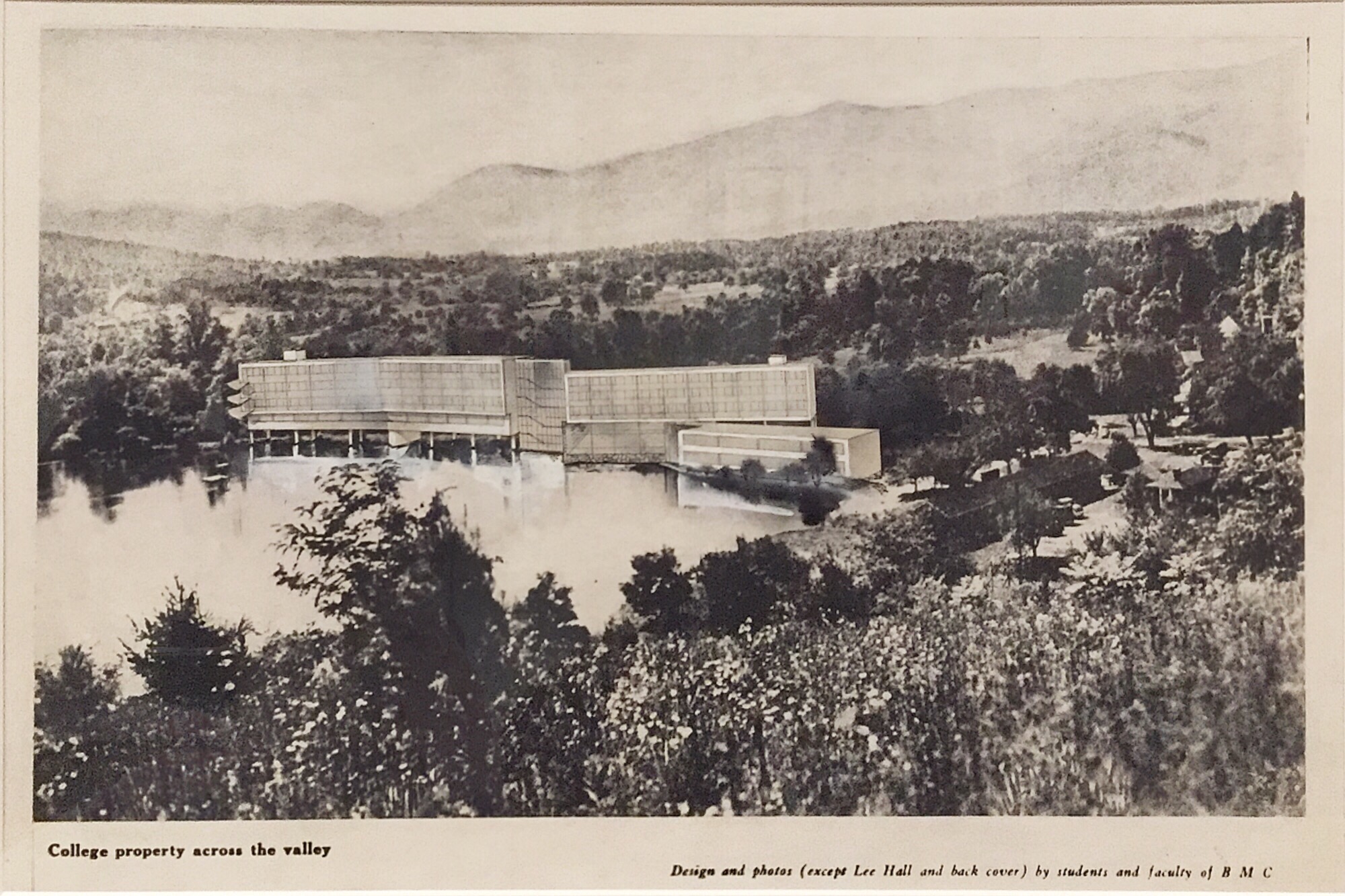
A student might repair a building in the morning, discuss colour with Albers in the afternoon, hear Cage at night, and build Fuller’s dome in summer. Black Mountain resembled a temporary society inventing itself more than a conventional university.
Editorial thesis
Black Mountain College showed that interdisciplinarity works not as a list of departments but as shared life: art, labour, education, music, architecture and experiment happened in one social space. 1
Reader question
How did a college with only a few dozen students become one of the central myths of the American avant-garde? 1
Short answer
Black Mountain College opened in North Carolina in September 1933 with 12 faculty members and 22 students. Its founders, led by John Andrew Rice, drew on John Dewey’s progressive educational ideas. Art was treated not as a specialised ornament to the curriculum but as a way of learning in general. Josef and Anni Albers arrived after the Bauhaus closed; later the college connected Robert Rauschenberg, Ruth Asawa, Buckminster Fuller, John Cage, Merce Cunningham and many others. It closed in 1957, but its model continued to shape arts education. 1
1. 1933: the college begins with conflict
John Andrew Rice and a group of colleagues left Rollins College after conflict and founded a new school. Rather than repair the old system, they built a small alternative where faculty governed the institution and education resembled shared intellectual life more than the completion of subjects. 2
2. The Alberses arrive from the closed Bauhaus
In the same year Josef and Anni Albers left Germany. Josef spoke almost no English yet became the new college’s first art teacher. Together they brought not “Bauhaus style” but respect for material, exercise and disciplined observation — perfectly aligned with Black Mountain’s experimental character. 3
3. Education includes kitchen, farm and construction
The college was faculty-owned, and the community participated in daily work: farming, kitchens and construction. This was not a romantic supplement to art but a way to erase the boundary between intellectual and practical labour. Students saw the consequences of decisions immediately — sometimes literally in a wall they helped build. 4
VANSMITHLAB interpretation: the school’s strength lies not in copying its outward language but in how learning is structured and observation is turned into decisions.
4. Summer institutes turn the mountains into an international laboratory
In summer Black Mountain gathered visiting artists, architects, musicians and scholars. Temporary intensity was part of the method: people who normally occupied different disciplines and cities lived close together and had to encounter one another’s work. Interdisciplinarity became daily reality rather than a slogan. [source]
5. Fuller: a failed dome as excellent teaching material
Buckminster Fuller experimented here with geodesic structures. One early dome did not rise as planned — an almost perfect Black Mountain legend: failure is not hidden but turned into investigation. In a good school, a prototype that does not work can be more valuable than a neat model that tests nothing. [source]
6. Cage, Cunningham and an event hard to call a performance
In 1952 the Dining Hall hosted Theatre Piece No. 1, associated with John Cage, Merce Cunningham, Robert Rauschenberg, M. C. Richards and Charles Olson. Simultaneous actions broke the conventional stage and linear script. It would later be remembered as a precursor to the happening — an example of an educational environment generating a new art form. [source]
7. Ruth Asawa: material becomes a way of seeing
Ruth Asawa studied at Black Mountain with Albers and later created her celebrated wire sculptures. Her trajectory shows the school’s effect clearly: material is not a skin for a predesigned form but a generator of structure. That transfer from classroom exercise to mature practice is what makes a school influential. [source]
VANSMITHLAB interpretation: the school’s strength lies not in copying its outward language but in how learning is structured and observation is turned into decisions.
8. Why the college had no sustainable business model
Black Mountain’s freedom had a price. Small enrolment, unstable finances and constant reliance on community enthusiasm gradually exhausted the institution. By the mid-1950s the college was selling property and shrinking. It officially closed in 1957. [source]
9. The myth of the school and the real reason for its influence
The celebrity list makes the story seductively simple: Cage, Rauschenberg, de Kooning, Fuller, Asawa. But Black Mountain’s influence is not explained by future stars accidentally meeting in one place. More important was the environment in which permission to experiment was normal and disciplines were not protected from one another. [source]
10. What to borrow today — and what not to romanticise
A contemporary school can borrow the intensity of shared work, openness to failure and contact between practices. But there is little reason to romanticise financial fragility or the round-the-clock merging of life and work. Black Mountain matters not as a recipe for a campus commune but as proof that educational structure itself can be a creative medium. [source]