research
Loewe: the leather workshop as a cultural institution
A house that redefined itself through craft: a prize, a foundation, and an exhibition programme became part of the brand alongside the bag.
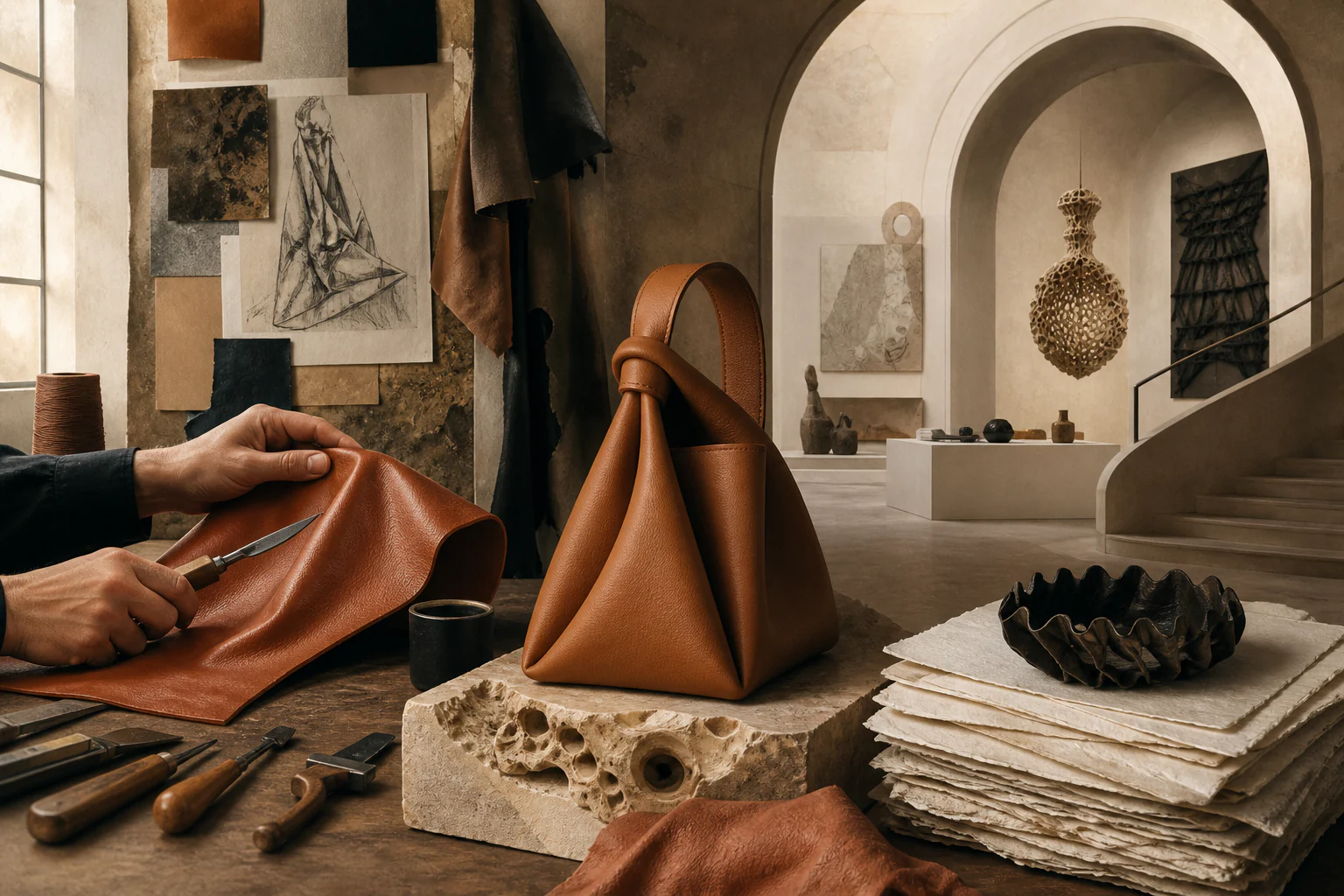
Editorial thesis
Loewe matters as a case in which a historical craft base was not preserved but converted into an active cultural programme with an institution of its own.
Reader question
How did a brand with nearly two centuries of history change its position without abandoning its craft foundation?
Short answer
Craft was redefined from heritage into contemporary practice — through a prize, a foundation, and work with artists. Founded 1846 in Madrid; base in leather manufacture.
1. Origin: a collective of makers
The brand grew from a mid-nineteenth-century Madrid leather workshop uniting several craftsmen. Its origin is guild-based rather than authorial, which distinguishes it from houses founded around a name.
2. Leather as the founding discipline
Working with leather sets a different production logic from working with cloth: cutting is constrained by hide shape, defects cannot be hidden in a seam, and edge finishing determines service life. These constraints shape the entire range.
3. Institutional standing
The brand acquired the status of supplier to the Spanish court, fixing its reputation long before the modern luxury industry existed. Institutional recognition here preceded promotional recognition.
4. Softness as technical achievement
The signature property is an unusually soft leather finish allowing an object to change shape according to its contents. This results from work with tanning and thickness rather than from a decorative decision.
5. The bag as principal carrier
A model from the mid-1970s fixed a recognisable silhouette and became the range’s anchor position. For a leather house the bag plays the role a dress plays for a couture house: every technical decision is tested on it.
6. Entering a conglomerate
The brand joined a major French group in the mid-1990s. This provided access to distribution and capital, though for a decade and a half its position remained largely heritage-based.
7. The relaunch of the early 2010s
From 2013 creative direction passed to Jonathan Anderson and the brand was redefined. The key decision was not to abandon craft but to make it a contemporary subject of discussion.
8. The puzzle as a constructional argument
A bag assembled into volume from flat geometric panels became a technical manifesto: it presents the cut as content. It is a direct analogue of a pattern brought to the surface.
9. The prize as institution
An international craft prize established in the mid-2010s turned the brand into an institution: it selects, exhibits, and publishes. This is the same mechanism by which a museum produces canon.
10. Foundation and exhibition work
The brand’s foundation runs a programme untied to the seasonal calendar. Separating commercial and cultural cycles gives the institutional voice a credibility that promotional communication lacks.
11. Craft as positioning
Work with ceramics, weaving, textile, and wood extended the brand well beyond leather. Craft became not a technique but a frame within which anything can be made while staying recognisable.
12. The show as exhibition
Shows used art objects and scenography bringing the runway closer to a gallery. This is a consistent extension of the institutional strategy rather than a separate visual device.
13. The 2025 change of leadership
From 2025 the collections are led by Jack McCollough and Lazaro Hernandez. The transition tests the case’s central question: whether the craft institution is an asset of the brand or was an asset of the departed author.
14. What is transferable here
It is the institutional part that transfers: prize, foundation, and archive exist independently of a signature and keep operating through a change of leadership. It is a rare example of correctly constructed succession.
15. Critical questions
The critique is justified: the brand simultaneously defines the value of craft and sells goods justified by that value — a conflict of interest familiar from corporate museums. The craft frame also conveniently obscures thoroughly industrial production volumes.
16. How to read this house today
Check what exactly is made by hand and in what quantity. A craft position becomes verifiable where workshop, technique, and edition are named; without that information a frame remains without content.