research
Fendi: fur, family, and the longest authorship in fashion
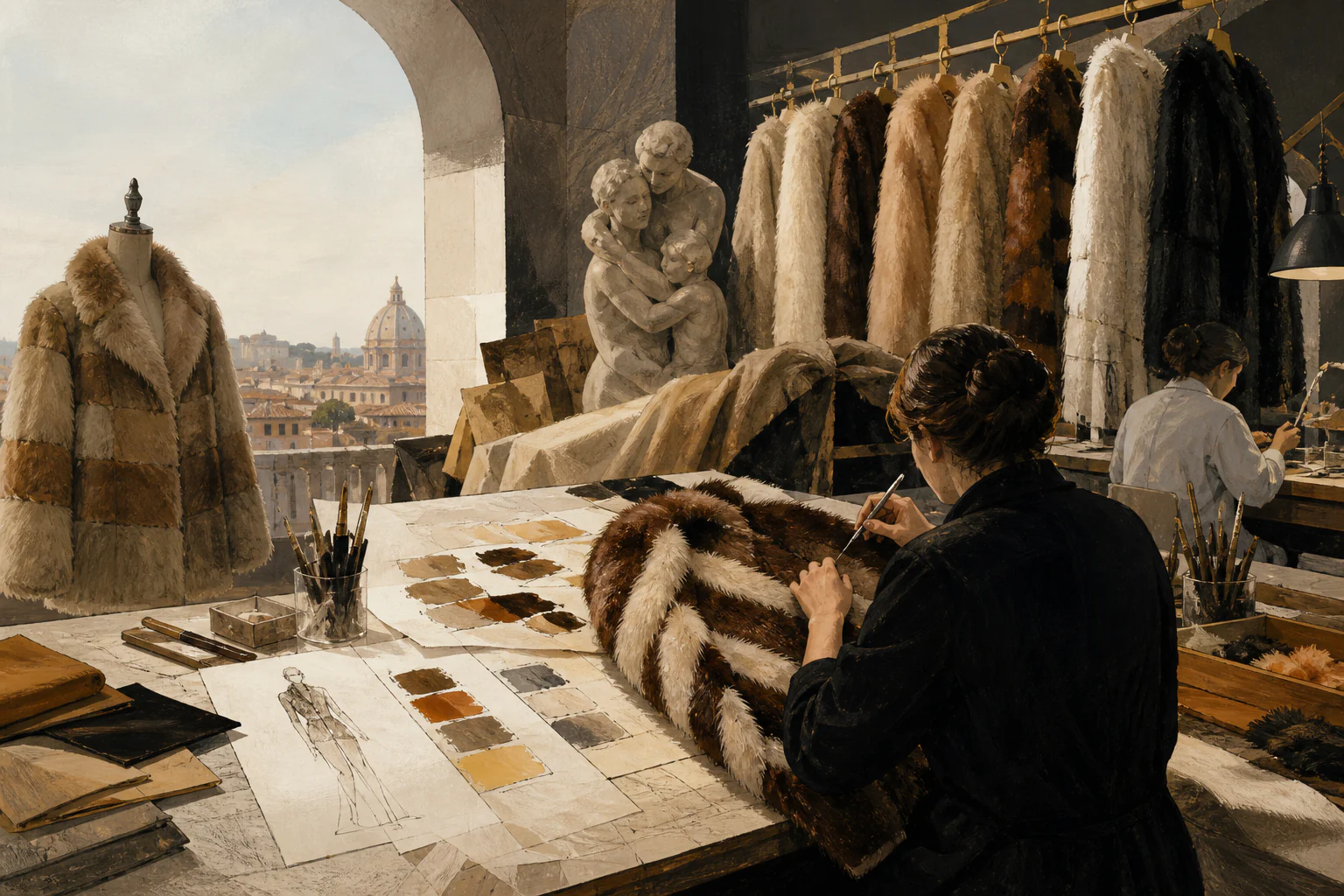
A Roman workshop where one appointed designer worked for over half a century and turned fur craft into a laboratory.
Editorial thesis
Fendi matters as a case of an exceptionally long authorial cycle: fifty-four years under one leadership makes it possible to see what happens to a house when the author does not change.
Reader question
What does half a century of continuous authorship give a house, and what is it paid for with?
Short answer
It yields accumulated technique and a complete absence of ruptures, but makes succession extremely difficult. Founded 1925 by Adele Casagrande and Edoardo Fendi; context Rome.
1. Origin: a fur and leather workshop
The house began as a Roman workshop working in fur and leather. This is a craft rather than a design foundation, and it explains why the technical base proved more durable than any stylistic decisions.
2. A family management structure
Management passed to the founders’ five daughters, each responsible for a separate area. Distributed family leadership is a rare construction in the industry, providing continuity without a single heir.
3. Bringing in an outside author
In the mid-1960s the house engaged a young designer who stayed for fifty-four years. The decision to hire an outside author while retaining family ownership proved decisive for everything that followed.
4. The double monogram
The house mark was designed by that same author in his first year and remained unchanged for decades. It neither illustrates the product nor refers to history — it is a purely geometric mark, usable on any carrier.
5. Fur as an experimental material
The author’s key contribution was treating fur not as a precious material but as ordinary textile. It was shorn, dyed, perforated, combined with other materials, and lightened — contradicting the entire preceding tradition.
6. Removing the status function
Devaluing fur as a symbol of wealth was a substantive gesture: the material stopped being a display of means and became a technical problem. It is a rare example of deliberately lowering a material’s status.
7. The technical constraints of fur
Fur sets strict rules: cutting depends on nap direction, a pelt has a finite size, joining requires a particular seam. All the house’s experiments read as work with precisely these constraints.
8. The bag as a second carrier
A model from the end of the 1990s, designed by a member of the family, introduced a small bag carried under the arm. It codified a category that later became an industry standard.
9. The bag as a collectable object
Releasing many versions of one model in different materials and techniques turned it into a collectable. This moved the bag from accessory to an independent line with its own economics.
10. Entering a conglomerate
Control passed to a major French group at the turn of the century while family members retained leading roles. Combining corporate ownership with family presence is an unusual and functioning configuration.
11. Headquarters as statement
The house took over a 1930s modernist building in Rome, a spatial assertion of belonging to the city and its history. The choice of address works here as a choice of position.
12. Entering haute couture
The house acquired a couture line of its own, allowing its craft base to be presented directly. For a workshop with a fur origin this is a logical step: couture is measured in hours of hand work.
13. Succession after a long author
The author’s death at the end of the 2010s posed the problem of succession after fifty-four years of continuity. The house divided its areas among several leaders — a risk-reduction strategy rather than a search for a replacement.
14. The current appointment
Maria Grazia Chiuri has been named chief creative officer, with a first collection scheduled for the autumn-winter 2026–2027 season. Bringing in an author experienced in leading a major house reads as a bet on institutional stability.
15. Critical questions
The critique is justified and serious: the house’s fur foundation is the subject of sustained ethical objection, and the industry as a whole is reducing use of the material. Half a century of dependence on one author also deferred the development of a transferable method by decades.
16. How to read this house today
Look at the technical base rather than the mark. The house’s durability rests on its workshop and accumulated material techniques; the monogram and the bag are what that base managed to present to the market.