research
Celine: how minimalism gains and loses a cult
A house where two opposite authorial lines in succession showed how far a brand’s identity depends on a single appointment.
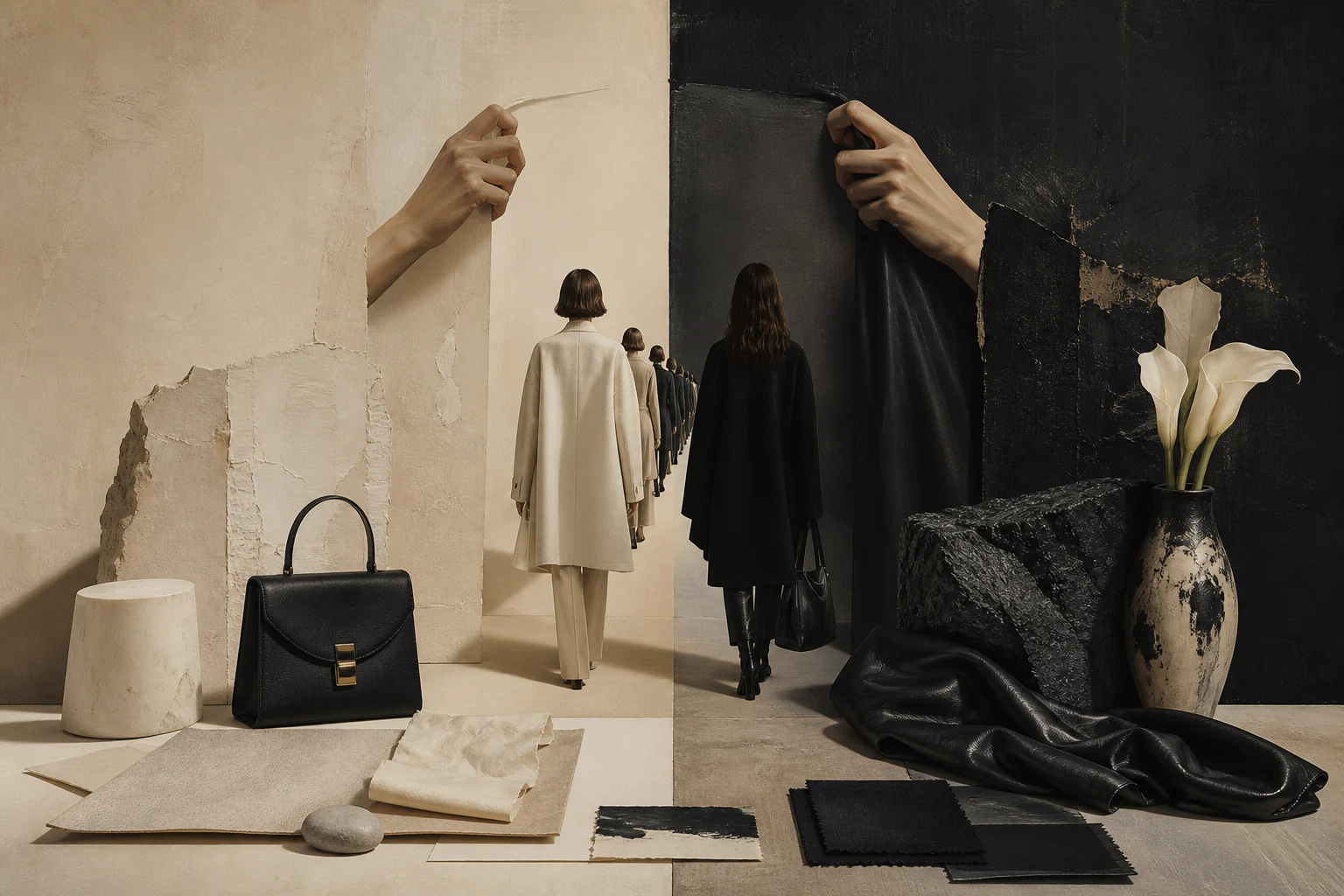
Editorial thesis
Celine matters as the clearest contemporary example that a change of creative director can wholly redefine a brand — including the spelling of its name.
Reader question
What remains of a house when each new leadership deliberately cancels the previous one?
Short answer
What remains is a production base and an archive of marks that can be returned to. Founded 1945 by Céline Vipiana; context Paris.
1. Origin: children’s shoes
The house began as a children’s shoe workshop in postwar Paris and only later moved to womenswear. Its footwear origin explains the house’s early strength in accessories and leather.
2. The move to ready-to-wear
The change of category in the 1960s coincided with the industry’s general shift to ready-to-wear. The house was formed outside the couture system from the start, giving it a different economics and a different clientele.
3. A mark borrowed from the city
The signature chain motif of the early 1970s was taken from the railing of a Paris square. The brand’s mark originates in the urban environment rather than in heraldry or a monogram — a rare and effective decision.
4. Entering a conglomerate
The house joined a major French group in the mid-1990s. From that point creative leadership is appointed by the owner, and the brand’s history becomes a history of appointments.
5. The American period
Leadership in the late 1990s and early 2000s set a line of functional luxury oriented to the American market. The period is rarely recalled, though it built the commercial base.
6. The relaunch of the late 2000s
From 2008 the house was led by Phoebe Philo and the brand was wholly redefined: a restrained palette, volume instead of closeness, an absence of decoration. The line proved exceptionally influential.
7. Addressee instead of seduction
The essential shift was not in silhouette but in addressee: the clothing spoke to the wearer rather than to the viewer. This editorial decision explains the audience’s attachment better than any description of cut.
8. Refusing digital presence
The house of that period deliberately maintained almost no social media and limited image circulation. Image scarcity intensified desire — a device opposite to the industry norm.
9. The formation of a cult
The combination of a strong line, limited imagery, and the author’s subsequent departure produced a rare phenomenon: a durable secondary market and a name of its own for the period. The cult was largely created by scarcity.
10. The 2018 rupture
New leadership under Hedi Slimane executed a demonstrative break: silhouette, audience, casting, and the brand’s register all changed. The rupture was announced rather than smoothed over.
11. Removing the accent as a gesture
The accent was removed from the spelling of the name. Changing a single mark in a logotype is an extremely economical way to declare a rupture, and it was read exactly as such.
12. The commercial result of the rupture
The new line substantially increased revenue, relying on a young audience, ready-to-wear with a recognisable silhouette, and a strong accessories range. The rupture was commercially justified, which is rarely stated.
13. The current direction
From January 2025 the house is led by Michael Rider, who worked at the brand in the earlier period. The appointment reads as an attempt to reconcile two incompatible legacies within one line.
14. What actually transfers here
Only three things transfer: leather manufacture, the archive of marks, and the accessories client base. Everything else changed twice within a decade and a half.
15. Critical questions
The critique is justified: the house is a plain illustration that in the conglomerate model a brand’s identity is a variable managed by its owner. Talk of heritage under such conditions serves marketing rather than describing practice.
16. How to read this house today
Read the house by period rather than as a whole. Naming a year is more informative than naming the brand, since two objects sharing a name may have nothing in common.