research
Maison Margiela: anonymity as an authorial signature
A house that built recognition on the refusal of face, name, and logotype — and turned the inside of construction into its signature code.
Editorial thesis
Maison Margiela matters as proof that identity can be built on systematic absences: a blank label, the colour white, and an invisible author proved stronger than any mark.
Reader question
How did a house that refused its author’s face and any logotype become one of the most recognisable in fashion?
Short answer
The refusal was consistent and extended to every level: label, show, interview, store. Founded 1988; key figure Martin Margiela; context Paris.
1. Origin: school and apprenticeship
Martin Margiela studied in Antwerp and worked as an assistant to Jean-Paul Gaultier before founding his own house. This matters: the deconstruction here grew out of knowing construction, not out of ignorance of it.
2. Founding and the first position
The house was founded in Paris in 1988 together with Jenny Meirens, who took on the business side. The co-founder’s role is usually omitted in retellings, though it was she who made anonymity economically viable.
3. The blank label
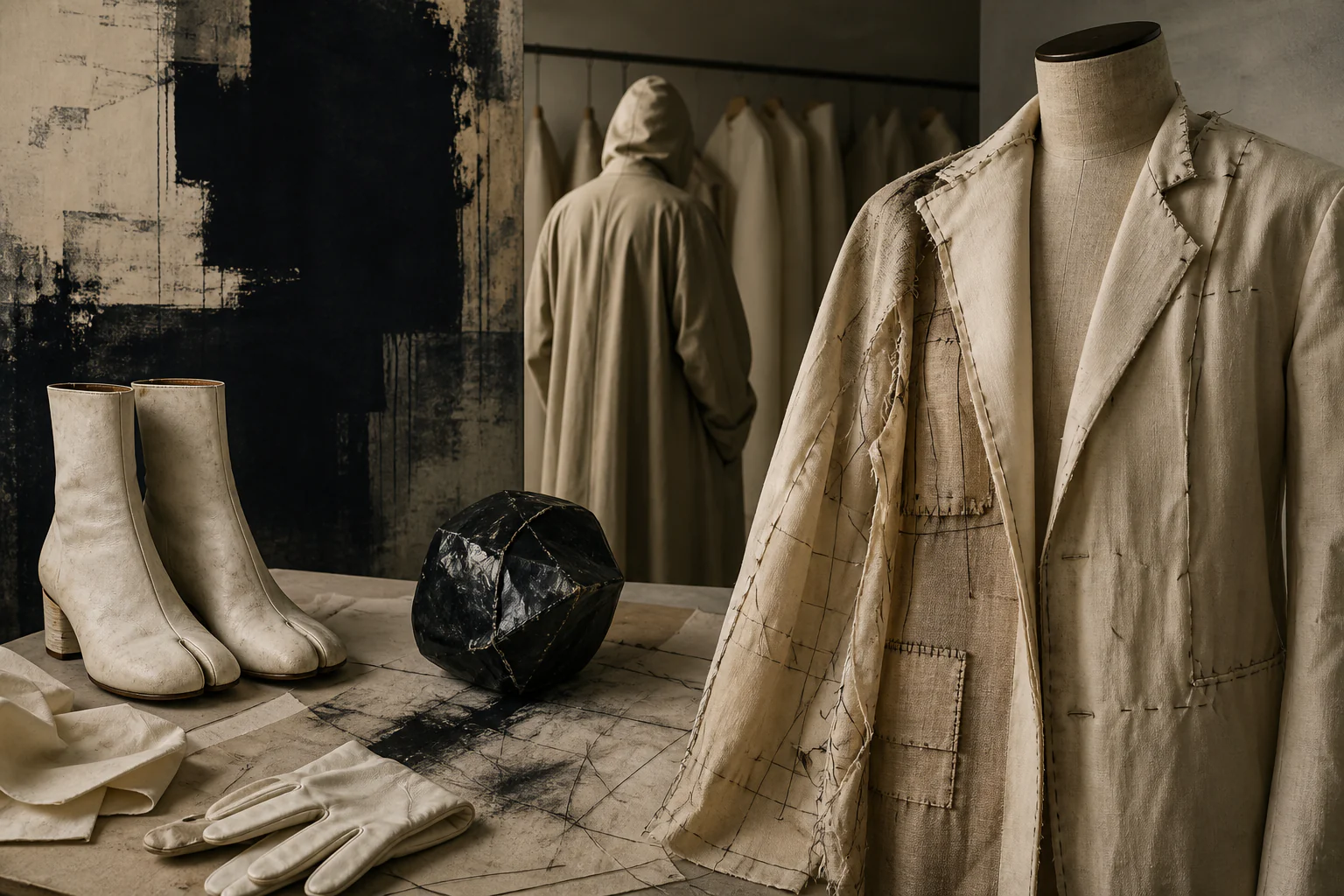
The house’s primary mark is a white rectangle without lettering, attached by four external stitches. It is identified from outside by those stitches and stays mute. It is a logotype constructed as its own negation.
4. Line numbering
The label later acquired a row of numbers from zero to twenty-three, with the number matching the line circled. The system states a category without stating a name, moving identification into the register of insider knowledge.
5. White as house code
White extends to every carrier: store interior, staff uniforms, packaging, and painted furniture. It performs the same work that black does in neighbouring houses — it removes the question of choice and leaves the question of form.
6. Showing the inside as method
Exposed seams, bared canvas, overlocking, and unfinished edges present construction as content. This is not carelessness: to show an inside convincingly it must be made more carefully than a face.
7. Reconstruction from existing objects
A line assembled from found garments and objects remade into new pieces appeared long before upcycling became a mainstream conversation. Each piece is unique in origin, which breaks the very idea of a production run.
8. Tabi: footwear that contests the outline of the foot
The split-toe boot, present from the first collection, remains the house’s most recognisable object. It borrows the form of Japanese work footwear and makes visible what shoes usually conceal — the structure of the foot.
9. Shows off the runway
Collections were presented on wasteland, in the metro, in a supermarket, and in derelict buildings, with non-professional models and covered faces. The choice of venue was part of the argument about who owns attention.
10. The covered face as refusal of a brand face
A mask, a veil, or a band across the eyes removes the model as a character and leaves the clothing. The device consistently extends the author’s anonymity: no person is to become the face of the house.
11. Collective authorship in communication
Interviews were given in the name of the house rather than a person, often in writing and in the plural. It is a rare case in which a declaration of collectivity is backed by procedure and not only by words.
12. The industrial base
Control passed to an Italian group at the end of the 1990s, providing a production and distribution base. It was that resource which allowed an anonymous house to operate at a scale unavailable to a workshop.
13. Recognition of the artisanal line
The house’s artisanal line was recognised by the industry federation within the haute couture schedule in the early 2010s. The recognition established reconstruction as a couture technique rather than a conceptual gesture.
14. The founder’s departure and the test of the system
Margiela left the house at the end of the 2000s, which directly tested the claim of collective authorship. The house continued, confirming that the code had been recorded well enough to be executed by others.
15. A change of register under new leadership
From the mid-2010s the house acquired pronounced authorial leadership that restored theatricality and a personal signature. This is the opposite of the original premise, and the tension between the two regimes remains unresolved.
16. Critical questions
The critique is fair: anonymity proved an exceptionally effective marketing asset, and the refusal of a mark produced a stronger mark. The house’s devices have also been widely copied as style, without the accompanying production care.
17. How to read this house today
Test the refusal against execution. A precisely made exposed seam and a carelessly left one look similar in a photograph and entirely different at close range. That difference is the content.