research
History of the Christian Dior fashion house
How ten years of work by one couturier turned into a global system of luxury that has survived changing eras, designers and ideas about femininity
“Dior is more than its founder’s name. It is a rare example of a fashion house that learned to turn its own history into creative material for every new generation.”
Editorial thesis
Reader question
How did a house founded in 1946 and led by Christian Dior himself for only about ten years become one of the most influential and enduring institutions in world fashion?
To trace Dior’s history as a history of aesthetics, haute couture as an institution, and the modern luxury business; to show the contribution of each creative era; and to separate established facts from the brand’s later myths.
The central subject is Christian Dior Couture and its women’s and men’s fashion lines; fragrance, jewellery and accessories are considered as parts of the house’s wider system.
The material covers the period from the birth of Christian Dior in 1905 to the Jonathan Anderson collections of 2026.
The article is not a catalog of all collections: it only includes turning points that changed the language or business model of the house.
Marketing language from official sources is used with attribution only and is not a substitute for independent analysis.
Financial indicators are included only if comparable public data is available; Christian Dior Couture does not disclose all operating statistics as a stand-alone public company.
Short answer
Christian Dior transformed post-war fashion by restoring the architectonic silhouette, sumptuous materials and the theatricality of couture. After his death, the house did not preserve a single formula: Yves Saint Laurent lightened its construction; Marc Bohan made Dior a modern, wearable institution; Gianfranco Ferré restored architectural monumentality; John Galliano turned the show into a global spectacle; Raf Simons brought the archive into dialogue with modernism; Maria Grazia Chiuri reframed heritage through female subjectivity; Kim Jones built men’s Dior around an exchange between couture, art and streetwear; and Jonathan Anderson began uniting the collections within a single creative system. Dior’s history is a model of managed continuity in which the archive functions not as a museum, but as an engine for new meaning.
-
Before Dior: family, art and the path to couture
-
Foundation of the house and the role of Marcel Boussac
-
February 12, 1947: New Look is born
-
Why the New Look was a historical turning point
-
The architecture of the house: couture, fragrance, licensing and global expansion
-
Christian Dior’s later collections and the house’s system of codes
-
Yves Saint Laurent: youth and a lighter silhouette
-
Marc Bohan: thirty years of institutional stability
-
Gianfranco Ferré: Architect at Dior
-
John Galliano: history as theater
-
Raf Simons: modernism and the distillation of the archive
-
Maria Grazia Chiuri: female subjectivity and global craft
-
Dior Men and Kim Jones: couture in the men's wardrobe
-
Jonathan Anderson: unified creative direction
-
Dior icons and codes
-
Dior as a luxury business system
-
Critical issues and controversies
-
Conclusion: why Dior outlives its creators
Appendices: chronology, fact register, glossary, media plan, sources and release checklist
Christian Dior led his own house from its foundation in 1946 until his sudden death in October 1957. In that short period he created twenty-two couture collections, established a recognisable vocabulary of lines and founded a business that expanded far beyond the Paris salon within his lifetime. Dior’s history therefore cannot be told only as the biography of a single designer. It is the history of an institution capable of preserving its authority through changes of founder, clientele, markets and cultural norms.
Unlike houses whose identity rests on a single logo or product, Dior is built on a constellation of interconnected codes: the emphasised waist, controlled volume, the flower as a metaphor for the female body, grey and pink, cannage, the star, lily of the valley, medallion chairs, 30 Avenue Montaigne and the idea of couture as a laboratory. These elements need not always appear literally; together they form an archive from which every new creative director selects a distinct version of Dior.
The house’s defining strength is its ability to turn contradictions into a resource. Dior is associated at once with post-war nostalgia and industrial modernisation, handcraft and large-scale licensing, idealised femininity and critiques of its constraints, French national prestige and a global market. These tensions make its history important not only to fashion, but to any understanding of modern luxury.
1. Before Dior: family, art and the path to couture
Christian Dior was born on January 21, 1905 in Granville, Normandy, into the wealthy family of industrialist Maurice Dior. Villa Les Rhumbs, the sea, the rose garden and the family gardens later became part of the visual mythology of the house. At Dior, flowers are not a decorative theme invented by marketing after his death: they were a constant personal motif for the designer and became a structural metaphor for his silhouettes.
At the request of his family, Dior studied political science, but his interests were related to art. In the late 1920s he opened a gallery with Jacques Bonjean and then participated in another gallery with Pierre Colle. Contemporary artists, including representatives of the avant-garde, exhibited in these circles. This experience is important: the future couturier came to fashion not only through the craft of clothing, but also through curatorial thinking, the ability to build the environment of an image and recognize an artistic gesture.
Economic crisis and family losses dismantled Dior’s former life. In the 1930s he began selling fashion illustrations and later worked for Robert Piguet and Lucien Lelong. At Lelong he worked alongside Pierre Balmain. The war years should not be romanticised: Paris couture continued under occupation, amid shortages and difficult compromises. Within this system Dior gained the technical and organisational experience required to establish his own house.
2. Foundation of the house and the role of Marcel Boussac
The house of Christian Dior was founded in 1946 with the financial support of textile industrialist Marcel Boussac. Official sources of Dior and LVMH indicate 1946 as the founding date, while the first collection was shown on February 12, 1947. Distinguishing between these dates is important: the brand emerged as an enterprise before its main public image emerged. [1]
Boussac hoped to revive the French textile industry and invited Dior to lead the existing house of Philippe et Gaston. Dior insisted on creating a new house in his own name. That decision shaped everything that followed: Christian Dior was founded not as the continuation of an older brand, but as an authorial institution in which the designer’s name served as both an aesthetic signature and a commercial guarantee.
The headquarters became a mansion at 30 Avenue Montaigne. The space of the salon was part of the product: the interior, the staircase, the gray walls, white paneling, gilding, Napoleon III chairs and the ritual of the show created a sense of a private world. Subsequently, the boutique's architecture and address became the same Dior codes as Bar jacket or Miss Dior.
3. February 12, 1947: New Look is born
The first spring-summer 1947 collection was presented on February 12 in the salons on Avenue Montaigne. Dior named the two main lines Corolle and En 8. The name New Look came from the reaction of Carmel Snow, editor-in-chief of Harper's Bazaar, who saw a radical new look in the collection. [2]
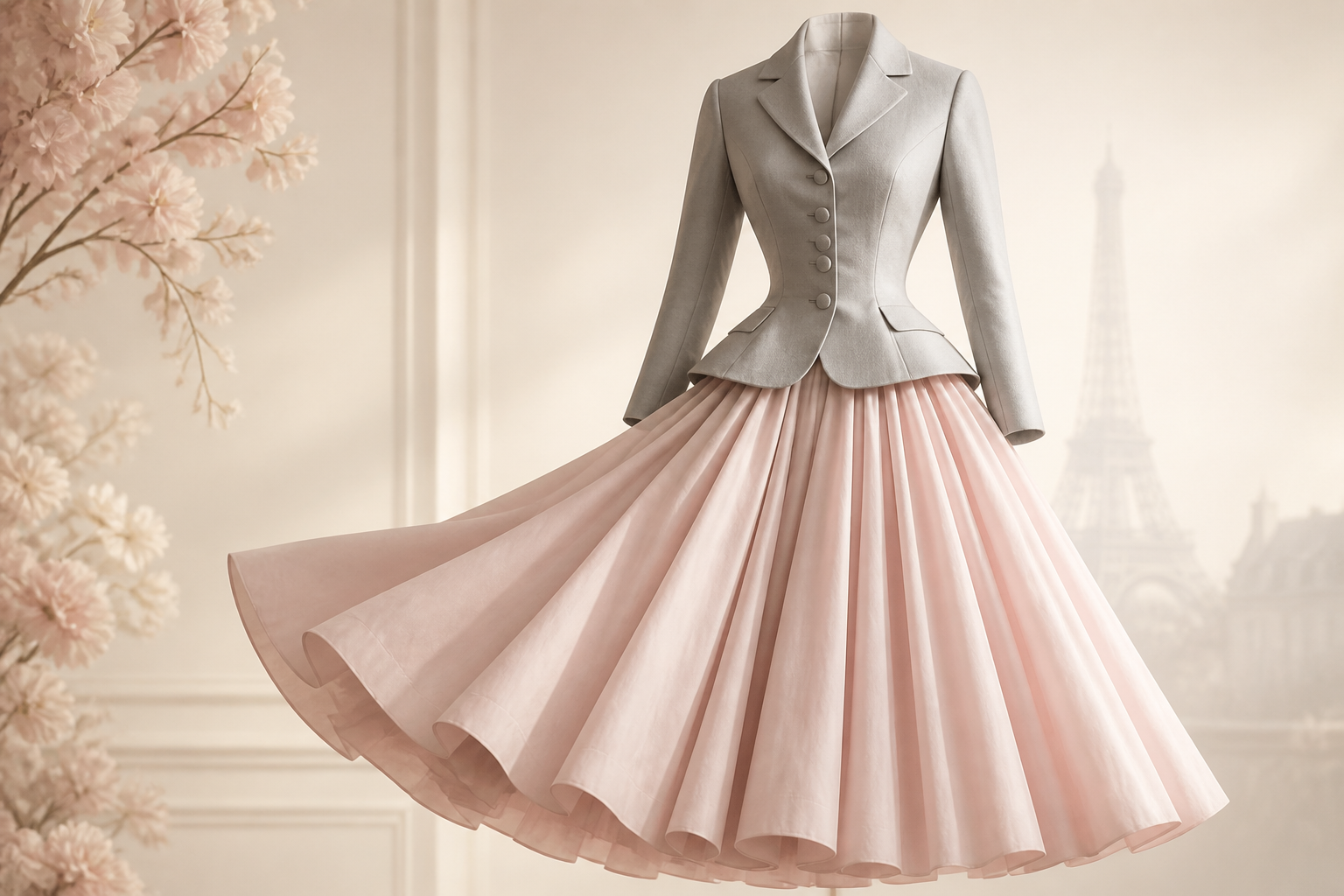
The most famous look was the Bar ensemble: a light jacket with soft shoulders, a sharply defined waist and rounded peplums was combined with a long black skirt. A 1947 copy is kept in the Costume Institute of the Metropolitan Museum of Art. [3]
The New Look is often reduced to the formula ‘narrow waist, wide skirt’, but its novelty was more complex. Dior redistributed volume around the body: the shoulder softened, the bust and hips became more sculpted, the waist became a point of constructive tension and the hem fell below the knee. The clothes required corsetry, linings, interlinings and generous quantities of fabric. This was not simply a new style, but the restoration of a controlled architecture of the body after wartime utilitarianism.
4. Why the New Look was a historical turning point
Military clothing was shaped by restrictions: fabric rationing, practicality, uniformity and reduced volumes. Dior offered the opposite image - excess, softness, length and ceremony. That is why the collection was perceived as both liberation and provocation.
For some, the New Look brought back beauty and private pleasure after the trauma of war. For others, it re-associated the female body with corsets, high cost, and restricted movement. In the USA and Europe, there were protests against long skirts and the waste of fabric. Therefore, the New Look cannot be described as a universally accepted revolution: its influence was enormous precisely because it made the silhouette a subject of public conflict.
The collection helped restore Paris’s symbolic leadership in international fashion. It demonstrated that French couture could do more than preserve craft: it could establish a new visual order. The V&A describes the launch of the New Look as the beginning of a decisive decade, which Dior himself called couture’s ‘golden age’. [4]
The success was enhanced by photography and international press. The Dior silhouette was easily recognizable in a black and white photograph, illustration and magazine page. The house realized early on that a fashionable image should exist not only in the fitting room, but also in the media space. Richard Avedon, Willy Maywald, Henry Clarke, Irving Penn and other photographers helped transform Dior into a global visual memory.
5. House architecture: couture, perfumes, licenses and global expansion
Dior's historical significance is not just about design. The house quickly formed a model of modern luxury business, in which high fashion creates prestige, and larger categories turn prestige into global circulation.
Couture provided authority and demonstrated the capabilities of the atelier. Models were created through drawing, toile, numerous fittings, the work of première, model makers, embroidery houses, feather and flower workshops. Even when couture ceased to be the main source of mass revenue, it retained its function as a research and symbolic center.
Miss Dior perfume was introduced in 1947 and named after the designer’s sister, Catherine Dior. It linked the first collection to a more accessible and reproducible experience of the brand. Perfume was not a secondary souvenir: it allowed a customer to enter the world of Dior without buying a couture dress and became one of the foundations of the name’s long-term resilience.
Dior was one of the first to systematically develop international licenses for stockings, gloves, ties and other categories. This practice accelerated the spread of the name, but created the risk of losing control over quality. The later history of the luxury industry was largely built on the search for a balance between brand expansion and maintaining exclusivity.
In 1948, Dior opened its presence in New York. The house developed branches, exports and contracts with local manufacturers. By the time of the founder’s death, the company was not a chamber salon, but an international organization. Musée Yves Saint Laurent notes that in 1957 the Dior group included several companies and numerous firms on different continents, and its staff numbered about 1,400 people. [5]
6. Christian Dior’s later collections and the house’s system of codes
Dior did not simply repeat the New Look. He organised almost every collection around a new line: Verticale, Oblique, Tulipe, H, A, Y, Flèche, Aimant, Libre and others. Naming each line turned a structural idea into a lucid media image. The practice showed that a house could remain recognisable not through one fixed form, but through a sequence of formal experiments.
The 1954 H line de-emphasized the waist and caused controversy due to its straighter, elongated design. Line A of 1955 expanded downward, and line Y concentrated volume at the top. The final Fuseau autumn-winter 1957 demonstrated that Dior itself was already moving from the early “flower woman” to more slender and mobile silhouettes. The official Dior publication describes the founder's journey from the first collection in 1947 to the Fuseau line in 1957. [6]
On October 24, 1957, Christian Dior died in Montecatini, Italy. His death could destroy the house built on a personal name. Instead, it became the first test of the institution he created. [7]
7. Yves Saint Laurent: youth and lightening of the silhouette, 1957–1960
Yves Saint Laurent joined the Dior studio in 1955. Christian Dior quickly recognized his talent and gradually increased his responsibility. After the death of the founder, 21-year-old Saint Laurent was appointed artistic director and became the youngest couturier to head a house of such scale. [8]
His first collection, spring-summer 1958, introduced the Trapèze line. Instead of a rigidly defined waist, the body was hidden under a light expanding volume. The collection was greeted with enthusiasm and showed that the successor was able to maintain the poetry of Dior without copying the New Look. [9]
Saint Laurent’s subsequent experiments were younger and more urban. For the Autumn–Winter 1960 Beat collection, he introduced elements associated with Paris street culture, including leather and a darker sense of drama. Some clients and members of management responded coolly. His period at Dior ended after he was called up for military service. This transition should not be reduced to an aesthetic dispute: health, military service, governance and the house’s commercial expectations were all intertwined.
Saint Laurent’s period proved that Dior could be younger than its founder. It first posed a question that would return with every change of leadership: should a successor protect a recognisable silhouette, or change the very idea of heritage?
8. Marc Bohan: institutional stability, 1960–1989
Marc Bohan took over Dior's artistic direction in 1960 and remained at the helm for nearly three decades, longer than any other successor. His period often receives less attention than the theatrical eras before and after it, but it was Bohan who ensured the house's long-term sustainability.
His 1961 Slim Look offered a leaner, more natural and wearable elegance. Bohan designed for a real international clientele that included celebrities and royalty. Dior under Bohan displayed less demonstrative historicism and more precision in the social wardrobe: suits, dresses, coats and evening ensembles were made to inhabit a client’s life, not only the history of fashion.
In 1967, the house launched Miss Dior as a ready-to-wear line; LVMH associates it with the Bohan era and the designer Philippe Guibourgé. [10]
In 1973, Marc Bohan represented Dior at the Battle of Versailles, where French couture houses were pitted against American ready-to-wear designers. The event highlighted a change in global fashion: spectacle, variety of designs, rhythm and commercial modernity were becoming as important as the traditional hierarchy of couture. [11]
The Bohan period shows that the history of a fashion house consists of more than just revolutions. Institutional longevity is built through decades of quality work, where a brand remains desirable without constant radical redefinition.
9. Gianfranco Ferré: architect at Dior, 1989–1996
In 1989, Italian designer Gianfranco Ferré became the artistic director of the women's collections. His appointment was symbolic: for the first time, a French house with a strong national mythology was headed by a foreign couturier. This demonstrated Dior's transition from a national symbol to an international luxury institution.
Ferré’s architectural training emerged in grand white shirts, exacting work with volume, complex sleeves, drapery and monumental construction. He did not literally attempt to restore 1947; rather, he read Dior as architecture around the body. In that sense, his approach was faithful to the principle of the New Look, not to its outward appearance.
Under Ferré, the house maintained couture prestige in an era when the industry increasingly shifted to accessories, advertising and global networks. His work provided subsequent leaders with an example of how archival code could be translated through the designer's personal discipline.
10. John Galliano: history as theater, 1996–2011
John Galliano was appointed to Dior in 1996. His period coincided with a large-scale transformation of the luxury industry, when shows became global media events, and the creative director became a public figure capable of creating not only clothes, but also the entire mythology of the season.
Galliano turned the story into theatrical material. He connected the Belle Époque, Orientalism, painting, cinema, subcultures and archival forms of Dior. Couture shows were structured like performances with characters, makeup, scenery and drama. The risk of this method was that cultural images could become a visual resource without sufficient context. Therefore, a modern analysis of the Galliano era must simultaneously consider formal craftsmanship, influence on the fashion show, and issues of representation.
Commercially, the era was associated with a growing accessories business. The Saddle bag, introduced in the late 1990s, became one of the house’s key products; logo pieces and J’Adore Dior entered popular culture. Lady Dior, which acquired its name in the 1990s through its association with Princess Diana, became an enduring icon. Galliano demonstrated that an archival couture house could be at once elitist and embedded in popular culture.
Galliano’s tenure at Dior ended with his dismissal in 2011 after a public scandal. This episode must not be aestheticised: artistic importance does not negate responsibility for antisemitic statements. The change in leadership showed that a modern fashion house must defend not only sales and design, but its institutional values.
11. Raf Simons: modernism and cleansing the archive, 2012–2015
After an interim period under the studio, Raf Simons became artistic director of the women’s lines in 2012. The appointment appeared unexpected: Simons was known for modern minimalism and menswear rather than historical couture theatre.
The debut couture collection was shown in rooms entirely covered with fresh flowers. The gesture precisely captured Simons’s method: rather than copy Dior’s flower dress, he translated the idea of the flower into space, material and modern construction. He reduced decorative noise, sharpened the purity of line and combined the Bar jacket with trousers, technical fabrics and abstract colour.
Simons saw the archive as a set of systems that could be combined with modernist art and the industrial present. His period returned attention to design and made Dior attractive to an audience that perceived historical romanticism as too literal. At the same time, the high speed of production of numerous collections has become part of the discussion about the workload of creative directors. Simons left the house in 2015.
12. Maria Grazia Chiuri: female subjectivity and global craft, 2016–2025
In 2016, Maria Grazia Chiuri became the first woman to head Dior's women's collections. The very fact of the appointment changed the frame of the conversation about the house, which for decades created an idealized image of women primarily through the male author's gaze.
Her debut included a We Should All Be Feminists T-shirt, referencing an essay by Chimamanda Ngozi Adichie. Critics have debated whether such a gesture constitutes substantive politics or a commercial appropriation of the slogan. But strategically, Chiuri shifted the question: Dior clothing was to be discussed not only as an object of contemplation, but also as an instrument of action, identity and voice.
She consistently reached out to women artists, writers, choreographers and craft communities. The shows became a platform for textiles, embroidery, dance, installation and local production traditions. This global approach expanded Dior's visual language, but required transparency: collaborations must show the artistry of the workshops and avoid turning culture into anonymous ornament.
Chiuri also made Dior’s everyday wardrobe more functional: jackets, dresses, skirts, boots, the embroidered Book Tote and a renewed Saddle bag created a commercially powerful offer. Her final collections in 2025 continued dialogues with costume history, Japan, theatre and Rome. LVMH’s 2025 annual document identifies her Cruise collection as her last for Dior. [12]
13. Dior Men and Kim Jones: couture in the men's wardrobe, 2018–2025
Dior’s menswear history developed along a separate path: the Dior Homme line was established in the 1970s and acquired a powerful identity in the early twenty-first century under Hedi Slimane and then Kris Van Assche. Kim Jones took charge of menswear in 2018, renamed it Dior Men and built a new model of exchange among heritage, art and contemporary culture.
Jones translated women’s couture codes into the men’s wardrobe: the shapes of the Bar jacket, embroidery, archival fabrics, cannage and floral motifs entered tailoring, outerwear, footwear and bags. He connected Dior’s ateliers with artists and designers across generations, while the collaboration with Jordan Brand became a significant meeting of luxury and sneaker culture.
His later collections revealed an especially strong interest in couture history. LVMH describes Winter 2025–2026 as a dialogue with Christian Dior’s H line and with movement between men’s and women’s wardrobes. [13]
The final Jones collection was presented in early 2025. LVMH's annual report lists it as the latest and links the new phase with the appointment of Jonathan Anderson. [12]
14. Jonathan Anderson: Unified Creative Direction, 2025–
In 2025 Jonathan Anderson became creative director of Dior’s men’s, women’s and haute couture collections. The appointment marked an important organisational change: for the first time in many years, the house’s principal fashion lines were united under one creative authority. Official LVMH sources identify him as Creative Director of all Dior collections. [14]
The debut Summer 2026 menswear collection was presented as a ‘decoding and recoding’ of the house’s language. Anderson placed Dior in dialogue with French painting, the history of men’s tailoring and his own fascination with objects. Instead of organising the collection around one archival emblem, he proposed a system of collisions: formality and naivety, the museum and the everyday, heritage and humour.
His first couture collection Spring–Summer 2026 was built as a cabinet of curiosities. Natural forms, ceramics, textile experiments and handiwork formed not a retrospective, but a laboratory. The official Dior text emphasizes the idea of couture as a living knowledge capable of exploring the present. [15]
As of August 2026, Anderson's period is still too short for a definitive estimate. The correct conclusion can only be preliminary: the house is trying to reassemble a branched system into a single creative statement without losing the commercial breadth created by previous teams.
15. Dior icons and codes
The Bar jacket is not merely a museum piece from 1947. It is a template: a soft shoulder, emphasised waist, rounded peplum and a balance between discipline and floral plasticity. Every successor resolves it differently—lightening or deconstructing it, transferring it to the men’s wardrobe, or translating it into knitwear.
Roses, lilies of the valley, the Granville garden and the femme-fleur image connect the personal biography of Dior, the structure of the New Look, embroidery, perfumes and show decorations. Official publications of the house trace this motif through the works of the founder and his successors. [16]
Gray is associated with the architecture of Avenue Montaigne and the sobriety of the interior; pink - with childhood, flowers and idealized softness; red - with theater, lipstick and a dramatic accent. It is important to understand color not as a fixed brand book, but as an emotional archive.
The cannage lattice pattern goes back to the weave of the Napoleon III chairs on which guests of the first shows sat. It later became a design surface for bags, jewelry and boutique decoration. This is how the piece of furniture turned into a portable sign of the brand.
Christian Dior was superstitious and consulted fortune-tellers. A metal star he found in the street entered the legend of the house’s foundation as an auspicious sign that encouraged him to establish his own enterprise. In contemporary Dior communications, the star connects personal biography with fate, navigation and the talisman.
Accessory icons come from different periods, but work according to the same logic: a product is given a form that can survive the season, then constantly reinterpreted through material, size, art and campaign. Lady Dior enhances cannage and architectural elegance; Saddle links irony, logo and recognizable outline; Book Tote turns embroidery and surface into the main carrier of identity.
16. Dior as a luxury business system
Haute couture creates symbolic capital, but the modern house exists thanks to a wide system of ready-to-wear, leather goods, shoes, accessories, perfumes, cosmetics and jewelry. This does not mean that couture is advertising in the simple sense. It produces ideas, techniques and images that are then distributed throughout the system.
The Dior archive works simultaneously as historical evidence, creative material, exhibition content and a means of legitimizing a new product. The reintroduction of the Saddle bag or the next version of the Bar jacket is perceived not as an ordinary retro release, but as a continuation of the canon. This is one of the central features of heritage brands.
Major exhibitions, including Christian Dior: Designer of Dreams, present the house within a museum frame. The V&A described the exhibition as a history of Dior's influence from 1947 to the present, and showed more than two hundred couture objects and archival materials. [17]
Museum institutionalization enhances the cultural status of a brand, but requires a critical distance. An exhibition created with input from the house's archive can be at once research, spectacle and a tool of reputation.
Bernard Arnault began the reorganization of Financière Agache in 1984 and made Christian Dior the cornerstone of the future luxury group; in 1989 he became the controlling shareholder of LVMH. [18]
Today, Christian Dior Couture and Parfums Christian Dior exist within the broader LVMH ecosystem. For editorial accuracy, performance should not be automatically combined or attributed to a single entity for the results of an entire brand.
17. Critical issues and controversies
Dior constantly balances between celebrating women and constructing a normative image of femininity. New Look provided beauty and theatricality, but required corset discipline. Contemporary collections speak of autonomy, but operate within an industry that continues to produce standards of the body and consumption.
The house emphasizes the handcraft of ateliers and local artisans. At the same time, it is a global commercial system. The analysis should ask questions about authorship, payment, visibility of artisans, sustainability of materials, and the relationship of a single couture object to the mass production of beauty and accessories.
The historical collections of Dior and its successors often looked to cultures outside of France. Modern appreciation depends not only on the aesthetic result, but also on the method of collaboration: who is named as the author, where the object was produced, which communities receive economic and symbolic returns, whether a complex tradition is reduced to exotic decoration.
Fashion loves the story of a single genius, but Dior is created by thousands of people: premières, seamstresses, modellers, embroiderers, accessory designers, archivists, producers, photographers, salespeople and executives. The author's signature is important, but should not hide the collective nature of the product.
The stronger the archive, the more difficult it is to create something new. Quoting too literally turns the house into its own copy; complete rejection of codes destroys recognition. The success of every Dior executive is determined not by the degree of fidelity to one model, but by the ability to choose which elements of the heritage to preserve, which to criticize, and which to temporarily forget.
18. Conclusion: why Dior outlives its creators
Christian Dior created the house in an era when couture could still offer society a single look for the season. Contemporary fashion is fragmented, global and instantaneous, but Dior remains influential because its legacy is structured not as a single form, but as a system of relationships: between body and architecture, garden and salon, handicraft and industry, Paris and the world, memory and newness.
Each era answered a different problem. Saint Laurent proved that a successor could rejuvenate the house. Bohan made it sustainable. Ferré translated heritage into monumental structure. Galliano created a global theatre. Simons distilled the archive through modernism. Chiuri reframed the question of Dior’s author and heroine. Jones extended couture logic into men’s culture. Anderson began assembling a many-branched heritage into one contemporary grammar.