research
Comme des Garçons: negation of the norm as a production system
A house where a radical main line is funded by a branched system of labels, and the store operates as an exhibition.
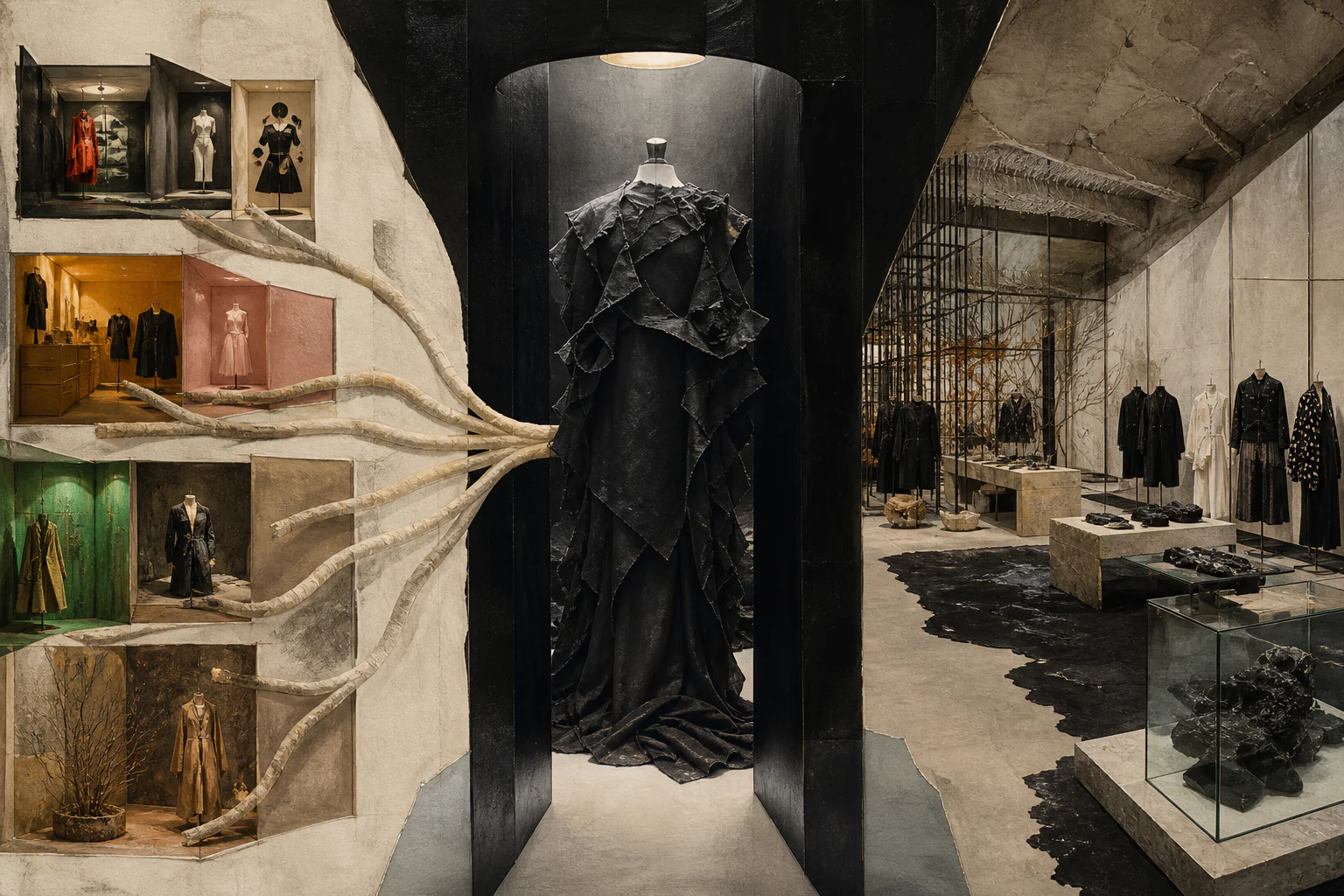
Editorial thesis
Comme des Garçons matters not as another authored house but as a rare case where a commercial structure was built specifically to sustain a non-commercial main line.
Reader question
How does a house whose main line deliberately refuses saleability survive for half a century without an external conglomerate?
Short answer
Through division: the experimental line sets the reputation while dozens of derivative labels and Dover Street Market generate revenue. Founded 1969; key figure Rei Kawakubo; context Tokyo and Paris.
1. Origin: advertising rather than tailoring
Rei Kawakubo trained neither as a tailor nor as a pattern cutter. She worked in advertising for a textile company and as a stylist, and that background explains her method: she thinks in whole images rather than in cut, and leaves construction to be solved by pattern makers.
2. Founding and the first decade
The label appeared in Tokyo in 1969 and was incorporated as a company in the early 1970s. Its first decade played out inside the Japanese market, which allowed a language to form before any encounter with European criticism.
3. Paris 1981: scandal as entry
The Paris debut in the early 1980s provoked a sharp press reaction: black, asymmetric, deliberately damaged. Some headlines were openly hostile. The scandal worked as an entrance: it immediately marked the house’s position against the European norm.
4. Black as position rather than colour
The wholesale use of black was not an aesthetic preference but a refusal: of colour as a means of seduction, of the seasonal palette, of the distinction between formal and everyday. Black removed the question of taste and left the question of form.
5. Damage as a technical decision
Holes and uneven knit surfaces were obtained by running knitting machines outside their specification. This detail matters: the defect was reproducible and controlled — a technological decision rather than an imitation of decay.
6. Refusing fit to the body
The key constructional shift was severing the link between garment and bodily outline. Clothing stopped describing the figure and began creating its own volume around it, which required a different pattern and a different logic of fitting.
7. The 1997 collection: the body as variable
The spring 1997 collection introduced padded volumes displacing the silhouette in unexpected places. It posed the question directly: if dress meets body and body meets dress, which of the two forms counts as the original.
8. The show as a way of posing a problem
The house’s shows regularly present not a wearable object but the statement of a problem. The commercial version appears later and in another line, so show and assortment should not be read as one utterance.
9. The label structure as financial engineering
A system is built around the main line: menswear lines, knitwear, fragrance, and a mass line with a heart motif. Each of them sells by ordinary rules, and precisely for that reason allows the main line not to observe them.
10. Fragrance as load-bearing structure
Fragrance provides margin and volume unattainable for experimental clothing. This is a standard luxury-industry mechanism, but here it serves not brand extension but the preservation of the brand’s least commercial part.
11. Raising authors inside the house
The house systematically launches its own designers with independent labels under its management. This is a rare model in the industry: not hiring a star from outside but growing an author inside the production structure.
12. Dover Street Market: retail as editorial
Opened in London in 2004, the store gathered other brands under one roof, selected by the house. The space is arranged as an exhibition with regular rebuilds, and it sells curatorial judgement alongside merchandise.
13. Institutional recognition
A solo exhibition at the Metropolitan Museum’s Costume Institute in 2017 was only the second occasion in that department’s history of a monographic show devoted to a living designer. It fixed the reading of the work as an object of history rather than a seasonal phenomenon.
14. Independence as a condition of the method
The house does not belong to a major conglomerate, and this is not a sentimental choice. An outside shareholder would demand justification for a loss-making main line, and it is precisely that line’s freedom that constitutes the brand.
15. Critical questions
The critique is justified on two points. The radicalism of the main line is partly paid for by entirely conventional mass products, a contradiction the house does not resolve. Moreover the method is barely transferable: it rests on one person and has never been written down as a procedure.
16. How to read this house today
Do not judge the house by its show, and do not judge it by a department-store rail — these are two different parts of one construction. It must be read whole: the radical statement and the commerce that funds it are a single project.